
BuddhistCatholicContemplativeEvangelicalGeneral ChristianHinduJewishLatter-day SaintMuslimNew VisionsProgressive Christian
Beliefs
- Buddhist
- Catholic
- Contemplative
- Evangelical
- General Christian
- Hindu
- Jewish
- Latter-day Saint
- More Voices
- Muslim
- New Visions
- Pagan
- Progressive Christian
Topics
- Religion News
- Food and Religion
- Sports and Religion
- Religious Art
- Religious Music and Entertainment
- Religious Events
- History and Religion
- Style and Religion
- Politics and Religion
- Women in Religion
- Recreation Outdoors and Religion
- Business Finance and Religion
- Careers Workplace and Religion
- Education and Religion
- Family Parenting and Religion
- Health Fitness and Religion
- Home and Religion
- Relationships and Religion
- Technology and Religion
- Travel and Religion
Columnists
- Buddhist Columnists
- Business Finance and Religion Columnists
- Careers Workplace and Religion Columnists
- Catholic Columnists
- Contemplative Columnists
- Education and Religion Columnists
- Evangelists Columnists
- Family Parenting and Religion Columnists
- General Christian Columnists
- Health Fitness and Religion Columnists
- Hindu Columnists
- History and Religion Columnists
- Home and Religion Columnists
- Jewish Columnists
- More Voices Columnists
- Latter Day Columnists
- Muslim Columnists
- New Visions Columnists
- Nonreligious Columnists
- Pagan Columnists
- Politics and Religion Columnists
- Progressive Columnists
- Recreation Outdoors and Religion Columnists
- Relationships and Religion Columnists
- Religion News Columnists
- Religious Art Columnists
- Religious Events Columnists
- Religious Music and Entertainment Columnists
- Sports and Religion Columnists
- Style and Religion Columnists
- Technology and Religion Columnists
- Travel and Religion Columnists
- Women in Religion Columnists
Resource Library
- 2026 Calendar
- Library of World Religions
- The 100 Most Holy Places on Earth
- Patheos Answers
- Podcasts
- Videos
- Faith Leaders Database
- Anglican Episcopalian
- Bahai
- Baptist
- Buddhism
- Christianity
- Confucianism
- Eastern Orthodoxy
- Hinduism
- Holiness and Pentecostal
- ISKCON
- Islam
- Judaism
- Lutheran
- Methodist
- The Church of Jesus Christ of Latter-day Saints
- New Age
- Paganism
- Presbytarian and Reformed
- Protestantism
- Religion Behind the Scenes
- Roman Catholic
- Scientology
- Shia Islam
- Sikhism
- Sufism
- Sunni Islam
- Taoism
- Zen
- See all religions
Research Tools
 Ad-Free & Subscriber Log-In Subscription Support
Ad-Free & Subscriber Log-In Subscription Support
Follow Patheos 

- Trending:
- Forgiveness
- |
- Marriage
- |
- Consciousness
- |
- Death Penalty
- |
- Election
- |
- Halloween

- Home
- About Dr. James F. McGrath
- Publications
- Blogroll
- Useful Websites
- Connections
- Easy Search Posts Page
- FREE NEWSLETTER
- Home
- Progressive Christian
- Bultmann vs. Miller
Bultmann vs. Miller
Last updated on: October 29, 2016 at 6:05 am by James F. McGrath
Bultmann vs. Miller 2016-10-28T11:08:48-04:00 James F. McGrath
Patheos Explore the world's faith through different perspectives on religion and spirituality! Patheos has the views of the prevalent religions and spiritualities of the world.
I was surprised to read a post by Richard Miller on the blog Debunking Christianity, which highlights the work of Rudolf Bultmann, only to really misunderstand/misrepresent what Bultmann was saying.
Miller writes:
The question I pose here at Debunking Christianity is this: After following all channels and tributaries of such myths as one honestly interrogates the New Testament texts, what truths may one salvage through demythologization? Bultmann supposed there to be a kernel of truth latent within the New Testament documents. I question that, unless those truths about the human condition come quite inadvertently as one deconstructs and uncovers the underlying anxieties and requirements of ancient civilization, i.e., via study of the applied performative myths of ancient human civilization. Perhaps then, the biblical texts merit a special place in the ranks of other ancient literary works muddled in a benighted worldview altogether untenable in our modern age.
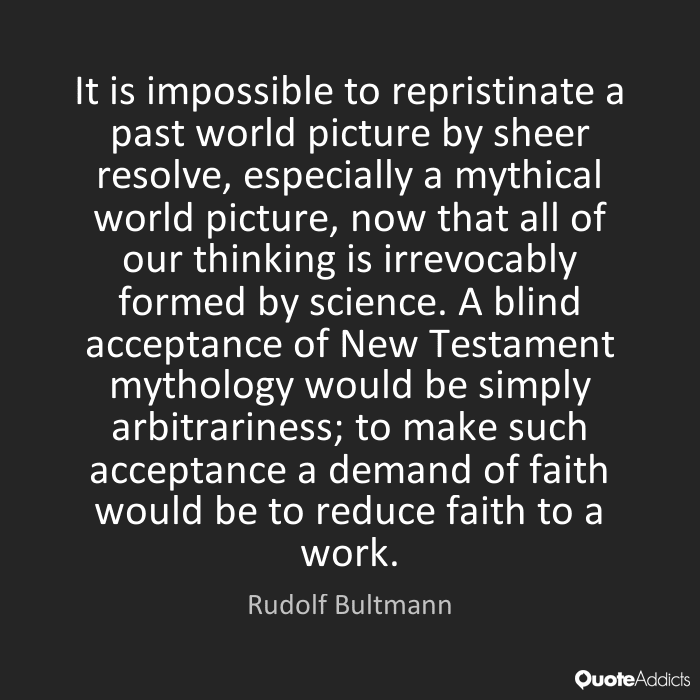 Bultmann was in fact directly opposed to the earlier liberal approach that thought you could merely peel off a shell of myth and discover a kernel of timeless truth. Let me share two longer quotations which, however dated they sound in their talk of what “modern man” supposedly cannot believe, articulate Bultmann’s perspective very clearly, and illustrate why his points retain their importance. Both are from his contribution to the volume Kerygma and Myth, which can be found online in more than one location, and which I highly recommend.
Whatever else may be true, we cannot save the kerygma by selecting some of its features and subtracting others, and thus reduce the amount of mythology in it. For instance, it is impossible to dismiss St. Paul’s teaching about the unworthy reception of Holy Communion or about baptism for the dead, and yet cling to the belief that physical eating and drinking can have a spiritual effect. If we accept one idea, we must accept everything which the New Testament has to say about Baptism and Holy Communion, and it is just this one idea which we cannot accept.
It may of course be argued that some features of the New Testament mythology are given greater prominence than others: not all of them appear with the same regularity in the various books. There is for example only one occurrence of the legends of the Virgin birth and the Ascension; St. Paul and St. John appear to be totally unaware of them. But, even if we take them to be later accretions, it does not affect the mythical character of the event of redemption as a whole. And if we once start subtracting from the kerygma, where are we to draw the line? The mythical view of the world must be accepted or rejected in its entirety.
At this point absolute clarity and ruthless honesty are essential both for the academic theologian and for the parish priest. It is a duty they owe to themselves, to the Church they serve, and to those whom they seek to win for the Church. They must make it quite clear what their hearers are expected to accept and what they are not. At all costs the preacher must not leave his people in the dark about what he secretly eliminates, nor must he be in the dark about it himself. In Karl Barth’s book The Resurrection of the Dead the cosmic eschatology in the sense of “chronologically final history” is eliminated in favor of what he intends to be a non-mythological “ultimate history”. He is able to delude himself into thinking that this is exegesis of St. Paul and of the New Testament generally only because he gets rid of everything mythological in I Corinthians by subjecting it to an interpretation which does violence to its meaning. But that is an impossible procedure.
If the truth of the New Testament proclamation is to be preserved, the only way is to demythologize it. But our motive in so doing must not be to make the New Testament relevant to the modern world at all costs. The question is simply whether the New Testament message consists exclusively of mythology, or whether it actually demands the elimination of myth if it is to be understood as it is meant to be.
And then continuing later, he adds:
It was characteristic of the older liberal theologians that they regarded mythology as relative and temporary. Hence they thought they could safely eliminate it altogether, and retain only the broad, basic principles of religion and ethics. They distinguished between what they took to be the essence of religion and the temporary garb which it assumed…
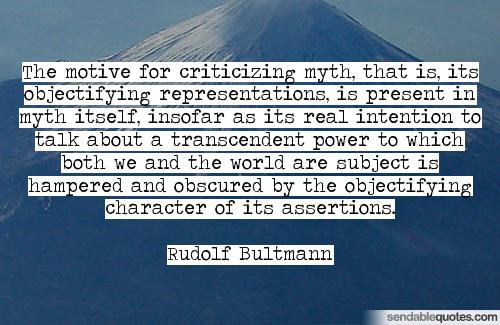
The meaning of these…types of mythology lies…not in their imagery with its apparent objectivity but in the understanding of human existence which both are trying to express. In other words, they need to be interpreted existentially.
One can argue with Bultmann over whether this existential reinterpretation of the Christian gospel is appropriate, whether it makes sense, and whether it remain the Christian gospel. But he is very explicit about the fact that he rejects the earlier liberal approach of Harnack and others which sought to peel off myth and find a core of timeless truth that could then be transferred into our time – a timeless truth which turned out, inevitably, to be a reflection of the values of the modern interpreters and their age. Bultmann instead asked whether the myth, as myth, nonetheless offered a challenge to human beings and a way of viewing human existence that could be reinterpreted and reexpressed as a whole.
And so I can’t understand why Miller presents his own view as though he were disagreeing with Bultmann about the problem of myth, and why he presents Bultmann as advocating the viewpoint that he actually argued against. Miller is free to reject the kerygma, the Christian proclamation, in the form Bultmann reinterpreted, and to do so for any number of reasons, whether the conviction that the approach is inherently invalid, or that Bultmann’s restatement of the message does not preserve essential elements of the historic Christian message, or that the reformulation isn’t meaningful to him, or that he simply chooses to reject it in his own act of existential decision. But Bultmann’s perspective deserves to at least be heard and understood properly before it is responded to in any of those ways.
Previous Post

October 28, 2016
Imaginal Worlds Conference
Next Post

October 30, 2016 R. Nathaniel Dett, The Ordering of Moses
Browse Our Archives
Select a Category 1 Corinthians 1 John 1 Peter 1 Samuel 1 Thessalonians 1 Timothy 2 Corinthians 2 Kings 2 Peter 2 Samuel 2 Thessalonians 2 Timothy academia Acts of the Apostles afterlife Akhaten Alcatraz American Academy of Religion Amos Anglican Arabic Aramaic archaeology art artificial intelligence astronomy atheism atonement Babylon 5 Baptists Battlestar Galactica Bible Biblical Studies Carnival biblioblogging Black Mirror Blade Runner Book of Job book review Buddhism Call for Papers China Christianity Christmas Christology Chronicles Coptic creation Daniel Deuteronomy Doctor Who Dune Easter Ecclesiastes economics education Eldad Keynan Enoch Seminar Ephesians eschatology Esther Evangelicals evolution Exodus Expanse Ezekiel Ezra fantasy Fringe fundamentalism Galatians games Ge'ez genealogy Genesis Gnosticism Gospel of Jesus' Wife Gospel of John Gospel of Judas Gospel of Luke Gospel of Mark Gospel of Matthew Gospel of Peter Gospel of Thomas Greek Harry Potter Hebrew Hebrews Hinduism historical Jesus history Hitchhiker's Guide to the Galaxy Holidays horror Hosea humor incarnation India inerrancy information literacy inspirational Intelligent Design Ireland Isaiah Islam Israel Italy James Jeremiah John the Baptist Jonah Joshua Judaism Jude Judges Judith Lamentations languages Latin Leviticus libraries literature Lord of the Rings LOST Mandaeans Mandaic memes Methodism Micah monotheism morality Mormons movies music mythicism NASSCAL Nehemiah new perspective New Testament news Numbers Orthodox paganism panentheism pantheism Patheos Paul and his letters Pentecostals Philippians Philippians 2:6-11 philosophy physics Planet of the Apes podcast politics Progressive Christianity Protestantism Proverbs Psalms pseudoscience racism religion Revelation Roman Catholicism Romania Romans Ruth scams science science fiction Secret Gospel of Mark Society of Biblical Literature Song of Songs Star Trek Star Wars Stargate Swahili Syriac Taoism technology Terminator The Handmaid's Tale The Hobbit The Matrix theodicy theology theory Timeless Titus tomb Torchwood travel TRON Uncategorized United Kingdom Westworld X-Files young-earth creationism Zechariah
Select a Month October 2026 September 2026 August 2026 July 2026 June 2026 May 2026 April 2026 March 2026 February 2026 January 2026 December 2025 November 2025 October 2025 September 2025 July 2025 June 2025 May 2025 April 2025 March 2025 February 2025 January 2025 December 2024 November 2024 October 2024 September 2024 August 2024 July 2024 June 2024 May 2024 April 2024 March 2024 February 2024 January 2024 December 2023 November 2023 October 2023 September 2023 August 2023 July 2023 May 2023 April 2023 March 2023 February 2023 January 2023 December 2022 November 2022 October 2022 September 2022 August 2022 July 2022 June 2022 May 2022 April 2022 March 2022 February 2022 January 2022 December 2021 November 2021 October 2021 September 2021 August 2021 July 2021 June 2021 May 2021 April 2021 March 2021 February 2021 January 2021 December 2020 November 2020 October 2020 September 2020 August 2020 July 2020 June 2020 May 2020 April 2020 March 2020 February 2020 January 2020 December 2019 November 2019 October 2019 September 2019 August 2019 July 2019 June 2019 May 2019 April 2019 March 2019 February 2019 January 2019 December 2018 November 2018 October 2018 September 2018 August 2018 July 2018 June 2018 May 2018 April 2018 March 2018 February 2018 January 2018 December 2017 November 2017 October 2017 September 2017 August 2017 July 2017 June 2017 May 2017 April 2017 March 2017 February 2017 January 2017 December 2016 November 2016 October 2016 September 2016 August 2016 July 2016 June 2016 May 2016 April 2016 March 2016 February 2016 January 2016 December 2015 November 2015 October 2015 September 2015 August 2015 July 2015 June 2015 May 2015 April 2015 March 2015 February 2015 January 2015 December 2014 November 2014 October 2014 September 2014 August 2014 July 2014 June 2014 May 2014 April 2014 March 2014 February 2014 January 2014 December 2013 November 2013 October 2013 September 2013 August 2013 July 2013 June 2013 May 2013 April 2013 March 2013 February 2013 January 2013 December 2012 November 2012 October 2012 September 2012 August 2012 July 2012 June 2012 May 2012 April 2012 March 2012 February 2012 January 2012 December 2011 November 2011 October 2011 September 2011 August 2011 July 2011 June 2011 May 2011 April 2011 March 2011 February 2011 January 2011 December 2010 November 2010 October 2010 September 2010 August 2010 July 2010 June 2010 May 2010 April 2010 March 2010 February 2010 January 2010 December 2009 November 2009 October 2009 September 2009 August 2009 July 2009 June 2009 May 2009 April 2009 March 2009 February 2009 January 2009 December 2008 November 2008 October 2008 September 2008 August 2008 July 2008 June 2008 May 2008 April 2008 March 2008 February 2008 January 2008 December 2007 November 2007 October 2007 September 2007 August 2007 July 2007 June 2007 February 2007 January 2001
Follow Us!
TAKE THE
Religious Wisdom Quiz
In 1 Peter, what does Peter say Christ was chosen before but revealed in when?
Select your answer to see how you score.
Before the creation of the world, revealed in these last times Before time began, revealed at the resurrection Before Abraham was born, revealed at his baptism Before the prophets spoke, revealed at Pentecost
Books by This Author Books by James F. McGrath
Related posts from Religion Prof: The Blog of James F. McGrath

ReligionProf Retrospective 2025
Religion Prof: The Blog of James F. McGrath

Religion Prof: The Blog of James F. McGrath
Paul, Mark, and Revelation Within Judaism (Enoch Seminar)
Religion Prof: The Blog of James F. McGrath
Religion Prof: The Blog of James F. McGrath
TRENDING AT PATHEOS Progressive Christian

The Dangers of Gradual Accommodation (Winking at Sin)
Recently, the “law of gradualness” resurfaced during the opening of a weeklong,...

The Iron Gates and the Lion of the...
Yesterday, I didn't finish my report about, well, yesterday. So I'll...

Dolly Parton’s Last Song Wins Dove Award with...
Bluegrass band The Grascals, speaking on the red carpet at the 57th...

The Image: On the Horror of Capitalism and...
The Image Then went the Pharisees, and took counsel how they might...

We are approaching the date of our new American national holiday: October...

Letters on Living the Faith by C.S. Lewis
Most of us met C.S. Lewis as a public intellectual. Mere Christianity....
view all Progressive Christian blogs
Ad-Free & Subscriber Log-In Subscription Support
- About Us
- 2026 Calendar
- Videos
- Podcasts
- Library of World Religions
- Faith In Media Tracker
- Advertise With Us
- Write for Us
- Privacy Policy
- Terms of Service
- Do Not Sell My Data
- Contact Us
- Radiant Digital
- Manage Newsletter Subscriptions
- Unsubscribe From Notifications
- Sitemap
Copyright 2008-2026, Patheos. All rights reserved.
Subscription Support Ad-Free & Subscriber Log-In
Follow Patheos