
BuddhistCatholicContemplativeEvangelicalGeneral ChristianHinduJewishLatter-day SaintMuslimNew VisionsProgressive Christian
Beliefs
- Buddhist
- Catholic
- Contemplative
- Evangelical
- General Christian
- Hindu
- Jewish
- Latter-day Saint
- More Voices
- Muslim
- New Visions
- Pagan
- Progressive Christian
Topics
- Religion News
- Food and Religion
- Sports and Religion
- Religious Art
- Religious Music and Entertainment
- Religious Events
- History and Religion
- Style and Religion
- Politics and Religion
- Women in Religion
- Recreation Outdoors and Religion
- Business Finance and Religion
- Careers Workplace and Religion
- Education and Religion
- Family Parenting and Religion
- Health Fitness and Religion
- Home and Religion
- Relationships and Religion
- Technology and Religion
- Travel and Religion
Columnists
- Buddhist Columnists
- Business Finance and Religion Columnists
- Careers Workplace and Religion Columnists
- Catholic Columnists
- Contemplative Columnists
- Education and Religion Columnists
- Evangelists Columnists
- Family Parenting and Religion Columnists
- General Christian Columnists
- Health Fitness and Religion Columnists
- Hindu Columnists
- History and Religion Columnists
- Home and Religion Columnists
- Jewish Columnists
- More Voices Columnists
- Latter Day Columnists
- Muslim Columnists
- New Visions Columnists
- Nonreligious Columnists
- Pagan Columnists
- Politics and Religion Columnists
- Progressive Columnists
- Recreation Outdoors and Religion Columnists
- Relationships and Religion Columnists
- Religion News Columnists
- Religious Art Columnists
- Religious Events Columnists
- Religious Music and Entertainment Columnists
- Sports and Religion Columnists
- Style and Religion Columnists
- Technology and Religion Columnists
- Travel and Religion Columnists
- Women in Religion Columnists
Resource Library
- 2026 Calendar
- Library of World Religions
- The 100 Most Holy Places on Earth
- Patheos Answers
- Podcasts
- Videos
- Faith Leaders Database
- Anglican Episcopalian
- Bahai
- Baptist
- Buddhism
- Christianity
- Confucianism
- Eastern Orthodoxy
- Hinduism
- Holiness and Pentecostal
- ISKCON
- Islam
- Judaism
- Lutheran
- Methodist
- The Church of Jesus Christ of Latter-day Saints
- New Age
- Paganism
- Presbytarian and Reformed
- Protestantism
- Religion Behind the Scenes
- Roman Catholic
- Scientology
- Shia Islam
- Sikhism
- Sufism
- Sunni Islam
- Taoism
- Zen
- See all religions
Research Tools
 Ad-Free & Subscriber Log-In Subscription Support
Follow Patheos 

- Trending:
- Advent
- |
- Forgiveness
- |
- Thanksgiving
- |
- Election
- |
- Seasonal Holidays
- |
- Marriage

- Home
- About Dr. James F. McGrath
- Publications
- Blogroll
- Useful Websites
- Connections
- Easy Search Posts Page
- FREE NEWSLETTER
- Home
- Progressive Christian
- How Jesus Saves the World From Us
How Jesus Saves the World From Us
Last updated on: July 21, 2016 at 6:06 pm by James F. McGrath
How Jesus Saves the World From Us 2016-07-21T18:06:59-04:00 James F. McGrath
Patheos Explore the world's faith through different perspectives on religion and spirituality! Patheos has the views of the prevalent religions and spiritualities of the world.

The main theme of the book is articulated in the opening question, “Have Christians become what Jesus came to stop us from being?” The title of the book alludes to the exploration of that theme in connection with the life of Saul of Tarsus. What God did by changing Saul’s direction was less about Paul “getting saved,” and more about saving the victims of his persecution from him (p.3).
It is these unconventional and insightful perspectives on familiar Biblical stories, and on contemporary theological ideas and church practices, that unite the disparate analogies and metaphors running through the book’s chapters, each of which is built around a contrast between something that at least some Christians tend to do or to understand, and another way of approaching things. These points are regularly articulated by way of relevant illustrations from contemporary life. For instance, in the chapter contrasting worship with performance, Guyton writes (p.17):
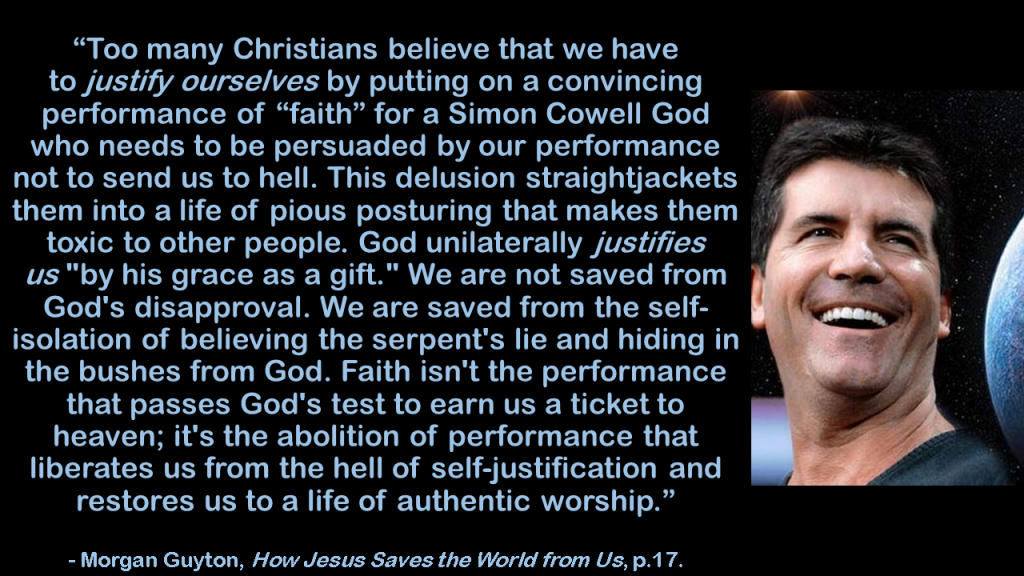
Too many Christians believe that we have to justify ourselves by putting on a convincing performance of “faith” for a Simon Cowell God who needs to be persuaded by our performance not to send us to hell. This delusion straightjackets them into a life of pious posturing that makes them toxic to other people. God unilaterally justifies us “by his grace as a gift.” We are not saved from God’s disapproval. We are saved from the self-isolation of believing the serpent’s lie and hiding in the bushes from God. Faith isn’t the performance that passes God’s test to earn us a ticket to heaven; it’s the abolition of performance that liberates us from the hell of self-justification and restores us to a life of authentic worship.
The book is full of such quotable passages, which I plan to turn into memes if others don’t beat me to it. Indeed, I could easily have quoted another passage from the same chapter as illustrating the important points made in memorable fashion (p.16):
It isn’t enough to change the audience for our performance from the world to God (which many Christians think we’re supposed to do). As long as we think we’re living “under the critic,” whether it’s the world or God himself, we will perform instead of worship.
A similar point emerges in a chapter contrasting honor with terror in relation to the fear of God, as Guyton compares Matthew 25:14-30 to an ancient episode of The Apprentice (p.59).
In discussing the Bible as more akin to poetry than math, Guyton writes that “Math is a type of knowledge that you can conquer, while poetry is a type of knowledge that conquers you” (p.70). He argues that poetry is able to connect with us, get under our skin, and persuade us in ways that rational argument may not.
I especially appreciated Guyton’s analogies from music, ranging from breathing that we are taught when we take singing lessons, to jamming the blues. Playing the blues is ruined by people who will stop a song because someone isn’t “getting it right,” and it is ruined by those who want to solo all the time. Theology, Guyton suggests, should be about learning the progressions and how to enjoy exploring the possibilities around them, rather than rigidly defining what the “perfect” song should be, in a manner that only a few if any might be able to play correctly, since “it’s impossible to play God’s song perfectly” (p.83). Heresy, in its meaning in Titus (which Guyton treats as written by Paul), is about causing divisions and not by holding the wrong views.
The chapter on solidarity as opposed to sanctimony is especially powerful, calling on us to become “perfectly loving, rather than the perfect rule enforcers” (p.109). Like the climactic emergence to prominence of a theme that has been woven through a piece of music from early on, chapter 9 depicts Jesus’ solidarity with sinners, as he defends women who may not have acted wisely or appropriately, but whose actions are nonetheless preferable to those of their critics (pp.113-114). So too the following chapter on insiders and outsiders highlights how different the message of the cross seems to those who live today fearing the equivalent of crucifixion. The cross has “become jewelry that cannot symbolize our loss of status because it is now a status symbol” (p.124). And again, “It makes sense for people who are not being crucified to reduce Jesus’ cross into an abstract spiritual transaction, but for people who are being crucified, Jesus’ cross proves his solidarity with their suffering” (p.126). In exploring this topic, Guyton is not unaware of his own privileges as a white male, nor of his own shortcomings when it comes to Jesus’ challenging teachings. As he puts it with characteristic frankness, “I’m not sure he’ll be happy with me if I blow off his parable on account of his grace” (p.128). Guyton seeks to avoid allowing the Gospel of grace as many understand it to be used to neutralize the challenge of Jesus’ call to take up our cross, to join the outsiders at the table. This chapter includes (as do all of them) personal experiences that illustrate the kinds of things that Christianity can be in our time at its best and not just at its worst. After describing the transforming impact of a community of Christians marginalized because of the sexual orientation of most members, Guyton writes (p.130):
LGBTQ people have become scapegoats for many insider Christians who were looking for a way to feel like the world’s scapegoats. Just because our culture has started to shift into accepting queer identity doesn’t mean that we can obfuscate our way our of Jesus’ call to radically renounce worldly privilege by using the gay issue to solicit “persecution” from “the world.”
The entire book is in essence a proclamation of the good news, the gospel not of how to experience an individualistic salvation that assures you of your own rightness and sanctity, but a gospel of how to be saved from precisely that “toxic understanding of salvation” (p.158). Perhaps the most important thing to say is that, for those who may be inclined to cheer and shout amens in response to these points, Guyton recognizes that Jesus didn’t just hobnob with the marginalized, but also with the powerful, and that progressive Christians likewise need to learn how not to unfriend those who have the opportunity to interact in the manner that Jesus did with those that are in fact precisely the kind of people that Jesus criticized. There is a real danger for those who recognize the problems with sanctimony, for instance, to simply develop yet another kind of self-righteousness about our supposed avoidance of it.
It is precisely the recognition both of major problems facing churches in our time, as well as pitfalls that lie in wait for those who recognize the problems, that makes Guyton’s book so important. I hope that How Jesus Saves the World from Us will be widely read, quoted, and discussed. And to facilitate that, each chapter ends with discussion questions. I conclude my review with one of them (p.68): “Have you ever had a Huck Finn moment when what you knew was right went completely against the grain of your community?”
Previous Post

May 18, 2016
Do No Harm Act
Next Post
May 19, 2016 Student-Made Documentary on the Gospel of Judas
Browse Our Archives
Select a Category 1 Corinthians 1 John 1 Peter 1 Samuel 1 Thessalonians 1 Timothy 2 Corinthians 2 Kings 2 Peter 2 Samuel 2 Thessalonians 2 Timothy academia Acts of the Apostles afterlife Akhaten Alcatraz American Academy of Religion Amos Anglican Arabic Aramaic archaeology art artificial intelligence astronomy atheism atonement Babylon 5 Baptists Battlestar Galactica Bible Biblical Studies Carnival biblioblogging Black Mirror Blade Runner Book of Job book review Buddhism Call for Papers China Christianity Christmas Christology Chronicles Coptic creation Daniel Deuteronomy Doctor Who Dune Easter Ecclesiastes economics education Eldad Keynan Enoch Seminar Ephesians eschatology Esther Evangelicals evolution Exodus Expanse Ezekiel Ezra fantasy Fringe fundamentalism Galatians games Ge'ez genealogy Genesis Gnosticism Gospel of Jesus' Wife Gospel of John Gospel of Judas Gospel of Luke Gospel of Mark Gospel of Matthew Gospel of Peter Gospel of Thomas Greek Harry Potter Hebrew Hebrews Hinduism historical Jesus history Hitchhiker's Guide to the Galaxy Holidays horror Hosea humor incarnation India inerrancy information literacy inspirational Intelligent Design Ireland Isaiah Islam Israel Italy James Jeremiah John the Baptist Jonah Joshua Judaism Jude Judges Judith Lamentations languages Latin Leviticus libraries literature Lord of the Rings LOST Mandaeans Mandaic memes Methodism Micah monotheism morality Mormons movies music mythicism NASSCAL Nehemiah new perspective New Testament news Numbers Orthodox paganism panentheism pantheism Patheos Paul and his letters Pentecostals Philippians Philippians 2:6-11 philosophy physics Planet of the Apes podcast politics Progressive Christianity Protestantism Proverbs Psalms pseudoscience racism religion Revelation Roman Catholicism Romania Romans Ruth scams science science fiction Secret Gospel of Mark Society of Biblical Literature Song of Songs Star Trek Star Wars Stargate Swahili Syriac Taoism technology Terminator The Handmaid's Tale The Hobbit The Matrix theodicy theology theory Timeless Titus tomb Torchwood travel TRON Uncategorized United Kingdom Westworld X-Files young-earth creationism Zechariah
Select a Month November 2026 October 2026 September 2026 August 2026 July 2026 June 2026 May 2026 April 2026 March 2026 February 2026 January 2026 December 2025 November 2025 October 2025 September 2025 July 2025 June 2025 May 2025 April 2025 March 2025 February 2025 January 2025 December 2024 November 2024 October 2024 September 2024 August 2024 July 2024 June 2024 May 2024 April 2024 March 2024 February 2024 January 2024 December 2023 November 2023 October 2023 September 2023 August 2023 July 2023 May 2023 April 2023 March 2023 February 2023 January 2023 December 2022 November 2022 October 2022 September 2022 August 2022 July 2022 June 2022 May 2022 April 2022 March 2022 February 2022 January 2022 December 2021 November 2021 October 2021 September 2021 August 2021 July 2021 June 2021 May 2021 April 2021 March 2021 February 2021 January 2021 December 2020 November 2020 October 2020 September 2020 August 2020 July 2020 June 2020 May 2020 April 2020 March 2020 February 2020 January 2020 December 2019 November 2019 October 2019 September 2019 August 2019 July 2019 June 2019 May 2019 April 2019 March 2019 February 2019 January 2019 December 2018 November 2018 October 2018 September 2018 August 2018 July 2018 June 2018 May 2018 April 2018 March 2018 February 2018 January 2018 December 2017 November 2017 October 2017 September 2017 August 2017 July 2017 June 2017 May 2017 April 2017 March 2017 February 2017 January 2017 December 2016 November 2016 October 2016 September 2016 August 2016 July 2016 June 2016 May 2016 April 2016 March 2016 February 2016 January 2016 December 2015 November 2015 October 2015 September 2015 August 2015 July 2015 June 2015 May 2015 April 2015 March 2015 February 2015 January 2015 December 2014 November 2014 October 2014 September 2014 August 2014 July 2014 June 2014 May 2014 April 2014 March 2014 February 2014 January 2014 December 2013 November 2013 October 2013 September 2013 August 2013 July 2013 June 2013 May 2013 April 2013 March 2013 February 2013 January 2013 December 2012 November 2012 October 2012 September 2012 August 2012 July 2012 June 2012 May 2012 April 2012 March 2012 February 2012 January 2012 December 2011 November 2011 October 2011 September 2011 August 2011 July 2011 June 2011 May 2011 April 2011 March 2011 February 2011 January 2011 December 2010 November 2010 October 2010 September 2010 August 2010 July 2010 June 2010 May 2010 April 2010 March 2010 February 2010 January 2010 December 2009 November 2009 October 2009 September 2009 August 2009 July 2009 June 2009 May 2009 April 2009 March 2009 February 2009 January 2009 December 2008 November 2008 October 2008 September 2008 August 2008 July 2008 June 2008 May 2008 April 2008 March 2008 February 2008 January 2008 December 2007 November 2007 October 2007 September 2007 August 2007 July 2007 June 2007 February 2007 January 2001
Follow Us!
TAKE THE
Religious Wisdom Quiz
I made a rash vow that cost me my only child after a military victory. Who am I?
Select your answer to see how you score.
Samson Gideon Barak Jephthah
Books by This Author Books by James F. McGrath
Related posts from Religion Prof: The Blog of James F. McGrath
Religion Prof: The Blog of James F. McGrath

The Obsolete Paradigm of a Purely Mythical Jesus
Religion Prof: The Blog of James F. McGrath
Religion Prof: The Blog of James F. McGrath
Reviews of Beyond Deconstruction (and an Easter Excerpt)
Religion Prof: The Blog of James F. McGrath
TRENDING AT PATHEOS Progressive Christian

Just as the emergence of leaves on the fig tree signals the...
Belief and Disbelief in Christ's Presence in Holy...
A study found that only 29% of Catholics believe that the bread...

Blue Christmas: Making Room for Grief at Church
A Blue Christmas service makes room for grief, remembrance, and hope. Explore...

We Can Trust That God Will Use Our...
A Jesus-loving young friend who is going through deep suffering sent me...

Everything is worship for Quakers. The Quakers emphasize contemplation, equality, pacifism and...

Happy Thanksgiving! I published this Thanksgiving column back in 2017 in...
view all Progressive Christian blogs
Ad-Free & Subscriber Log-In Subscription Support
- About Us
- 2026 Calendar
- Videos
- Podcasts
- Library of World Religions
- Faith In Media Tracker
- Advertise With Us
- Write for Us
- Privacy Policy
- Terms of Service
- Do Not Sell My Data
- Contact Us
- Radiant Digital
- Manage Newsletter Subscriptions
- Unsubscribe From Notifications
- Sitemap
Copyright 2008-2026, Patheos, part of the Radiant Digital network of media brands. All rights reserved.
Subscription Support Ad-Free & Subscriber Log-In
Follow Patheos