
BuddhistCatholicContemplativeEvangelicalGeneral ChristianHinduJewishLatter-day SaintMuslimNew VisionsProgressive Christian
Beliefs
- Buddhist
- Catholic
- Contemplative
- Evangelical
- General Christian
- Hindu
- Jewish
- Latter-day Saint
- More Voices
- Muslim
- New Visions
- Pagan
- Progressive Christian
Topics
- Religion News
- Food and Religion
- Sports and Religion
- Religious Art
- Religious Music and Entertainment
- Religious Events
- History and Religion
- Style and Religion
- Politics and Religion
- Women in Religion
- Recreation Outdoors and Religion
- Business Finance and Religion
- Careers Workplace and Religion
- Education and Religion
- Family Parenting and Religion
- Health Fitness and Religion
- Home and Religion
- Relationships and Religion
- Technology and Religion
- Travel and Religion
Columnists
- Buddhist Columnists
- Business Finance and Religion Columnists
- Careers Workplace and Religion Columnists
- Catholic Columnists
- Contemplative Columnists
- Education and Religion Columnists
- Evangelists Columnists
- Family Parenting and Religion Columnists
- General Christian Columnists
- Health Fitness and Religion Columnists
- Hindu Columnists
- History and Religion Columnists
- Home and Religion Columnists
- Jewish Columnists
- More Voices Columnists
- Latter Day Columnists
- Muslim Columnists
- New Visions Columnists
- Nonreligious Columnists
- Pagan Columnists
- Politics and Religion Columnists
- Progressive Columnists
- Recreation Outdoors and Religion Columnists
- Relationships and Religion Columnists
- Religion News Columnists
- Religious Art Columnists
- Religious Events Columnists
- Religious Music and Entertainment Columnists
- Sports and Religion Columnists
- Style and Religion Columnists
- Technology and Religion Columnists
- Travel and Religion Columnists
- Women in Religion Columnists
Resource Library
- 2026 Calendar
- Library of World Religions
- The 100 Most Holy Places on Earth
- Patheos Answers
- Podcasts
- Videos
- Faith Leaders Database
- Anglican Episcopalian
- Bahai
- Baptist
- Buddhism
- Christianity
- Confucianism
- Eastern Orthodoxy
- Hinduism
- Holiness and Pentecostal
- ISKCON
- Islam
- Judaism
- Lutheran
- Methodist
- The Church of Jesus Christ of Latter-day Saints
- New Age
- Paganism
- Presbytarian and Reformed
- Protestantism
- Religion Behind the Scenes
- Roman Catholic
- Scientology
- Shia Islam
- Sikhism
- Sufism
- Sunni Islam
- Taoism
- Zen
- See all religions
Research Tools
 Ad-Free & Subscriber Log-In Subscription Support
Ad-Free & Subscriber Log-In Subscription Support
Follow Patheos 

- Trending:
- Forgiveness
- |
- Marriage
- |
- Consciousness
- |
- Death Penalty
- |
- Election
- |
- Halloween

- Home
- About Dr. James F. McGrath
- Publications
- Blogroll
- Useful Websites
- Connections
- Easy Search Posts Page
- FREE NEWSLETTER
- Home
- Progressive Christian
- Brant Pitre, The Case for Jesus
Brant Pitre, The Case for Jesus
Last updated on: February 5, 2016 at 9:55 pm by James F. McGrath
Brant Pitre, The Case for Jesus 2016-02-05T21:55:45-05:00 James F. McGrath
Patheos Explore the world's faith through different perspectives on religion and spirituality! Patheos has the views of the prevalent religions and spiritualities of the world.


The overarching question of the book is one that many have asked: Did Jesus claim to be God? Pitre recognizes that there are a number of links in the chain that could lead to a positive answer to that question, each of which depends upon the next, and so successive chapters address these in turn. Along the way, Pitre offers autobiographical glimpses into his own story of pursuing academic study, having his assumptions challenged, and subsequently turning the tables and challenging the assumptions of those who previously challenged him.
The first topic addressed is the question of Gospel authorship. Pitre points out that, despite the impression many have, we do not have any copies of the Gospels which lack the titles by which they are traditionally known, and which indicate the names of the authors. Nor do we have any copies of these works which attribute them to someone different. I suspect that many in the wider public – and perhaps some in the academy who have never looked into the matter – have confused a surmise offered in the past with something confirmed by manuscript evidence. The suggestion that the Gospels initially did not bear the titles by which we now know them is based on the observation that the titles are all of a type, and are unlikely to have arisen before there was a second Gospel to distinguish from the first. And so, conversely, as Pitre points out, the titles of Gospels are probably at least as old as the point at which the second Gospel was composed. My own surmise would be that the Gospel of Mark was originally known by its opening words, as many ancient works were, and so its beginning was the beginning of the “Gospel of/about Jesus Christ,” with “according to Mark” being added once a second Gospel was composed and circulating, and also providing the pattern by which subsequent Gospels were named. Pitre also emphasizes how unlikely it is that the church would invent attributions to Mark and Luke, who were not eyewitnesses nor part of the inner circle of the Twelve. And on this point I agree with him. When it comes to Matthew and John, things seem less clear to me, for a number of reasons, among which is the fact that relationship of the Greek Gospel we know as “Matthew” to the Hebrew composition by the apostle of which the church Fathers speak is unclear. While Pitre points to the use of the name Matthew in that Gospel as evidence of authorship, for me it is the precise opposite. I can well envisage Matthew using Mark, regardless of whether it was based on Peter's own testimony. But I simply cannot imagine him copying the story of his own first encounter with Jesus from Mark and offering nothing of his own, other than changing the name by which he is called (see pp.28-9).
Pitre also makes cogent and important points about the genre of the Gospels (as ancient biographies) as well as the date of the Gospels. Certain dates have become traditional, but are based on deduction and then guesswork as to how long after a source the work that draws upon it would have been composed. Pitre asks important questions, such as why exhortations to pray that the destruction of Jerusalem not occur on a particular day or at a particular time of year would be added after that destruction had already occurred (pp.93-4). At the very least, certain elements in the Gospels must, I agree, have taken their present form at an earlier point, and as James Crossley has argued, Mark 13 seems to be shaped by the Caligula crisis in the 40s. Whether this allows us to date the final form of the Gospels is less clear, but either way Pitre's point is sound, namely that we are not dealing with works that were only written long after the time of Jesus and the potential for his words and deeds to be remembered.
After a useful discussion not just of Jesus' own messianic self-understanding, but also of the sense many in his time had that the Book of Daniel foresaw the arrival of the Messiah in that time, Pitre turns his attention to the question of Jesus' divinity. On this point, I found his treatment much less compelling. The suggestion that Jesus indicated his own divinity through riddles and allusions is itself problematic – not because Jesus was not renowned for communicating in precisely that way, but because the riddles and allusions in question need not be understood in the manner that Pitre suggests. But even if one were to grant this, we see the Gospel authors regularly spelling out for readers things that Jesus at best left implicit. And yet the only way to claim that the Synoptic Gospels depict Jesus as God is to view them as likewise content to offer hints and insinuations, a claim which does not seem plausible to me. I plan to blog through the Gospel of Mark and its Christology, and so will revisit some of the texts in more detail. But Pitre regularly draws conclusions which I find it unlikely that ancient Jewish authors would draw. For instance, if there are echoes of theophanies in the story of Jesus walking across the sea, would those have been allowed to trump the conviction that there is only one God, who is not a man, and thus this individual must at best be a person whom the one God has infused with his power in a way he has never done with another of his emissaries? Likewise, the suggestion that the common phrase “I am” indicates divinity is not as self-evident as Pitre suggestions – not only because, in certain contexts, it can mean “it is I,” but because even when a person says “I am” it obviously does not always represent a claim to be the one God! Moreover, if “I am” echoed the divine name, there is a long Jewish tradition of God sharing the divine name with a principal agent. Even in the Gospel of John, even if one grants that it is based on eyewitness testimony as it explicitly claims, Jesus is not depicted as claiming to be God, but as claiming to be the one whom the only true God has sent, the Son who does nothing of himself, but only the will of the one who sent him. And so I am quite happy to agree that even the very different Fourth Gospel needs to be reconsidered, in the manner that John A. T. Robinson suggested. But doing so does not bring the Synoptic Christology in line with the traditional way that Christians have read John, but rather shows John to depart less drastically from the Synoptics than some have thought.
I often felt, while reading the book, that Pitre had paid less attention to precisely what other scholars were saying than he ought to have. In some cases, their wording certainly seemed to justify Pitre's appeal to them, as in the case of Adela Yarbro Collins' statement, “Being seated at the right hand of God implies being equal to God, at least in terms of authority and power” (quoted pp.160-161). In the original context, however, she is clearly referring to a status of qualified equality to which Jesus as Messiah would be exalted. In other cases, the appeal is less justifiable even in terms of the words quoted in the book, as for instance in the case of Joel Marcus, who clearly speaks of “co-regency” and “near equality with God,” which is not the same thing as claiming to be God (quoted p.147). And so I found myself wondering how many of those who read the book hoping to have their beliefs reinforced would notice that some of the scholars to whom Pitre appeals would not actually agree with the case he presents or the precise conclusions that he is arguing for.
Hopefully the first part of my review made clear that, even if I am not persuaded by Pitre's case for Jesus having claimed to be divine, or that the Synoptic Gospels present him that way, there are nonetheless a lot of fascinating details along the way which are persuasive, and others which are at least thought provoking and will require further reflection. Examples include the suggestion that blood and water flowing from Jesus' side would have recalled the flow of blood and water from the side of the temple (pp.170-171), and the suggestion that the story of Jonah is much more readily understood as about a resurrection than we tend to assume (pp.185-189). Yet even on this point, Pitre does not address the fact that, for the Gospel of Luke, the sign of Jonah means what Mark means by saying that no sign will be given. It is only the Gospel of Matthew that turns this into a prediction of resurrection. And so whether or not the Gospel authors were eyewitnesses, their interpretative role and additions to the story do not disappear.
If some scholars in the past have gone too far in dismissing traditional information about the Gospels, or have made inadequately justified leaps in the direction of treating them as late folklore, Pitre is the least persuasive when he attempts to swing the pendulum too far in the other direction, in a way that seems to me equally unjustified. If the Gospel authors have not completely rewritten Jesus, neither do they simply record what he himself said, or necessarily even what they thought about him when he was in their presence. Despite Pitre's concluding altar call of sorts, it is simply not the case that “if you are going to hold to the theory that Jesus never claimed to be God, you had better be committed to eliminating a lot of historical evidence” nor do you “have to eliminate the entire Gospel of John and what it tells us about who Jesus claimed to be” (p.193). Even in the Gospel of John, Jesus is a person who embodies the divine presence in the form of God's own Word and/or Spirit, who was sent by God, and who as the Messiah is persuaded that he was in some way prepared in heaven before his life on Earth began. Far from it being necessary to deny the historical evidence in order to draw the conclusion that Jesus himself understood himself to be God's appointed agent, and that the Gospel authors also understood him that way, for many scholars who read the Gospels – many of whom are Christians – these are precisely the conclusions that the evidence in the Gospels themselves points towards.
And so I think that Pitre's chain of evidence is an important one, leading us to revisit the Gospels and recognize that they tell us more about the historical Jesus than some have been willing to admit. But it is precisely the Gospels, understood within the framework and against the background of ancient Jewish monotheism and ideas about agents and emissaries that God appointed and sent, which lead to the conclusion that Jesus did not claim to be God. That is not a claim I make denying the evidence, but because of the evidence, even though like Pitre I resisted the conclusion and did not want to reach it.
As you can gather from the length of this post, as well as the details, Pitre's book is very engaging and worth reading, regardless whether you agree with his conclusions either before reading it or afterwards. Click through to read what others around the Patheos blogs have had to say about the book!

Previous Post

February 5, 2016
You Can Own The Sarcasm Shirt
Next Post
February 6, 2016 Ancient Computers?
Browse Our Archives
Select a Category 1 Corinthians 1 John 1 Peter 1 Samuel 1 Thessalonians 1 Timothy 2 Corinthians 2 Kings 2 Peter 2 Samuel 2 Thessalonians 2 Timothy academia Acts of the Apostles afterlife Akhaten Alcatraz American Academy of Religion Amos Anglican Arabic Aramaic archaeology art artificial intelligence astronomy atheism atonement Babylon 5 Baptists Battlestar Galactica Bible Biblical Studies Carnival biblioblogging Black Mirror Blade Runner Book of Job book review Buddhism Call for Papers China Christianity Christmas Christology Chronicles Coptic creation Daniel Deuteronomy Doctor Who Dune Easter Ecclesiastes economics education Eldad Keynan Enoch Seminar Ephesians eschatology Esther Evangelicals evolution Exodus Expanse Ezekiel Ezra fantasy Fringe fundamentalism Galatians games Ge'ez genealogy Genesis Gnosticism Gospel of Jesus' Wife Gospel of John Gospel of Judas Gospel of Luke Gospel of Mark Gospel of Matthew Gospel of Peter Gospel of Thomas Greek Harry Potter Hebrew Hebrews Hinduism historical Jesus history Hitchhiker's Guide to the Galaxy Holidays horror Hosea humor incarnation India inerrancy information literacy inspirational Intelligent Design Ireland Isaiah Islam Israel Italy James Jeremiah John the Baptist Jonah Joshua Judaism Jude Judges Judith Lamentations languages Latin Leviticus libraries literature Lord of the Rings LOST Mandaeans Mandaic memes Methodism Micah monotheism morality Mormons movies music mythicism NASSCAL Nehemiah new perspective New Testament news Numbers Orthodox paganism panentheism pantheism Patheos Paul and his letters Pentecostals Philippians Philippians 2:6-11 philosophy physics Planet of the Apes podcast politics Progressive Christianity Protestantism Proverbs Psalms pseudoscience racism religion Revelation Roman Catholicism Romania Romans Ruth scams science science fiction Secret Gospel of Mark Society of Biblical Literature Song of Songs Star Trek Star Wars Stargate Swahili Syriac Taoism technology Terminator The Handmaid's Tale The Hobbit The Matrix theodicy theology theory Timeless Titus tomb Torchwood travel TRON Uncategorized United Kingdom Westworld X-Files young-earth creationism Zechariah
Select a Month October 2026 September 2026 August 2026 July 2026 June 2026 May 2026 April 2026 March 2026 February 2026 January 2026 December 2025 November 2025 October 2025 September 2025 July 2025 June 2025 May 2025 April 2025 March 2025 February 2025 January 2025 December 2024 November 2024 October 2024 September 2024 August 2024 July 2024 June 2024 May 2024 April 2024 March 2024 February 2024 January 2024 December 2023 November 2023 October 2023 September 2023 August 2023 July 2023 May 2023 April 2023 March 2023 February 2023 January 2023 December 2022 November 2022 October 2022 September 2022 August 2022 July 2022 June 2022 May 2022 April 2022 March 2022 February 2022 January 2022 December 2021 November 2021 October 2021 September 2021 August 2021 July 2021 June 2021 May 2021 April 2021 March 2021 February 2021 January 2021 December 2020 November 2020 October 2020 September 2020 August 2020 July 2020 June 2020 May 2020 April 2020 March 2020 February 2020 January 2020 December 2019 November 2019 October 2019 September 2019 August 2019 July 2019 June 2019 May 2019 April 2019 March 2019 February 2019 January 2019 December 2018 November 2018 October 2018 September 2018 August 2018 July 2018 June 2018 May 2018 April 2018 March 2018 February 2018 January 2018 December 2017 November 2017 October 2017 September 2017 August 2017 July 2017 June 2017 May 2017 April 2017 March 2017 February 2017 January 2017 December 2016 November 2016 October 2016 September 2016 August 2016 July 2016 June 2016 May 2016 April 2016 March 2016 February 2016 January 2016 December 2015 November 2015 October 2015 September 2015 August 2015 July 2015 June 2015 May 2015 April 2015 March 2015 February 2015 January 2015 December 2014 November 2014 October 2014 September 2014 August 2014 July 2014 June 2014 May 2014 April 2014 March 2014 February 2014 January 2014 December 2013 November 2013 October 2013 September 2013 August 2013 July 2013 June 2013 May 2013 April 2013 March 2013 February 2013 January 2013 December 2012 November 2012 October 2012 September 2012 August 2012 July 2012 June 2012 May 2012 April 2012 March 2012 February 2012 January 2012 December 2011 November 2011 October 2011 September 2011 August 2011 July 2011 June 2011 May 2011 April 2011 March 2011 February 2011 January 2011 December 2010 November 2010 October 2010 September 2010 August 2010 July 2010 June 2010 May 2010 April 2010 March 2010 February 2010 January 2010 December 2009 November 2009 October 2009 September 2009 August 2009 July 2009 June 2009 May 2009 April 2009 March 2009 February 2009 January 2009 December 2008 November 2008 October 2008 September 2008 August 2008 July 2008 June 2008 May 2008 April 2008 March 2008 February 2008 January 2008 December 2007 November 2007 October 2007 September 2007 August 2007 July 2007 June 2007 February 2007 January 2001
Follow Us!
TAKE THE
Religious Wisdom Quiz
Who taught Apollos about the gospel of Jesus Christ.
Select your answer to see how you score.
Timothy Paul Aquila and Priscilla Barnabas
Books by This Author Books by James F. McGrath
Related posts from Religion Prof: The Blog of James F. McGrath

Religion Prof: The Blog of James F. McGrath

The Obsolete Paradigm of a Purely Mythical Jesus
Religion Prof: The Blog of James F. McGrath

Religion Prof: The Blog of James F. McGrath
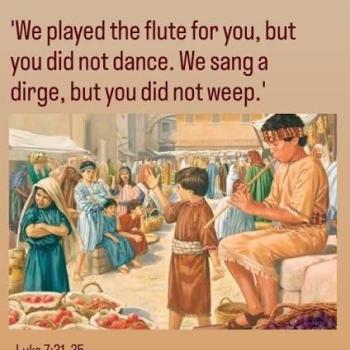
Mourning John and Dancing Jesus?
Religion Prof: The Blog of James F. McGrath
TRENDING AT PATHEOS Progressive Christian

Pope Leo Celebrates Mass for Nurses & Docs...
I don't have any idea how he did it, but Pope Leo...

The Sermon on the Mount, Part I: Matthew...
The Sermon on the Mount, Part I (Matthew 4:12-5:12) St. Matthew moves...

What's up from Crossway: Reviewing some of their latest A few weeks...

Janie Learns the Way of the Cross: A...
Teaching children about Jesus' Passion can be challenging. Many parents and educators...

Looking For Good Catholic Writing - October 2026
He alone extends the heavens, and he walks upon the waves of...

In "Irreplaceable," our book on vocation and technology, Trevor Sutton and I...
view all Progressive Christian blogs
Ad-Free & Subscriber Log-In Subscription Support
- About Us
- 2026 Calendar
- Videos
- Podcasts
- Library of World Religions
- Faith In Media Tracker
- Advertise With Us
- Write for Us
- Privacy Policy
- Terms of Service
- Do Not Sell My Data
- Contact Us
- Radiant Digital
- Manage Newsletter Subscriptions
- Unsubscribe From Notifications
- Sitemap
Copyright 2008-2026, Patheos. All rights reserved.
Subscription Support Ad-Free & Subscriber Log-In
Follow Patheos