
BuddhistCatholicContemplativeEvangelicalGeneral ChristianHinduJewishLatter-day SaintMuslimNew VisionsProgressive Christian
Beliefs
- Buddhist
- Catholic
- Contemplative
- Evangelical
- General Christian
- Hindu
- Jewish
- Latter-day Saint
- More Voices
- Muslim
- New Visions
- Pagan
- Progressive Christian
Topics
- Religion News
- Food and Religion
- Sports and Religion
- Religious Art
- Religious Music and Entertainment
- Religious Events
- History and Religion
- Style and Religion
- Politics and Religion
- Women in Religion
- Recreation Outdoors and Religion
- Business Finance and Religion
- Careers Workplace and Religion
- Education and Religion
- Family Parenting and Religion
- Health Fitness and Religion
- Home and Religion
- Relationships and Religion
- Technology and Religion
- Travel and Religion
Columnists
- Buddhist Columnists
- Business Finance and Religion Columnists
- Careers Workplace and Religion Columnists
- Catholic Columnists
- Contemplative Columnists
- Education and Religion Columnists
- Evangelists Columnists
- Family Parenting and Religion Columnists
- General Christian Columnists
- Health Fitness and Religion Columnists
- Hindu Columnists
- History and Religion Columnists
- Home and Religion Columnists
- Jewish Columnists
- More Voices Columnists
- Latter Day Columnists
- Muslim Columnists
- New Visions Columnists
- Nonreligious Columnists
- Pagan Columnists
- Politics and Religion Columnists
- Progressive Columnists
- Recreation Outdoors and Religion Columnists
- Relationships and Religion Columnists
- Religion News Columnists
- Religious Art Columnists
- Religious Events Columnists
- Religious Music and Entertainment Columnists
- Sports and Religion Columnists
- Style and Religion Columnists
- Technology and Religion Columnists
- Travel and Religion Columnists
- Women in Religion Columnists
Resource Library
- 2026 Calendar
- Library of World Religions
- The 100 Most Holy Places on Earth
- Patheos Answers
- Podcasts
- Videos
- Faith Leaders Database
- Anglican Episcopalian
- Bahai
- Baptist
- Buddhism
- Christianity
- Confucianism
- Eastern Orthodoxy
- Hinduism
- Holiness and Pentecostal
- ISKCON
- Islam
- Judaism
- Lutheran
- Methodist
- The Church of Jesus Christ of Latter-day Saints
- New Age
- Paganism
- Presbytarian and Reformed
- Protestantism
- Religion Behind the Scenes
- Roman Catholic
- Scientology
- Shia Islam
- Sikhism
- Sufism
- Sunni Islam
- Taoism
- Zen
- See all religions
Research Tools
 Ad-Free & Subscriber Log-In Subscription Support
Follow Patheos 

- Trending:
- Advent
- |
- Forgiveness
- |
- Thanksgiving
- |
- Election
- |
- Seasonal Holidays
- |
- Marriage

- Home
- About Dr. James F. McGrath
- Publications
- Blogroll
- Useful Websites
- Connections
- Easy Search Posts Page
- FREE NEWSLETTER
- Home
- Progressive Christian
- The Final Blogger Session #AARSBL15
The Final Blogger Session #AARSBL15
Last updated on: November 22, 2015 at 11:11 am by James F. McGrath
The Final Blogger Session #AARSBL15 2015-11-22T11:11:04-05:00 James F. McGrath
Patheos Explore the world's faith through different perspectives on religion and spirituality! Patheos has the views of the prevalent religions and spiritualities of the world.
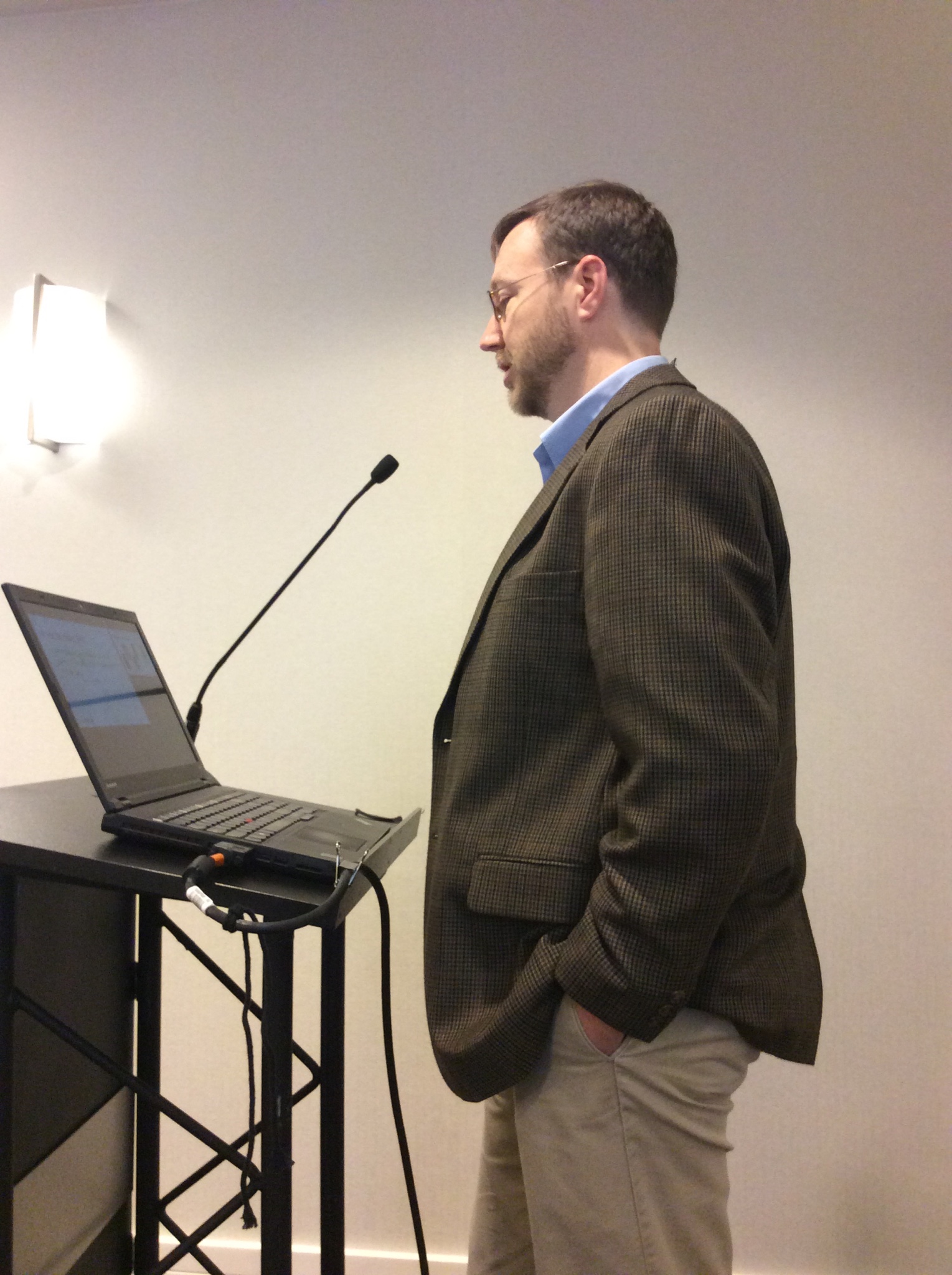
For the last ever Blogger and Online Publication session, we had two papers and a panel lined up. First up was Rick Brannan, who talked about the process of blogging as a stepping stone to producing a book. He invited the audience to take photos and blog and tweet as he spoke, and so I obliged and took a photo as he was presenting. Brannan told the story of how his interest in apocryphal Gospels was rekindled, and noticing that Faithlife/Logos did not have an edition of the Greek texts. He talked all the way through the process, including prior to it going into the blogosphere. Archive.org had many older published editions, but often finding versions of fragments and agrapha proved more difficult. P.Oxy.5072 was what moved the project into the realm of the blogs, since in fact it had been mentioned on the blogs, and Brannan remembered having read about it there. He then tweeted an appeal to anyone who had access to a copy of the relevant published volume, and someone sent him pictures. He then blogged his transcription, for the reason that he wanted feedback on his transcription and translation, knowing that the internet is full of people who are happy to tell you when you are wrong. Blogging and other social media also came into the picture since he had to do his own promotion of the publication. The concluding point of his paper was less “you can blog and get a book out of it” and more the relationships and networking that resulted out of the process. He then ended up contributing to a printed volume that Tony Burke was putting together, and Brannan and Burke were connected via blogs. A pdf of Brannan's paper will be on his site soon.
Christian Brady was up next and said that what he was going to do is perfect for the internet age: talk about himself and his blog. Brady had blogged from around 2003, but the first “official” post on his blog Targuman was in 2006. Initially he thought he wanted to be anonymous. But he realized (as was key when they tracked down Ross Ulbricht) that he would have to tell people about the blog as himself to get people to read it. A combination of ego and honesty also contributed: if he said something worthwhile on his blog, he wanted people to know that he was the one who said it. His first blogged about research on the targumim, posting thoughts about his own work and about articles he had been reading. Because relatively few people work on the targumim, having conversations and getting feedback was great, since work in such areas can leave one feeling isolated. Photography is a passion of his, and so he also blogged his photography. Humor, in particular cartoons, is an area of interest, and blogging has gotten him to know some cartoonists. As many know, his son Mack passed away in 2012, when he was 9 years old, and the community support he received touched him greatly. Brady also mentioned the support that professors whose jobs were threatened received from blogs. Brady ended up blogging about the theology of suffering. When internet troll “theologyarchaeology” (aka David Tee) posted hurtful comments, other people responded. When someone mentioned Emil Brunner, it opened up a whole interesting world. Brady also talked about the apparent different professional and personal personas that scholars may have online. His concluding comments were about the SBL speech policy and said that one of the great things about blogs is that they give everyone a voice, and it is the reader who has to provide intelligence. We can ignore trolls, and don't need our minds to be guarded. In the discussion, there was a question about Facebook, and so there was discussion about the SBL Facebook group, as well as using Facebook to drive traffic to blogs, and having to block his mother on Facebook. Daniel McClellan asked about the advice that is given to students to delete their online presence before looking for jobs. Brady responded by saying that he is involved a leadership institute which brings up students' Facebook pages and talks about them. Someone mentioned that unfocused blogs, with personal as well as professional, are prone to lose followers. Brady uses tags to make it possible for people to follow just certain topics. Brady said that in many respects his blog is his journal. It is great to be able to go back and read about past experiences. The last question from the audience was essentially a compliment on the nice appearance of Brady's blog.
Next was the panel. Bart Ehrman was up first and talked about not having a natural desire to blog, and his model of having paid subscriptions raising money for charity. His aims are to disseminate knowledge to an interested public (he isn't writing for scholars, although some scholars subscribe), and to raise money. The latter is his main goal – if it did not raise money for charity, he wouldn't blog. Each year he has raised tens of thousands of dollars, and this year it has passed $100,000. There have been challenges. He wondered when he first started how long it would take to run out of things to say when posting this often, but it has not happened yet. Now the question is when he will start repeating himself, and after three years he has found himself saying the same things, albeit differently. Since he doesn't remember exactly what he said that long ago, neither do readers. He had to hire a tech person to help him since he is not a techie. While most members are courteous, there are exceptions. If someone keeps flouting the rule to that effect, they will be blocked and their money refunded. Once a week he makes a post which is entirely visible to the public.
Wil Gafney spoke next, and started with the issue of trolls and diversity. Women get rape threats, black bloggers get racist comments and messages. Ignoring trolls and expecting them to go away doesn't work in such cases. Some will mail blog excerpts to board members at the blogger's institution. Originally Gafney blogged anonymously. Gafney mentioned Twitter being where her finely sharpened social activism is articulated. Facebook is more like the home of grandparents, where things are said for family and parishoners. She described the challenge of posting sermons, then getting a book deal on the topic that would incorporate that material, and having to develop two different versions from that point, one for the congregation and one for the book. Gafney also shared her experience of blogging about television and film. She concluded talking about which posts on her blog have received the most traffic.
Larry Schiffman started by talking about the case of Raphael Golb setting up sock puppets and posting in the name of scholars who disagree with his father, including Schiffman. This meant you would find those things if you searched for Schiffman's name, and so he needed to get his actual self online. The website helps publicize his lecturing activity. Most of his blogging is an effort at public education, just as his public lectures and involvement with documentaries and the media. He aims at keeping the blog “religiously neutral” because he wants all readers to feel that the content is for them. It is all academic, with nothing about politics. He uses the blog for things he writes that he doesn't know what else to do with. Schiffman said that there is a “morality of discourse” that we stand for as scholars, which we need to stand for on our blogs just as in the classroom and elsewhere. He also talked about the fact that academic writing earns us very little, and so we would lose very little in the way of royalties if we gave it away for free, but he is still stuck in the older way of doing things. His blog does not allow comments and so in a sense is not really a blog but a dissemination tool. But readers can submit questions, and some of those will be answered on the blog if the person who submitted it gives permission.
We then had time for discussion. One question was about the possibility of Wil Gafney getting a professional publicist to help her in the same way other public figures have done. Publicists can help protect someone and not just help those who do not have attention get it. Another question was about whether blogging by professors helps with university recruitment. Schiffman said he doubts that it helps – but answering e-mails from high school students does. High school students do not tend to read our blogs! Gafney said that it is different with Masters-level students. Potential students may start as the “good kind of stalkers” on Twitter. Brady said that a blog needs to be run by an institution to work well for recruitment. Daniel Gulotta mentioned taking his blog down, and discovering that “hate shrines” by others remain. Ehrman replied that the mythicists are characteristic of the democratization the internet represents – a small minority can be very loud. Another question was about attacks from within one's group rather than outsiders. Schiffman said he thinks it is unwise for graduate students and untenured faculty to get involved in disputations, because online information can influence hires even if not consciously. He advised against responding to what others say about you online, at least when those people do not share our morality concerning discourse. There was a question from someone who had been blocked by Gafney on Twitter, who had questioned her credentials. She replied mentioning the challenge of interpreting what people say on Twitter. Daniel McClellan asked Ehrman about using the blog to clarify points in relation to How Jesus Became God and the response to it. Ehrman had found the response book largely disappointing, but thought that Craig Evans' was particularly good and yet also misrepresented the evidence, and so he blogged a response to get information out about what we know about Roman crucifixion and burial practices. The next question was whether the panelists would have a blog if they were grad students today. Schiffman said no, Ehrman agreed saying that it takes time away from your research, and Gafney concurred, saying that if you are a student somewhere that requires blogging you should avoid controversy. The next question was about time dedicated each week to blogging. Ehrman said he is lucky to write fast and so 1000 words takes him about 20 minutes. He spends about six hours a week on the blog. That is seven work-weeks from his year. Gafney said she is a “rage blogger” and aims to not let a month pass without blogging. Schiffman has his daughter run the blog and sends her material. He also emphasized that blogging has to be the right choice for you, it isn't one size fits all. The next question was about guidance for bloggers. Brady replied that different platforms may suit different blogs. The next question was whether people ever concede a point, change their minds, or apologize. Gafney mentioned having apologized for losing her temper on Twitter. But the other person had wanted to keep fighting. Another question was about whether one can have high quality discourse online. Schiffman said it is hard to do so without face to face interaction, but one needs to live one's ethics online as in person. Defending oneself already puts one in an inappropriate mode.
Don't forget the bloggers' dinner tonight at Meehan's at 5pm!
Society of Biblical Literature
Society of Biblical Literature
Previous Post

November 22, 2015
Gets The Last Word, The Dark Side Does Not
Browse Our Archives
Select a Category 1 Corinthians 1 John 1 Peter 1 Samuel 1 Thessalonians 1 Timothy 2 Corinthians 2 Kings 2 Peter 2 Samuel 2 Thessalonians 2 Timothy academia Acts of the Apostles afterlife Akhaten Alcatraz American Academy of Religion Amos Anglican Arabic Aramaic archaeology art artificial intelligence astronomy atheism atonement Babylon 5 Baptists Battlestar Galactica Bible Biblical Studies Carnival biblioblogging Black Mirror Blade Runner Book of Job book review Buddhism Call for Papers China Christianity Christmas Christology Chronicles Coptic creation Daniel Deuteronomy Doctor Who Dune Easter Ecclesiastes economics education Eldad Keynan Enoch Seminar Ephesians eschatology Esther Evangelicals evolution Exodus Expanse Ezekiel Ezra fantasy Fringe fundamentalism Galatians games Ge'ez genealogy Genesis Gnosticism Gospel of Jesus' Wife Gospel of John Gospel of Judas Gospel of Luke Gospel of Mark Gospel of Matthew Gospel of Peter Gospel of Thomas Greek Harry Potter Hebrew Hebrews Hinduism historical Jesus history Hitchhiker's Guide to the Galaxy Holidays horror Hosea humor incarnation India inerrancy information literacy inspirational Intelligent Design Ireland Isaiah Islam Israel Italy James Jeremiah John the Baptist Jonah Joshua Judaism Jude Judges Judith Lamentations languages Latin Leviticus libraries literature Lord of the Rings LOST Mandaeans Mandaic memes Methodism Micah monotheism morality Mormons movies music mythicism NASSCAL Nehemiah new perspective New Testament news Numbers Orthodox paganism panentheism pantheism Patheos Paul and his letters Pentecostals Philippians Philippians 2:6-11 philosophy physics Planet of the Apes podcast politics Progressive Christianity Protestantism Proverbs Psalms pseudoscience racism religion Revelation Roman Catholicism Romania Romans Ruth scams science science fiction Secret Gospel of Mark Society of Biblical Literature Song of Songs Star Trek Star Wars Stargate Swahili Syriac Taoism technology Terminator The Handmaid's Tale The Hobbit The Matrix theodicy theology theory Timeless Titus tomb Torchwood travel TRON Uncategorized United Kingdom Westworld X-Files young-earth creationism Zechariah
Select a Month November 2026 October 2026 September 2026 August 2026 July 2026 June 2026 May 2026 April 2026 March 2026 February 2026 January 2026 December 2025 November 2025 October 2025 September 2025 July 2025 June 2025 May 2025 April 2025 March 2025 February 2025 January 2025 December 2024 November 2024 October 2024 September 2024 August 2024 July 2024 June 2024 May 2024 April 2024 March 2024 February 2024 January 2024 December 2023 November 2023 October 2023 September 2023 August 2023 July 2023 May 2023 April 2023 March 2023 February 2023 January 2023 December 2022 November 2022 October 2022 September 2022 August 2022 July 2022 June 2022 May 2022 April 2022 March 2022 February 2022 January 2022 December 2021 November 2021 October 2021 September 2021 August 2021 July 2021 June 2021 May 2021 April 2021 March 2021 February 2021 January 2021 December 2020 November 2020 October 2020 September 2020 August 2020 July 2020 June 2020 May 2020 April 2020 March 2020 February 2020 January 2020 December 2019 November 2019 October 2019 September 2019 August 2019 July 2019 June 2019 May 2019 April 2019 March 2019 February 2019 January 2019 December 2018 November 2018 October 2018 September 2018 August 2018 July 2018 June 2018 May 2018 April 2018 March 2018 February 2018 January 2018 December 2017 November 2017 October 2017 September 2017 August 2017 July 2017 June 2017 May 2017 April 2017 March 2017 February 2017 January 2017 December 2016 November 2016 October 2016 September 2016 August 2016 July 2016 June 2016 May 2016 April 2016 March 2016 February 2016 January 2016 December 2015 November 2015 October 2015 September 2015 August 2015 July 2015 June 2015 May 2015 April 2015 March 2015 February 2015 January 2015 December 2014 November 2014 October 2014 September 2014 August 2014 July 2014 June 2014 May 2014 April 2014 March 2014 February 2014 January 2014 December 2013 November 2013 October 2013 September 2013 August 2013 July 2013 June 2013 May 2013 April 2013 March 2013 February 2013 January 2013 December 2012 November 2012 October 2012 September 2012 August 2012 July 2012 June 2012 May 2012 April 2012 March 2012 February 2012 January 2012 December 2011 November 2011 October 2011 September 2011 August 2011 July 2011 June 2011 May 2011 April 2011 March 2011 February 2011 January 2011 December 2010 November 2010 October 2010 September 2010 August 2010 July 2010 June 2010 May 2010 April 2010 March 2010 February 2010 January 2010 December 2009 November 2009 October 2009 September 2009 August 2009 July 2009 June 2009 May 2009 April 2009 March 2009 February 2009 January 2009 December 2008 November 2008 October 2008 September 2008 August 2008 July 2008 June 2008 May 2008 April 2008 March 2008 February 2008 January 2008 December 2007 November 2007 October 2007 September 2007 August 2007 July 2007 June 2007 February 2007 January 2001
Follow Us!
TAKE THE
Religious Wisdom Quiz
Which Old Testament prophet predicted the suffering of the Messiah?
Select your answer to see how you score.
Ezekiel Isaiah Jeremiah Micah
Books by This Author Books by James F. McGrath
Related posts from Religion Prof: The Blog of James F. McGrath
Religion Prof: The Blog of James F. McGrath

Where I'll Be (November 2025 Edition)
Religion Prof: The Blog of James F. McGrath
Paul, Mark, and Revelation Within Judaism (Enoch Seminar)
Religion Prof: The Blog of James F. McGrath

Calls for Papers and Butler University Day of...
Religion Prof: The Blog of James F. McGrath
TRENDING AT PATHEOS Progressive Christian

The Late Francis Frangipane & the Failure Too...
I learned today that another one of my heroes has gone to...

Thomas Paine, the Smiths, the apostles in England,...
I'm pleased to announce that the Becoming Brigham Black Friday Sale,...

CatholicTV Series: Six Black Catholics on Path to...
WATERTOWN, Mass., November 9, 2026 – In recognition of Black Catholic History...

New Advent Journal Invites Catholics to Be Pilgrims
Florissant, MO, November 16, 2026— What if Advent were more than a...

INNER CIRCLE: John's Quantum Gospel
INTRODUCTION In this next Inner Circle series, which I anticipate will...

"Three B's" of My Apologetics Ministry (+ VIDEO)
In early December 2026 (less than a week from the time...
view all Progressive Christian blogs
Ad-Free & Subscriber Log-In Subscription Support
- About Us
- 2026 Calendar
- Videos
- Podcasts
- Library of World Religions
- Faith In Media Tracker
- Advertise With Us
- Write for Us
- Privacy Policy
- Terms of Service
- Do Not Sell My Data
- Contact Us
- Radiant Digital
- Manage Newsletter Subscriptions
- Unsubscribe From Notifications
- Sitemap
Copyright 2008-2026, Patheos, part of the Radiant Digital network of media brands. All rights reserved.
Subscription Support Ad-Free & Subscriber Log-In
Follow Patheos