
BuddhistCatholicContemplativeEvangelicalGeneral ChristianHinduJewishLatter-day SaintMuslimNew VisionsProgressive Christian
Beliefs
- Buddhist
- Catholic
- Contemplative
- Evangelical
- General Christian
- Hindu
- Jewish
- Latter-day Saint
- More Voices
- Muslim
- New Visions
- Pagan
- Progressive Christian
Topics
- Religion News
- Food and Religion
- Sports and Religion
- Religious Art
- Religious Music and Entertainment
- Religious Events
- History and Religion
- Style and Religion
- Politics and Religion
- Women in Religion
- Recreation Outdoors and Religion
- Business Finance and Religion
- Careers Workplace and Religion
- Education and Religion
- Family Parenting and Religion
- Health Fitness and Religion
- Home and Religion
- Relationships and Religion
- Technology and Religion
- Travel and Religion
Columnists
- Buddhist Columnists
- Business Finance and Religion Columnists
- Careers Workplace and Religion Columnists
- Catholic Columnists
- Contemplative Columnists
- Education and Religion Columnists
- Evangelists Columnists
- Family Parenting and Religion Columnists
- General Christian Columnists
- Health Fitness and Religion Columnists
- Hindu Columnists
- History and Religion Columnists
- Home and Religion Columnists
- Jewish Columnists
- More Voices Columnists
- Latter Day Columnists
- Muslim Columnists
- New Visions Columnists
- Nonreligious Columnists
- Pagan Columnists
- Politics and Religion Columnists
- Progressive Columnists
- Recreation Outdoors and Religion Columnists
- Relationships and Religion Columnists
- Religion News Columnists
- Religious Art Columnists
- Religious Events Columnists
- Religious Music and Entertainment Columnists
- Sports and Religion Columnists
- Style and Religion Columnists
- Technology and Religion Columnists
- Travel and Religion Columnists
- Women in Religion Columnists
Resource Library
- 2026 Calendar
- Library of World Religions
- The 100 Most Holy Places on Earth
- Patheos Answers
- Podcasts
- Videos
- Faith Leaders Database
- Anglican Episcopalian
- Bahai
- Baptist
- Buddhism
- Christianity
- Confucianism
- Eastern Orthodoxy
- Hinduism
- Holiness and Pentecostal
- ISKCON
- Islam
- Judaism
- Lutheran
- Methodist
- The Church of Jesus Christ of Latter-day Saints
- New Age
- Paganism
- Presbytarian and Reformed
- Protestantism
- Religion Behind the Scenes
- Roman Catholic
- Scientology
- Shia Islam
- Sikhism
- Sufism
- Sunni Islam
- Taoism
- Zen
- See all religions
Research Tools
 Ad-Free & Subscriber Log-In Subscription Support
Ad-Free & Subscriber Log-In Subscription Support
Follow Patheos 

- Trending:
- Forgiveness
- |
- Marriage
- |
- Consciousness
- |
- Death Penalty
- |
- Election
- |
- Halloween

- Home
- About Dr. James F. McGrath
- Publications
- Blogroll
- Useful Websites
- Connections
- Easy Search Posts Page
- FREE NEWSLETTER
- Home
- Progressive Christian
- Review of God and the Gay Christian
Review of God and the Gay Christian
Last updated on: May 10, 2014 at 8:18 am by James F. McGrath
Review of God and the Gay Christian 2014-05-10T08:18:12-04:00 James F. McGrath
Patheos Explore the world's faith through different perspectives on religion and spirituality! Patheos has the views of the prevalent religions and spiritualities of the world.
I’m happy to be part of the Patheos Book Club about Matthew Vines’ book, God and the Gay Christian: The Biblical Case in Support of Same-Sex Relationships
Patheos will be hosting a live chat with the author on May 14 at noon EST, with other guests to include Rachel Held Evans and Tony Jones.
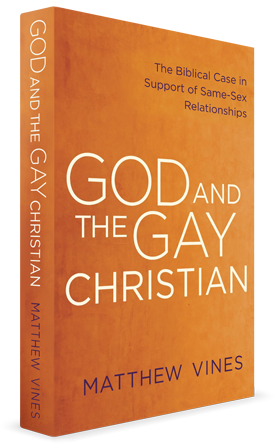 This book is absolute dynamite. It is quite possibly the most important book I have encountered on this subject. A lot has been written, but most of it has either been too technical, or has simply taken a negative view of same-sex relations that would only be found convincing by those already predisposed to accept that view, or has presupposed a liberal approach to the Bible which might be well and good for me, but is never going to connect with, much less convince, conservative Christians.
That is why Vines’ book is so important. It is written by a conservative Christian who is gay. It accepts the authority of Scripture. And it makes a convincing case within that framework that what the Bible says does not provide a basis for disapproving of same-sex marriage. Although Vines is not a scholar, by drawing on scholarship and carefully investigating the subject, he comes up with interpretations of the relevant Biblical texts, against the backdrop of their cultural setting, that are thoroughly persuasive.
It is a remarkable achievement. I can well imagine that a century from now, people may look back to this book as the one that decisively turned the tide regarding conservative Christians views on homosexuality.
The first chapter introduces the book, offering some autobiography while also tackling the question of whether it is appropriate to allow one’s experience to impact the way that one thinks about the teaching of Scripture. Vines points out that the Bible itself asks people to look at the fruit that is produced by people and by teachings. An overview is offered of the arguments to be explored in the rest of the book.
The second chapter starts with Galileo and how new information requires us at times to let go of earlier interpretations of Scripture. A similar paradigm shift is of course occuring in our time, with lots of new information about same-sex attraction. But there is other relevant data, and much of this chapter is devoted to exploring the evidence about what ancient people, especially in Biblical times, thought about same-sex intercourse. It turns out that there is no discussion whatsoever in ancient literature of people who have an exclusive attraction to people of the same gender or the opposite gender. For most men in the Greco-Roman world, sex with other men was not an alternative to sex with women, but something which was pursued, in the eyes of critics, because of the insatiability of their lusts, seeking novel pleasures. The main criticisms of same-sex relations were when two people of the same age and social status engaged in them, since, because of the preevailing patriarchal values, it was felt to be demeaning for a male to take the passive role appropriate to inferior females. The implications of the survey of primary texts as well as scholars is that “There are no Christians today who hold truly traditional views on homosexuality” (p.33).
Chapter 3 focuses on celibacy, noting that there is no suggestion anywhere in the Bible that people may have natural attraction to people of the same gender and that they are called to celibacy. The Biblical and later the mainstream church’s stance is consistently that some people are called to celibacy, and that it is perilous for those who are not so called to try to be celibate.
Chapter 4 looks at the meaning of the story of Sodom and Gomorrah, noting that the attempted same-sex act in the story was gang rape, which is wrong regardless of whether the victim is male or female, as Judges 19 shows. The history of interpretation is surveyed, tracing when and why same-sex intercourse becomes part of the picture. In light of the considerations earlier in the book, it is noted that, even when the focus does shift away from hospitality to same-sex lust, the point of view expressed is still not that of modern non-affirming Christians.
Chapter 5 looks at the abominations of Leviticus, seeking to go deeper than either the one side that says “homosexuality is an abomination” and the other that says “so is shellfish” (p.80). The chapter shows that not all rules about sexuality found in Leviticus carried over into Christianity, and thus Leviticus cannot be cited simplistically on the matter. The chapter then turns to the deeply misogynistic culture of the ancient world, noting the following about what ancient authors do and do not say about men and women and sex: “They don’t talk about the design of male and female bodies – there is no mention of anatomical complementarity. Instead, they base their rejection of same-sex relations on a different belief: Because women are inferior to men, it is degrading for a man to be treated like a woman” (p.91). And again, “the entire question of how bodies fit together doesn’t seem to be on the radar. The concern we see instead is centered around the proper ordering of roles in a patriarchal society” (p.93). Hence the main foundation of modern conservative Christian opposition to same-sex relations, namely anatomical compatibility, isn’t even mentioned, much less a central focus, in the Bible or other ancient texts on the topic.
Chapter 6 deals with what Paul says in Romans, saying “There is no question that Romans 1:26-is the most significant biblical passages in this debate” (p.98). A key point is that, just as with any other instructions encountered in the New Testament, we need to ask why Paul wrote what he did, so that we can understand the underlying principle and its application, and then seek how to relate that to our current context. Vines concludes that Paul was not speaking about “homosexuality” in the sense that we use that term today: “The context in which Paul discussed same-sex relations differs so much from our own that it cannot reasonably be called the same issue” (p.109). For Paul, the issue was not the appropriateness of people with an innate attraction for the same sex entering into a lifelong covenant of marriage, but what he like many of his contemporaries viewed as excessive lust expressing itself in seeking sex with men in addition to with women. A helpful treatment of the difference between what “nature” and “unnatural” meant in Paul’s time and what it means in ours is provided.
Chapter 7 tackles the words malakoi and arsenokoitai. A survey of past translations highlights that it is only recently that the former was connected with same-sex intercourse. It has to do with being “effeminate,” and in the ancient viewpoint of Paul’s time, that meant being weak and not keeping your passions under control – so that what might seem to some today to be odd, an effeminate womanizer, was a commonplace in ancient literature (p.123). The two words are never used as a pair to indicate those who engaged in same-sex relations (while other terms did have those connotations – see p.129). And the context in which arsenokoitai appears in vice lists suggests that it had not only or primarily a sexual connotation, but one that also involved economic exploitation.
Chapter 8 then moves from showing that these texts are not about committed same-sex marriages in our context, to making a positive case for same-sex marriage from the Bible. A key question is asked: “Can we translate basic biblical principles about marriage to this new situation without losing something essential in the process?” (p.139). In the story in Genesis 2, the joy of finding a life partner is articulated not in terms of difference, such as different sexual organs or other notions of “gender complementarity,” but in terms of sameness – here now I’ve found one who is flesh of my flesh and bone of my bone!
Chapter 9 is about the image of God, and highlights the fact that, since same-sex attraction is part of who a person is, teaching someone to hate this may be teaching them to hate themselves. Vines writes (p.163):
Yes, plenty of Christian teachings are hard for us to live out. But no other teaching that Christians widely continue to embrace has caused anything like the torment, destruction, and alienation from God that our rejection of same-sex relationships has caused. When we tell people that their every desire for intimate, sexual bonding is shameful and disordered, we encourage them to hate a core part of who they are. And when we reject the desire of gay Christians to express their sexuality within a lifelong covenant, we separate them from our covenantal God, and we tarnish their ability to bear his image.
He adds (p.166):
Instead of making gay Christians more like God, as turning from genuine sin would do, embracing a non-affirming position makes them less like God. In the final analysis, it is not gay Christians who are sinning against God by entering into monogamous, loving relationships. It is we who are sinning against them by rejecting their intimate relationships.
Vines pulls no punches.
In chapter 10, the final chapter of the book, Vines calls readers to act, to turn our response to the arguments in the book into concrete practice, whether by getting involved in a new reformation, or merely learning to accept gay Christians who have sincerely reached a different conviction than you based on Scripture.
My own support for same-sex marriage was closely connected with my “coming out” as a liberal Christian. I saw clearly for the first time the harm caused by the negative view of gays and lesbians among many Christians and Christianists. I was already a liberal, but a rather timid one, rarely outspoken. Seeing the harm that the form of Christianity I once espoused was having on people in general, and one colleague in particular, made me decide to speak out. Vines tells the story of Christians more conservative than myself who had a similar experience, and who even had their views changes by it. One example he offers is Jim Brownson, a seminar professor who found that his assumptions and answers did not work when he sought to apply them when his own son came out as gay.
Vines’ book is full of sound contextual exegesis. None of it bothered me or seemed dubious to me from my perspective as a liberal, but none of it is a liberal interpretation or based on a liberal view of the Bible.
That is what makes this book dynamite. And that is what makes this book seem so dangerous to those who want to defend the conservative Christian status quo.
I highly recommend Vines’ book. When you read it, I’ll be interested to hear your thoughts on it. Whether you agree with his conclusions or not, I am persuaded that no one can read this book and not come to think that same-sex marriage is a subject about which conservative Christians can disagree without needing to anathematize or break fellowship with those who have different views. Vines shows that you can support same-sex marriage without abandoning your high view of Scripture.
And so I recommend buying at least two copies. Keep one for yourself, and pass the second one on to a conservative Christian you know who thinks that the Bible simply condemns same-sex relations. I expect that it will lead to fruitful conversations. And I anticipate the same thing happening throughout the church.
I can hardly wait to see the impact this book has.
For more, click through to the book website to read a sample, and/or watch the video below, courtesy of Convergent Books.

Previous Post

May 9, 2014
Evening Prayer
Next Post
May 10, 2014 Ancient Greek OCR
Browse Our Archives
Select a Category 1 Corinthians 1 John 1 Peter 1 Samuel 1 Thessalonians 1 Timothy 2 Corinthians 2 Kings 2 Peter 2 Samuel 2 Thessalonians 2 Timothy academia Acts of the Apostles afterlife Akhaten Alcatraz American Academy of Religion Amos Anglican Arabic Aramaic archaeology art artificial intelligence astronomy atheism atonement Babylon 5 Baptists Battlestar Galactica Bible Biblical Studies Carnival biblioblogging Black Mirror Blade Runner Book of Job book review Buddhism Call for Papers China Christianity Christmas Christology Chronicles Coptic creation Daniel Deuteronomy Doctor Who Dune Easter Ecclesiastes economics education Eldad Keynan Enoch Seminar Ephesians eschatology Esther Evangelicals evolution Exodus Expanse Ezekiel Ezra fantasy Fringe fundamentalism Galatians games Ge'ez genealogy Genesis Gnosticism Gospel of Jesus' Wife Gospel of John Gospel of Judas Gospel of Luke Gospel of Mark Gospel of Matthew Gospel of Peter Gospel of Thomas Greek Harry Potter Hebrew Hebrews Hinduism historical Jesus history Hitchhiker's Guide to the Galaxy Holidays horror Hosea humor incarnation India inerrancy information literacy inspirational Intelligent Design Ireland Isaiah Islam Israel Italy James Jeremiah John the Baptist Jonah Joshua Judaism Jude Judges Judith Lamentations languages Latin Leviticus libraries literature Lord of the Rings LOST Mandaeans Mandaic memes Methodism Micah monotheism morality Mormons movies music mythicism NASSCAL Nehemiah new perspective New Testament news Numbers Orthodox paganism panentheism pantheism Patheos Paul and his letters Pentecostals Philippians Philippians 2:6-11 philosophy physics Planet of the Apes podcast politics Progressive Christianity Protestantism Proverbs Psalms pseudoscience racism religion Revelation Roman Catholicism Romania Romans Ruth scams science science fiction Secret Gospel of Mark Society of Biblical Literature Song of Songs Star Trek Star Wars Stargate Swahili Syriac Taoism technology Terminator The Handmaid's Tale The Hobbit The Matrix theodicy theology theory Timeless Titus tomb Torchwood travel TRON Uncategorized United Kingdom Westworld X-Files young-earth creationism Zechariah
Select a Month October 2026 September 2026 August 2026 July 2026 June 2026 May 2026 April 2026 March 2026 February 2026 January 2026 December 2025 November 2025 October 2025 September 2025 July 2025 June 2025 May 2025 April 2025 March 2025 February 2025 January 2025 December 2024 November 2024 October 2024 September 2024 August 2024 July 2024 June 2024 May 2024 April 2024 March 2024 February 2024 January 2024 December 2023 November 2023 October 2023 September 2023 August 2023 July 2023 May 2023 April 2023 March 2023 February 2023 January 2023 December 2022 November 2022 October 2022 September 2022 August 2022 July 2022 June 2022 May 2022 April 2022 March 2022 February 2022 January 2022 December 2021 November 2021 October 2021 September 2021 August 2021 July 2021 June 2021 May 2021 April 2021 March 2021 February 2021 January 2021 December 2020 November 2020 October 2020 September 2020 August 2020 July 2020 June 2020 May 2020 April 2020 March 2020 February 2020 January 2020 December 2019 November 2019 October 2019 September 2019 August 2019 July 2019 June 2019 May 2019 April 2019 March 2019 February 2019 January 2019 December 2018 November 2018 October 2018 September 2018 August 2018 July 2018 June 2018 May 2018 April 2018 March 2018 February 2018 January 2018 December 2017 November 2017 October 2017 September 2017 August 2017 July 2017 June 2017 May 2017 April 2017 March 2017 February 2017 January 2017 December 2016 November 2016 October 2016 September 2016 August 2016 July 2016 June 2016 May 2016 April 2016 March 2016 February 2016 January 2016 December 2015 November 2015 October 2015 September 2015 August 2015 July 2015 June 2015 May 2015 April 2015 March 2015 February 2015 January 2015 December 2014 November 2014 October 2014 September 2014 August 2014 July 2014 June 2014 May 2014 April 2014 March 2014 February 2014 January 2014 December 2013 November 2013 October 2013 September 2013 August 2013 July 2013 June 2013 May 2013 April 2013 March 2013 February 2013 January 2013 December 2012 November 2012 October 2012 September 2012 August 2012 July 2012 June 2012 May 2012 April 2012 March 2012 February 2012 January 2012 December 2011 November 2011 October 2011 September 2011 August 2011 July 2011 June 2011 May 2011 April 2011 March 2011 February 2011 January 2011 December 2010 November 2010 October 2010 September 2010 August 2010 July 2010 June 2010 May 2010 April 2010 March 2010 February 2010 January 2010 December 2009 November 2009 October 2009 September 2009 August 2009 July 2009 June 2009 May 2009 April 2009 March 2009 February 2009 January 2009 December 2008 November 2008 October 2008 September 2008 August 2008 July 2008 June 2008 May 2008 April 2008 March 2008 February 2008 January 2008 December 2007 November 2007 October 2007 September 2007 August 2007 July 2007 June 2007 February 2007 January 2001
Follow Us!
TAKE THE
Religious Wisdom Quiz
Who was called out of Ur to go to a land God would show him?
Select your answer to see how you score.
Jacob Isaac Moses Abraham
Books by This Author Books by James F. McGrath
Related posts from Religion Prof: The Blog of James F. McGrath

Religion Prof: The Blog of James F. McGrath

Unscriptural Doctrines of Scripture
Religion Prof: The Blog of James F. McGrath

Religion Prof: The Blog of James F. McGrath

Neither Conservative Nor Christian
Religion Prof: The Blog of James F. McGrath
TRENDING AT PATHEOS Progressive Christian

In "Irreplaceable," our book on vocation and technology, Trevor Sutton and I...

I was strolling through the top floor of the brand new Parthenon...

What Does Gêvâh Mean For Kimberley Guifoyle &...
This week, a lot of the news is focused on Kimberly Guilfoyle....

INNER CIRCLE: Profound Mystery (Of Christ In All...
Ephesians 5:31-32 “For this reason, a man will leave his father and...

Do Not Rejoice When Your Enemy Falls: The...
Turning an execution into a public spectacle is a disturbing expression of...

'The Chosen' S6 Trailer: The Passion Gets Very...
Not many watching 'The Chosen' worry about spoilers, but just because they...
view all Progressive Christian blogs
Ad-Free & Subscriber Log-In Subscription Support
- About Us
- 2026 Calendar
- Videos
- Podcasts
- Library of World Religions
- Faith In Media Tracker
- Advertise With Us
- Write for Us
- Privacy Policy
- Terms of Service
- Do Not Sell My Data
- Contact Us
- Radiant Digital
- Manage Newsletter Subscriptions
- Unsubscribe From Notifications
- Sitemap
Copyright 2008-2026, Patheos. All rights reserved.
Subscription Support Ad-Free & Subscriber Log-In
Follow Patheos