
BuddhistCatholicContemplativeEvangelicalGeneral ChristianHinduJewishLatter-day SaintMuslimNew VisionsProgressive Christian
Beliefs
- Buddhist
- Catholic
- Contemplative
- Evangelical
- General Christian
- Hindu
- Jewish
- Latter-day Saint
- More Voices
- Muslim
- New Visions
- Pagan
- Progressive Christian
Topics
- Religion News
- Food and Religion
- Sports and Religion
- Religious Art
- Religious Music and Entertainment
- Religious Events
- History and Religion
- Style and Religion
- Politics and Religion
- Women in Religion
- Recreation Outdoors and Religion
- Business Finance and Religion
- Careers Workplace and Religion
- Education and Religion
- Family Parenting and Religion
- Health Fitness and Religion
- Home and Religion
- Relationships and Religion
- Technology and Religion
- Travel and Religion
Columnists
- Buddhist Columnists
- Business Finance and Religion Columnists
- Careers Workplace and Religion Columnists
- Catholic Columnists
- Contemplative Columnists
- Education and Religion Columnists
- Evangelists Columnists
- Family Parenting and Religion Columnists
- General Christian Columnists
- Health Fitness and Religion Columnists
- Hindu Columnists
- History and Religion Columnists
- Home and Religion Columnists
- Jewish Columnists
- More Voices Columnists
- Latter Day Columnists
- Muslim Columnists
- New Visions Columnists
- Nonreligious Columnists
- Pagan Columnists
- Politics and Religion Columnists
- Progressive Columnists
- Recreation Outdoors and Religion Columnists
- Relationships and Religion Columnists
- Religion News Columnists
- Religious Art Columnists
- Religious Events Columnists
- Religious Music and Entertainment Columnists
- Sports and Religion Columnists
- Style and Religion Columnists
- Technology and Religion Columnists
- Travel and Religion Columnists
- Women in Religion Columnists
Resource Library
- 2026 Calendar
- Library of World Religions
- The 100 Most Holy Places on Earth
- Patheos Answers
- Podcasts
- Videos
- Faith Leaders Database
- Anglican Episcopalian
- Bahai
- Baptist
- Buddhism
- Christianity
- Confucianism
- Eastern Orthodoxy
- Hinduism
- Holiness and Pentecostal
- ISKCON
- Islam
- Judaism
- Lutheran
- Methodist
- The Church of Jesus Christ of Latter-day Saints
- New Age
- Paganism
- Presbytarian and Reformed
- Protestantism
- Religion Behind the Scenes
- Roman Catholic
- Scientology
- Shia Islam
- Sikhism
- Sufism
- Sunni Islam
- Taoism
- Zen
- See all religions
Research Tools
 Ad-Free & Subscriber Log-In Subscription Support
Ad-Free & Subscriber Log-In Subscription Support
Follow Patheos 

- Trending:
- Forgiveness
- |
- Marriage
- |
- Consciousness
- |
- Death Penalty
- |
- Election
- |
- Halloween

- Home
- About Dr. James F. McGrath
- Publications
- Blogroll
- Useful Websites
- Connections
- Easy Search Posts Page
- FREE NEWSLETTER
- Home
- Progressive Christian
- Logos Jesus Studies Collection
Logos Jesus Studies Collection
Last updated on: February 7, 2014 at 2:25 pm by James F. McGrath
Logos Jesus Studies Collection 2014-02-07T14:25:31-05:00 James F. McGrath
Patheos Explore the world's faith through different perspectives on religion and spirituality! Patheos has the views of the prevalent religions and spiritualities of the world.
I have been overdue for some time to blog about the Logos Jesus Studies Collection, a set of books which converge on the figure of Jesus from different angles. The volumes are important ones, their contents fascinating and useful to scholar and interested general reader alike. This is truly a wonderful set of resources.
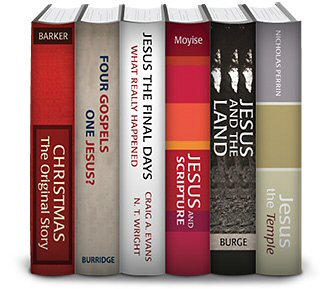
Richard Burridge’s book Four Gospels, One Jesus? explores some of the topics that Burridge is best known for writing about, in a manner that is accessible to a general audience. Despite the promise of a “symbolic” reading in the book’s subtitle, the book actually gives all the major details one might hope for in an introduction to the scholarly study of the Gospels, such as form, redaction, and literary criticism, and the Synoptic problem. The question of the Gospels’ genre is given significant focus, and illustrations from teaching and the spotting of cheating or plagiarism help turn what can often seem like arcane scholarly concerns into something clear and interesting for any reader.
Symbolism comes to the fore after the introductory matters are covered, as Burridge uses the traditional animal used to symbolize each Gospel and its author, as a way of drawing together major themes. John’s eagle leads to mentions of the lunar lander and the Lord of the Rings! Burridge concludes by relating the Gospels to the historical Jesus and to contemporary Christology.
References to the New Testament in this and other books are interactive, and bring up the relevant passage in Greek, with the option of going to the fuller text. This is but one of many advantages of reading a book like this through the Logos platform rather than in traditional print form.
Jesus, The Final Days by Craig Evans and N. T. Wright is based on lectures these two scholars gave. Not aimed primarily at NT scholars, the volume is nonetheless full of a wealth of detail and interaction with primary as well as secondary sources, including Targums, Rabbinic texts, Josephus, the Dead Sea Scrolls, and the Psalms of Solomon, to name a few. Greco-Roman sources and archaeological evidence are also treated. An interesting suggestion is made regarding the popularity of ossuaries in the time of Jesus. An excellent explanation is offered of the importance of burial in Judaism, and why Jesus is likely to have been buried.
Norman Perrin’s Jesus the Temple is a study of New Testament sources, but one that is driven by a contemporary faith concern. The focus of the book is summarized on p.12: “In this book, I wish to argue that Jesus of Nazareth saw himself and his movement as nothing less than the decisive embodiment of Yahweh’s eschatological temple.” As Perrin explains in the introduction, he focuses on the possibility that Jesus thought of himself as taking the place of the temple, because this provides a potential opportunity for Jesus to transcend and encompass history. This seems to me to be a problematic starting point for historical investigation. Nonetheless, our starting points and presuppositions as scholars and readers are never out of the picture, and so this open statement of Perrin’s aim is to be appreciated. The volume begins with Jewish works and movements which were critical of the temple – the Psalms of Solomon, Dead Sea Scrolls, and John the Baptist and his followers, in particular. The image of the church as “counter-temple” is explored, as is Jesus’ temple action. Perrin makes a plausible case for the authenticity of material he discusses, such as on p.106 where he writes:
Had this phrase been the by-product of some clever early believers putting words into Jesus’ mouth, one wonders why they were not also clever enough to have Jesus predict the time of his own arrival more accurately. Exhibiting anything but ecclesial theologizing, the tag ‘after three days’ probably pre-dates Paul, certainly pre-dates Mark, and by all means shows the stamp of the most primitive tradition.
Perrin makes a number of interesting connections, including between the notion of having a “treasure room in heaven” and the temple treasury. The study makes connections between specific imagery in Jesus’ parables, the practice of exorcism, meals, and his ethic of nonviolence. Perrin explicitly states that the proposal is offered provisionally. It certainly offers a means of connecting Jesus centrally to NT theology. I fully expect Perrin’s proposal to stimulate scholarly discussion in lots of interesting and exciting ways.
In Jesus and the Land, Gary Burge offers a survey of the theme of land and territory in the New Testament. It highlights both what the texts do say, and what they do not say – the latter often represents a marked contrast to what one would expect if the authors of these texts had embraced traditional Jewish territorial emphases and expectations. Burge concludes with an evaluation of today’s so-called “Christian Zionism” in light of the New Testament. This volume needs to be widely read by those who use the New Testament to justify their stance regarding the modern state of Israel and the Palestinians, as there are views which are held as though they are “what the Bible says,” but which are in fact diametrically opposed to the teachings and emphases of the early Christian writings.
Margaret Barker’s book Christmas, the Original Story is interesting not only because of Barker’s very distinctive interpretation of early Christology, but also because she reads the New Testament infancy stories in conversation with Islam. And so the book is of interest not only for those engaged in the study of the Gospels, but also for those engaged in contemporary inter-religious dialogue.
In the book, the Temple structure and its symbolism is given much attention. Barker ultimately sees the New Testament and other depictions of Jesus as rooted in ancient Israelite traditions about the king and about a second divine figure, as Barker has explored in past books. Here is an example:
The words of Gabriel are the key to the original story of the birth of Jesus. What did it mean to be ‘Son of the Highest’, that is, to be Yahweh the Lord? The context is the royal rituals of the old temple, when the new king was enthroned and became the human presence of the Lord. Since the first Christians knew that the Lord was the Son of God Most High, and that God Most High had allotted Jacob to him as his special people, this is how we should understand Gabriel’s message. The child, like the ancient kings, would be given the Name (Yahweh the Lord), and established as his presence and his king on earth. The two stages of sonship, the two births, are assumed here, not explained: the relationship within the divine—the Most High and the Son, the eternal generation of the Son; and then the relationship of the divine and the human—the Son and his earthly manifestation, the Virgin birth and the incarnation.
While those who find Barker’s particular Christological views unpersuasive are unlikely to have their minds changed by this volume, her attention to detail, interaction with other ancient sources such as the Qumran texts, and exploration of matters of contemporary relevant that are not often treated in Biblical scholarship makes this volume an important and interesting one nonetheless.
Finally, Steve Moyise’s Jesus and Scripture looks at how Jesus interpreted and used Scripture, a subject that is all too often neglected – in particular by those who self-identify as followers of Jesus and who consider Scripture important! That Jesus often gave one text priority over another, or used one text to essentially overrule and nullify another (as in the case of his prohibition of divorce), is brought to the fore. Jesus’ use of Scripture is compared to that of other ancient Jews. Text boxes address aspects of New Testament scholarship that can normally be taken for granted by scholars but may not be familiar to a general audience – such as the question of the Q source, or the criteria used in evaluating the historicity of material in the Gospels. After chapters examining the Gospels, a survey of scholars’ views is offered, categorized as “minimalist,” “moderate,” and “maximalist” in terms of how much material they deem historical, and with what degree of confidence. Moyise helpfully highlights that the differences between these stances are not just about religious commitments (although that is part of the picture in many cases) but also about historical judgments. A useful appendix lists all the instances of Jesus purportedly citing Scripture, and as was mentioned previously, each reference can be clicked to bring up a pop-up box with the New Testament text in Greek or the Hebrew Bible in English.
Each of these volumes is an important contribution to some aspect of the study of Jesus, and taken together, they represent an important cross-section of recent New Testament scholarship. The matter of the historical Jesus is perhaps given the most attention, but contemporary Christology, literary considerations, ancient Judaism, and inter-religious dialogue are brought into conversation with the standard elements of academic study. Most of the volumes provide an introduction to an important aspect of the academic study of Jesus, as well as the author’s distinctive perspective and insights. The ability to conveniently carry the books with me, and cross-reference the Biblical texts at the tap of a finger, is an added plus. I highly recommend the Logos Jesus Studies Collection to any and all who are interested in Jesus and/or the New Testament, and I am very grateful to Logos for having provided me with a review copy so that I could dive into these important scholarly volumes!
NOTE: When I first published this, I mentioned that I had occasionally experienced issues with accessing the resources when I was without a wi-fi connection. While I have sometimes found this to be true even with the SBL Greek New Testament, which I know I have downloaded to my device, the other books I seem to have neglected to download and so it was presumably my own error on this occasion. When taking your iPad with you on a long train or plane journey to be able to read, don’t forget to download the books to your device so that you can access them even without the internet!
Previous Post

February 7, 2014
Before and After A Polite Bribe
Next Post
February 7, 2014 Cain and Abel according to Young-Earth Creationism
Browse Our Archives
Select a Category 1 Corinthians 1 John 1 Peter 1 Samuel 1 Thessalonians 1 Timothy 2 Corinthians 2 Kings 2 Peter 2 Samuel 2 Thessalonians 2 Timothy academia Acts of the Apostles afterlife Akhaten Alcatraz American Academy of Religion Amos Anglican Arabic Aramaic archaeology art artificial intelligence astronomy atheism atonement Babylon 5 Baptists Battlestar Galactica Bible Biblical Studies Carnival biblioblogging Black Mirror Blade Runner Book of Job book review Buddhism Call for Papers China Christianity Christmas Christology Chronicles Coptic creation Daniel Deuteronomy Doctor Who Dune Easter Ecclesiastes economics education Eldad Keynan Enoch Seminar Ephesians eschatology Esther Evangelicals evolution Exodus Expanse Ezekiel Ezra fantasy Fringe fundamentalism Galatians games Ge'ez genealogy Genesis Gnosticism Gospel of Jesus' Wife Gospel of John Gospel of Judas Gospel of Luke Gospel of Mark Gospel of Matthew Gospel of Peter Gospel of Thomas Greek Harry Potter Hebrew Hebrews Hinduism historical Jesus history Hitchhiker's Guide to the Galaxy Holidays horror Hosea humor incarnation India inerrancy information literacy inspirational Intelligent Design Ireland Isaiah Islam Israel Italy James Jeremiah John the Baptist Jonah Joshua Judaism Jude Judges Judith Lamentations languages Latin Leviticus libraries literature Lord of the Rings LOST Mandaeans Mandaic memes Methodism Micah monotheism morality Mormons movies music mythicism NASSCAL Nehemiah new perspective New Testament news Numbers Orthodox paganism panentheism pantheism Patheos Paul and his letters Pentecostals Philippians Philippians 2:6-11 philosophy physics Planet of the Apes podcast politics Progressive Christianity Protestantism Proverbs Psalms pseudoscience racism religion Revelation Roman Catholicism Romania Romans Ruth scams science science fiction Secret Gospel of Mark Society of Biblical Literature Song of Songs Star Trek Star Wars Stargate Swahili Syriac Taoism technology Terminator The Handmaid's Tale The Hobbit The Matrix theodicy theology theory Timeless Titus tomb Torchwood travel TRON Uncategorized United Kingdom Westworld X-Files young-earth creationism Zechariah
Select a Month October 2026 September 2026 August 2026 July 2026 June 2026 May 2026 April 2026 March 2026 February 2026 January 2026 December 2025 November 2025 October 2025 September 2025 July 2025 June 2025 May 2025 April 2025 March 2025 February 2025 January 2025 December 2024 November 2024 October 2024 September 2024 August 2024 July 2024 June 2024 May 2024 April 2024 March 2024 February 2024 January 2024 December 2023 November 2023 October 2023 September 2023 August 2023 July 2023 May 2023 April 2023 March 2023 February 2023 January 2023 December 2022 November 2022 October 2022 September 2022 August 2022 July 2022 June 2022 May 2022 April 2022 March 2022 February 2022 January 2022 December 2021 November 2021 October 2021 September 2021 August 2021 July 2021 June 2021 May 2021 April 2021 March 2021 February 2021 January 2021 December 2020 November 2020 October 2020 September 2020 August 2020 July 2020 June 2020 May 2020 April 2020 March 2020 February 2020 January 2020 December 2019 November 2019 October 2019 September 2019 August 2019 July 2019 June 2019 May 2019 April 2019 March 2019 February 2019 January 2019 December 2018 November 2018 October 2018 September 2018 August 2018 July 2018 June 2018 May 2018 April 2018 March 2018 February 2018 January 2018 December 2017 November 2017 October 2017 September 2017 August 2017 July 2017 June 2017 May 2017 April 2017 March 2017 February 2017 January 2017 December 2016 November 2016 October 2016 September 2016 August 2016 July 2016 June 2016 May 2016 April 2016 March 2016 February 2016 January 2016 December 2015 November 2015 October 2015 September 2015 August 2015 July 2015 June 2015 May 2015 April 2015 March 2015 February 2015 January 2015 December 2014 November 2014 October 2014 September 2014 August 2014 July 2014 June 2014 May 2014 April 2014 March 2014 February 2014 January 2014 December 2013 November 2013 October 2013 September 2013 August 2013 July 2013 June 2013 May 2013 April 2013 March 2013 February 2013 January 2013 December 2012 November 2012 October 2012 September 2012 August 2012 July 2012 June 2012 May 2012 April 2012 March 2012 February 2012 January 2012 December 2011 November 2011 October 2011 September 2011 August 2011 July 2011 June 2011 May 2011 April 2011 March 2011 February 2011 January 2011 December 2010 November 2010 October 2010 September 2010 August 2010 July 2010 June 2010 May 2010 April 2010 March 2010 February 2010 January 2010 December 2009 November 2009 October 2009 September 2009 August 2009 July 2009 June 2009 May 2009 April 2009 March 2009 February 2009 January 2009 December 2008 November 2008 October 2008 September 2008 August 2008 July 2008 June 2008 May 2008 April 2008 March 2008 February 2008 January 2008 December 2007 November 2007 October 2007 September 2007 August 2007 July 2007 June 2007 February 2007 January 2001
Follow Us!
TAKE THE
Religious Wisdom Quiz
How many verses are in the shortest chapter in the Bible?
Select your answer to see how you score.
7 5 2 10
Books by This Author Books by James F. McGrath
Related posts from Religion Prof: The Blog of James F. McGrath

Religion Prof: The Blog of James F. McGrath

The Obsolete Paradigm of a Purely Mythical Jesus
Religion Prof: The Blog of James F. McGrath

Reviews of Beyond Deconstruction (and an Easter Excerpt)
Religion Prof: The Blog of James F. McGrath
Religion Prof: The Blog of James F. McGrath
TRENDING AT PATHEOS Progressive Christian

The First Eucharistic Controversy: Christ’s Real Presence
For Catholics, the Eucharist is the source and summit of the Christian...

What a Stop Sign Can Teach Us About...
How to Make a Decision When You Can't Hear God Main point:...

Archdiocese Hosts Military Marriage Retreat in Germany
RASTATT, Germany — The transient military lifestyle, with its frequent deployments and...

Nearly every morning, I make the drive to Detroit with my high-school-age...

The Real AI Story Is Adoption Without Trust
Artificial intelligence has crossed a political threshold. It is no longer a...

A new article, written by Jeff Lindsay and Gale L. Pooley,...
view all Progressive Christian blogs
Ad-Free & Subscriber Log-In Subscription Support
- About Us
- 2026 Calendar
- Videos
- Podcasts
- Library of World Religions
- Faith In Media Tracker
- Advertise With Us
- Write for Us
- Privacy Policy
- Terms of Service
- Do Not Sell My Data
- Contact Us
- Radiant Digital
- Manage Newsletter Subscriptions
- Unsubscribe From Notifications
- Sitemap
Copyright 2008-2026, Patheos. All rights reserved.
Subscription Support Ad-Free & Subscriber Log-In
Follow Patheos