
BuddhistCatholicContemplativeEvangelicalGeneral ChristianHinduJewishLatter-day SaintMuslimNew VisionsProgressive Christian
Beliefs
- Buddhist
- Catholic
- Contemplative
- Evangelical
- General Christian
- Hindu
- Jewish
- Latter-day Saint
- More Voices
- Muslim
- New Visions
- Pagan
- Progressive Christian
Topics
- Religion News
- Food and Religion
- Sports and Religion
- Religious Art
- Religious Music and Entertainment
- Religious Events
- History and Religion
- Style and Religion
- Politics and Religion
- Women in Religion
- Recreation Outdoors and Religion
- Business Finance and Religion
- Careers Workplace and Religion
- Education and Religion
- Family Parenting and Religion
- Health Fitness and Religion
- Home and Religion
- Relationships and Religion
- Technology and Religion
- Travel and Religion
Columnists
- Buddhist Columnists
- Business Finance and Religion Columnists
- Careers Workplace and Religion Columnists
- Catholic Columnists
- Contemplative Columnists
- Education and Religion Columnists
- Evangelists Columnists
- Family Parenting and Religion Columnists
- General Christian Columnists
- Health Fitness and Religion Columnists
- Hindu Columnists
- History and Religion Columnists
- Home and Religion Columnists
- Jewish Columnists
- More Voices Columnists
- Latter Day Columnists
- Muslim Columnists
- New Visions Columnists
- Nonreligious Columnists
- Pagan Columnists
- Politics and Religion Columnists
- Progressive Columnists
- Recreation Outdoors and Religion Columnists
- Relationships and Religion Columnists
- Religion News Columnists
- Religious Art Columnists
- Religious Events Columnists
- Religious Music and Entertainment Columnists
- Sports and Religion Columnists
- Style and Religion Columnists
- Technology and Religion Columnists
- Travel and Religion Columnists
- Women in Religion Columnists
Resource Library
- 2026 Calendar
- Library of World Religions
- The 100 Most Holy Places on Earth
- Patheos Answers
- Podcasts
- Videos
- Faith Leaders Database
- Anglican Episcopalian
- Bahai
- Baptist
- Buddhism
- Christianity
- Confucianism
- Eastern Orthodoxy
- Hinduism
- Holiness and Pentecostal
- ISKCON
- Islam
- Judaism
- Lutheran
- Methodist
- The Church of Jesus Christ of Latter-day Saints
- New Age
- Paganism
- Presbytarian and Reformed
- Protestantism
- Religion Behind the Scenes
- Roman Catholic
- Scientology
- Shia Islam
- Sikhism
- Sufism
- Sunni Islam
- Taoism
- Zen
- See all religions
Research Tools
 Ad-Free & Subscriber Log-In Subscription Support
Ad-Free & Subscriber Log-In Subscription Support
Follow Patheos 

- Trending:
- Forgiveness
- |
- Marriage
- |
- Consciousness
- |
- Death Penalty
- |
- Election
- |
- Halloween

- Home
- About Dr. James F. McGrath
- Publications
- Blogroll
- Useful Websites
- Connections
- Easy Search Posts Page
- FREE NEWSLETTER
- Home
- Progressive Christian
- Review of The First Thanksgiving
Review of The First Thanksgiving
Last updated on: November 28, 2013 at 10:41 pm by James F. McGrath
Review of The First Thanksgiving 2013-11-28T22:41:56-05:00 James F. McGrath
Patheos Explore the world's faith through different perspectives on religion and spirituality! Patheos has the views of the prevalent religions and spiritualities of the world.


But as it turns out, this book is directly relevant to the things that I normally work on. While its subject is Thanksgiving and what if anything it has to do with the Pilgrims, its focus is on how we study history, what its relevance is to the present, and much else that I think and talk about often. (This is presumably important to emphasize not only so that potential readers will be aware that it is of interest, but also so that potential readers will know that it is worth reading even after Thanksgiving has passed!)
McKenzie begins by noting that there were other thanksgiving celebrations in the “New World” prior to that in Plymouth. The Plymouth celebration could be called the “First American Protestant Christian Thanksgiving North of Virginia and South of Maine” but he doubts it will catch on (p.9). In fact, the event that is the focus of Thanksgiving lore does not, in the evidence available to us, provide a basis for many of the claims that are made about it and the practices which are allegedly based upon it. Over the course of the book, we see evidence for the retrojection of a later practice in New England onto the Pilgrims, who were also rarely so designated until much later.
But that is getting ahead of ourselves. McKenzie first explains the academic study of history, and throughout he is concerned with how Evangelical Christians ought to approach the subject. Although the book has much that will be of interest to just about anyone, McKenzie writes as an Evangelical for other Evangelicals, and one ought to know that when diving into the book. Even if some readers may not share certain theological views of the author, that won’t detract from the soundness of his advice for everyone. For instance, McKenzie writes that “we must beware of the temptation to go to the past for ammunition instead of illumination – more determined to prove points than to gain understanding. We fall into this trap whenever we know too definitely what we want to find in the past, when we can already envision how our anticipated ‘discoveries’ will reinforce values that we already hold or promote agendas to which we are already committed” (p.16). Other emphases include the importance of evidence and of nuance. “Our society asks for easy lessons and uncomplicated truths, and if our primary reason for studying the past is to win arguments in the public square, we will be sorely tempted to provide them – to our detriment” (p.19). The historian is not wholly objective, but is nonetheless constrained by the evidence (p.27). And an appropriate balance should be maintained between sympathy and skepticism (p.32).
Among the misperceptions of the Pilgrims that McKenzie challenges is that they came to America seeking freedom. The truth is that they already had freedom, having fled England to Leiden. What they sought was freedom coupled with the ability to work to earn a living, maintain their English language and identity, and pass their values on effectively to the next generation (pp.64-70). As an academic, I was struck by the mention of the fact that, already in their time, Leiden was a major city for academic publishing (p.60).
Other interesting points relevant to modern appeal to the New England Puritans include what could be called their “war on Christmas” (they opposed the celebration) and their rejection of the King James Bible (p.103). Also important is that they sought freedom to practice what they were convinced was true religion, and not freedom for anyone to follow their conscience no matter what their beliefs, convictions, or practices (pp.109-110).
Yet McKenzie also makes an appeal that we stop talking about “revisionists,” not because it is not apt but because we need to realize the penchant we all have to not merely study but rewrite history in light of our own assumptions and standpoint, and to offer more than mere name-calling when that tendency is allowed to severely distort or even attempt to rewrite the evidence (pp.146-148). His exploration of false memories and hoaxes, and of how later practices were projected onto these early settlers, is of obvious relevance not only to those who study American history, but to those seeking the historical figure of Jesus as well. The author clarifies why people in the later United States found it natural and appealing to connect an increasingly popular national holiday with figures who could be viewed as (to give one example) exemplary immigrants who could be held up to a new wave of newcomers as examples – or used as a standard by which to find them supposedly wanting.
Overall, McKenzie does an excellent job of helping the reader to recognize that “the chances are good that the understandings we cling to as sacred are themselves revisions of earlier verities. Taking this truth seriously can produce in us a much-needed measure of intellectual humility” (p.170). While the history of Thanksgiving and that of the Plymouth settlement are used as examples, the book is broader in its message, tackling the nature of historical inquiry and the balance that is required if one is to engage the past in conversation in an effort to learn from it without turning its figures into idols and spokespersons for our own views.
I highly recommend the volume to any Christians interested in history – and perhaps even more so, I recommend it to those Christians who are not interested in history except perhaps as a place to turn for ammunition in the latest culture wars. The author and I would both agree, I think, that such people need to hear its message more than anyone.
Previous Post

November 28, 2013
Thanksgiving Travel
Next Post
November 29, 2013 An Adventure in Time and Space
Browse Our Archives
Select a Category 1 Corinthians 1 John 1 Peter 1 Samuel 1 Thessalonians 1 Timothy 2 Corinthians 2 Kings 2 Peter 2 Samuel 2 Thessalonians 2 Timothy academia Acts of the Apostles afterlife Akhaten Alcatraz American Academy of Religion Amos Anglican Arabic Aramaic archaeology art artificial intelligence astronomy atheism atonement Babylon 5 Baptists Battlestar Galactica Bible Biblical Studies Carnival biblioblogging Black Mirror Blade Runner Book of Job book review Buddhism Call for Papers China Christianity Christmas Christology Chronicles Coptic creation Daniel Deuteronomy Doctor Who Dune Easter Ecclesiastes economics education Eldad Keynan Enoch Seminar Ephesians eschatology Esther Evangelicals evolution Exodus Expanse Ezekiel Ezra fantasy Fringe fundamentalism Galatians games Ge'ez genealogy Genesis Gnosticism Gospel of Jesus' Wife Gospel of John Gospel of Judas Gospel of Luke Gospel of Mark Gospel of Matthew Gospel of Peter Gospel of Thomas Greek Harry Potter Hebrew Hebrews Hinduism historical Jesus history Hitchhiker's Guide to the Galaxy Holidays horror Hosea humor incarnation India inerrancy information literacy inspirational Intelligent Design Ireland Isaiah Islam Israel Italy James Jeremiah John the Baptist Jonah Joshua Judaism Jude Judges Judith Lamentations languages Latin Leviticus libraries literature Lord of the Rings LOST Mandaeans Mandaic memes Methodism Micah monotheism morality Mormons movies music mythicism NASSCAL Nehemiah new perspective New Testament news Numbers Orthodox paganism panentheism pantheism Patheos Paul and his letters Pentecostals Philippians Philippians 2:6-11 philosophy physics Planet of the Apes podcast politics Progressive Christianity Protestantism Proverbs Psalms pseudoscience racism religion Revelation Roman Catholicism Romania Romans Ruth scams science science fiction Secret Gospel of Mark Society of Biblical Literature Song of Songs Star Trek Star Wars Stargate Swahili Syriac Taoism technology Terminator The Handmaid's Tale The Hobbit The Matrix theodicy theology theory Timeless Titus tomb Torchwood travel TRON Uncategorized United Kingdom Westworld X-Files young-earth creationism Zechariah
Select a Month October 2026 September 2026 August 2026 July 2026 June 2026 May 2026 April 2026 March 2026 February 2026 January 2026 December 2025 November 2025 October 2025 September 2025 July 2025 June 2025 May 2025 April 2025 March 2025 February 2025 January 2025 December 2024 November 2024 October 2024 September 2024 August 2024 July 2024 June 2024 May 2024 April 2024 March 2024 February 2024 January 2024 December 2023 November 2023 October 2023 September 2023 August 2023 July 2023 May 2023 April 2023 March 2023 February 2023 January 2023 December 2022 November 2022 October 2022 September 2022 August 2022 July 2022 June 2022 May 2022 April 2022 March 2022 February 2022 January 2022 December 2021 November 2021 October 2021 September 2021 August 2021 July 2021 June 2021 May 2021 April 2021 March 2021 February 2021 January 2021 December 2020 November 2020 October 2020 September 2020 August 2020 July 2020 June 2020 May 2020 April 2020 March 2020 February 2020 January 2020 December 2019 November 2019 October 2019 September 2019 August 2019 July 2019 June 2019 May 2019 April 2019 March 2019 February 2019 January 2019 December 2018 November 2018 October 2018 September 2018 August 2018 July 2018 June 2018 May 2018 April 2018 March 2018 February 2018 January 2018 December 2017 November 2017 October 2017 September 2017 August 2017 July 2017 June 2017 May 2017 April 2017 March 2017 February 2017 January 2017 December 2016 November 2016 October 2016 September 2016 August 2016 July 2016 June 2016 May 2016 April 2016 March 2016 February 2016 January 2016 December 2015 November 2015 October 2015 September 2015 August 2015 July 2015 June 2015 May 2015 April 2015 March 2015 February 2015 January 2015 December 2014 November 2014 October 2014 September 2014 August 2014 July 2014 June 2014 May 2014 April 2014 March 2014 February 2014 January 2014 December 2013 November 2013 October 2013 September 2013 August 2013 July 2013 June 2013 May 2013 April 2013 March 2013 February 2013 January 2013 December 2012 November 2012 October 2012 September 2012 August 2012 July 2012 June 2012 May 2012 April 2012 March 2012 February 2012 January 2012 December 2011 November 2011 October 2011 September 2011 August 2011 July 2011 June 2011 May 2011 April 2011 March 2011 February 2011 January 2011 December 2010 November 2010 October 2010 September 2010 August 2010 July 2010 June 2010 May 2010 April 2010 March 2010 February 2010 January 2010 December 2009 November 2009 October 2009 September 2009 August 2009 July 2009 June 2009 May 2009 April 2009 March 2009 February 2009 January 2009 December 2008 November 2008 October 2008 September 2008 August 2008 July 2008 June 2008 May 2008 April 2008 March 2008 February 2008 January 2008 December 2007 November 2007 October 2007 September 2007 August 2007 July 2007 June 2007 February 2007 January 2001
Follow Us!
TAKE THE
Religious Wisdom Quiz
Who said, "He must increase, but I must decrease"?
Select your answer to see how you score.
Elijah John the Baptist Paul Peter
Books by This Author Books by James F. McGrath
Related posts from Religion Prof: The Blog of James F. McGrath

Religion Prof: The Blog of James F. McGrath

Religion Prof: The Blog of James F. McGrath

The Obsolete Paradigm of a Purely Mythical Jesus
Religion Prof: The Blog of James F. McGrath
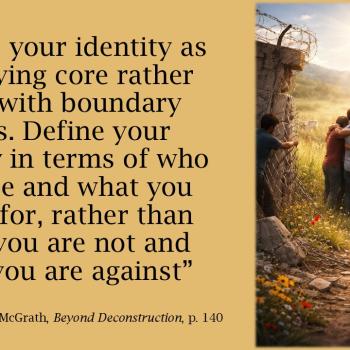
Reviews of Beyond Deconstruction (and an Easter Excerpt)
Religion Prof: The Blog of James F. McGrath
TRENDING AT PATHEOS Progressive Christian

The Pillar of the Boatmen: the Ancient Monument...
The Pillar of the Boatmen is a Romano-Gaulish sculpture that dates from...

In one sense walking into Westminster Abbey is like walking down the...

'Super Scam Me' Exposes AI Jon Bon Jovi...
Leslie Pickett believed she was in a relationship with Jon Bon Jovi....

The Brazilian Remake of Kendricks' 'Flywheel' Opens in...
“Flywheel,” the story that launched the Kendrick Brothers’ filmmaking career is getting...

The Dangers of Gradual Accommodation (Winking at Sin)
Recently, the “law of gradualness” resurfaced during the opening of a weeklong,...

The Iron Gates and the Lion of the...
Yesterday, I didn't finish my report about, well, yesterday. So I'll...
view all Progressive Christian blogs
Ad-Free & Subscriber Log-In Subscription Support
- About Us
- 2026 Calendar
- Videos
- Podcasts
- Library of World Religions
- Faith In Media Tracker
- Advertise With Us
- Write for Us
- Privacy Policy
- Terms of Service
- Do Not Sell My Data
- Contact Us
- Radiant Digital
- Manage Newsletter Subscriptions
- Unsubscribe From Notifications
- Sitemap
Copyright 2008-2026, Patheos. All rights reserved.
Subscription Support Ad-Free & Subscriber Log-In
Follow Patheos