
BuddhistCatholicContemplativeEvangelicalGeneral ChristianHinduJewishLatter-day SaintMuslimNew VisionsProgressive Christian
Beliefs
- Buddhist
- Catholic
- Contemplative
- Evangelical
- General Christian
- Hindu
- Jewish
- Latter-day Saint
- More Voices
- Muslim
- New Visions
- Pagan
- Progressive Christian
Topics
- Religion News
- Food and Religion
- Sports and Religion
- Religious Art
- Religious Music and Entertainment
- Religious Events
- History and Religion
- Style and Religion
- Politics and Religion
- Women in Religion
- Recreation Outdoors and Religion
- Business Finance and Religion
- Careers Workplace and Religion
- Education and Religion
- Family Parenting and Religion
- Health Fitness and Religion
- Home and Religion
- Relationships and Religion
- Technology and Religion
- Travel and Religion
Columnists
- Buddhist Columnists
- Business Finance and Religion Columnists
- Careers Workplace and Religion Columnists
- Catholic Columnists
- Contemplative Columnists
- Education and Religion Columnists
- Evangelists Columnists
- Family Parenting and Religion Columnists
- General Christian Columnists
- Health Fitness and Religion Columnists
- Hindu Columnists
- History and Religion Columnists
- Home and Religion Columnists
- Jewish Columnists
- More Voices Columnists
- Latter Day Columnists
- Muslim Columnists
- New Visions Columnists
- Nonreligious Columnists
- Pagan Columnists
- Politics and Religion Columnists
- Progressive Columnists
- Recreation Outdoors and Religion Columnists
- Relationships and Religion Columnists
- Religion News Columnists
- Religious Art Columnists
- Religious Events Columnists
- Religious Music and Entertainment Columnists
- Sports and Religion Columnists
- Style and Religion Columnists
- Technology and Religion Columnists
- Travel and Religion Columnists
- Women in Religion Columnists
Resource Library
- 2026 Calendar
- Library of World Religions
- The 100 Most Holy Places on Earth
- Patheos Answers
- Podcasts
- Videos
- Faith Leaders Database
- Anglican Episcopalian
- Bahai
- Baptist
- Buddhism
- Christianity
- Confucianism
- Eastern Orthodoxy
- Hinduism
- Holiness and Pentecostal
- ISKCON
- Islam
- Judaism
- Lutheran
- Methodist
- The Church of Jesus Christ of Latter-day Saints
- New Age
- Paganism
- Presbytarian and Reformed
- Protestantism
- Religion Behind the Scenes
- Roman Catholic
- Scientology
- Shia Islam
- Sikhism
- Sufism
- Sunni Islam
- Taoism
- Zen
- See all religions
Research Tools
 Ad-Free & Subscriber Log-In Subscription Support
Ad-Free & Subscriber Log-In Subscription Support
Follow Patheos 

- Trending:
- Forgiveness
- |
- Marriage
- |
- Consciousness
- |
- Death Penalty
- |
- Election
- |
- Halloween

- Home
- About Dr. James F. McGrath
- Publications
- Blogroll
- Useful Websites
- Connections
- Easy Search Posts Page
- FREE NEWSLETTER
- Home
- Progressive Christian
- From The Archives: What’s Wrong With Being ‘Right’?
From The Archives: What’s Wrong With Being ‘Right’?
Last updated on: July 3, 2009 at 7:53 am by James F. McGrath
From The Archives: What’s Wrong With Being ‘Right’? 2009-07-03T07:53:00-04:00 James F. McGrath
Patheos Explore the world's faith through different perspectives on religion and spirituality! Patheos has the views of the prevalent religions and spiritualities of the world.
For those who are enthusiastic about the voices calling for a return to or preservation of the Christian foundations of our society, you will probably find yourself largely in agreement with the sentiment of another famous politician, who said:
The national government will maintain and defend the foundations on which the power of our nation rests. It will offer strong protection to Christianity as the very basis of our collective morality.
Today Christians stand at the head of our country. We want to fill our culture again with the Christian spirit. We want to burn out all the recent immoral developments in literature, in the theatre, and in the press – in short, we want to burn out the poison of immorality which has entered into our whole life and culture as a result of liberal excess during recent years.
For those following currents in American religious and political life, the language sounds very familiar, and you may wonder precisely whose words these are. They are the words of Adolf Hitler. This is a quotation from the address he gave after coming to power in Germany (from “My New Order, The Speeches of Adolf Hitler, 1922-1939”, Vol. 1, pp. 871-872, Oxford University Press, London, 1942).
I was tempted to simply leave it at that, without comment. But just to make certain my point is clear, I will say just a few words about it. It is my hope that, by highlighting the similarity between current American voices and that of Hitler, my fellow Americans will understand why the voices on the far-right scare so many of us who do not share their views. Moderate leanings to the left or right are not what I am talking about here, but there are voices that are far to the right of center, and some use that language often without realizing what it means: far in the direction of Hitler, of the Nazis, of fascism. Many in our time lean in that direction, and reflect a view which claims that our heritage (cultural, religious, economic, political, whatever) is the best, and that it is our destiny to be the most powerful nation precisely for this reason. It claims certainty that those who question our cherished values are wrong, and would ideally like to see our laws uphold and enforce these values.
Yet in an American context, to claim that our nation’s heritage is simply “Christian” is misleading. The faith of Thomas Jefferson, a Deist, would not be considered acceptable to most of those American Christians today who claim that the founding fathers were Christians. The Bill of Rights guarantees Americans the right to break at least the first two of the Ten Commandments by guaranteeing religious freedom for all.
What is wrong with being on the right? There are voices in our time that seem to be leaning further and further in that direction, even though they would claim to abhor what Hitler did. Yet all it takes for history to repeat itself is a nation leaning in that direction, a leader willing to use the language of Christianity and conservativism to manipulate the populace and exploit their faith and enthusiasm, and a failure to care when those we disagree with are persecuted and punished. The spirit of the far right is absolutely antithetical to the heritage and foundations of American democracy. And it is precisely that democracy that protects Christianity as well as all other religions to present their case, to make their appeal, to urge any and all who will listen to follow their lead and adhere to their values and convictions – whether they are about abortion, social justice, or the editing of Veggie Tales on NBC.
It is only a faith that is insecure that wants to force itself on others through legislation, because of a lack of trust in the persuasive power of the message itself. It is only the faith of the proud that claims absolute certainty, as opposed to humility and absolute trust in God as the only one who truly knows with certainty.
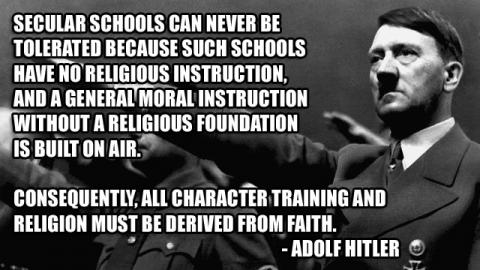
I found a couple more quotes from Hitler that illustrate just how similar the language he used is to that of certain voices in American Christianity today:”Secular schools can never be tolerated because such schools have no religious instruction, and a general moral instruction without a religious foundation is built on air; consequently, all character training and religion must be derived from faith . . . we need believing people.” (Adolf Hitler, April 26, 1933, from a speech made during negotiations leading to the Nazi-Vatican Concordant of 1933).
In his book Mein Kampf he wrote: “. . . I am convinced that I am acting as the agent of our Creator. By fighting off the Jews, I am doing the Lord’s work.”
The founding fathers, despite what is so often claimed, were very careful to point our nation in a direction that could not (at least not legally) be taken in that direction. Much of what we assume to be the case about our “Christian nation” (such as the universal addition of the motto “In God We Trust” and the addition of “under God” to the pledge of allegiance) is shaped by things that were added in the 1950s, and certainly subsequent to the composition of the Constitution. Not only did Thomas Jefferson emphatically argue that American law is NOT based on the Bible [letter to Thomas Cooper, February 10, 1814], but in Article 11 of the Treaty of Tripoli, which the U.S. Senate ratified, it emphasizes that “the government of the United States of America is not in any sense founded on the Christian Religion.” Fundamentalists claim to believe the whole Bible and take it literally, and yet they ignore whole vast parts of it and impose their own interpretative framework on those verses they quote out of context. They claim to be following in the footsteps of the founding fathers and yet clearly have never read the writings of our nation’s early leaders or studied the historical evidence in an appropriate, scholarly manner. This is not to deny the profound influence of Christianity upon all of them in some way, shape or form. It is merely to assert their awareness that as soon as one allows a particular religious tradition to have a unique status, then there will be wrangling over whose version of that tradition is the right one, and the debates will never end.
Returning to our original subject, it is true that once he rose to power Hitler came to oppose Christianity, but it is important to note that this does not suggest that his earlier religious views were simply a charade. His opposition to Christianity results from his conviction that the church was a threat to his power; it is clear, however, that his anti-Semitic views were adopted in close connection with his extreme religious views. Quotes found online illustrate this point and the shift in his views well.
The form of Christianity that he adhered to was known as Positive Christianity, and it essentially remade Jesus in the image of the culture and ideals of Northern Europeans. Now it is inevitably true that people read their own cultural and personal presuppositions and ideals into their Scriptures, and project these values onto God, but some do it more radically than others. American fundamentalist Christianity does this to a lesser extent than Hitler’s Positive Christianity, but to a far greater extent than is healthy for the church if it is to have a role in challenging cultural norms with the Gospel. [There was a wonderful illustration of this on the 2006 season premier of Trading Spouses, where an orthodox Jewish mother from Boston changed places with a Pentecostal mother from a small town in the South. The latter viewed the Jewish woman’s way of thinking as “un-American”, and she assumed that her own traditions were what is meant by Christianity, as did the rest of her family.]
Hitler had been raised a Catholic and viewed himself as such at least until 1941. Lest it be assumed that these views have nothing to do with other branches of Christianity, let’s have a few quotes from Martin Luther: “The Jews deserve to be hanged on gallows seven times higher than ordinary thieves,” and “We ought to take revenge on the Jews and kill them.”
It is because racism, greed, lack of concern for the poor, and countless other values that are at odds with the most basic teachings of Christianity (as of most religions) continue to flourish in our society that I am so passionate about getting good Biblical scholarship to the public and teaching not only religion majors but as many students as possible. There is a wonderful paragraph in LeAnn Snow Flesher’s recent book Left Behind?: The Facts Behind the Fiction that puts it beautifully and shows the connection with the topic we’ve been discussing:
Every fall a new set of students enters my Introduction to the Old Testament course, and invariably, at least one student will come up to me and say, “I really don’t need to take this class, I already know the Bible.” Having read the Bible is not equal to knowing the Bible. Reading the Bible is essential, of course, but the Bible is a very complex collection of documents from an ancient age and culture. In the United States today, and I dare to say in much of the world, the common method for reading has become one of direct application wherein the reader selects a passage, often at random, reads it through, and immediately sits back to contemplate how the text directly applies to today andto his or her life. This almost magical approach entirely disregards the realities of what the Bible is and what it means to read it with integrity. In the end, this method demonstrates disrespect for Scripture and replaces the authority of the Word with the authority of the reader’s time, place, and needs. Scripture verses pulled out of their contexts and strung together can be made to say almost anything. Many bad interpretations have resulted from such a process- some of which have been downright devastating (pp.57-58).
It fascinates me that religion seems to mean two completely opposite things for people in our time. On the one hand, there are the fundamentalists for whom religion is all about certainty, about my own knowledge about God being accurate, about being correct in what one believes/knows. On the other hand, there are those of us who have had a personal spiritual experience of genuinely being born again, and although most of us start out spiritually with a fundamentalist outlooks (just as young children see the world in black-and-white terms), as (or I should say if) we mature we acknowledge that all our words and doctrines are simply pointers to that experience that transcends them, to a God who transcends them. For us, religion is not about our own certainty, but a recognition of our own human limitations, so that we cast ourselves utterly upon God who alone is certain, alone is wise, alone knows, alone is right.
[NOTE: The above post originally appeared as two separate entries here and first appeared as a combined single post here]

Previous Post

July 2, 2009
The Apocalypse of Eve
Next Post
July 5, 2009 From The Archives: The Two Doctors (Arguing With Oneself)
Browse Our Archives
Select a Category 1 Corinthians 1 John 1 Peter 1 Samuel 1 Thessalonians 1 Timothy 2 Corinthians 2 Kings 2 Peter 2 Samuel 2 Thessalonians 2 Timothy academia Acts of the Apostles afterlife Akhaten Alcatraz American Academy of Religion Amos Anglican Arabic Aramaic archaeology art artificial intelligence astronomy atheism atonement Babylon 5 Baptists Battlestar Galactica Bible Biblical Studies Carnival biblioblogging Black Mirror Blade Runner Book of Job book review Buddhism Call for Papers China Christianity Christmas Christology Chronicles Coptic creation Daniel Deuteronomy Doctor Who Dune Easter Ecclesiastes economics education Eldad Keynan Enoch Seminar Ephesians eschatology Esther Evangelicals evolution Exodus Expanse Ezekiel Ezra fantasy Fringe fundamentalism Galatians games Ge'ez genealogy Genesis Gnosticism Gospel of Jesus' Wife Gospel of John Gospel of Judas Gospel of Luke Gospel of Mark Gospel of Matthew Gospel of Peter Gospel of Thomas Greek Harry Potter Hebrew Hebrews Hinduism historical Jesus history Hitchhiker's Guide to the Galaxy Holidays horror Hosea humor incarnation India inerrancy information literacy inspirational Intelligent Design Ireland Isaiah Islam Israel Italy James Jeremiah John the Baptist Jonah Joshua Judaism Jude Judges Judith Lamentations languages Latin Leviticus libraries literature Lord of the Rings LOST Mandaeans Mandaic memes Methodism Micah monotheism morality Mormons movies music mythicism NASSCAL Nehemiah new perspective New Testament news Numbers Orthodox paganism panentheism pantheism Patheos Paul and his letters Pentecostals Philippians Philippians 2:6-11 philosophy physics Planet of the Apes podcast politics Progressive Christianity Protestantism Proverbs Psalms pseudoscience racism religion Revelation Roman Catholicism Romania Romans Ruth scams science science fiction Secret Gospel of Mark Society of Biblical Literature Song of Songs Star Trek Star Wars Stargate Swahili Syriac Taoism technology Terminator The Handmaid's Tale The Hobbit The Matrix theodicy theology theory Timeless Titus tomb Torchwood travel TRON Uncategorized United Kingdom Westworld X-Files young-earth creationism Zechariah
Select a Month October 2026 September 2026 August 2026 July 2026 June 2026 May 2026 April 2026 March 2026 February 2026 January 2026 December 2025 November 2025 October 2025 September 2025 July 2025 June 2025 May 2025 April 2025 March 2025 February 2025 January 2025 December 2024 November 2024 October 2024 September 2024 August 2024 July 2024 June 2024 May 2024 April 2024 March 2024 February 2024 January 2024 December 2023 November 2023 October 2023 September 2023 August 2023 July 2023 May 2023 April 2023 March 2023 February 2023 January 2023 December 2022 November 2022 October 2022 September 2022 August 2022 July 2022 June 2022 May 2022 April 2022 March 2022 February 2022 January 2022 December 2021 November 2021 October 2021 September 2021 August 2021 July 2021 June 2021 May 2021 April 2021 March 2021 February 2021 January 2021 December 2020 November 2020 October 2020 September 2020 August 2020 July 2020 June 2020 May 2020 April 2020 March 2020 February 2020 January 2020 December 2019 November 2019 October 2019 September 2019 August 2019 July 2019 June 2019 May 2019 April 2019 March 2019 February 2019 January 2019 December 2018 November 2018 October 2018 September 2018 August 2018 July 2018 June 2018 May 2018 April 2018 March 2018 February 2018 January 2018 December 2017 November 2017 October 2017 September 2017 August 2017 July 2017 June 2017 May 2017 April 2017 March 2017 February 2017 January 2017 December 2016 November 2016 October 2016 September 2016 August 2016 July 2016 June 2016 May 2016 April 2016 March 2016 February 2016 January 2016 December 2015 November 2015 October 2015 September 2015 August 2015 July 2015 June 2015 May 2015 April 2015 March 2015 February 2015 January 2015 December 2014 November 2014 October 2014 September 2014 August 2014 July 2014 June 2014 May 2014 April 2014 March 2014 February 2014 January 2014 December 2013 November 2013 October 2013 September 2013 August 2013 July 2013 June 2013 May 2013 April 2013 March 2013 February 2013 January 2013 December 2012 November 2012 October 2012 September 2012 August 2012 July 2012 June 2012 May 2012 April 2012 March 2012 February 2012 January 2012 December 2011 November 2011 October 2011 September 2011 August 2011 July 2011 June 2011 May 2011 April 2011 March 2011 February 2011 January 2011 December 2010 November 2010 October 2010 September 2010 August 2010 July 2010 June 2010 May 2010 April 2010 March 2010 February 2010 January 2010 December 2009 November 2009 October 2009 September 2009 August 2009 July 2009 June 2009 May 2009 April 2009 March 2009 February 2009 January 2009 December 2008 November 2008 October 2008 September 2008 August 2008 July 2008 June 2008 May 2008 April 2008 March 2008 February 2008 January 2008 December 2007 November 2007 October 2007 September 2007 August 2007 July 2007 June 2007 February 2007 January 2001
Follow Us!
TAKE THE
Religious Wisdom Quiz
Who was Hezekiah's prophet counselor?
Select your answer to see how you score.
Jeremiah Nathan Ezekiel Isaiah
Books by This Author Books by James F. McGrath
Related posts from Religion Prof: The Blog of James F. McGrath

The Time-Traveler’s Apprentice (A Short Story)
Religion Prof: The Blog of James F. McGrath
A Baptist's Defense of the Muslim Call to...
Religion Prof: The Blog of James F. McGrath

Religion Prof: The Blog of James F. McGrath

Religion Prof: The Blog of James F. McGrath
TRENDING AT PATHEOS Progressive Christian

The Sermon on the Mount, Part I: Matthew...
The Sermon on the Mount, Part I (Matthew 4:12-5:12) St. Matthew moves...

What's up from Crossway: Reviewing some of their latest A few weeks...

Janie Learns the Way of the Cross: A...
Teaching children about Jesus' Passion can be challenging. Many parents and educators...

Looking For Good Catholic Writing - October 2026
He alone extends the heavens, and he walks upon the waves of...

In "Irreplaceable," our book on vocation and technology, Trevor Sutton and I...

I was strolling through the top floor of the brand new Parthenon...
view all Progressive Christian blogs
Ad-Free & Subscriber Log-In Subscription Support
- About Us
- 2026 Calendar
- Videos
- Podcasts
- Library of World Religions
- Faith In Media Tracker
- Advertise With Us
- Write for Us
- Privacy Policy
- Terms of Service
- Do Not Sell My Data
- Contact Us
- Radiant Digital
- Manage Newsletter Subscriptions
- Unsubscribe From Notifications
- Sitemap
Copyright 2008-2026, Patheos. All rights reserved.
Subscription Support Ad-Free & Subscriber Log-In
Follow Patheos