
BuddhistCatholicContemplativeEvangelicalGeneral ChristianHinduJewishLatter-day SaintMuslimNew VisionsProgressive Christian
Beliefs
- Buddhist
- Catholic
- Contemplative
- Evangelical
- General Christian
- Hindu
- Jewish
- Latter-day Saint
- More Voices
- Muslim
- New Visions
- Pagan
- Progressive Christian
Topics
- Religion News
- Food and Religion
- Sports and Religion
- Religious Art
- Religious Music and Entertainment
- Religious Events
- History and Religion
- Style and Religion
- Politics and Religion
- Women in Religion
- Recreation Outdoors and Religion
- Business Finance and Religion
- Careers Workplace and Religion
- Education and Religion
- Family Parenting and Religion
- Health Fitness and Religion
- Home and Religion
- Relationships and Religion
- Technology and Religion
- Travel and Religion
Columnists
- Buddhist Columnists
- Business Finance and Religion Columnists
- Careers Workplace and Religion Columnists
- Catholic Columnists
- Contemplative Columnists
- Education and Religion Columnists
- Evangelists Columnists
- Family Parenting and Religion Columnists
- General Christian Columnists
- Health Fitness and Religion Columnists
- Hindu Columnists
- History and Religion Columnists
- Home and Religion Columnists
- Jewish Columnists
- More Voices Columnists
- Latter Day Columnists
- Muslim Columnists
- New Visions Columnists
- Nonreligious Columnists
- Pagan Columnists
- Politics and Religion Columnists
- Progressive Columnists
- Recreation Outdoors and Religion Columnists
- Relationships and Religion Columnists
- Religion News Columnists
- Religious Art Columnists
- Religious Events Columnists
- Religious Music and Entertainment Columnists
- Sports and Religion Columnists
- Style and Religion Columnists
- Technology and Religion Columnists
- Travel and Religion Columnists
- Women in Religion Columnists
Resource Library
- 2026 Calendar
- Library of World Religions
- The 100 Most Holy Places on Earth
- Patheos Answers
- Podcasts
- Videos
- Faith Leaders Database
- Anglican Episcopalian
- Bahai
- Baptist
- Buddhism
- Christianity
- Confucianism
- Eastern Orthodoxy
- Hinduism
- Holiness and Pentecostal
- ISKCON
- Islam
- Judaism
- Lutheran
- Methodist
- The Church of Jesus Christ of Latter-day Saints
- New Age
- Paganism
- Presbytarian and Reformed
- Protestantism
- Religion Behind the Scenes
- Roman Catholic
- Scientology
- Shia Islam
- Sikhism
- Sufism
- Sunni Islam
- Taoism
- Zen
- See all religions
Research Tools
 Ad-Free & Subscriber Log-In Subscription Support
Follow Patheos 

- Trending:
- Advent
- |
- Forgiveness
- |
- Thanksgiving
- |
- Election
- |
- Seasonal Holidays
- |
- Marriage

- Home
- Religion News
- What Is a Caliph? The Islamic State Hijacks a Historic Institution
What Is a Caliph? The Islamic State Hijacks a Historic Institution
Last updated on: November 13, 2019 at 11:34 am by The Conversation
What Is a Caliph? The Islamic State Hijacks a Historic Institution 2019-11-13T11:34:22-05:00 The Conversation
Patheos Explore the world's faith through different perspectives on religion and spirituality! Patheos has the views of the prevalent religions and spiritualities of the world.

An image of Islamic State leader Abu Bakr al-Baghdadi, who died on Oct. 26, 2019. (Department of Defense via AP)
By Ken Chitwood, University of Florida
Just days after the death of Abu Bakr al-Baghdadi on Oct. 27, the Islamic State named Abu Ibrahim al-Hashimi al-Qurashi as the new “caliph.”
In 2014, IS conquered vast swaths of Iraq and Syria and declared itself to be the “caliphate.”
Defined and applied in different ways over the centuries, the fundamental idea behind the caliphate is the just ordering of society according to the will of God.
The Islamic State’s caliphate was never widely recognized among the global Muslim community and no longer has significant territory. But the Islamic State still uses the history of the caliphate to push their claims.
As a scholar of global Islam, every time I teach my “Introduction to Islam” class, questions about the caliphate come up, in part because of IS’s claims.
Caliph conundrums
The leader of a caliphate is called the caliph, meaning deputy or representative. All caliphs are believed to be the successor to Prophet Muhammad. Muhammad was not a caliph; according to the Quran he was the last and greatest of the prophets.
That means no one can replace Muhammad as the messenger of God. The caliph, for example, is not always seen as holding special spiritual authority. But he is meant to preside over the caliphate in the absence of Muhammad.
The debate over who was the rightful representative of the prophet began immediately after his death. While the majority supported Abu Bakr – one of the prophet’s closest companions – a minority opted for his young son-in-law and cousin, Ali.
Abu Bakr’s supporters would come to be known as Sunni Muslims, who believe that Muhammad did not leave instructions regarding his successor. Those who felt Ali was appointed by the prophet to be the political and spiritual leader of the fledgling Muslim community became known as Shiite Muslims.
Abu Bakr was the first caliph and Ali the fourth.
The second and third caliphs were Umar and Uthman. Under Umar, the caliphate expanded to include many regions of the world such as the lands of the former Byzantine and Sassanian empires in Asia Minor, Persia and Central Asia. Uthman is credited with compiling the Quran.
That al-Baghdadi adopted the name of the first caliph was no coincidence. Together, Sunni Muslims call the first four caliphs the Rashidun, or the “Rightly Guided Caliphs,” because they were close companions or relations of Muhammad. They are also believed to be extraordinarily pious. This period lasted about 30 years.
The complex history of the caliphate
After rebels assassinated Uthman in A.D. 656, Ali was elected caliph. However, a civil war soon broke out between Ali and Muʿawiya ibn Abi Sufyan. The civil war ended in Sufyan’s victory and the formation of the Umayyad caliphate in A.D. 661.
The Umayyad dynasty lasted 89 years.
The Abbasid dynasty descended from Muhammad’s uncle, Abbas ibn Abdul-Muttalib, and succeeded the Umayyads.
These two caliphates oversaw the continuing expansion of the empire. Under them architecture, the arts and sciences flourished.
For example, the “Dome of the Rock,” a shrine in the Old City of Jerusalem, was built under an Umayyad caliph as a monument to the rising supremacy of their empire.
The Grand Library of Baghdad, also known as the “House of Wisdom,” was supported by Abbasid patronage. The “House of Wisdom” is credited with being a center of translation, scientific study and academic exchange. This period of flourishing, from the eighth to the 14th century, is often referred to as the “Islamic Golden Age.”
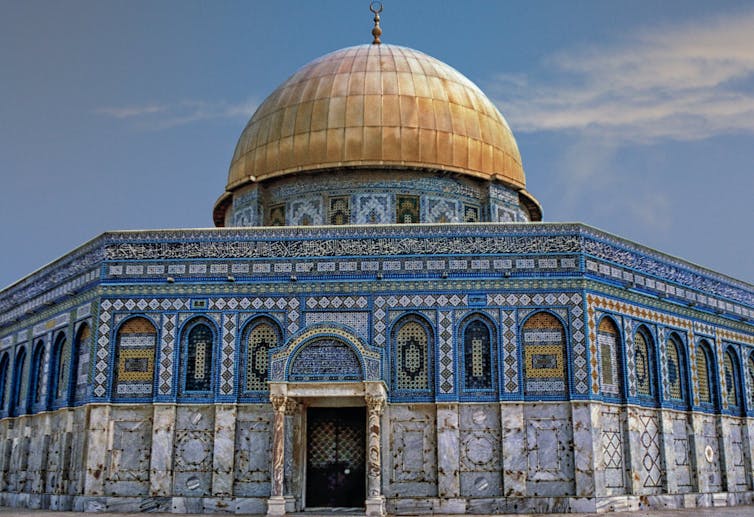
Dome of The Rock, in Jerusalem.
Ray in Manila, CC BY
Both before and after the fall of the Abbasids in A.D. 1258, a succession of various empires made overlapping and competing claims to the caliphate. These included the Mamluks of Cairo and the Umayyads in Cordóba, Spain.
In 1517, the Turkish Ottomans amassed enough land and power throughout Asia Minor, North Africa, the Arabian Peninsula and Eastern Europe to claim the title “caliphate.” Ottoman sultans, however, were not universally recognized as caliphs. Many Muslims believe that the caliphate effectively ended after the Mongol conquest of Abbasid Baghdad in A.D. 1258.
Nonetheless, the Ottomans effectively held on to that title until 1924, when the Turkish nationalist and secularist Kemal Ataturk abolished the caliphate.
Resurrecting the caliphate?
The idea of the caliphate, which the Islamic State has forcefully promoted, recalls a time and a place when Islamic states flourished politically, economically and socially. It also summons up a spiritual vision of a supposedly more devout and dedicated Muslim community than exists today.
Other modern-day Islamists have called for a resurrection of the caliphate, or at least its ideals, as a way to recapture the vibrancy of the past. However, only violent extremist groups such as al-Qaida or the Islamic State have tried to make it a tangible reality.
Killing al-Baghdadi has not quashed the Islamic State’s version of the caliphate. The idea lives on and continues to motivate its members in enclaves across the globe. It is worth mentioning that the name of their new caliph is an honorific title for a member of Prophet Muhammad’s family – “al-Qurashi.” This prophetic lineage is one more way IS is trying to resurrect the history of the caliphate for its destructive purposes.

Ken Chitwood, Journalist-fellow, University of Southern California’s Center for Religion and Civic Culture / Lecturer, Concordia College New York, University of Florida
This article is republished from The Conversation under a Creative Commons license. Read the original article.
Previous Post

November 11, 2019
How the U.S. Military Has Embraced Growing Religious Diversity
Browse Our Archives
Select a Category Story of God Uncategorized
Select a Month September 2022 August 2022 January 2022 December 2021 August 2021 July 2021 February 2021 January 2021 January 2020 December 2019 November 2019 October 2019 September 2019 August 2019 July 2019 June 2019 May 2019 April 2019 March 2019 February 2019 January 2019 December 2018 November 2018 October 2018 September 2018 July 2018 June 2018 May 2018 April 2018 November 2017 October 2017 August 2017 June 2017 May 2017 April 2017 November 2016 October 2016 September 2016 July 2016 June 2016 May 2016 April 2016 March 2016 February 2016 January 2016 December 2015 November 2015 October 2015 September 2015 August 2015 July 2015 June 2015 May 2015 April 2015 March 2015 February 2015 January 2015 December 2014 October 2014 September 2014 July 2014 May 2014 April 2014 March 2014 February 2014 January 2014 September 2013 August 2013 July 2013 June 2013 May 2013 April 2013 March 2013 February 2013 January 2013 December 2012
Follow Us!
TAKE THE
Religious Wisdom Quiz
What does Romans say about those who are led by the Spirit of God?
Select your answer to see how you score.
They are the children of God (or sons of God) They will have eternal life They will not sin They are saved
Related posts from Religion Now
Secondary Separation, in Islam

“Real” Islam and the Secular State
Truth is Narrow, but God’s Grace is Wide
Is Progressive Christianity Counterfeit Gospel?
TRENDING AT PATHEOS Religion News

Catholic Integralists believe that religious values – specifically Christian ones – should...

Electing A Virtuous President Would Make Immunity Irrelevant
Presidential immunity can bring with it many risks. So how can we...

Why The Olympic Games Are A ‘Civil Religious’...
Sporting events form a vital space where Americans display their 'civil religious...

After more than a decade of news, research updates, and insights on...

Q: Why do Southern Baptists and like-minded Protestants...
THE RELIGION GUY’S ANSWER: Why? Simple. Because they believe that’s what the...

THE QUESTION: Is gambling evil? THE RELIGION GUY’S ANSWER: Analysts anticipate a...
view all Religion News blogs
Ad-Free & Subscriber Log-In Subscription Support
- About Us
- 2026 Calendar
- Videos
- Podcasts
- Library of World Religions
- Faith In Media Tracker
- Advertise With Us
- Write for Us
- Privacy Policy
- Terms of Service
- Do Not Sell My Data
- Contact Us
- Radiant Digital
- Manage Newsletter Subscriptions
- Unsubscribe From Notifications
- Sitemap
Copyright 2008-2026, Patheos, part of the Radiant Digital network of media brands. All rights reserved.
Subscription Support Ad-Free & Subscriber Log-In
Follow Patheos