
BuddhistCatholicContemplativeEvangelicalGeneral ChristianHinduJewishLatter-day SaintMuslimNew VisionsProgressive Christian
Beliefs
- Buddhist
- Catholic
- Contemplative
- Evangelical
- General Christian
- Hindu
- Jewish
- Latter-day Saint
- More Voices
- Muslim
- New Visions
- Pagan
- Progressive Christian
Topics
- Religion News
- Food and Religion
- Sports and Religion
- Religious Art
- Religious Music and Entertainment
- Religious Events
- History and Religion
- Style and Religion
- Politics and Religion
- Women in Religion
- Recreation Outdoors and Religion
- Business Finance and Religion
- Careers Workplace and Religion
- Education and Religion
- Family Parenting and Religion
- Health Fitness and Religion
- Home and Religion
- Relationships and Religion
- Technology and Religion
- Travel and Religion
Columnists
- Buddhist Columnists
- Business Finance and Religion Columnists
- Careers Workplace and Religion Columnists
- Catholic Columnists
- Contemplative Columnists
- Education and Religion Columnists
- Evangelists Columnists
- Family Parenting and Religion Columnists
- General Christian Columnists
- Health Fitness and Religion Columnists
- Hindu Columnists
- History and Religion Columnists
- Home and Religion Columnists
- Jewish Columnists
- More Voices Columnists
- Latter Day Columnists
- Muslim Columnists
- New Visions Columnists
- Nonreligious Columnists
- Pagan Columnists
- Politics and Religion Columnists
- Progressive Columnists
- Recreation Outdoors and Religion Columnists
- Relationships and Religion Columnists
- Religion News Columnists
- Religious Art Columnists
- Religious Events Columnists
- Religious Music and Entertainment Columnists
- Sports and Religion Columnists
- Style and Religion Columnists
- Technology and Religion Columnists
- Travel and Religion Columnists
- Women in Religion Columnists
Resource Library
- 2026 Calendar
- Library of World Religions
- The 100 Most Holy Places on Earth
- Patheos Answers
- Podcasts
- Videos
- Faith Leaders Database
- Anglican Episcopalian
- Bahai
- Baptist
- Buddhism
- Christianity
- Confucianism
- Eastern Orthodoxy
- Hinduism
- Holiness and Pentecostal
- ISKCON
- Islam
- Judaism
- Lutheran
- Methodist
- The Church of Jesus Christ of Latter-day Saints
- New Age
- Paganism
- Presbytarian and Reformed
- Protestantism
- Religion Behind the Scenes
- Roman Catholic
- Scientology
- Shia Islam
- Sikhism
- Sufism
- Sunni Islam
- Taoism
- Zen
- See all religions
Research Tools
 Ad-Free & Subscriber Log-In Subscription Support
Ad-Free & Subscriber Log-In Subscription Support
Follow Patheos 

- Trending:
- Forgiveness
- |
- Marriage
- |
- Consciousness
- |
- Death Penalty
- |
- Election
- |
- Halloween

- Home
- Religion News
- Universal Ethical Truths Are at the Core of Jewish High Holy Days
Universal Ethical Truths Are at the Core of Jewish High Holy Days
Last updated on: October 21, 2019 at 11:44 am by The Conversation
Universal Ethical Truths Are at the Core of Jewish High Holy Days 2019-10-21T11:44:44-04:00 The Conversation
Patheos Explore the world's faith through different perspectives on religion and spirituality! Patheos has the views of the prevalent religions and spiritualities of the world.

Blowing the shofar during Rosh Hashana is one of the holiday’s many traditions. AP Photo/Emile Wamsteker
Ronald W. Pies, Tufts University
My most vivid adolescent memories of the Jewish High Holy Days are the painful rumbling of my empty stomach as I fasted on Yom Kippur, and the sharp blasts of the shofar – the ram’s horn – sounding from the synagogue pulpit.
I was one of millions of Jews the world over who observe “Yamim Nora’im.” That’s Hebrew for “Days of Awe” or “High Holy Days.”
This 10-day period begins with the two-day celebration of the Jewish New Year, Rosh Hashana. It ends with the one-day observance of Yom Kippur, when adult Jews in good health are expected to fast.
What is the significance of these holy days for orthodox Jews, secular Jews and perhaps even for non-Jews?
Traditional beliefs
Rosh Hashana and Yom Kippur are known, respectively, as “The Day of Judgment” and “The Day of Atonement.” In Orthodox Judaism, these combined Days of Awe embody both celebration and trepidation, renewal and repentance.
This is a time when Jews believe that all humankind is judged by God and inscribed either in “The Book of Life” or “The Book of Death.” Judaism doesn’t believe these are actual “books.” However, Jewish tradition tells us that God writes down the names of the righteous in The Book of Life, and the names of the wicked in the Book of Death.
The belief is that the righteous will live through the coming year; the wicked will not. All others – neither fully wicked nor fully righteous – will have their fate decided between Rosh Hashana and Yom Kippur.
The angst surrounding these holidays is captured in a liturgical poem called the “Unetanneh Tokef,” translated as “let us speak of the awesomeness.” This ancient prayer is chanted during both Rosh Hashana and Yom Kippur services, and states that,
“On Rosh Hashanah they are inscribed, and on the fast day of Yom Kippur they are sealed…who shall live and who shall die… who shall perish by water and who by fire; who by the sword, and who by a wild beast; who by hunger and who by thirst…”
Leonard Cohen, considered among the greatest of songwriters, was inspired by this poem and used similar words in his song, “Who By Fire.” He wrote,
And who by fire, who by water
Who in the sunshine, who in the night time
Who by high ordeal, who by common trial
Who in your merry merry month of May
Who by very slow decay
And who shall I say is calling?
Given the apprehension that accompanies these stark pronouncements, it is hardly surprising that during the Days of Awe, observant Jews often greet each other with a phrase of hope, “G’mar Chatimah Tovah” – roughly translated, “May you be inscribed in the Book of Life.”
As a psychiatrist reflecting on the High Holy Days, I have often wondered how many traditionally raised Jewish children have been frightened by the prospect of winding up in the Book of Death. I know I was.
As someone who has written extensively on Jewish ethics, I know that the High Holy Days also embody an “ethical core” that transcends religious doctrines and embodies universal ethical truths.
The varieties of Jewish beliefs
Judaism encompasses a wide range of beliefs. Orthodox Judaism is based on the premise that the Torah – essentially, the first five books of the Hebrew Bible –represents God’s eternal and unchangeable rules for Jewish living and religious observance.
But non-Orthodox branches of Judaism emphasize Jewish ethical and cultural traditions more than strict adherence to Jewish law and scripture. They seek to adapt Jewish traditions to modern needs.
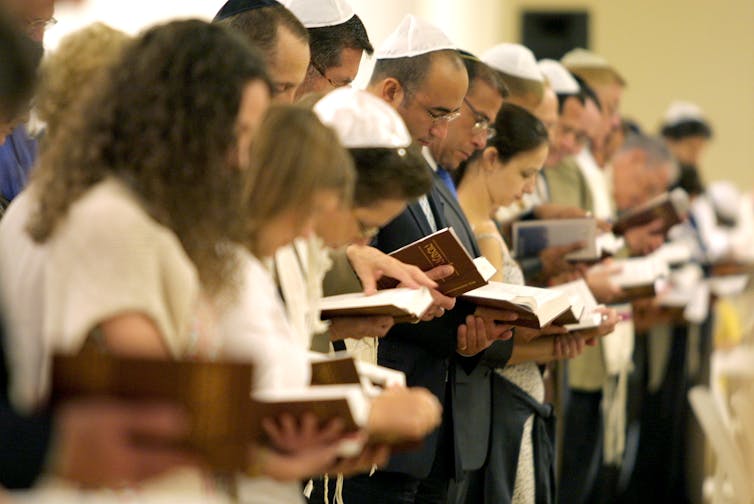
Worshippers pray during Rosh Hashana services.
AP Photo/Diane Bondareff
Judaism in all its varieties is, at heart, a religion of hope and optimism. For example, the somber warnings of the liturgical poem “Unetanneh Tokef” are softened by its reminder that one can avert being inscribed in the “Book of Death” by means of repentance, prayer and charity. That is done in the interval between Rosh Hashana and Yom Kippur.
Repentance, or teshuvah in Hebrew, requires taking a kind of “spiritual inventory” aimed at improving the health of our souls. True repentance during the High Holy Days also requires making amends to those we have sinned against or mistreated. Merely asking God to forgive such sins is not enough.

Jews from an ultra-Orthodox sect listen to their rabbi on a hill overlooking the Mediterranean Sea as they participate in a Tashlich ceremony in Herzeliya, Israel.
AP Photo/Ariel Schalit
The ethical core of the High Holy Days
Secular and Humanistic Judaism are branches of non-Orthodox Judaism and are often considered together under the rubric, “Secular Humanistic Judaism.” This tradition does not invoke or accept the concept of an eternal, transcendent God. During the High Holy Days, emphasis is placed on how all people – Jews and non-Jews – can become better human beings.
In this secular humanist tradition, Rosh Hashana is seen as a time for self-evaluation and self-improvement, without reference to God. Instead, emphasis is placed on the cultural, historical and ethical aspects of Judaism.
A common ceremony in the secular humanist tradition is “Tashlikh,” which involves symbolically casting off one’s sins by throwing bread crumbs into the water.
Tashlikh allows Humanistic Jews “…to reflect on their behavior; to cast off behaviors they are not proud of; and to vow to be better people in the year to come.”
Finally, although Rosh Hashana and Yom Kippur are quintessentially Jewish holidays, their ethical values transcend any one religion.
[ Like what you’ve read? Want more? Sign up for The Conversation’s daily newsletter. ]
Ronald W. Pies, Emeritus Professor of Psychiatry, Lecturer on Bioethics & Humanities at SUNY Upstate Medical University; and Clinical Professor of Psychiatry, Tufts University School of Medicine [through Dec. 2019], Tufts University
This article is republished from The Conversation under a Creative Commons license. Read the original article.

Next Post

October 31, 2019 Day of the Dead: From Aztec Goddess Worship to Modern Mexican Celebration
Browse Our Archives
Select a Category Story of God Uncategorized
Select a Month September 2022 August 2022 January 2022 December 2021 August 2021 July 2021 February 2021 January 2021 January 2020 December 2019 November 2019 October 2019 September 2019 August 2019 July 2019 June 2019 May 2019 April 2019 March 2019 February 2019 January 2019 December 2018 November 2018 October 2018 September 2018 July 2018 June 2018 May 2018 April 2018 November 2017 October 2017 August 2017 June 2017 May 2017 April 2017 November 2016 October 2016 September 2016 July 2016 June 2016 May 2016 April 2016 March 2016 February 2016 January 2016 December 2015 November 2015 October 2015 September 2015 August 2015 July 2015 June 2015 May 2015 April 2015 March 2015 February 2015 January 2015 December 2014 October 2014 September 2014 July 2014 May 2014 April 2014 March 2014 February 2014 January 2014 September 2013 August 2013 July 2013 June 2013 May 2013 April 2013 March 2013 February 2013 January 2013 December 2012
Follow Us!
TAKE THE
Religious Wisdom Quiz
What was the most common staple grain in ancient Israel?
Select your answer to see how you score.
Rice Wheat Barley Oats
Related posts from Religion Now

Is It Unethical to Give Your Cat Catnip?


Chicago Jains Celebrate Ancient Ritual of Repentance and...

Outlawing the Jain Fast-Unto-Death Is a Bioethical Issue
TRENDING AT PATHEOS Religion News

Catholic Integralists believe that religious values – specifically Christian ones – should...

Electing A Virtuous President Would Make Immunity Irrelevant
Presidential immunity can bring with it many risks. So how can we...

Why The Olympic Games Are A ‘Civil Religious’...
Sporting events form a vital space where Americans display their 'civil religious...

After more than a decade of news, research updates, and insights on...

Q: Why do Southern Baptists and like-minded Protestants...
THE RELIGION GUY’S ANSWER: Why? Simple. Because they believe that’s what the...

THE QUESTION: Is gambling evil? THE RELIGION GUY’S ANSWER: Analysts anticipate a...
view all Religion News blogs
Ad-Free & Subscriber Log-In Subscription Support
- About Us
- 2026 Calendar
- Videos
- Podcasts
- Library of World Religions
- Faith In Media Tracker
- Advertise With Us
- Write for Us
- Privacy Policy
- Terms of Service
- Do Not Sell My Data
- Contact Us
- Radiant Digital
- Manage Newsletter Subscriptions
- Unsubscribe From Notifications
- Sitemap
Copyright 2008-2026, Patheos. All rights reserved.
Subscription Support Ad-Free & Subscriber Log-In
Follow Patheos