
BuddhistCatholicContemplativeEvangelicalGeneral ChristianHinduJewishLatter-day SaintMuslimNew VisionsProgressive Christian
Beliefs
- Buddhist
- Catholic
- Contemplative
- Evangelical
- General Christian
- Hindu
- Jewish
- Latter-day Saint
- More Voices
- Muslim
- New Visions
- Pagan
- Progressive Christian
Topics
- Religion News
- Food and Religion
- Sports and Religion
- Religious Art
- Religious Music and Entertainment
- Religious Events
- History and Religion
- Style and Religion
- Politics and Religion
- Women in Religion
- Recreation Outdoors and Religion
- Business Finance and Religion
- Careers Workplace and Religion
- Education and Religion
- Family Parenting and Religion
- Health Fitness and Religion
- Home and Religion
- Relationships and Religion
- Technology and Religion
- Travel and Religion
Columnists
- Buddhist Columnists
- Business Finance and Religion Columnists
- Careers Workplace and Religion Columnists
- Catholic Columnists
- Contemplative Columnists
- Education and Religion Columnists
- Evangelists Columnists
- Family Parenting and Religion Columnists
- General Christian Columnists
- Health Fitness and Religion Columnists
- Hindu Columnists
- History and Religion Columnists
- Home and Religion Columnists
- Jewish Columnists
- More Voices Columnists
- Latter Day Columnists
- Muslim Columnists
- New Visions Columnists
- Nonreligious Columnists
- Pagan Columnists
- Politics and Religion Columnists
- Progressive Columnists
- Recreation Outdoors and Religion Columnists
- Relationships and Religion Columnists
- Religion News Columnists
- Religious Art Columnists
- Religious Events Columnists
- Religious Music and Entertainment Columnists
- Sports and Religion Columnists
- Style and Religion Columnists
- Technology and Religion Columnists
- Travel and Religion Columnists
- Women in Religion Columnists
Resource Library
- 2026 Calendar
- Library of World Religions
- The 100 Most Holy Places on Earth
- Patheos Answers
- Podcasts
- Videos
- Faith Leaders Database
- Anglican Episcopalian
- Bahai
- Baptist
- Buddhism
- Christianity
- Confucianism
- Eastern Orthodoxy
- Hinduism
- Holiness and Pentecostal
- ISKCON
- Islam
- Judaism
- Lutheran
- Methodist
- The Church of Jesus Christ of Latter-day Saints
- New Age
- Paganism
- Presbytarian and Reformed
- Protestantism
- Religion Behind the Scenes
- Roman Catholic
- Scientology
- Shia Islam
- Sikhism
- Sufism
- Sunni Islam
- Taoism
- Zen
- See all religions
Research Tools
 Ad-Free & Subscriber Log-In Subscription Support
Ad-Free & Subscriber Log-In Subscription Support
Follow Patheos 

- Trending:
- Forgiveness
- |
- Marriage
- |
- Consciousness
- |
- Death Penalty
- |
- Election
- |
- Halloween

- Home
- Religion News
- More Central American Migrants Take Shelter in Churches, Recalling 1980s Sanctuary Movement
More Central American Migrants Take Shelter in Churches, Recalling 1980s Sanctuary Movement
Last updated on: August 6, 2019 at 7:00 am by The Conversation
More Central American Migrants Take Shelter in Churches, Recalling 1980s Sanctuary Movement 2019-08-05T14:03:37-04:00 The Conversation
Patheos Explore the world's faith through different perspectives on religion and spirituality! Patheos has the views of the prevalent religions and spiritualities of the world.
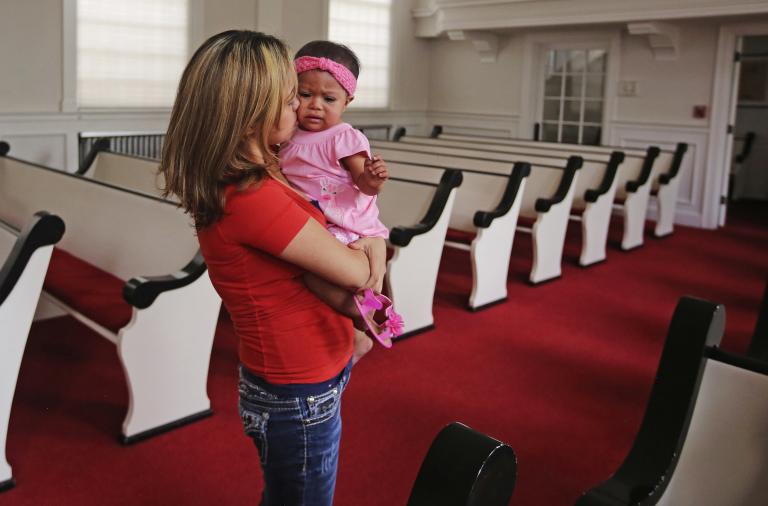
In this May 31, 2018, photo, Vicky Chavez comforts her daughter Issabella in the First Unitarian Church, in Salt Lake City. Chavez says seeing fellow Central Americans separated from their children at the U.S.-Mexico border makes her intent on trying to fight to stay in the United States. (AP Photo/Rick Bowmer)
Mario Garcia, University of California, Santa Barbara
The ongoing threat of mass immigration raids is terrifying immigrant communities across the United States.
Many of those targeted in these raids are Central Americans who came to the United States illegally, came legally but overstayed their visas or whose asylum requests were not granted. Refugees from these violence-torn countries live in fear of being sent back home to one of the world’s most dangerous regions.
Since 2012, an estimated 1.5 million people have come to the United States fleeing gang violence and state repression in El Salvador, Honduras and Guatemala. Just over 330,000 have applied for asylum, according to United Nations data. On average, about 75% of asylum claims from this population are denied. Though migrants may appeal these decisions, they may still be deported during the end stages of the legal process.
To avoid arrest, thousands of Central Americans have taken shelter in churches, which U.S. Immigration and Customs Enforcement considers sensitive locations where officers should be hesitant to make arrests.
Asylum denied
Central Americans facing deportation have long sought protection in houses of worship.
As I write in my new book on the sanctuary movement in Los Angeles, hundreds of thousands of people came to the U.S seeking political asylum in the 1980s due to civil wars in El Salvador and Guatemala.
Under U.S. refugee laws, a political asylee has the right to stay in the United States if they would be tortured, killed or both back home. While many civil rights lawyers and immigration advocates in the 1980s felt this standard clearly applied to the Central Americans, acknowledging their fears of persecution would have been an implicit acknowledgment by the Reagan administration that its Central American allies were engaged in human rights abuses.
Central Americans’ asylum applications were largely denied. Just 5% of Salvadorans, for example, received asylum between 1980 and 1990, my research found.
Declaring that the Central Americans were economic migrants seeking jobs that belonged to U.S. citizens and must return to their country, the Reagan administration began workplace raids in the early 1980s.
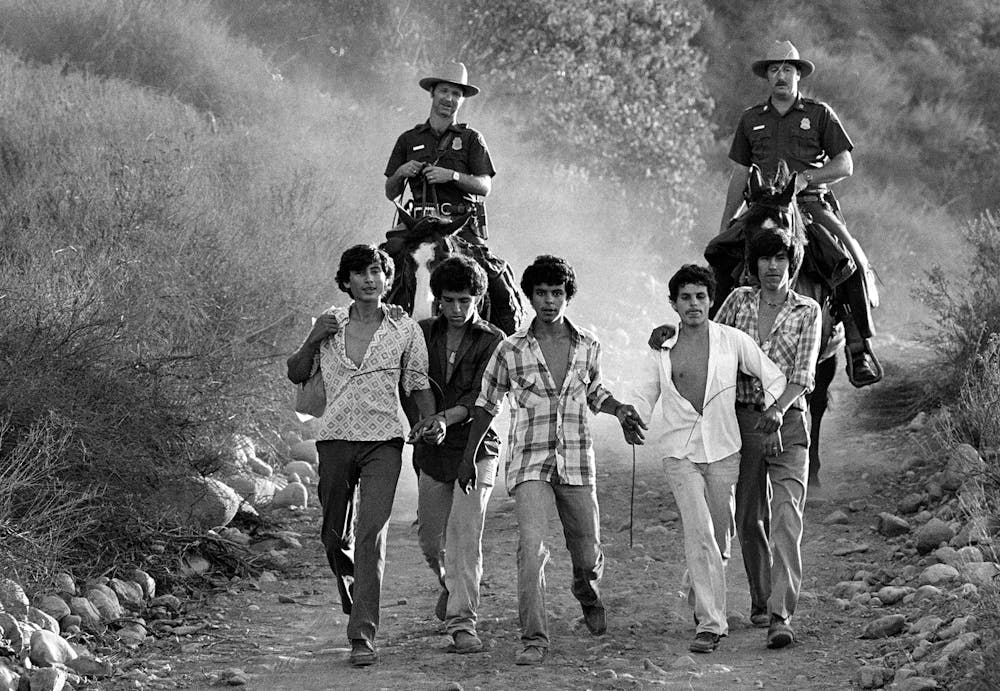
U.S. Border Patrolmen march migrants to a holding center in Texas after their apprehension in the desert, Aug. 18, 1981.
AP Photo/Lennox McLendon
In response, many churches and synagogues proclaimed themselves sanctuary sites. Based on biblical, theological and historical – but not legal – grounds that compel religious groups to protect victims of persecution, they opened their doors to the Central American migrants.
The sanctuary movement, as this operation came to be called, began in 1982 in Tucson, Arizona and soon spread throughout the country. By 1990 some 2,000 churches and cities had declared themselves to be havens where these immigrants, virtually all of whom were Catholic, would be protected.
Father Olivares and La Placita Church
Of the estimated 1 million Salvadorans who came to the U.S in the 1980s, about half of them went to Los Angeles – then, as now, a city of Latin American immigrants.
So after originating in Tucson, the sanctuary movement really exploded in L.A., both in numbers and in ambition.
The heart and soul of the L.A. sanctuary movement was Our Lady Queen of the Angeles Church, popularly known as La Placita Church. Its pastor, Luis Olivares, was a charismatic leader dedicated to helping the poor and oppressed in the social justice tradition that has long defined one strain of Latin American Catholicism.
He joined La Placita, a predominantly Latino church, in 1981, just as the Central Americans began arriving to the United States. Father Olivares, a Mexican American from Texas, embraced these refugees.
In this, he was guided by his faith. He said that he saw Jesus in the faces of the refugees and hence could not turn his back to them.
“What if that person is Jesus and I turn him away?” Olivares said in a 1990 interview. “How can I do that?”
Jesus had ministered to the poor and the oppressed, Father Olivares felt, so he – a pastor to the poor and oppressed – could do no less.
By assisting these refugees, Olivares was technically defying U.S. immigration law, which prohibits anyone from knowingly harboring an undocumented immigrant. But he said that he obeyed a higher law – God’s law.
He felt that “we are all responsible” for “God’s children.”
Father Olivares answered this call to action by establishing the most widespread sanctuary program anywhere in the country. He fed, clothed and housed the refugees, allowing hundreds of Central American men to sleep in La Placita’s pews for a few nights at a time. Women and families were housed with family members in the area, or stayed in a renovated former Jesuit seminary in North Hollywood.
La Placita also provided medical assistance and legal assistance to Central American refugees, helped them get jobs and get their children into schools.
By the time Father Olivares publicly proclaimed La Placita a sanctuary church on December 12, 1985, the feast day of Our Lady of Guadalupe, this well-established sanctuary operation was already in action. He alerted immigration officials that La Placita was a safe space for the refugees and out of bounds for “la migra,” immigration officials.
The declaration was symbolic, since churches have no legal standing to provide sanctuary. Yet despite threats to arrest Olivares for harboring “illegal aliens,” immigration officials never entered La Placita. No one there, including Father Olivares, was ever arrested.
And, with one or two exceptions, immigration chose not to breach sanctuary of other U.S. churches, either.
Two years later, in 1987, Olivares did what no other sanctuary movement in the country did: He extended sanctuary to undocumented Mexican immigrants, too.
A modern sanctuary movement
By the time La Placita’s sanctuary program ended, in 1990, Reagan was out of office and the mass immigration raids had ended.
The Trump administration’s renewed crackdown on Central Americans – who are, once again, fleeing the region in droves due to violence – has sparked talk of a modern sanctuary movement.
According to Voice of America News, 1,100 religious congregations today offer some form of sanctuary for the undocumented. Last year, only about 50 migrants took asylum in churches, but the number has spiked recently in anticipation of immigration raids and mass deportation.
The history of La Placita, and of the broader church sanctuary movement, serves as a roadmap for how the houses of worship that protect migrants as a religious duty can go beyond symbolism to assist the poor and oppressed in tangible, lasting ways.
[ Like what you’ve read? Want more? Sign up for The Conversation’s daily newsletter. ]
Mario Garcia, Professor, Department of Chicano Studies, University of California, Santa Barbara
This article is republished from The Conversation under a Creative Commons license. Read the original article.
Previous Post

August 6, 2019
The Hajj: A Muslim Spiritual Pilgrimage With Political Overtones
Browse Our Archives
Select a Category Story of God Uncategorized
Select a Month September 2022 August 2022 January 2022 December 2021 August 2021 July 2021 February 2021 January 2021 January 2020 December 2019 November 2019 October 2019 September 2019 August 2019 July 2019 June 2019 May 2019 April 2019 March 2019 February 2019 January 2019 December 2018 November 2018 October 2018 September 2018 July 2018 June 2018 May 2018 April 2018 November 2017 October 2017 August 2017 June 2017 May 2017 April 2017 November 2016 October 2016 September 2016 July 2016 June 2016 May 2016 April 2016 March 2016 February 2016 January 2016 December 2015 November 2015 October 2015 September 2015 August 2015 July 2015 June 2015 May 2015 April 2015 March 2015 February 2015 January 2015 December 2014 October 2014 September 2014 July 2014 May 2014 April 2014 March 2014 February 2014 January 2014 September 2013 August 2013 July 2013 June 2013 May 2013 April 2013 March 2013 February 2013 January 2013 December 2012
Follow Us!
TAKE THE
Religious Wisdom Quiz
What did Moses receive on Mount Sinai?
Select your answer to see how you score.
A rainbow The Ten Commandments A sword A crown
Related posts from Religion Now
Detaining Migrant Children at Military Bases Un-American? It's...
Today's Diverse American Muslim Population First Arrived 400...
Who's More Compassionate, Republicans or Democrats?
TRENDING AT PATHEOS Religion News

Catholic Integralists believe that religious values – specifically Christian ones – should...

Electing A Virtuous President Would Make Immunity Irrelevant
Presidential immunity can bring with it many risks. So how can we...

Why The Olympic Games Are A ‘Civil Religious’...
Sporting events form a vital space where Americans display their 'civil religious...

After more than a decade of news, research updates, and insights on...

Q: Why do Southern Baptists and like-minded Protestants...
THE RELIGION GUY’S ANSWER: Why? Simple. Because they believe that’s what the...

THE QUESTION: Is gambling evil? THE RELIGION GUY’S ANSWER: Analysts anticipate a...
view all Religion News blogs
Ad-Free & Subscriber Log-In Subscription Support
- About Us
- 2026 Calendar
- Videos
- Podcasts
- Library of World Religions
- Faith In Media Tracker
- Advertise With Us
- Write for Us
- Privacy Policy
- Terms of Service
- Do Not Sell My Data
- Contact Us
- Radiant Digital
- Manage Newsletter Subscriptions
- Unsubscribe From Notifications
- Sitemap
Copyright 2008-2026, Patheos. All rights reserved.
Subscription Support Ad-Free & Subscriber Log-In
Follow Patheos