
BuddhistCatholicContemplativeEvangelicalGeneral ChristianHinduJewishLatter-day SaintMuslimNew VisionsProgressive Christian
Beliefs
- Buddhist
- Catholic
- Contemplative
- Evangelical
- General Christian
- Hindu
- Jewish
- Latter-day Saint
- More Voices
- Muslim
- New Visions
- Pagan
- Progressive Christian
Topics
- Religion News
- Food and Religion
- Sports and Religion
- Religious Art
- Religious Music and Entertainment
- Religious Events
- History and Religion
- Style and Religion
- Politics and Religion
- Women in Religion
- Recreation Outdoors and Religion
- Business Finance and Religion
- Careers Workplace and Religion
- Education and Religion
- Family Parenting and Religion
- Health Fitness and Religion
- Home and Religion
- Relationships and Religion
- Technology and Religion
- Travel and Religion
Columnists
- Buddhist Columnists
- Business Finance and Religion Columnists
- Careers Workplace and Religion Columnists
- Catholic Columnists
- Contemplative Columnists
- Education and Religion Columnists
- Evangelists Columnists
- Family Parenting and Religion Columnists
- General Christian Columnists
- Health Fitness and Religion Columnists
- Hindu Columnists
- History and Religion Columnists
- Home and Religion Columnists
- Jewish Columnists
- More Voices Columnists
- Latter Day Columnists
- Muslim Columnists
- New Visions Columnists
- Nonreligious Columnists
- Pagan Columnists
- Politics and Religion Columnists
- Progressive Columnists
- Recreation Outdoors and Religion Columnists
- Relationships and Religion Columnists
- Religion News Columnists
- Religious Art Columnists
- Religious Events Columnists
- Religious Music and Entertainment Columnists
- Sports and Religion Columnists
- Style and Religion Columnists
- Technology and Religion Columnists
- Travel and Religion Columnists
- Women in Religion Columnists
Resource Library
- 2026 Calendar
- Library of World Religions
- The 100 Most Holy Places on Earth
- Patheos Answers
- Podcasts
- Videos
- Faith Leaders Database
- Anglican Episcopalian
- Bahai
- Baptist
- Buddhism
- Christianity
- Confucianism
- Eastern Orthodoxy
- Hinduism
- Holiness and Pentecostal
- ISKCON
- Islam
- Judaism
- Lutheran
- Methodist
- The Church of Jesus Christ of Latter-day Saints
- New Age
- Paganism
- Presbytarian and Reformed
- Protestantism
- Religion Behind the Scenes
- Roman Catholic
- Scientology
- Shia Islam
- Sikhism
- Sufism
- Sunni Islam
- Taoism
- Zen
- See all religions
Research Tools
 Ad-Free & Subscriber Log-In Subscription Support
Ad-Free & Subscriber Log-In Subscription Support
Follow Patheos 

- Trending:
- Forgiveness
- |
- Marriage
- |
- Consciousness
- |
- Death Penalty
- |
- Election
- |
- Halloween

- Home
- Religion News
- What Is Eid and How Do Muslims Celebrate It? 6 Questions Answered
What Is Eid and How Do Muslims Celebrate It? 6 Questions Answered
Last updated on: June 4, 2019 at 12:04 pm by The Conversation
What Is Eid and How Do Muslims Celebrate It? 6 Questions Answered 2019-06-04T12:04:34-04:00 The Conversation
Patheos Explore the world's faith through different perspectives on religion and spirituality! Patheos has the views of the prevalent religions and spiritualities of the world.
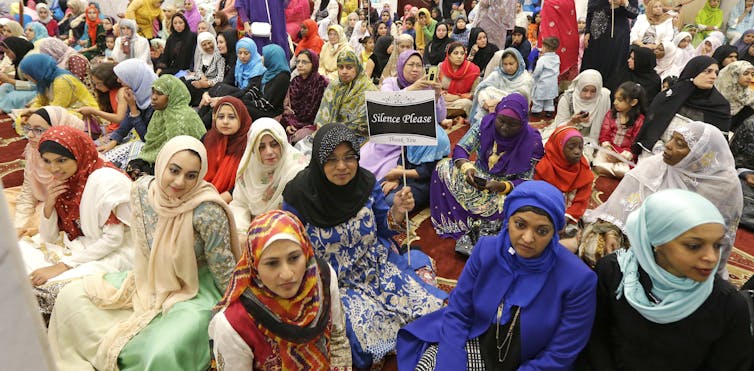
Muslim women at a prayer service at a mosque in Redmond, Washington, to mark the end of Ramadan and the start of Eid-al-Fitr in 2016.
AP Photo/Ted S. Warren
By Ken Chitwood, University of Florida
Editor’s note: Muslims all over the world are celebrating Eid al-Fitr, one of the religion’s principal festivals. In August, Muslims will celebrate Eid al-Adha. Ken Chitwood, a scholar of global Islam, explains the two Islamic festivals.
1. What is Eid?
Eid literally means a “festival” or “feast” in Arabic. There are two major eids in the Islamic calendar per year – Eid al-Fitr earlier in the year and Eid al-Adha later.
Eid al-Fitr is a three-day-long festival and is known as the “Lesser” or “Smaller Eid” when compared to Eid al-Adha, which is four-days-long and is known as the “Greater Eid.”
2. Why is Eid celebrated twice a year?
The two Eids recognize, celebrate and recall two distinct events that are significant to the story of Islam.
Eid al-Fitr means “the feast of breaking the fast.” The fast, in this instance, is Ramadan, which recalls the revealing of the Quran to Prophet Muhammad and requires Muslims to fast from sunrise to sundown for a month.
3. How do Muslims celebrate Eid al-Fitr?
Eid al-Fitr features two to three days of celebrations that include special morning prayers. People greet each other with “Eid Mubarak,” meaning “Blessed Eid” and with formal embraces. Sweet dishes are prepared at home and gifts are given to children and to those in need. In addition, Muslims are encouraged to forgive and seek forgiveness. Practices vary from country to country.
In many countries with large Muslim populations, Eid al-Fitr is a national holiday. Schools, offices and businesses are closed so family, friends and neighbors can enjoy the celebrations together. In the U.S. and the U.K., Muslims may request to have the day off from school or work to travel or celebrate with family and friends.
In countries like Egypt and Pakistan, Muslims decorate their homes with lanterns, twinkling lights or flowers. Special food is prepared and friends and family are invited over to celebrate.
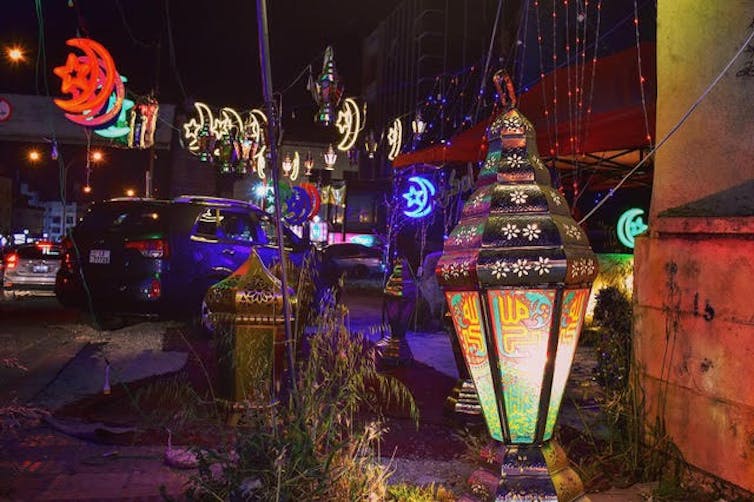
Fanous, the colorful lanterns of Ramadan, light up the streets of Amman, Jordan, throughout the holy month of fasting.
Ken Chitwood, CC BY
In places like Jordan, with its Muslim majority population, the days before Eid al-Fitr can see a rush at local malls and special “Ramadan markets” as people prepare to exchange gifts on Eid al-Fitr.
In Turkey and in places that were once part of the Ottoman-Turkish empire such as Bosnia and Herzegovina, Albania, Azerbaijan and the Caucasus, it is also known as the, “Lesser Bayram” or “festival” in Turkish.
4. How do Muslims celebrate Eid al-Adha?
The other festival, Eid al-Adha, is the “feast of the sacrifice.” It comes at the end of the Hajj, an annual pilgrimage by millions of Muslims to the holy city of Mecca in Saudi Arabia that is obligatory once in a lifetime, but only for those with means.
Eid al-Adha recalls the story of how God commanded Ibrahim to sacrifice his son Ismail as a test of faith. The story, as narrated in the Quran, describes Satan’s attempt to tempt Ibrahim so he would disobey God’s command. Ibrahim, however, remains unmoved and informs Ismail, who is willing to be sacrificed.
But, just as Ibrahim attempts to kill his son, God intervenes and a ram is sacrificed in place of Ismail. During Eid al-Adha, Muslims slaughter an animal to remember Ibrahim’s sacrifice and remind themselves of the need to submit to the will of God.
5. When are they celebrated?
Eid al-Fitr is celebrated on the first day of the 10th month in the Islamic calendar.
Eid al-Adha is celebrated on the 10th day of the final month in the Islamic calendar.
The Islamic calendar is a lunar calendar, and dates are calculated based on lunar phases. Since the Islamic calendar year is shorter than the solar Gregorian calendar year by 10 to 12 days, the dates for Ramadan and Eid on the Gregorian calendar can vary year by year.
6. What is the spiritual meaning of Eid al-Fitr?
Eid al-Fitr, as it follows the fasting of Ramadan, is also seen as a spiritual celebration of Allah’s provision of strength and endurance.
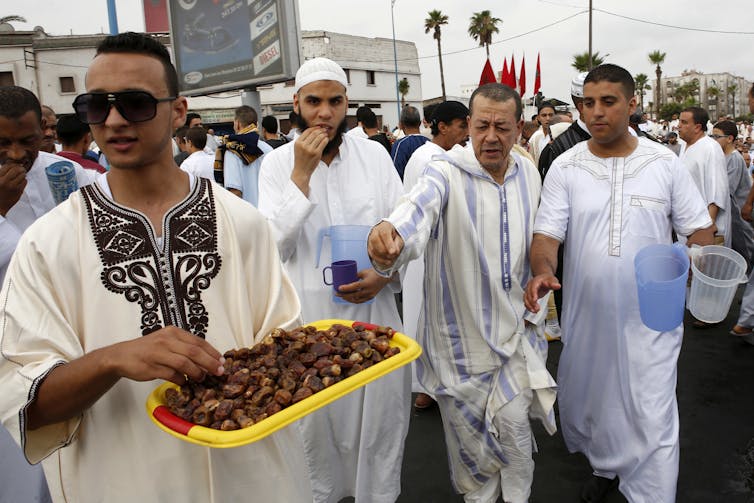
People distribute food and drinks during the Eid celebrations in Casablanca, Morocco.
AP Photo/Abdeljalil Bounhar
Amid the reflection and rejoicing, Eid al-Fitr is a time for charity, known as Zakat al-Fitr. Eid is meant to be a time of joy and blessing for the entire Muslim community and a time for distributing one’s wealth.
Charity to the poor is a highly emphasized value in Islam. The Quran says,
“Believe in Allah and his messenger, and give charity out of the (substance) that Allah has made you heirs of. For those of you who believe and give charity – for them is a great reward.”
This piece incorporates materials from an article first published on Aug. 28, 2017.
Ken Chitwood, Ph.D. Candidate, Religion in the Americas, Global Islam, University of Florida
This article is republished from The Conversation under a Creative Commons license. Read the original article.
Previous Post

May 30, 2019
What Israel's New Election Reveals About the Struggle Over Jewishness
Next Post

June 4, 2019 Teaching in America's Prisons Has Taught Me to Believe in Second Chances
Browse Our Archives
Select a Category Story of God Uncategorized
Select a Month September 2022 August 2022 January 2022 December 2021 August 2021 July 2021 February 2021 January 2021 January 2020 December 2019 November 2019 October 2019 September 2019 August 2019 July 2019 June 2019 May 2019 April 2019 March 2019 February 2019 January 2019 December 2018 November 2018 October 2018 September 2018 July 2018 June 2018 May 2018 April 2018 November 2017 October 2017 August 2017 June 2017 May 2017 April 2017 November 2016 October 2016 September 2016 July 2016 June 2016 May 2016 April 2016 March 2016 February 2016 January 2016 December 2015 November 2015 October 2015 September 2015 August 2015 July 2015 June 2015 May 2015 April 2015 March 2015 February 2015 January 2015 December 2014 October 2014 September 2014 July 2014 May 2014 April 2014 March 2014 February 2014 January 2014 September 2013 August 2013 July 2013 June 2013 May 2013 April 2013 March 2013 February 2013 January 2013 December 2012
Follow Us!
TAKE THE
Religious Wisdom Quiz
Multitudes, multitudes in the valley of decision! What is this valley also called?
Select your answer to see how you score.
The valley of judgment The valley of Megiddo The valley of Jehoshaphat The valley of Kidron
Related posts from Religion Now
Why Jefferson's Vision of American Islam Matters Today
Secondary Separation, in Islam

Respect for Women Is a Common Bond in...

Dangers of Legitimizing Bigotry
TRENDING AT PATHEOS Religion News

Catholic Integralists believe that religious values – specifically Christian ones – should...

Electing A Virtuous President Would Make Immunity Irrelevant
Presidential immunity can bring with it many risks. So how can we...

Why The Olympic Games Are A ‘Civil Religious’...
Sporting events form a vital space where Americans display their 'civil religious...

After more than a decade of news, research updates, and insights on...

Q: Why do Southern Baptists and like-minded Protestants...
THE RELIGION GUY’S ANSWER: Why? Simple. Because they believe that’s what the...

THE QUESTION: Is gambling evil? THE RELIGION GUY’S ANSWER: Analysts anticipate a...
view all Religion News blogs
Ad-Free & Subscriber Log-In Subscription Support
- About Us
- 2026 Calendar
- Videos
- Podcasts
- Library of World Religions
- Faith In Media Tracker
- Advertise With Us
- Write for Us
- Privacy Policy
- Terms of Service
- Do Not Sell My Data
- Contact Us
- Radiant Digital
- Manage Newsletter Subscriptions
- Unsubscribe From Notifications
- Sitemap
Copyright 2008-2026, Patheos. All rights reserved.
Subscription Support Ad-Free & Subscriber Log-In
Follow Patheos