
BuddhistCatholicContemplativeEvangelicalGeneral ChristianHinduJewishLatter-day SaintMuslimNew VisionsProgressive Christian
Beliefs
- Buddhist
- Catholic
- Contemplative
- Evangelical
- General Christian
- Hindu
- Jewish
- Latter-day Saint
- More Voices
- Muslim
- New Visions
- Pagan
- Progressive Christian
Topics
- Religion News
- Food and Religion
- Sports and Religion
- Religious Art
- Religious Music and Entertainment
- Religious Events
- History and Religion
- Style and Religion
- Politics and Religion
- Women in Religion
- Recreation Outdoors and Religion
- Business Finance and Religion
- Careers Workplace and Religion
- Education and Religion
- Family Parenting and Religion
- Health Fitness and Religion
- Home and Religion
- Relationships and Religion
- Technology and Religion
- Travel and Religion
Columnists
- Buddhist Columnists
- Business Finance and Religion Columnists
- Careers Workplace and Religion Columnists
- Catholic Columnists
- Contemplative Columnists
- Education and Religion Columnists
- Evangelists Columnists
- Family Parenting and Religion Columnists
- General Christian Columnists
- Health Fitness and Religion Columnists
- Hindu Columnists
- History and Religion Columnists
- Home and Religion Columnists
- Jewish Columnists
- More Voices Columnists
- Latter Day Columnists
- Muslim Columnists
- New Visions Columnists
- Nonreligious Columnists
- Pagan Columnists
- Politics and Religion Columnists
- Progressive Columnists
- Recreation Outdoors and Religion Columnists
- Relationships and Religion Columnists
- Religion News Columnists
- Religious Art Columnists
- Religious Events Columnists
- Religious Music and Entertainment Columnists
- Sports and Religion Columnists
- Style and Religion Columnists
- Technology and Religion Columnists
- Travel and Religion Columnists
- Women in Religion Columnists
Resource Library
- 2026 Calendar
- Library of World Religions
- The 100 Most Holy Places on Earth
- Patheos Answers
- Podcasts
- Videos
- Faith Leaders Database
- Anglican Episcopalian
- Bahai
- Baptist
- Buddhism
- Christianity
- Confucianism
- Eastern Orthodoxy
- Hinduism
- Holiness and Pentecostal
- ISKCON
- Islam
- Judaism
- Lutheran
- Methodist
- The Church of Jesus Christ of Latter-day Saints
- New Age
- Paganism
- Presbytarian and Reformed
- Protestantism
- Religion Behind the Scenes
- Roman Catholic
- Scientology
- Shia Islam
- Sikhism
- Sufism
- Sunni Islam
- Taoism
- Zen
- See all religions
Research Tools
 Ad-Free & Subscriber Log-In Subscription Support
Ad-Free & Subscriber Log-In Subscription Support
Follow Patheos 

- Trending:
- Forgiveness
- |
- Marriage
- |
- Consciousness
- |
- Death Penalty
- |
- Election
- |
- Halloween

- Home
- Religion News
- Why Good Friday Was Dangerous for Jews in the Middle Ages and How That Changed
Why Good Friday Was Dangerous for Jews in the Middle Ages and How That Changed
Last updated on: April 18, 2019 at 6:00 am by The Conversation
Why Good Friday Was Dangerous for Jews in the Middle Ages and How That Changed 2019-04-17T19:27:16-04:00 The Conversation
Patheos Explore the world's faith through different perspectives on religion and spirituality! Patheos has the views of the prevalent religions and spiritualities of the world.
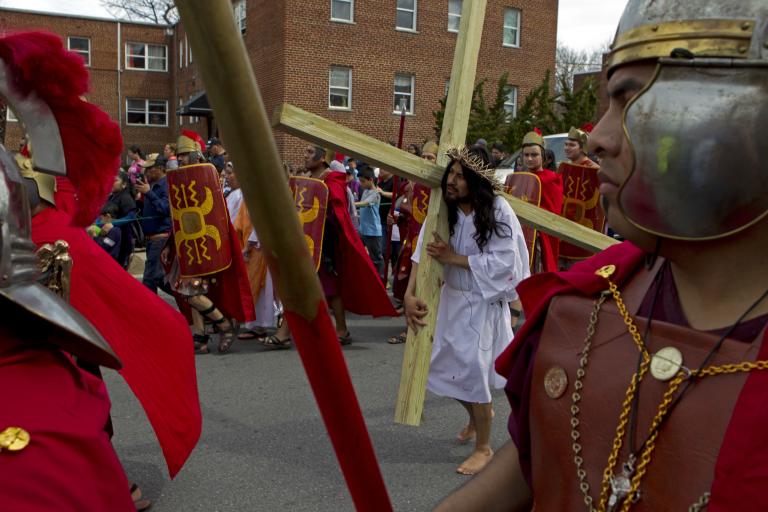
Jesus Christ, portrayed by Bertin Gonzalez reenacts the Passion of Christ, with other parishioners of St. Bernard Catholic Church, during a Good Friday procession to commemorate the Stations of the Cross in Riverdale Md. on Friday, March 30, 2018. ( AP Photo/Jose Luis Magana)
Daniel Joslyn-Siemiatkoski, Seminary of the Southwest
As Christians observe Good Friday they will remember, with devotion and prayer, the death of Jesus on the Cross. It is a day of solemnity in which Christians give thanks for their salvation made possible by the suffering of Jesus. They prepare for rejoicing on Easter Sunday, when the resurrection of Jesus is celebrated.
In the Middle Ages, however, Good Friday was a dangerous time for Jews.
Good Friday in the Middle Ages
As a scholar of Jewish-Christian relations, I teach a course called “Undoing Anti-Judaism” at my seminary with a local rabbi. What I have found is that since at least the fourth century, Christians have traditionally read the Gospel of John’s version of the trial and death of Jesus during Good Friday services. This gospel persistently uses the phrase “the Jews” to describe those who conspired to kill Jesus.
This language shifted the blame for the death of Jesus in medieval Christianity from Roman authorities to the Jewish people as a whole.
During the medieval Good Friday service, Christians prayed for the “perfidious” – or deceitful – Jews that God might “remove the veil from their hearts so that they would know Jesus Christ.” In another part of the service, a crucifix was placed in front of the congregation so people could venerate the crucified body of Jesus.
During this time, a chant known as “the Reproaches” was sung. In this piece, the voice of God accused the Jewish people of faithlessness in rejecting Jesus as their Messiah and crucifying him instead.
Medieval Christians thus received the message on Good Friday that the Jews who lived in their midst were the enemies of Christians who killed their savior and needed to either convert to Christianity or face divine punishment.
Good Friday and medieval Jews
This language about Jews in the medieval Good Friday liturgy often carried over into physical violence toward local Jewish communities.
It was common for Jewish houses to be attacked with stones. Often these attacks were led by the clergy. David Nirenberg, a scholar of medieval Jewish-Christian relations, argues that this violence reenacted the violence of Jesus’ suffering and death.
Another scholar of this history, Lester Little, argues that the attack on the Jewish community was meant to be a revenge for the death of Jesus and a ritual act that reinforced the boundary between Jews and Christians.
Local clergy who encouraged and participated in the violence against Jews were in violation of the rules of their own church. Church law sought to protect Jews and required them to stay inside on Good Friday. Historically, the western church took responsibility for the safeguarding of Jewish communities because they viewed Jews as preservers of the Old Testament, and thus of the prophecies concerning Jesus. Official positions were, however, often ignored locally as many Christians sought to assert their power over the Jewish community.
Civil authorities protected Jews by setting up armed guards and not permitting Christians under 16 years to throw stones. But this could not always prevent bloodshed and violence.
What changed after World War II
Although violence against Jews on Good Friday receded after the medieval period, the language about Jews in the Good Friday service did not go away until the 20th century. After the Holocaust, Christian churches realized that their own teachings and practices had contributed to the Nazi genocide against the Jewish people.
The Second Vatican Council was a turning point in Roman Catholicism. This was a gathering of all bishops in the church that met from 1962 to 1965 and set a new direction for how the church would engage with the modern world.
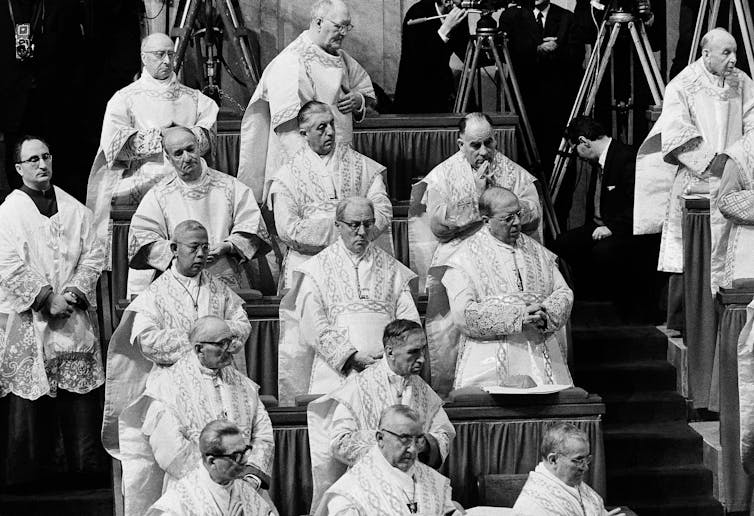
Cardinals at the Second Vatican Council in St. Peter’s Basilica, Vatican City in 1963.
AP Photo
During the council, the Roman Catholic Church issued a decree on relations with non-Christians called “Nostra Aetate.”
This document affirmed that the church emerged from the Jewish people and declared that Jews should not be held responsible for the death of Jesus. Furthermore, Nostra Aetate stated that it “decries hatred, persecutions, displays of anti-Semitism, directed against Jews at any time and by anyone.”
As a result of this decree, the Roman Catholic Church began a concerted effort that continues to this day to improve relations with the Jewish people and engage in extended dialogues.
Although some churches still use the Reproaches during Good Friday services, it is less common, and the negative language about Jews often has been removed. Among Roman Catholics, a revised prayer for the conversion of the Jews is still permitted, though only in the Latin version of the liturgy. This version of liturgy is only used by a minority of Catholics.
The most common version of the Good Friday service used by Roman Catholics now has a new prayer that recognizes the Jewish people’s relationship with God that replaces the prayer for the conversion of Jews.
Around the same time after the Holocaust, many Protestant churches in Europe and North America also worked to revise their Holy Week services so that anti-Jewish language and actions were avoided.
The work that remains
However, there is still some work to be done on the worship services of Holy Week, including in my tradition of the Episcopal Church.
In my church, the Gospel of John remains the only authorized passion narrative for the Good Friday service. While the reading of the Gospel of John does not explicitly encourage violence against Jews, retaining this reading as the only option for Good Friday, I believe, might show an unwillingness by the institutional church to confront the history of its use.
I want to emphasize that the Episcopal Church has elsewhere encouraged reconciliation and dialogue with Jews in the United States. Similarly, Christians of other denominations too have demonstrated time and again how they stand against acts of violence against Jews.

Communities came together after the shooting at Tree of Life Synagogue in Pittsburgh.
AP Photo/Keith Srakocic
In October 2018, Christians across the country gathered in the synagogues of their Jewish neighbors to mourn with them in the wake of the shooting at the Tree of Life Synagogue in Pittsburgh.
But more work needs to address wherever the legacy of hostility against Jews remains embedded in Christian scriptures and liturgies.
Daniel Joslyn-Siemiatkoski, Professor of Church History, Seminary of the Southwest
This article is republished from The Conversation under a Creative Commons license. Read the original article.

Next Post

May 1, 2019 From Paris to Boston, the Crucial Role of Fire Chaplains
Browse Our Archives
Select a Category Story of God Uncategorized
Select a Month September 2022 August 2022 January 2022 December 2021 August 2021 July 2021 February 2021 January 2021 January 2020 December 2019 November 2019 October 2019 September 2019 August 2019 July 2019 June 2019 May 2019 April 2019 March 2019 February 2019 January 2019 December 2018 November 2018 October 2018 September 2018 July 2018 June 2018 May 2018 April 2018 November 2017 October 2017 August 2017 June 2017 May 2017 April 2017 November 2016 October 2016 September 2016 July 2016 June 2016 May 2016 April 2016 March 2016 February 2016 January 2016 December 2015 November 2015 October 2015 September 2015 August 2015 July 2015 June 2015 May 2015 April 2015 March 2015 February 2015 January 2015 December 2014 October 2014 September 2014 July 2014 May 2014 April 2014 March 2014 February 2014 January 2014 September 2013 August 2013 July 2013 June 2013 May 2013 April 2013 March 2013 February 2013 January 2013 December 2012
Follow Us!
TAKE THE
Religious Wisdom Quiz
Which woman was the judge and prophetess who led Israel?
Select your answer to see how you score.
Deborah Miriam Esther Jael
Related posts from Religion Now

Why Trump's Tweets on Ilhan Omar and Rashida...

Daniel Berrigan and Rabbi Ben-Zion Gold: Missing Voices...
"Covenant and Controversy": Examining the Christian Roots of...

TRENDING AT PATHEOS Religion News

Catholic Integralists believe that religious values – specifically Christian ones – should...

Electing A Virtuous President Would Make Immunity Irrelevant
Presidential immunity can bring with it many risks. So how can we...

Why The Olympic Games Are A ‘Civil Religious’...
Sporting events form a vital space where Americans display their 'civil religious...

After more than a decade of news, research updates, and insights on...

Q: Why do Southern Baptists and like-minded Protestants...
THE RELIGION GUY’S ANSWER: Why? Simple. Because they believe that’s what the...

THE QUESTION: Is gambling evil? THE RELIGION GUY’S ANSWER: Analysts anticipate a...
view all Religion News blogs
Ad-Free & Subscriber Log-In Subscription Support
- About Us
- 2026 Calendar
- Videos
- Podcasts
- Library of World Religions
- Faith In Media Tracker
- Advertise With Us
- Write for Us
- Privacy Policy
- Terms of Service
- Do Not Sell My Data
- Contact Us
- Radiant Digital
- Manage Newsletter Subscriptions
- Unsubscribe From Notifications
- Sitemap
Copyright 2008-2026, Patheos. All rights reserved.
Subscription Support Ad-Free & Subscriber Log-In
Follow Patheos