
BuddhistCatholicContemplativeEvangelicalGeneral ChristianHinduJewishLatter-day SaintMuslimNew VisionsProgressive Christian
Beliefs
- Buddhist
- Catholic
- Contemplative
- Evangelical
- General Christian
- Hindu
- Jewish
- Latter-day Saint
- More Voices
- Muslim
- New Visions
- Pagan
- Progressive Christian
Topics
- Religion News
- Food and Religion
- Sports and Religion
- Religious Art
- Religious Music and Entertainment
- Religious Events
- History and Religion
- Style and Religion
- Politics and Religion
- Women in Religion
- Recreation Outdoors and Religion
- Business Finance and Religion
- Careers Workplace and Religion
- Education and Religion
- Family Parenting and Religion
- Health Fitness and Religion
- Home and Religion
- Relationships and Religion
- Technology and Religion
- Travel and Religion
Columnists
- Buddhist Columnists
- Business Finance and Religion Columnists
- Careers Workplace and Religion Columnists
- Catholic Columnists
- Contemplative Columnists
- Education and Religion Columnists
- Evangelists Columnists
- Family Parenting and Religion Columnists
- General Christian Columnists
- Health Fitness and Religion Columnists
- Hindu Columnists
- History and Religion Columnists
- Home and Religion Columnists
- Jewish Columnists
- More Voices Columnists
- Latter Day Columnists
- Muslim Columnists
- New Visions Columnists
- Nonreligious Columnists
- Pagan Columnists
- Politics and Religion Columnists
- Progressive Columnists
- Recreation Outdoors and Religion Columnists
- Relationships and Religion Columnists
- Religion News Columnists
- Religious Art Columnists
- Religious Events Columnists
- Religious Music and Entertainment Columnists
- Sports and Religion Columnists
- Style and Religion Columnists
- Technology and Religion Columnists
- Travel and Religion Columnists
- Women in Religion Columnists
Resource Library
- 2026 Calendar
- Library of World Religions
- The 100 Most Holy Places on Earth
- Patheos Answers
- Podcasts
- Videos
- Faith Leaders Database
- Anglican Episcopalian
- Bahai
- Baptist
- Buddhism
- Christianity
- Confucianism
- Eastern Orthodoxy
- Hinduism
- Holiness and Pentecostal
- ISKCON
- Islam
- Judaism
- Lutheran
- Methodist
- The Church of Jesus Christ of Latter-day Saints
- New Age
- Paganism
- Presbytarian and Reformed
- Protestantism
- Religion Behind the Scenes
- Roman Catholic
- Scientology
- Shia Islam
- Sikhism
- Sufism
- Sunni Islam
- Taoism
- Zen
- See all religions
Research Tools
 Ad-Free & Subscriber Log-In Subscription Support
Ad-Free & Subscriber Log-In Subscription Support
Follow Patheos 

- Trending:
- Forgiveness
- |
- Marriage
- |
- Consciousness
- |
- Death Penalty
- |
- Election
- |
- Halloween

- Home
- Religion News
- Do You Have a Moral Duty to Pay Taxes?
Do You Have a Moral Duty to Pay Taxes?
Last updated on: April 15, 2019 at 11:42 am by The Conversation
Do You Have a Moral Duty to Pay Taxes? 2019-04-15T11:42:16-04:00 The Conversation
Patheos Explore the world's faith through different perspectives on religion and spirituality! Patheos has the views of the prevalent religions and spiritualities of the world.
By Brookes Brown, Clemson University
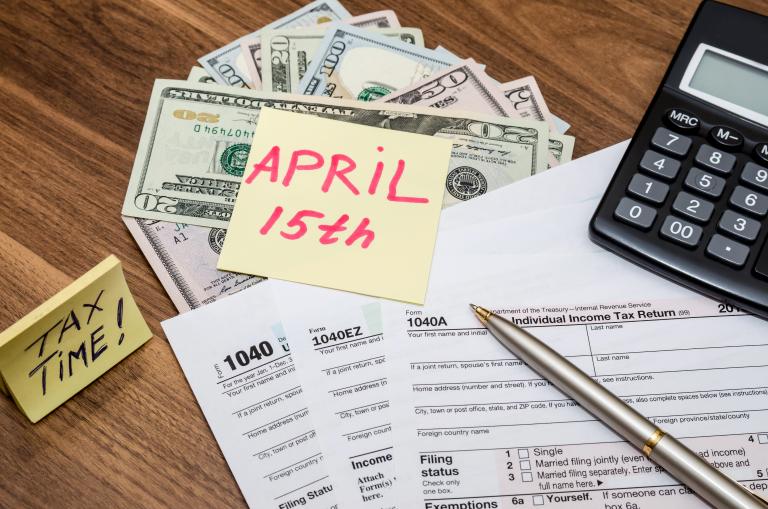
It’s tax season. Americans will pay an average of US$10,489 in personal taxes – about 14 percent of the average household’s total income.
Most will do so because they think it is their civic duty. Many believe they are morally obliged to obey the law and pay their share. But as tax day approaches, many Americans will bemoan their tax bill and complain that it is unfair.
So, how are we to know if paying taxes is the right thing to do? Perhaps philosophy has some clues?
Reasons to obey the law
Many philosophers agree that we should obey the law. In his book, “The Crito,” Plato, for example, describes Socrates’ choice after the Athenian jury sentenced him to death for impiety. Crito, a wealthy friend of Socrates, arranges for him to escape from the prison a night before his execution. Socrates refuses saying he ought to obey the law.
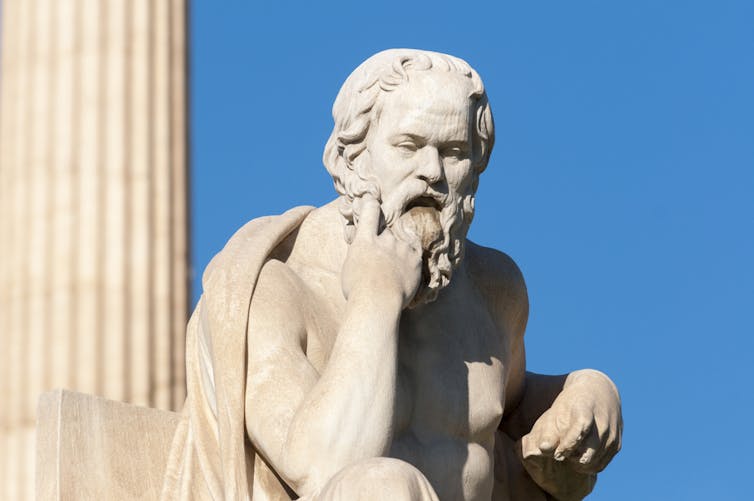
Socrates chose to die rather than disobey the Athenian jury.
vangelis aragiannis/Shutterstock.com
In explaining his decision, Socrates hinted at roughly three reasons why it would be wrong for him to break the law: First, he had chosen to stay in the city for many years despite being at liberty to leave if he did not like the laws. Second, he might hurt other people – by damaging the state if he disobeyed. Finally, he had benefited from the laws in the past.
More recent scholars endorse many of these claims. Eighteenth-century philosophers like John Locke and Jean-Jacques Rousseau argued that citizens agreed to the law of the state by continuing to live in the place. Locke, for example, held that “if a man owns or enjoys some part of the land under a given government, while that enjoyment lasts he gives his tacit consent to the laws of that government and is obliged to obey them.”
Twentieth-century British philosopher R.M. Hare suggests that citizens should obey the law to promote good social outcomes.
Another British philosopher of the same era, H.L.A. Hart argued that citizens should comply out of fairness to others who obey. He held that it is unfair, and therefore wrong to benefit from their actions, without doing the same for them in turn.
Is there a moral duty to pay taxes?
Yet it is hard to see why these arguments would give the average citizen a moral responsibility to pay their taxes.
Most of us never consented to the law. We were simply born here. Leaving would be costly, and even the chance to emigrate is dependent on another country’s willingness to accept us.
Given the amount of government waste and its total budget individual citizens could think that their tax bill is unlikely to make a difference to the services the government can provide. Even if they agree with how the government spends money, they might therefore conclude they have no reason to contribute. After all, one person’s ten thousand dollars is not going to determine whether the military can secure national borders.
The most commonly defended argument from scholars for why one should pay taxes is a duty of fair play. Fair play is the notion of reciprocity, the idea that you should not take advantage of others.
As philosophers like George Klosko argue, people benefit from their fellow citizens paying their taxes.
They enjoy the roads that everyone helps pay for, the fire departments they fund. They ought to pay back fellow citizens who benefited them, just like you ought to do something for a friend who gives you a ride to the airport.
The case against paying taxes
As a philosopher who studies civic ethics, I have argued in a recent paper that this kind of responsibility still does not explain why one should pay taxes.
The idea that we have to pay your taxes because other people have benefited by paying theirs rests, from my perspective, on a wrongly narrow view of what it means to satisfy one’s duties of reciprocity. All that reciprocity requires is that one should compensate people for the work they have done that benefits us.
Just like we can repay a friend who gives us a ride to the airport by doing something else that benefits them – say, making them dinner or helping them move – so too can we repay our fellow citizens by doing something other than paying our taxes.
Lots of actions benefit your fellow citizens that you might pay for – taking a pay cut to do legally discretionary work to help the environment, volunteering to do policy research, choosing a career in public service over a more financially rewarding line of work, and more.
If you do enough such acts, it could be argued, you would have no duty of reciprocity to pay your taxes. You would already have done enough to compensate your fellow citizens.
Why pay taxes

Here’s why you should pay your taxes.
adriaticfoto/Shutterstock.com
Given this, the best argument for paying our taxes, as I argue in my paper, is “intellectual humility.” And here is what it means.
Satisfying these duties of reciprocity requires successfully compensating our fellow citizens for all the burdens they took on our behalf. As one can imagine, it is a hard calculation to make.
It is difficult to know if we have done enough. If we choose not to pay taxes because we think we have already repaid our fellow citizens in other ways, we run a strong risk of getting it wrong.
Paying the tax bill is one way of avoiding that risk and making sure we treat our fellow citizens fairly.
Editor’s note: This piece is part of our series on ethical questions arising from everyday life. We would welcome your suggestions. Please email us at [email protected].
Brookes Brown, Assistant Professor of Philosophy, Director of the Law, Liberty, & Justice Program, Clemson University
This article is republished from The Conversation under a Creative Commons license. Read the original article.
Previous Post

April 5, 2019
What Your Pet's Microchip Has to Do with the Mark of the Beast
Next Post

April 16, 2019 Why Are We so Moved by the Plight of the Notre Dame?
Browse Our Archives
Select a Category Story of God Uncategorized
Select a Month September 2022 August 2022 January 2022 December 2021 August 2021 July 2021 February 2021 January 2021 January 2020 December 2019 November 2019 October 2019 September 2019 August 2019 July 2019 June 2019 May 2019 April 2019 March 2019 February 2019 January 2019 December 2018 November 2018 October 2018 September 2018 July 2018 June 2018 May 2018 April 2018 November 2017 October 2017 August 2017 June 2017 May 2017 April 2017 November 2016 October 2016 September 2016 July 2016 June 2016 May 2016 April 2016 March 2016 February 2016 January 2016 December 2015 November 2015 October 2015 September 2015 August 2015 July 2015 June 2015 May 2015 April 2015 March 2015 February 2015 January 2015 December 2014 October 2014 September 2014 July 2014 May 2014 April 2014 March 2014 February 2014 January 2014 September 2013 August 2013 July 2013 June 2013 May 2013 April 2013 March 2013 February 2013 January 2013 December 2012
Follow Us!
TAKE THE
Religious Wisdom Quiz
What mountain was the site of Elijah's showdown with Baal's prophets?
Select your answer to see how you score.
Mount Hermon Mount Tabor Mount Carmel Mount Sinai
Related posts from Religion Now

Truth is Narrow, but God’s Grace is Wide

Is Progressive Christianity Counterfeit Gospel?


Reviving the Divine Feminine with Beth Ames Swartz
TRENDING AT PATHEOS Religion News

Catholic Integralists believe that religious values – specifically Christian ones – should...

Electing A Virtuous President Would Make Immunity Irrelevant
Presidential immunity can bring with it many risks. So how can we...

Why The Olympic Games Are A ‘Civil Religious’...
Sporting events form a vital space where Americans display their 'civil religious...

After more than a decade of news, research updates, and insights on...

Q: Why do Southern Baptists and like-minded Protestants...
THE RELIGION GUY’S ANSWER: Why? Simple. Because they believe that’s what the...

THE QUESTION: Is gambling evil? THE RELIGION GUY’S ANSWER: Analysts anticipate a...
view all Religion News blogs
Ad-Free & Subscriber Log-In Subscription Support
- About Us
- 2026 Calendar
- Videos
- Podcasts
- Library of World Religions
- Faith In Media Tracker
- Advertise With Us
- Write for Us
- Privacy Policy
- Terms of Service
- Do Not Sell My Data
- Contact Us
- Radiant Digital
- Manage Newsletter Subscriptions
- Unsubscribe From Notifications
- Sitemap
Copyright 2008-2026, Patheos. All rights reserved.
Subscription Support Ad-Free & Subscriber Log-In
Follow Patheos