
BuddhistCatholicContemplativeEvangelicalGeneral ChristianHinduJewishLatter-day SaintMuslimNew VisionsProgressive Christian
Beliefs
- Buddhist
- Catholic
- Contemplative
- Evangelical
- General Christian
- Hindu
- Jewish
- Latter-day Saint
- More Voices
- Muslim
- New Visions
- Pagan
- Progressive Christian
Topics
- Religion News
- Food and Religion
- Sports and Religion
- Religious Art
- Religious Music and Entertainment
- Religious Events
- History and Religion
- Style and Religion
- Politics and Religion
- Women in Religion
- Recreation Outdoors and Religion
- Business Finance and Religion
- Careers Workplace and Religion
- Education and Religion
- Family Parenting and Religion
- Health Fitness and Religion
- Home and Religion
- Relationships and Religion
- Technology and Religion
- Travel and Religion
Columnists
- Buddhist Columnists
- Business Finance and Religion Columnists
- Careers Workplace and Religion Columnists
- Catholic Columnists
- Contemplative Columnists
- Education and Religion Columnists
- Evangelists Columnists
- Family Parenting and Religion Columnists
- General Christian Columnists
- Health Fitness and Religion Columnists
- Hindu Columnists
- History and Religion Columnists
- Home and Religion Columnists
- Jewish Columnists
- More Voices Columnists
- Latter Day Columnists
- Muslim Columnists
- New Visions Columnists
- Nonreligious Columnists
- Pagan Columnists
- Politics and Religion Columnists
- Progressive Columnists
- Recreation Outdoors and Religion Columnists
- Relationships and Religion Columnists
- Religion News Columnists
- Religious Art Columnists
- Religious Events Columnists
- Religious Music and Entertainment Columnists
- Sports and Religion Columnists
- Style and Religion Columnists
- Technology and Religion Columnists
- Travel and Religion Columnists
- Women in Religion Columnists
Resource Library
- 2026 Calendar
- Library of World Religions
- The 100 Most Holy Places on Earth
- Patheos Answers
- Podcasts
- Videos
- Faith Leaders Database
- Anglican Episcopalian
- Bahai
- Baptist
- Buddhism
- Christianity
- Confucianism
- Eastern Orthodoxy
- Hinduism
- Holiness and Pentecostal
- ISKCON
- Islam
- Judaism
- Lutheran
- Methodist
- The Church of Jesus Christ of Latter-day Saints
- New Age
- Paganism
- Presbytarian and Reformed
- Protestantism
- Religion Behind the Scenes
- Roman Catholic
- Scientology
- Shia Islam
- Sikhism
- Sufism
- Sunni Islam
- Taoism
- Zen
- See all religions
Research Tools
 Ad-Free & Subscriber Log-In Subscription Support
Ad-Free & Subscriber Log-In Subscription Support
Follow Patheos 

- Trending:
- Forgiveness
- |
- Marriage
- |
- Consciousness
- |
- Death Penalty
- |
- Election
- |
- Halloween

- Home
- Religion News
- Digital Technology Offers New Ways to Teach Lessons From the Holocaust
Digital Technology Offers New Ways to Teach Lessons From the Holocaust
Last updated on: January 25, 2019 at 9:47 am by The Conversation
Digital Technology Offers New Ways to Teach Lessons From the Holocaust 2019-01-25T09:47:37-05:00 The Conversation
Patheos Explore the world's faith through different perspectives on religion and spirituality! Patheos has the views of the prevalent religions and spiritualities of the world.

Matthew Rosca-Halmagean, 17, right, a student at Westchester Academy for International Studies, asks a question to Holocaust survivor William Morgan using an interactive virtual conversation exhibit at the the Holocaust Museum Houston Friday, Jan. 11, 2019, in Houston. The University of Southern California Shoah Foundation has recorded 18 interactive testimonies with Holocaust survivors over the last several years. (AP Photo/David J. Phillip)
By Jennifer Rich, Rowan University
When it comes to understanding the horrors of the Holocaust – one of the key aims of International Holocaust Remembrance Day – most millennials are woefully lacking in knowledge. That much was laid bare in a 2018 study commissioned by the Claims Conference – an organization that supports survivors of the Holocaust.
For instance, the study found that nearly half of all millennials – that is, those born from the early 1980s through the 1990s – are unable to name even one of the more than 42,000 camps and ghettos in existence during the Holocaust. The same study found that 41 percent of millennials believe that substantially fewer Jewish people were murdered during the Holocaust than the accepted 6 million figure.
The Centre for Holocaust Education at the University College London found similar gaps in knowledge. For instance, the University College London study found that a third of England’s high school students “massively underestimated the scale of the murder of Jewish people.”
This is a problem when you consider that millennials and young people worldwide have entered or will soon enter classrooms in the United States and elsewhere as teachers.
I’ve found similar deficits in knowledge in my own research into Holocaust education. Several years ago, I conducted a study that measured what student teacher candidates in New Jersey knew about the Holocaust.
The study – which is soon to be published in the journal The Social Studies – found that teachers had giant gaps in their knowledge. Their responses prompted me to probe deeper.
Deficits in knowledge
In my survey of nearly 200 future teachers, I found that only 30 percent knew that the Jewish people were the primary victim of the Holocaust. Even fewer knew the correct century in which the Holocaust took place. Auschwitz was the only concentration camp they identified – although, in their responses, the teaching students spelled it 28 different ways.
This past fall – spurred in part by a rise in anti-Semitism – I conducted a follow-up survey to measure if these future teachers were learning anything more than in the past. The sample was modest but representative – 75 students, all on track to become teachers in another year or so. All had attended New Jersey public schools.
When the student teachers saw the questions, they groaned and uttered things such as, “I can’t believe I don’t know this.” (If you want to figure out how you might have done on the survey, you can ask yourself if you know the answers to the following survey questions: When did the Holocaust take place? What was the political party that perpetrated the Holocaust? Who were the victim groups? Who was the American president? What other genocides can you identify?)
After they completed the survey, the student teachers immediately began to search for the correct answers online. They were disappointed to see just how far off they were. One student teacher after another placed the Holocaust in the 1800s. Others listed Ronald Reagan as the American president during the Holocaust. Perhaps most disturbingly, many listed the number of victims in the thousands, which falls way short of the actual figure.
Digital lessons emerge
Every person cannot be expected to know every single facet of the Holocaust. At the same time, it’s deeply disturbing when large segments of the population don’t know basic facts about one of the most horrendous atrocities – actually a series of atrocities – ever perpetrated against humanity.
Knowing about the Holocaust is a vital part of historical understanding. It is a means of promoting tolerance and inclusion. And it also serves as a form of innoculation against future atrocities.
Fortunately, new advances in learning about the Holocaust through digital humanities offer new ways for American students and teachers – or anyone who cares to learn more about the Holocaust – to learn about an event that took place nearly three-quarters of a century ago.
Here are three examples:
Courtroom 600
The University of Connecticut recently unveiled Courtroom 600, a project that places users inside the courtroom at the Nuremberg trials where Nazis and collaborators were tried. This project, still in prototype form, allows users to engage with virtual reality technology in order to interact with a fictitious member of the United States team of prosecutors. It also enables users to read primary source documents, gather evidence and prosecute select defendants.
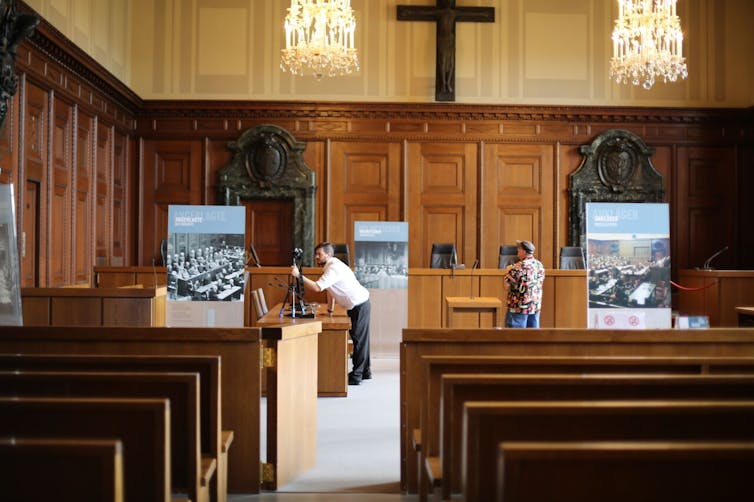
Ken Thompson, assistant professor-in-residence of game design, takes 3D scans of Courtroom 600 in the Justizpalast in Nuremberg, Germany.
University of Connecticut
IWitness and holograms
Another digital resource is available through the University of Southern California Shoah Foundation. The foundation, perhaps best known as the holder of thousands of Holocaust survivor testimonies, has created the IWitness program. This is a collection of 1,500 testimonies of survivors and witnesses to genocide – the Holocaust, as well as others like the Nanjing Massacre in China. The testimonies can be searched by subject. There are also ready-made lessons for teachers that can be accessed from anywhere and used freely at any time.
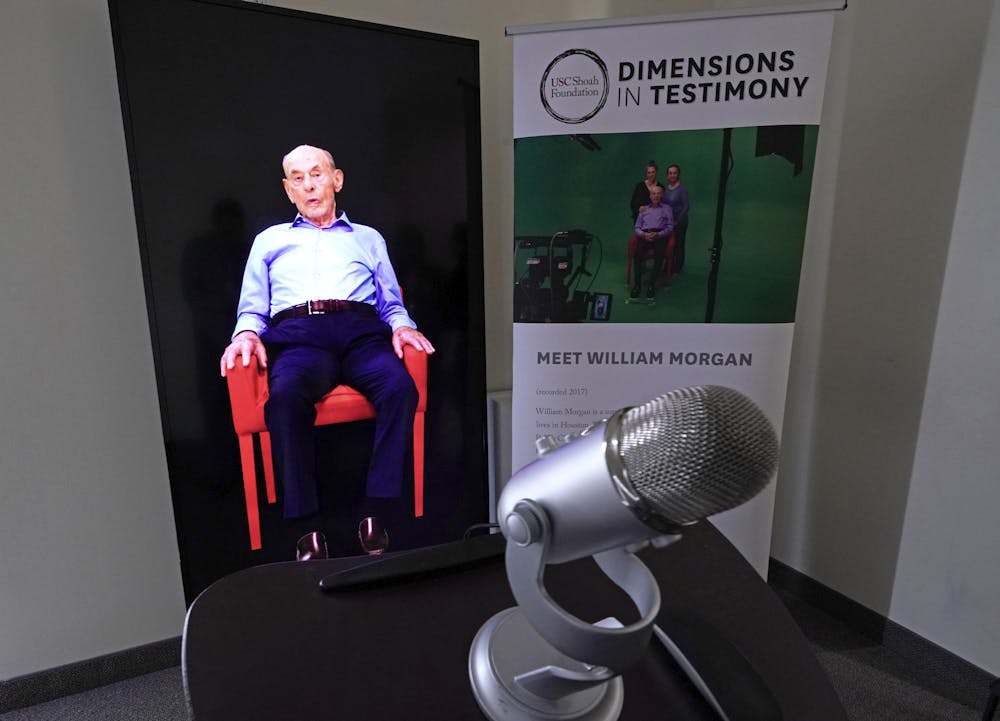
A Dimensions in Testimony exhibit featuring Holocaust survivor William Morgan using an interactive virtual conversation is shown at the the Holocaust Museum Houston. The University of Southern California Shoah Foundation has recorded 18 interactive testimonies with Holocaust survivors over the last several years.
David J. Phillip
The Shoah Foundation has also recently launched 3D holograms of survivors, giving users the experience of having a conversation with a survivor rather than passively viewing testimony. This project, called Dimensions in Testimony, is groundbreaking. It encourages students and others to engage with survivor testimony in new ways. For instance, each survivor hologram is able to participate in a “conversation,” with responses to commonly asked questions about faith, life before, during and after the war.
Digital source documents
Finally, a partnership between the United States Holocaust Memorial Museum, the Wiener Library in London, and the International Tracing Service in Bad Arolsen, Germany, has produced two online sourcebooks that feature primary sources that deal with the Holocaust. These online sources focus on the camp system and women under Nazi persecution.
Each guide provides images of primary sources found in the International Tracing Service database, descriptions, questions to guide conversation and further avenues of investigation for students. A high school teacher who is using these guides – even though they were originally intended for university-level classes – told me that the documents are easy to modify. She uses them to discuss how to read and engage with primary sources.
The International Tracing Service in Bad Arolsen has also produced an “ITS e-guide,” intended to help families and scholars better understand the vast array of paperwork that was produced for any given survivor or victim of the Holocaust. By clicking on an image of a document, users are able to learn more about what the document was used for, how to decode it, who created it, and what to consider when reading the document. Examples include prisoner registration cards, malaria cards and personal effects cards. These artifacts show the great lengths that Nazis went to keep records – even as they carried out one of the most horrific massacres that humanity has ever experienced.
Ultimately, there is not a single solution for the challenges that face Holocaust education. Still, these digital examples all move teaching and learning from passively reading textbooks to actively engaging with history.
As for the answers to the survey questions I mentioned above, the Holocaust took place from 1933 to 1945. The victim groups included Jews, Poles, Roma and Sinti, homosexuals, Jehovah’s Witnesses, people with disabilities and other groups deemed inferior. The American president during the Holocaust was Franklin D. Roosevelt. Other genocides in the 20th century include the Armenian, Cambodian, Rwandan and Bosnian genocides.
Jennifer Rich, Assistant Professor; Director of Research and Education for the Rowan Center for Holocaust and Genocide Studies, Rowan University
This article is republished from The Conversation under a Creative Commons license. Read the original article.
International Holocaust Remembrance Day
Previous Post

January 10, 2019
Who's More Compassionate, Republicans or Democrats?
Next Post

January 29, 2019 What are Muslim prayer rugs?
Browse Our Archives
Select a Category Story of God Uncategorized
Select a Month September 2022 August 2022 January 2022 December 2021 August 2021 July 2021 February 2021 January 2021 January 2020 December 2019 November 2019 October 2019 September 2019 August 2019 July 2019 June 2019 May 2019 April 2019 March 2019 February 2019 January 2019 December 2018 November 2018 October 2018 September 2018 July 2018 June 2018 May 2018 April 2018 November 2017 October 2017 August 2017 June 2017 May 2017 April 2017 November 2016 October 2016 September 2016 July 2016 June 2016 May 2016 April 2016 March 2016 February 2016 January 2016 December 2015 November 2015 October 2015 September 2015 August 2015 July 2015 June 2015 May 2015 April 2015 March 2015 February 2015 January 2015 December 2014 October 2014 September 2014 July 2014 May 2014 April 2014 March 2014 February 2014 January 2014 September 2013 August 2013 July 2013 June 2013 May 2013 April 2013 March 2013 February 2013 January 2013 December 2012
Follow Us!
TAKE THE
Religious Wisdom Quiz
How many books are in the Old Testament?
Select your answer to see how you score.
42 27 39 66
Related posts from Religion Now

The Little-Known Jewish History in the Heart of...

Truth is Narrow, but God’s Grace is Wide

Is Progressive Christianity Counterfeit Gospel?
TRENDING AT PATHEOS Religion News

Catholic Integralists believe that religious values – specifically Christian ones – should...

Electing A Virtuous President Would Make Immunity Irrelevant
Presidential immunity can bring with it many risks. So how can we...

Why The Olympic Games Are A ‘Civil Religious’...
Sporting events form a vital space where Americans display their 'civil religious...

After more than a decade of news, research updates, and insights on...

Q: Why do Southern Baptists and like-minded Protestants...
THE RELIGION GUY’S ANSWER: Why? Simple. Because they believe that’s what the...

THE QUESTION: Is gambling evil? THE RELIGION GUY’S ANSWER: Analysts anticipate a...
view all Religion News blogs
Ad-Free & Subscriber Log-In Subscription Support
- About Us
- 2026 Calendar
- Videos
- Podcasts
- Library of World Religions
- Faith In Media Tracker
- Advertise With Us
- Write for Us
- Privacy Policy
- Terms of Service
- Do Not Sell My Data
- Contact Us
- Radiant Digital
- Manage Newsletter Subscriptions
- Unsubscribe From Notifications
- Sitemap
Copyright 2008-2026, Patheos. All rights reserved.
Subscription Support Ad-Free & Subscriber Log-In
Follow Patheos