
BuddhistCatholicContemplativeEvangelicalGeneral ChristianHinduJewishLatter-day SaintMuslimNew VisionsProgressive Christian
Beliefs
- Buddhist
- Catholic
- Contemplative
- Evangelical
- General Christian
- Hindu
- Jewish
- Latter-day Saint
- More Voices
- Muslim
- New Visions
- Pagan
- Progressive Christian
Topics
- Religion News
- Food and Religion
- Sports and Religion
- Religious Art
- Religious Music and Entertainment
- Religious Events
- History and Religion
- Style and Religion
- Politics and Religion
- Women in Religion
- Recreation Outdoors and Religion
- Business Finance and Religion
- Careers Workplace and Religion
- Education and Religion
- Family Parenting and Religion
- Health Fitness and Religion
- Home and Religion
- Relationships and Religion
- Technology and Religion
- Travel and Religion
Columnists
- Buddhist Columnists
- Business Finance and Religion Columnists
- Careers Workplace and Religion Columnists
- Catholic Columnists
- Contemplative Columnists
- Education and Religion Columnists
- Evangelists Columnists
- Family Parenting and Religion Columnists
- General Christian Columnists
- Health Fitness and Religion Columnists
- Hindu Columnists
- History and Religion Columnists
- Home and Religion Columnists
- Jewish Columnists
- More Voices Columnists
- Latter Day Columnists
- Muslim Columnists
- New Visions Columnists
- Nonreligious Columnists
- Pagan Columnists
- Politics and Religion Columnists
- Progressive Columnists
- Recreation Outdoors and Religion Columnists
- Relationships and Religion Columnists
- Religion News Columnists
- Religious Art Columnists
- Religious Events Columnists
- Religious Music and Entertainment Columnists
- Sports and Religion Columnists
- Style and Religion Columnists
- Technology and Religion Columnists
- Travel and Religion Columnists
- Women in Religion Columnists
Resource Library
- 2026 Calendar
- Library of World Religions
- The 100 Most Holy Places on Earth
- Patheos Answers
- Podcasts
- Videos
- Faith Leaders Database
- Anglican Episcopalian
- Bahai
- Baptist
- Buddhism
- Christianity
- Confucianism
- Eastern Orthodoxy
- Hinduism
- Holiness and Pentecostal
- ISKCON
- Islam
- Judaism
- Lutheran
- Methodist
- The Church of Jesus Christ of Latter-day Saints
- New Age
- Paganism
- Presbytarian and Reformed
- Protestantism
- Religion Behind the Scenes
- Roman Catholic
- Scientology
- Shia Islam
- Sikhism
- Sufism
- Sunni Islam
- Taoism
- Zen
- See all religions
Research Tools
 Ad-Free & Subscriber Log-In Subscription Support
Follow Patheos 

- Trending:
- Advent
- |
- Forgiveness
- |
- Thanksgiving
- |
- Election
- |
- Seasonal Holidays
- |
- Marriage

- Home
- Religion News
- Religious Communities: Welcoming the “One-Percent”
Religious Communities: Welcoming the “One-Percent”
Last updated on: June 7, 2016 at 12:17 pm by Guest Contributor
Religious Communities: Welcoming the “One-Percent” 2016-06-07T12:17:31-04:00 Guest Contributor
Patheos Explore the world's faith through different perspectives on religion and spirituality! Patheos has the views of the prevalent religions and spiritualities of the world.
By Shaun Casey.
The success of refugee resettlement undoubtedly has required a “whole of society collaboration,” and it is a woefully under-told good news story.
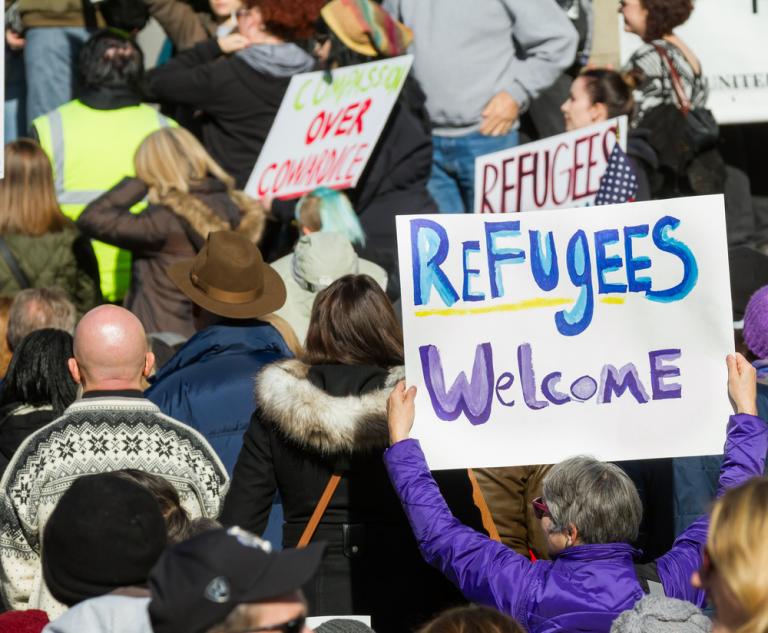
txking / Shutterstock.com
During the past few months, I’ve been privileged to have one-on-one conversations with some of the “1 percent” in the United States. To be clear, I’m not talking about the wealthiest of the approximately 318 million Americans in the United States. I’m referring to refugees resettled in cities like Des Moines, Dallas, Phoenix, Chicago, Jersey City, and Baltimore—refugees that are among the more than 3 million people that the United States government and its partners have resettled since 1975.
I met individuals like Nasser, a Burmese refugee who washes dishes at a local casino at night, but who by day is establishing a Rohingya cultural center to assist other refugee families. I spoke with Shakra, an Afghan woman who relays that she received death threats in her country of origin, and who now speaks in impassioned tones about her hopes that her eldest child can pursue dreams of becoming a doctor in the United States. I was privileged to talk with Youssef, an Iraqi refugee whose story is illustrative of the challenges and opportunities refugees face in creating a new life for themselves and their families in the United States. Youssef works 90 hours a week at two different jobs to provide a better life for his children. Recently he took the oath to become an American citizen, an experience he said was one of the most emotional and moving of his life. “I still believe in the American dream,” he said.
The refugee resettlement program in the U.S. is a unique public-private partnership that involves the U.S. Department of State, state governments, a network of nine contracted refugee resettlement agencies (six of which are religiously-affiliated), and the support of local communities. This includes civil society, municipal institutions, religious communities, and others that make resettlement processes possible. The success of refugee resettlement undoubtedly has required a “whole of society collaboration,” and it is a woefully under-told good news story.
Since Congress enacted its first refugee legislation in 1948 and admitted thousands of Europeans displaced from World War II, American religious communities, among others, have boldly been at the forefront of efforts to welcome refugees to the United States. When standardized federally-supported resettlement services were approved by Congress in 1980 and the United States faced the challenge of resettling hundreds of thousands of refugees, religious communities served as an example of the compassion, generosity, and leadership that are characteristic of American society.
It’s not hard to understand why. In April, Secretary Kerry gave a speech at Rice University about the intersection of religion and policy. He noted that “religion today remains deeply consequential, affecting the values, the actions, the choices, and the worldview of people in every walk of life on every continent and, obviously, also here at home.”
Consider for a moment that four out of five people on the planet identify with a religious tradition. Religious teachings, texts, movements, and leaders have been a powerful force in shaping political contexts and geographic boundaries. It is religion, beliefs, and values that are the catalysts that encourage many people to build bridges, not walls, with “the other.”
Secretary Kerry created the Office of Religion and Global Affairs in the U.S. Department of State to advise him and the entire U.S. State Department on how religion impacts U.S. foreign policy priorities. In its almost three years, our office has helped the Department establish wider and deeper ties with key religious stakeholders and actors who are effecting change in their societies. With regard to refugee resettlement, however, there is much to be learned and shared about American religious communities who have committed to reaching out to and supporting refugees—through financial support, furniture donations, offering English classes, creating women’s empowerment programs, establishing innovative agricultural incubator programs, and a myriad of other activities.
But religion is also complex. As Secretary Kerry noted, it can prompt some to eagerly reach across borders of nation and creed, and others to build higher and higher walls separating one group from the next. It can provide a justification to deny the common humanity shared with “the other,” or repudiate the idea that refugees enrich American communities economically and culturally. It has led Americans to conclude that the U.S. government and its partners cannot be equally concerned about the security in our country and the well-being of the world’s most vulnerable seeking a chance for a new life in the United States, when in fact the opposite is true.
June 20 is World Refugee Day, and an opportunity for the “99 percent” in the United States to welcome the “1 percent,” people hoping for an opportunity to live a normal life and effect positive change in their communities. In reality, though, almost all of us are the “1 percent”; our ancestors came from somewhere other than the territory we call the United States, seeking tolerance, freedom, and an ability to lead ordinary lives. Local community organizations, religious institutions and leaders, and volunteers are already taking visionary steps to welcome refugees and create connections. The challenge is identifying ways we can celebrate the diversity and resilience of American society, and the ways that all of us—all 100 percent—contribute to the strength of the United States.
 Shaun Casey serves as the Special Representative for Secretary Kerry’s Office of Religion and Global Affairs at the U.S. Department of State.
Previous Post

June 6, 2016
Judge Baylor: Football, Faith, and Price of Justice
Next Post

June 14, 2016 Christianity and Culture in the 2016 Election
Browse Our Archives
Select a Category Story of God Uncategorized
Select a Month September 2022 August 2022 January 2022 December 2021 August 2021 July 2021 February 2021 January 2021 January 2020 December 2019 November 2019 October 2019 September 2019 August 2019 July 2019 June 2019 May 2019 April 2019 March 2019 February 2019 January 2019 December 2018 November 2018 October 2018 September 2018 July 2018 June 2018 May 2018 April 2018 November 2017 October 2017 August 2017 June 2017 May 2017 April 2017 November 2016 October 2016 September 2016 July 2016 June 2016 May 2016 April 2016 March 2016 February 2016 January 2016 December 2015 November 2015 October 2015 September 2015 August 2015 July 2015 June 2015 May 2015 April 2015 March 2015 February 2015 January 2015 December 2014 October 2014 September 2014 July 2014 May 2014 April 2014 March 2014 February 2014 January 2014 September 2013 August 2013 July 2013 June 2013 May 2013 April 2013 March 2013 February 2013 January 2013 December 2012
Follow Us!
TAKE THE
Religious Wisdom Quiz
Who led the Israelites into the Promised Land?
Select your answer to see how you score.
Joshua Moses Caleb Aaron
Related posts from Religion Now
More Central American Migrants Take Shelter in Churches,...
Detaining Migrant Children at Military Bases Un-American? It's...
Today's Diverse American Muslim Population First Arrived 400...
Who's More Compassionate, Republicans or Democrats?
TRENDING AT PATHEOS Religion News

Catholic Integralists believe that religious values – specifically Christian ones – should...

Electing A Virtuous President Would Make Immunity Irrelevant
Presidential immunity can bring with it many risks. So how can we...

Why The Olympic Games Are A ‘Civil Religious’...
Sporting events form a vital space where Americans display their 'civil religious...

After more than a decade of news, research updates, and insights on...

Q: Why do Southern Baptists and like-minded Protestants...
THE RELIGION GUY’S ANSWER: Why? Simple. Because they believe that’s what the...

THE QUESTION: Is gambling evil? THE RELIGION GUY’S ANSWER: Analysts anticipate a...
view all Religion News blogs
Ad-Free & Subscriber Log-In Subscription Support
- About Us
- 2026 Calendar
- Videos
- Podcasts
- Library of World Religions
- Faith In Media Tracker
- Advertise With Us
- Write for Us
- Privacy Policy
- Terms of Service
- Do Not Sell My Data
- Contact Us
- Radiant Digital
- Manage Newsletter Subscriptions
- Unsubscribe From Notifications
- Sitemap
Copyright 2008-2026, Patheos, part of the Radiant Digital network of media brands. All rights reserved.
Subscription Support Ad-Free & Subscriber Log-In
Follow Patheos