
BuddhistCatholicContemplativeEvangelicalGeneral ChristianHinduJewishLatter-day SaintMuslimNew VisionsProgressive Christian
Beliefs
- Buddhist
- Catholic
- Contemplative
- Evangelical
- General Christian
- Hindu
- Jewish
- Latter-day Saint
- More Voices
- Muslim
- New Visions
- Pagan
- Progressive Christian
Topics
- Religion News
- Food and Religion
- Sports and Religion
- Religious Art
- Religious Music and Entertainment
- Religious Events
- History and Religion
- Style and Religion
- Politics and Religion
- Women in Religion
- Recreation Outdoors and Religion
- Business Finance and Religion
- Careers Workplace and Religion
- Education and Religion
- Family Parenting and Religion
- Health Fitness and Religion
- Home and Religion
- Relationships and Religion
- Technology and Religion
- Travel and Religion
Columnists
- Buddhist Columnists
- Business Finance and Religion Columnists
- Careers Workplace and Religion Columnists
- Catholic Columnists
- Contemplative Columnists
- Education and Religion Columnists
- Evangelists Columnists
- Family Parenting and Religion Columnists
- General Christian Columnists
- Health Fitness and Religion Columnists
- Hindu Columnists
- History and Religion Columnists
- Home and Religion Columnists
- Jewish Columnists
- More Voices Columnists
- Latter Day Columnists
- Muslim Columnists
- New Visions Columnists
- Nonreligious Columnists
- Pagan Columnists
- Politics and Religion Columnists
- Progressive Columnists
- Recreation Outdoors and Religion Columnists
- Relationships and Religion Columnists
- Religion News Columnists
- Religious Art Columnists
- Religious Events Columnists
- Religious Music and Entertainment Columnists
- Sports and Religion Columnists
- Style and Religion Columnists
- Technology and Religion Columnists
- Travel and Religion Columnists
- Women in Religion Columnists
Resource Library
- 2026 Calendar
- Library of World Religions
- The 100 Most Holy Places on Earth
- Patheos Answers
- Podcasts
- Videos
- Faith Leaders Database
- Anglican Episcopalian
- Bahai
- Baptist
- Buddhism
- Christianity
- Confucianism
- Eastern Orthodoxy
- Hinduism
- Holiness and Pentecostal
- ISKCON
- Islam
- Judaism
- Lutheran
- Methodist
- The Church of Jesus Christ of Latter-day Saints
- New Age
- Paganism
- Presbytarian and Reformed
- Protestantism
- Religion Behind the Scenes
- Roman Catholic
- Scientology
- Shia Islam
- Sikhism
- Sufism
- Sunni Islam
- Taoism
- Zen
- See all religions
Research Tools
 Ad-Free & Subscriber Log-In Subscription Support
Ad-Free & Subscriber Log-In Subscription Support
Follow Patheos 

- Trending:
- Forgiveness
- |
- Marriage
- |
- Consciousness
- |
- Death Penalty
- |
- Election
- |
- Halloween

- Home
- Religion News
- (Culture) War Is a Force That Gives Us Meaning
(Culture) War Is a Force That Gives Us Meaning
Last updated on: June 26, 2016 at 4:10 pm by Guest Contributor
(Culture) War Is a Force That Gives Us Meaning 2016-06-26T16:10:15-04:00 Guest Contributor
Patheos Explore the world's faith through different perspectives on religion and spirituality! Patheos has the views of the prevalent religions and spiritualities of the world.
By Christopher Pieper and Nathaniel Dietrick, Baylor University.
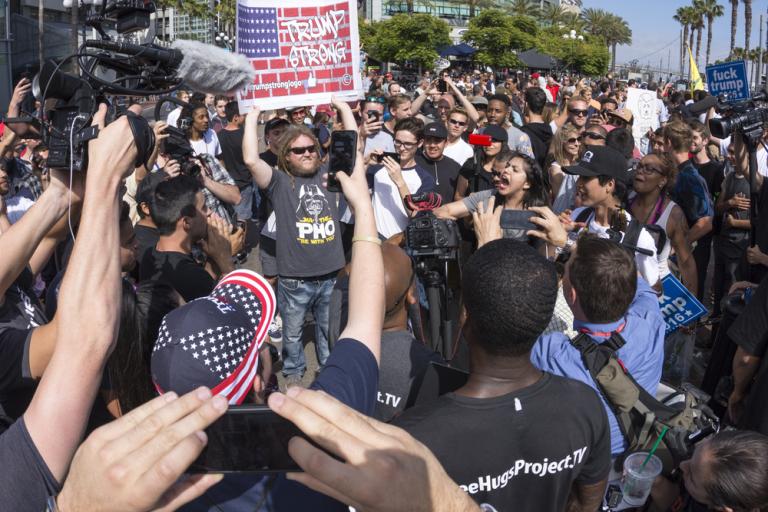
Chad Zuber / Shutterstock.com
In 2002, a year after America became embroiled in the War on Terror, journalist Chris Hedges published his insightful book, War Is A Force That Gives Us Meaning. There he relives his experiences as a reporter in many battle zones and beseeches American readers to consider the reasons for which they are consenting to war. But somewhere along the way, Hedges abandons the greater argument that the title implies. He teased at what we believe is the sociological answer, but it should be made clearer: Americans are deriving a sense of purpose and meaning from conflict, ranging in size from full-scale war to Twitter spats. Conflict has become a quick fix for the meaning many Americans are having difficulty finding in postmodern society.
The “culture wars” are now a familiar backdrop to our lives. Coined in the 1990s by sociologist James Davison Hunter, the term refers to battles between notions of moral orthodoxy and progressivism. As with Hedges, Hunter’s otherwise thorough treatment of the issue leaves one question inadequately addressed: Why is conflict so popular? On its surface, the resources and energy devoted to wars both military and cultural is taxing. What is the payoff of such an expensive investment?
While part of the culture wars can be attributed to a media system impelled to highlight drama in order to sustain high ratings, the reality of underlying cleavages persist. A 2014 study from the Pew Research Center reveals these exact divisions: over the past two decades, the number of Americans reporting consistently liberal or conservative views has doubled, climbing from 10 percent to 21 percent respectively. And while more Americans have moved to the extremes, more have also begun to perceive opposing ideologies as “so misguided that they threaten the nation’s well-being.” According to Pew, 36 percent of Republicans and 27 percent of Democrats fit this description. Not only have political views shifted, but views on the affairs of daily life have as well, such as where a family should live, the makeup of the neighborhood, and who is appropriate to marry. These data illustrate, in sharp relief, how ripe the American culture is for generating conflicts.
Traditionally a sense of meaning has been cultivated through institutions like religion, family, and even the state. In a 2007 address, sociologist Stephen McNamee outlined the key pathways to generating meaning: 1) emotionally engaging relationships, 2) work, 3) leisure, and 4) adherence to ideological systems. While these conventional purposes satisfy many, others remain restless. It is easy to see why. At no other point in history has there been such easy access to alternative ways of finding purpose in life. The Internet, mass media, and ease of travel expose us to an unprecedented menu of purposes and lifestyles to choose from. But as any postmodern will attest, too many options can be overwhelming.
These contemporary wanderers suffer from what Victor Frankl called an “existential vacuum,” resulting from institutions and instincts losing their influence. As Americans embrace expressive individualistic ideas and are allowed to choose how they find meaning, social institutions are less able to mold ideas about what constitutes purpose. This can cause immense stress, resulting in anomie, Emile Durkheim’s perfect term for a life unmoored from guiding structures and community. So how do anomic post-moderns find what they are looking for? Can those struggling to find a lofty purpose settle for a baser substitute?
American culture is saturated with “culture wars” and other wars on abstractions. The “war on Christmas” (remember the red Starbucks coffee cups kerfuffle?), the “war against masculinity,” “spiritual warfare,” and the wars on drugs, crime and terror—among similar others too countless to list— illustrate how ready Americans are to adopt a combative stance against foes often manufactured or exaggerated. These conflicts allow Americans opportunities to fly their tribal colors, skirmish with those who espouse threatening views, and find allies with which they can cultivate new ties. In every battle, victory or defeat, we fulfill our existential needs and find belonging—for a time.
As we march into the 2016 election, the appeal of conflict as a source of meaning has only become more apparent. Candidates will continue to engage in personal attacks, while strutting their own ideological purity. Despite their pleading to the contrary, Americans secretly love politics. Televised “debates” are designed to attract our conflict-addled minds. Candidates tailor their discourse to scripts popular with the drama-seeking masses, and the networks present the whole affair in a manner identical to a football game. Sports and politics are popular sociologically because they are structurally identical to America’s truly favorite pastime: fighting. And in fighting, we find a purpose for our lives, a structure for our time, and a cause to organize our lives behind. The 2016 campaign, in this light, is a Purposepalooza.
More than a century ago, Georg Simmel explored conflict analytically for the first time, finding a great many benefits. For Simmel, conflicts actually allow social groups to coexist; without the opportunity to express tension, the only result would be the termination of the relationship. Conflict gives us the the belief that we have the power to affect intergroup relationships. Without healthy conflict, society stagnates and may ignore serious problems. Social injustices are often brought to awareness and corrected by conflict.
What then, differentiates good conflict from bad? Here motive makes all the difference. When pursued with the sincere intent to right wrongs, conflict has an indispensable place in the world. When pursued, however, for its own sake due to a lack of more satisfying forms of purpose, conflict is wholly destructive.
This way of looking at the many conflicts in our culture allows us to understand that they are not fundamentally about what they seem to be about. They are engaged in to meet an existential need, not to defeat the enemy or resolve the tension. Indeed, most of these battles are chosen precisely because the enemy can never be defeated. Battle itself is the objective. Therefore, to a large degree, any enemy will suffice. It becomes clear after considering a number of cases over decades of history that the content of the conflict is near irrelevant. What is essential is the form. The form of conflict provides a structure and direction, a profound type of clarity to life, and ultimately a sense of belonging.
Note: There are alternatives to conflict, and a subsequent article will address these.
 Christopher Pieper, Ph.D is lecturer in sociology at Baylor University. His book Sociology as a Spiritual Practice: How Studying People Can Make You a Better Person, demonstrates that spirituality and social science are complementary paths toward personal and collective flourishing. He is now working on several projects related to morality, economics, and media culture.
 Nathaniel Dietrick is a sociology alumnus of Baylor University and longtime Wacoan. After finishing his military service he became interested in stratification, masculinity, and the reasons for conflict. He is currently serving as an AmeriCorps Vista working to build curriculum for a scholars program.

Next Post

June 27, 2016 Brexit: What Happened? And What's Next?
Recent Comments
Browse Our Archives
Select a Category Story of God Uncategorized
Select a Month September 2022 August 2022 January 2022 December 2021 August 2021 July 2021 February 2021 January 2021 January 2020 December 2019 November 2019 October 2019 September 2019 August 2019 July 2019 June 2019 May 2019 April 2019 March 2019 February 2019 January 2019 December 2018 November 2018 October 2018 September 2018 July 2018 June 2018 May 2018 April 2018 November 2017 October 2017 August 2017 June 2017 May 2017 April 2017 November 2016 October 2016 September 2016 July 2016 June 2016 May 2016 April 2016 March 2016 February 2016 January 2016 December 2015 November 2015 October 2015 September 2015 August 2015 July 2015 June 2015 May 2015 April 2015 March 2015 February 2015 January 2015 December 2014 October 2014 September 2014 July 2014 May 2014 April 2014 March 2014 February 2014 January 2014 September 2013 August 2013 July 2013 June 2013 May 2013 April 2013 March 2013 February 2013 January 2013 December 2012
Follow Us!
TAKE THE
Religious Wisdom Quiz
What is the name for the Christian practice of immersion or sprinkling in water to welcome believers?
Select your answer to see how you score.
Baptism Eucharist Confirmation Ordination
Related posts from Religion Now
Kneeling in Silence: Colin Kaepernick and the Religious...

The Rise of Virtue Signaling: The New Put-down...

Breaking Our Addiction to Conflict Through Creativity
TRENDING AT PATHEOS Religion News

Catholic Integralists believe that religious values – specifically Christian ones – should...

Electing A Virtuous President Would Make Immunity Irrelevant
Presidential immunity can bring with it many risks. So how can we...

Why The Olympic Games Are A ‘Civil Religious’...
Sporting events form a vital space where Americans display their 'civil religious...

After more than a decade of news, research updates, and insights on...

Q: Why do Southern Baptists and like-minded Protestants...
THE RELIGION GUY’S ANSWER: Why? Simple. Because they believe that’s what the...

THE QUESTION: Is gambling evil? THE RELIGION GUY’S ANSWER: Analysts anticipate a...
view all Religion News blogs
Ad-Free & Subscriber Log-In Subscription Support
- About Us
- 2026 Calendar
- Videos
- Podcasts
- Library of World Religions
- Faith In Media Tracker
- Advertise With Us
- Write for Us
- Privacy Policy
- Terms of Service
- Do Not Sell My Data
- Contact Us
- Radiant Digital
- Manage Newsletter Subscriptions
- Unsubscribe From Notifications
- Sitemap
Copyright 2008-2026, Patheos. All rights reserved.
Subscription Support Ad-Free & Subscriber Log-In
Follow Patheos