
BuddhistCatholicContemplativeEvangelicalGeneral ChristianHinduJewishLatter-day SaintMuslimNew VisionsProgressive Christian
Beliefs
- Buddhist
- Catholic
- Contemplative
- Evangelical
- General Christian
- Hindu
- Jewish
- Latter-day Saint
- More Voices
- Muslim
- New Visions
- Pagan
- Progressive Christian
Topics
- Religion News
- Food and Religion
- Sports and Religion
- Religious Art
- Religious Music and Entertainment
- Religious Events
- History and Religion
- Style and Religion
- Politics and Religion
- Women in Religion
- Recreation Outdoors and Religion
- Business Finance and Religion
- Careers Workplace and Religion
- Education and Religion
- Family Parenting and Religion
- Health Fitness and Religion
- Home and Religion
- Relationships and Religion
- Technology and Religion
- Travel and Religion
Columnists
- Buddhist Columnists
- Business Finance and Religion Columnists
- Careers Workplace and Religion Columnists
- Catholic Columnists
- Contemplative Columnists
- Education and Religion Columnists
- Evangelists Columnists
- Family Parenting and Religion Columnists
- General Christian Columnists
- Health Fitness and Religion Columnists
- Hindu Columnists
- History and Religion Columnists
- Home and Religion Columnists
- Jewish Columnists
- More Voices Columnists
- Latter Day Columnists
- Muslim Columnists
- New Visions Columnists
- Nonreligious Columnists
- Pagan Columnists
- Politics and Religion Columnists
- Progressive Columnists
- Recreation Outdoors and Religion Columnists
- Relationships and Religion Columnists
- Religion News Columnists
- Religious Art Columnists
- Religious Events Columnists
- Religious Music and Entertainment Columnists
- Sports and Religion Columnists
- Style and Religion Columnists
- Technology and Religion Columnists
- Travel and Religion Columnists
- Women in Religion Columnists
Resource Library
- 2026 Calendar
- Library of World Religions
- The 100 Most Holy Places on Earth
- Patheos Answers
- Podcasts
- Videos
- Faith Leaders Database
- Anglican Episcopalian
- Bahai
- Baptist
- Buddhism
- Christianity
- Confucianism
- Eastern Orthodoxy
- Hinduism
- Holiness and Pentecostal
- ISKCON
- Islam
- Judaism
- Lutheran
- Methodist
- The Church of Jesus Christ of Latter-day Saints
- New Age
- Paganism
- Presbytarian and Reformed
- Protestantism
- Religion Behind the Scenes
- Roman Catholic
- Scientology
- Shia Islam
- Sikhism
- Sufism
- Sunni Islam
- Taoism
- Zen
- See all religions
Research Tools
 Ad-Free & Subscriber Log-In Subscription Support
Ad-Free & Subscriber Log-In Subscription Support
Follow Patheos 

- Trending:
- Forgiveness
- |
- Marriage
- |
- Consciousness
- |
- Death Penalty
- |
- Election
- |
- Halloween

- Home
- Religion News
- Why It’s Possible to Reject the Klan and Still Support Racism
Why It’s Possible to Reject the Klan and Still Support Racism
Last updated on: March 3, 2016 at 12:59 pm by Guest Contributor
Why It’s Possible to Reject the Klan and Still Support Racism 2016-03-03T12:59:36-05:00 Guest Contributor
Patheos Explore the world's faith through different perspectives on religion and spirituality! Patheos has the views of the prevalent religions and spiritualities of the world.
By Rev. Dr. William J. Barber, II and Jonathan Wilson-Hartgrove
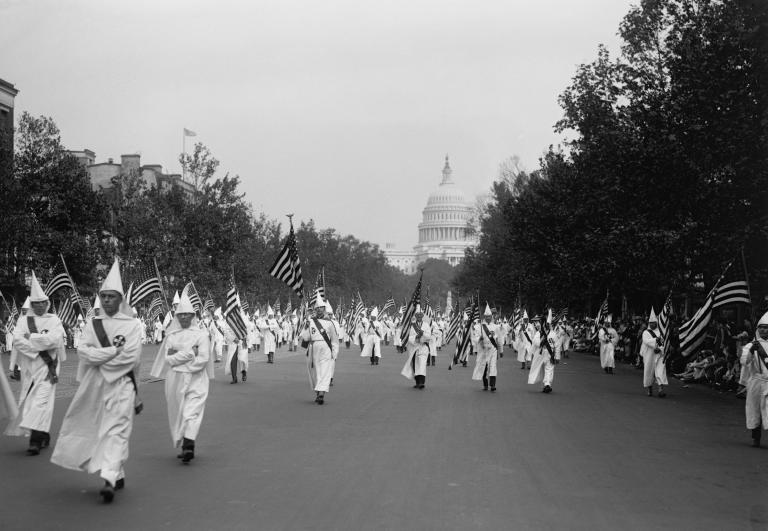
If Donald Trump is telling the truth, he only recently learned that David Duke, former Grand Wizard of the Ku Klux Klan, is an avowed segregationist. Apparently, the KKK and its history have faded from many white Americans’ memory. Jeffrey Lord argued on national television this week that the Klan is an invention of “the left.” As native sons of the South, we could forgive these men their ignorance. (“Bless their hearts. They ain’t from around here,” is the polite way to say it.) But we can neither forgive nor ignore the way 400 years of white supremacy have been naively reduced to whether a candidate will disavow the support of a hate group leader. Racism lives on in policies that perpetuate racial disparities, with or without the KKK.
For those unfamiliar with Southern history, white supremacists in the South have a long history of disavowing the KKK. Strom Thurmond disavowed them in 1964, even as he filibustered the Civil Rights Bill in the US Senate. White Citizens Councils disavowed them while they fought desegregation in Mississippi. George Wallace publicly disavowed Klan violence in Alabama, but hired Klansman Al Lingo to oversee his state’s Highway Patrol.
No one wants to be associated with the KKK in polite company today. But almost no one wanted to be publicly associated with them fifty years ago either.
Nor sixty years before that. Here in North Carolina, Democrats waged a take-over of state government in 1898, seeding a propaganda campaign to incite racial fears and arming the vigilante Red Shirts. But no sooner than they had regained power, Democratic leaders disavowed all violence and called for civility and a restoration of order.
Racial disparities in America have not persisted since the end of the Civil War because people believe in the ideology or the tactics of the KKK. Inequality continues because we have never finished the work of Reconstruction.
“Forty acres and a mule” was the promise to formerly enslaved people during the First Reconstruction, recognizing that their success would require an economic base. But black representatives in Reconstruction legislatures were clear that more was needed; they demanded equal access to education, voting rights, and equal protection under the law. The Klan’s violence didn’t end Reconstruction. While terror intimidated both black and white progressives, it took the denial of African-American voting rights and regressive legislative action to usher in the era of Jim Crow. While white Southerners have often been willing to resort to terror to maintain control, they disavow violence whenever power is securely in their hands.
We have learned that nothing challenges white supremacy more than the people joining hands across dividing lines to confront race-based policy. In the summer of 2013, over one thousand black, white, and brown North Carolinians—rich and poor, Republican, Independent, and Democrat—were arrested in the largest state government-focused civil disobedience campaign in U.S. history. Our movement noted that the same Constitutional provision that prohibits KKK influence in state government also guarantees all citizens the right to instruct our legislators about matters affecting the general welfare. A Superior Court judge agreed, dismissing charges against us and affirming our right to publicly disavow race-based policies.
Some Republicans have suggested they cannot support Trump if he refuses to disavow the KKK. But the question we should ask of every politician is this: Do you also disavow policies that perpetuate racial inequality and disparity? Because it is possible to reject the Klan and still support racism. We need more than trite disassociation; we need true political transformation.
We cannot reconstruct democracy in America without disavowing efforts to resegregate public schools through voucher programs, neighborhood schools, and attacks on public funding. In order to address disparities in our criminal justice system, we must also disavow the racially charged War on Drugs, mandatory minimum laws, and the death penalty. More black people died this year because of state governments refusing to expand Medicaid than at the hands of police officers. We must disavow policies that deny a living wage while 62 million Americans struggle to survive on less than 15 dollars an hour. Fifty-four percent of African-Americans earn less than a living wage, and many Southern states do not have a minimum wage 150 years after the end of slavery. We must also disavow the inherent racism that fuels fear and hate mongering by politicians toward Latinos and Muslims.
Every aspect of institutional racism must be disavowed to complete the work of Reconstruction in America, but maybe none is more important than the current attack on voting rights. In the midst of the first presidential campaign since the Supreme Court’s Shelby decision gutted the Voting Rights Act, we must disavow the racially gerrymandered districts and voter suppression laws, many of which are in play for the first time during this primary season. Nothing could be more racist than the cynical attempt to maintain white control in a nation where whites are quickly becoming one among many minorities by suppressing people of color’s voting power.
These are not conservative or liberal issues; they are moral issues that deserve the same outrage that Americans on the left and the right have expressed about the KKK.
It’s past time for a grown up conversation about race in America. Let’s stop talking about whether Trump will, has, or should disavow the KKK and start asking who will disavow the policies that perpetuate racial disparities and prevent us from achieving freedom and justice for all.
Rev. Dr. William J. Barber II is President of the NC NAACP and founder of Repairers of the Breach. Together with Jonathan Wilson-Hartgrove, he is author of the recently released The Third Reconstruction: Moral Mondays, Fusion Politics, and the Rise of a New Justice Movement.
Next Post

March 16, 2016 Faith-Based Food Traditions and Religious Identities
Recent Comments
Browse Our Archives
Select a Category Story of God Uncategorized
Select a Month September 2022 August 2022 January 2022 December 2021 August 2021 July 2021 February 2021 January 2021 January 2020 December 2019 November 2019 October 2019 September 2019 August 2019 July 2019 June 2019 May 2019 April 2019 March 2019 February 2019 January 2019 December 2018 November 2018 October 2018 September 2018 July 2018 June 2018 May 2018 April 2018 November 2017 October 2017 August 2017 June 2017 May 2017 April 2017 November 2016 October 2016 September 2016 July 2016 June 2016 May 2016 April 2016 March 2016 February 2016 January 2016 December 2015 November 2015 October 2015 September 2015 August 2015 July 2015 June 2015 May 2015 April 2015 March 2015 February 2015 January 2015 December 2014 October 2014 September 2014 July 2014 May 2014 April 2014 March 2014 February 2014 January 2014 September 2013 August 2013 July 2013 June 2013 May 2013 April 2013 March 2013 February 2013 January 2013 December 2012
Follow Us!
TAKE THE
Religious Wisdom Quiz
What is the book of songs and prayers in the Bible called?
Select your answer to see how you score.
Psalms Proverbs Genesis Matthew
Related posts from Religion Now

Why Trump's Tweets on Ilhan Omar and Rashida...
Who's More Compassionate, Republicans or Democrats?

The Power of Modern Media – Combating Bigotry...
TRENDING AT PATHEOS Religion News

Catholic Integralists believe that religious values – specifically Christian ones – should...

Electing A Virtuous President Would Make Immunity Irrelevant
Presidential immunity can bring with it many risks. So how can we...

Why The Olympic Games Are A ‘Civil Religious’...
Sporting events form a vital space where Americans display their 'civil religious...

After more than a decade of news, research updates, and insights on...

Q: Why do Southern Baptists and like-minded Protestants...
THE RELIGION GUY’S ANSWER: Why? Simple. Because they believe that’s what the...

THE QUESTION: Is gambling evil? THE RELIGION GUY’S ANSWER: Analysts anticipate a...
view all Religion News blogs
Ad-Free & Subscriber Log-In Subscription Support
- About Us
- 2026 Calendar
- Videos
- Podcasts
- Library of World Religions
- Faith In Media Tracker
- Advertise With Us
- Write for Us
- Privacy Policy
- Terms of Service
- Do Not Sell My Data
- Contact Us
- Radiant Digital
- Manage Newsletter Subscriptions
- Unsubscribe From Notifications
- Sitemap
Copyright 2008-2026, Patheos. All rights reserved.
Subscription Support Ad-Free & Subscriber Log-In
Follow Patheos