
BuddhistCatholicContemplativeEvangelicalGeneral ChristianHinduJewishLatter-day SaintMuslimNew VisionsProgressive Christian
Beliefs
- Buddhist
- Catholic
- Contemplative
- Evangelical
- General Christian
- Hindu
- Jewish
- Latter-day Saint
- More Voices
- Muslim
- New Visions
- Pagan
- Progressive Christian
Topics
- Religion News
- Food and Religion
- Sports and Religion
- Religious Art
- Religious Music and Entertainment
- Religious Events
- History and Religion
- Style and Religion
- Politics and Religion
- Women in Religion
- Recreation Outdoors and Religion
- Business Finance and Religion
- Careers Workplace and Religion
- Education and Religion
- Family Parenting and Religion
- Health Fitness and Religion
- Home and Religion
- Relationships and Religion
- Technology and Religion
- Travel and Religion
Columnists
- Buddhist Columnists
- Business Finance and Religion Columnists
- Careers Workplace and Religion Columnists
- Catholic Columnists
- Contemplative Columnists
- Education and Religion Columnists
- Evangelists Columnists
- Family Parenting and Religion Columnists
- General Christian Columnists
- Health Fitness and Religion Columnists
- Hindu Columnists
- History and Religion Columnists
- Home and Religion Columnists
- Jewish Columnists
- More Voices Columnists
- Latter Day Columnists
- Muslim Columnists
- New Visions Columnists
- Nonreligious Columnists
- Pagan Columnists
- Politics and Religion Columnists
- Progressive Columnists
- Recreation Outdoors and Religion Columnists
- Relationships and Religion Columnists
- Religion News Columnists
- Religious Art Columnists
- Religious Events Columnists
- Religious Music and Entertainment Columnists
- Sports and Religion Columnists
- Style and Religion Columnists
- Technology and Religion Columnists
- Travel and Religion Columnists
- Women in Religion Columnists
Resource Library
- 2026 Calendar
- Library of World Religions
- The 100 Most Holy Places on Earth
- Patheos Answers
- Podcasts
- Videos
- Faith Leaders Database
- Anglican Episcopalian
- Bahai
- Baptist
- Buddhism
- Christianity
- Confucianism
- Eastern Orthodoxy
- Hinduism
- Holiness and Pentecostal
- ISKCON
- Islam
- Judaism
- Lutheran
- Methodist
- The Church of Jesus Christ of Latter-day Saints
- New Age
- Paganism
- Presbytarian and Reformed
- Protestantism
- Religion Behind the Scenes
- Roman Catholic
- Scientology
- Shia Islam
- Sikhism
- Sufism
- Sunni Islam
- Taoism
- Zen
- See all religions
Research Tools
 Ad-Free & Subscriber Log-In Subscription Support
Ad-Free & Subscriber Log-In Subscription Support
Follow Patheos 

- Trending:
- Forgiveness
- |
- Marriage
- |
- Consciousness
- |
- Death Penalty
- |
- Election
- |
- Halloween

- Home
- Religion News
- ¡Si, se puede! The Feathered Snake Comes to Bring Spring
¡Si, se puede! The Feathered Snake Comes to Bring Spring
Last updated on: March 24, 2015 at 2:39 pm by Guest Contributor
¡Si, se puede! The Feathered Snake Comes to Bring Spring 2015-03-24T14:39:51-04:00 Guest Contributor
Patheos Explore the world's faith through different perspectives on religion and spirituality! Patheos has the views of the prevalent religions and spiritualities of the world.
By Mandy Gardner.
Southern Mexico, 21 March 2015, 5:17pm
The sky was peppered with clouds, some quite dark and ominous. More worrying than the rain was the concern that Kukulkan would not appear to bring in the new season, but still the people came in droves. Hopeful, they clapped and cheered each time the sun’s rays penetrated the clouds, as if their encouragement could coax the shy God from his hiding place. Abandoned for hundreds of years, the old city and its towering limestone spiritual center still has a pull on the human psyche. People have travelled for thousands of miles to be here, at Chichen Itza, on March 21 to be with the Mayan God as he descends the side of the 98-foot step-pyramid.
 The scene surely resembles that of an ancient Mayan celebration, albeit without the priest at the precipice of El Castillo, the largest structure in the city.
The Mayan Sun God, the Creator
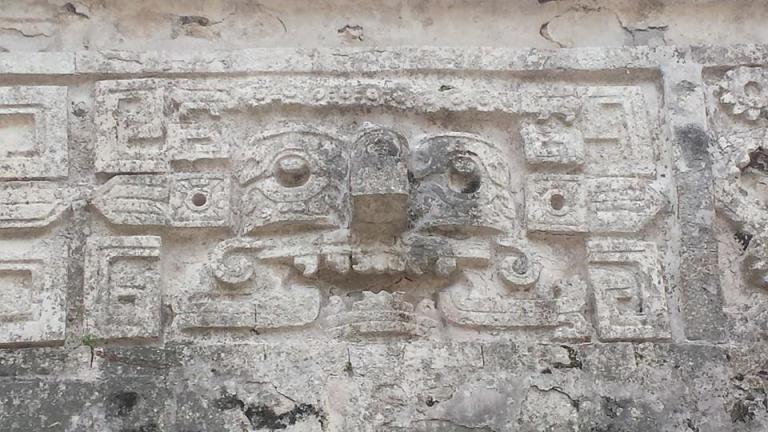
Known as Kukulkan, the Sun was the primary God to the Mayan civilization. He was artistically represented by the image of a snake, and literally called the “feathered serpent.” Worshipped as the Creator of the Mayan world, Kukulkan was connected with death and rebirth.
To celebrate their Lord, Mayan engineers designed and built the tower at Chichen Itza, known to modern cultures as El Castillo, sometime between 750 and 1200 CE. This was far more than just a tall building to its builders, however. The precise construction of the step pyramid is such that it represents a working calendar with 365 steps for each day of the year.
Incredibly, El Castillo was also designed so that worshippers in Chichen Itza could catch a glimpse of Kukulkan himself. At sunset on March 21, the light from the sun is meant to hit El Castillo in such a way that the shadows gather, and the brilliant physical form of Kukulkan appears along the side of the pyramid as bright light. For this reason, the crowds gather; they want to feel the power of the great Kukulkan as he brings a new season from the sky.
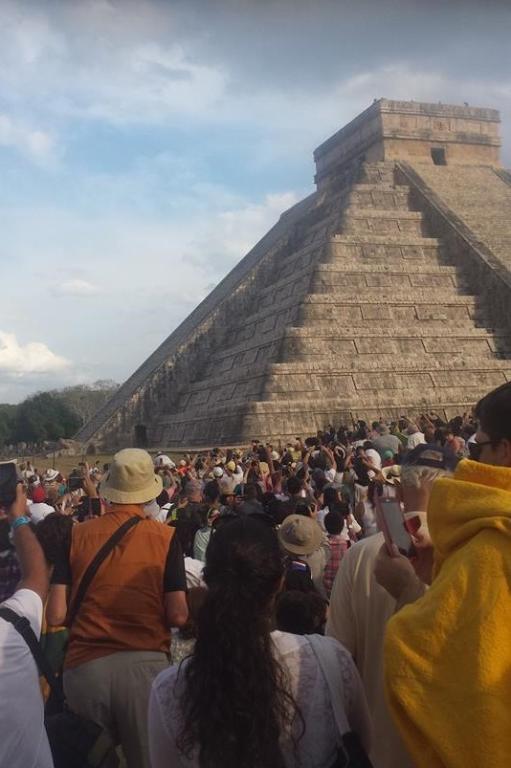 The clouds persisted, but the people continued clapping and chanting, urging forth the snake in the sky.
21st-Century Spirituality and Mayan Beliefs
Modern spirituality is generally centered on the idea of a holistic world, in which every small action and existence influences the wider universe. Largely, it is a method in which one can step away from the pressures of childhood and cultural religious indoctrination, and explore more personal truths. So what is it about New Age spirituality that draws so many people to Chichen Itza to celebrate the first day of spring or fall? What personal gratification comes from the visual image of the ancient God slithering down his temple as the sun sets?
A glance around the crowd showed clues to the motivations of those gathered around the temple. Mayan girls danced in traditional white dresses, while people clapped in front of the pyramid, delighting in the reverberated sound that mimicked an eagle’s cry. Argentinians smiled and cheered in normal summer attire, while a mix of British, American, Canadian and Mexican people dressed especially for the occasion in colorful scarves and flowing Arabian-style pants. They were there to worship; it’s as simple as that.
The attraction between New Age spirituality and the ancient Mayan religion is based in mystery, duality, and foremost, in nature. Both belief systems share perspectives on the sun and moon, cycles of growth and death, and a fundamental faith in nature as the ultimate provider.
¡Si se puede! Yes you can!
The applause grew even greater as the sun began to droop lower in the sky. Mayan tour guides and children roared like jaguars through their specially-carved whistles, and from all directions, hands beat on small drums more and more rapidly. They began to chant:
¡Si se puede! ¡Si se puede!
Yes you can, Kukulkan! Yes you can!
A lone Canadian traveler was swept up in the excitement, clapping in time with the crowd and smiling from ear to ear as the sun toyed with the thick cloud cover.
“I’m at Chichen Itza today because I’m fascinated by the ancient culture that built this place,” she said. “I appreciate that their religion was nature-based but also fact-based. It was more of a holistic, all-encompassing life religion than modern religions seem to be.” Of the city’s pull on modern pilgrims, she said, “It is still a place that seems to hold power. For those on a spiritual journey there is a peace here in which you can contemplate the true order of life.”
José Luis Castillo Silva, born in Mexico City, was also visiting El Castillo and the surrounding city for the equinox. He felt that seeing the ancient Mayan city first-hand and hopefully witnessing the descent of Kukulkan was about honoring the indigenous Mexican culture of the Yucatan.
“It is not about religion for me,” he explained, “but about history. I want to give respect to the people that lived here before, by coming to see their city and appreciating their art and architecture.”
José also admits that there is a spiritual aspect to his Chichen Itza visit, although it wasn’t his primary motivation.
“People come together here from everywhere in the world and they are always happy and excited. It is a good place to be, to watch the Earth spin and think about your place in the world, and in history. We are all the same, and this gives us a chance to remember it.”
Perhaps the persistent connection between spiritualism and nature-based religions of the past is based on an integral piece of the human experience. Like the Maya, we’re still just looking up to the sun and the moon and the stars, and wondering about our place amongst them.
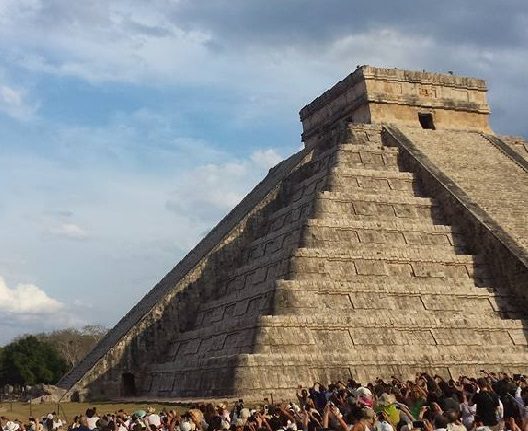 Kukulkan did indeed make an appearance at sunset, for just a few precious and spiritually-fulfilling minutes. Spring has officially begun.
Mandy Gardner is a freelance writer living in the beautiful Mexican Caribbean. She has two Canadian cats, 1 Mexican gato and plenty of sunshine! Her work focuses on animal and human rights, nature, food and travel. You can find her blog at www.TheFreelancerSociety.com.
Previous Post

March 11, 2015
The Mar Thoma Church: Gender Equality in the Sacred Space
Next Post
April 24, 2015 “White God”: More Than a Whiff of Transcendence
Browse Our Archives
Select a Category Story of God Uncategorized
Select a Month September 2022 August 2022 January 2022 December 2021 August 2021 July 2021 February 2021 January 2021 January 2020 December 2019 November 2019 October 2019 September 2019 August 2019 July 2019 June 2019 May 2019 April 2019 March 2019 February 2019 January 2019 December 2018 November 2018 October 2018 September 2018 July 2018 June 2018 May 2018 April 2018 November 2017 October 2017 August 2017 June 2017 May 2017 April 2017 November 2016 October 2016 September 2016 July 2016 June 2016 May 2016 April 2016 March 2016 February 2016 January 2016 December 2015 November 2015 October 2015 September 2015 August 2015 July 2015 June 2015 May 2015 April 2015 March 2015 February 2015 January 2015 December 2014 October 2014 September 2014 July 2014 May 2014 April 2014 March 2014 February 2014 January 2014 September 2013 August 2013 July 2013 June 2013 May 2013 April 2013 March 2013 February 2013 January 2013 December 2012
Follow Us!
TAKE THE
Religious Wisdom Quiz
Who said: "See to it that no one takes you captive through hollow and deceptive philosophy"?
Select your answer to see how you score.
John Paul Peter James
Related posts from Religion Now

Kneeling in Silence: Colin Kaepernick and the Religious...


(Culture) War Is a Force That Gives Us...
TRENDING AT PATHEOS Religion News

Catholic Integralists believe that religious values – specifically Christian ones – should...

Electing A Virtuous President Would Make Immunity Irrelevant
Presidential immunity can bring with it many risks. So how can we...

Why The Olympic Games Are A ‘Civil Religious’...
Sporting events form a vital space where Americans display their 'civil religious...

After more than a decade of news, research updates, and insights on...

Q: Why do Southern Baptists and like-minded Protestants...
THE RELIGION GUY’S ANSWER: Why? Simple. Because they believe that’s what the...

THE QUESTION: Is gambling evil? THE RELIGION GUY’S ANSWER: Analysts anticipate a...
view all Religion News blogs
Ad-Free & Subscriber Log-In Subscription Support
- About Us
- 2026 Calendar
- Videos
- Podcasts
- Library of World Religions
- Faith In Media Tracker
- Advertise With Us
- Write for Us
- Privacy Policy
- Terms of Service
- Do Not Sell My Data
- Contact Us
- Radiant Digital
- Manage Newsletter Subscriptions
- Unsubscribe From Notifications
- Sitemap
Copyright 2008-2026, Patheos. All rights reserved.
Subscription Support Ad-Free & Subscriber Log-In
Follow Patheos