
BuddhistCatholicContemplativeEvangelicalGeneral ChristianHinduJewishLatter-day SaintMuslimNew VisionsProgressive Christian
Beliefs
- Buddhist
- Catholic
- Contemplative
- Evangelical
- General Christian
- Hindu
- Jewish
- Latter-day Saint
- More Voices
- Muslim
- New Visions
- Pagan
- Progressive Christian
Topics
- Religion News
- Food and Religion
- Sports and Religion
- Religious Art
- Religious Music and Entertainment
- Religious Events
- History and Religion
- Style and Religion
- Politics and Religion
- Women in Religion
- Recreation Outdoors and Religion
- Business Finance and Religion
- Careers Workplace and Religion
- Education and Religion
- Family Parenting and Religion
- Health Fitness and Religion
- Home and Religion
- Relationships and Religion
- Technology and Religion
- Travel and Religion
Columnists
- Buddhist Columnists
- Business Finance and Religion Columnists
- Careers Workplace and Religion Columnists
- Catholic Columnists
- Contemplative Columnists
- Education and Religion Columnists
- Evangelists Columnists
- Family Parenting and Religion Columnists
- General Christian Columnists
- Health Fitness and Religion Columnists
- Hindu Columnists
- History and Religion Columnists
- Home and Religion Columnists
- Jewish Columnists
- More Voices Columnists
- Latter Day Columnists
- Muslim Columnists
- New Visions Columnists
- Nonreligious Columnists
- Pagan Columnists
- Politics and Religion Columnists
- Progressive Columnists
- Recreation Outdoors and Religion Columnists
- Relationships and Religion Columnists
- Religion News Columnists
- Religious Art Columnists
- Religious Events Columnists
- Religious Music and Entertainment Columnists
- Sports and Religion Columnists
- Style and Religion Columnists
- Technology and Religion Columnists
- Travel and Religion Columnists
- Women in Religion Columnists
Resource Library
- 2026 Calendar
- Library of World Religions
- The 100 Most Holy Places on Earth
- Patheos Answers
- Podcasts
- Videos
- Faith Leaders Database
- Anglican Episcopalian
- Bahai
- Baptist
- Buddhism
- Christianity
- Confucianism
- Eastern Orthodoxy
- Hinduism
- Holiness and Pentecostal
- ISKCON
- Islam
- Judaism
- Lutheran
- Methodist
- The Church of Jesus Christ of Latter-day Saints
- New Age
- Paganism
- Presbytarian and Reformed
- Protestantism
- Religion Behind the Scenes
- Roman Catholic
- Scientology
- Shia Islam
- Sikhism
- Sufism
- Sunni Islam
- Taoism
- Zen
- See all religions
Research Tools
 Ad-Free & Subscriber Log-In Subscription Support
Ad-Free & Subscriber Log-In Subscription Support
Follow Patheos 

- Trending:
- Forgiveness
- |
- Marriage
- |
- Consciousness
- |
- Death Penalty
- |
- Election
- |
- Halloween

- Home
- Religion News
- “Real” Islam and the Secular State
“Real” Islam and the Secular State
Last updated on: September 15, 2014 at 12:07 pm by Guest Contributor
“Real” Islam and the Secular State 2014-09-15T12:07:21-04:00 Guest Contributor
Patheos Explore the world's faith through different perspectives on religion and spirituality! Patheos has the views of the prevalent religions and spiritualities of the world.
By Mark E. Gammon.
In his address to the nation on Wednesday night, President Obama laid out a strategy for dealing with the Islamic State (ISIS, or, alternatively, ISIL) that was predicated on two basic propositions. As many Twitter users put it succinctly: “The Islamic State is neither Islamic nor a state.” Both of these assumptions are open to debate, but for those with more than a passing interest in religious ethics, the first deserves special scrutiny.
The president of course was echoing President George W. Bush’s famous proclamation that Islam is a “religion of peace.” Coming just after the September 11, 2001 terrorist attacks, Bush seemingly hoped to stave off possible retribution directed toward Muslims in the United States and to reaffirm the United States’ positive relations with many Muslim allies abroad. Despite the good intentions behind the statement, many recognized it as an overly simplistic characterization of a large, diverse, and complex religious tradition. We certainly can affirm that the number of Muslims determined to participate in terrorist acts is proportionally miniscule, but affirming Islam as a “religion of peace” fails to recognize that peace, itself, is subjective and a culturally conditioned idea.
No substantial pacifist movement has developed in Islam. From approximately the time of the Hijra, the migration of Muhammad and his followers from Mecca to Medina in 622 C.E., the revelations recorded in the Qur’an justify the use of violence in certain specific circumstances. These revelations originally justified warfare in the early Muslim community’s clashes with the Quraysh tribe that controlled Mecca. The proclamation of true peace in Islam refers to what is found among persons who submit to God’s will—that is, peace is to be found in the Ummah, the community of Muslims. Muhammad’s successors in the caliphate, especially the second caliph Umar, expanded the territory of the Ummah exponentially, and in so doing developed the idea that violence was the result of persons not submitting to God. This idea justified the caliphate conquering territory to put under Muslim political control. Even if the inhabitants of a territory were not Muslim and, according to the Qur’an, could not be forced to convert, the spread of peace was identified with the physical expansion of the Ummah.
This is not to say that Islam is fundamentally a “violent” religion. As with other religious traditions, its teachings and practices have evolved over the centuries, and disagreements among Islam’s practitioners make it difficult to identify one clear doctrine regarding the legitimate use of violent force. Muslim jurists and theologians draw on recognized religious authorities—most importantly the Qur’an, but also the example of the Prophet as reported in hadith, tradition, and reason—to support a huge variety of positions on violence in contemporary practice. While President Bush was correct to identify Islam as a religion that promotes peace, it is fair to say that many Muslims have a different understanding of peace than those definitions most prominent in the secular West.
President Obama’s statement differed from President Bush’s in one important, problematic way. While Bush made a simplistic generalization about Islam, Obama presumed the authority to declare who is and is not a Muslim. By saying that “ISIL is not Islamic,” the president made a statement not only factually inaccurate, but also indicative of a typical Western attitude that feeds the enmity at the root of the conflict. Certainly some Muslims are using this same language, but they speak from inside the faith tradition and make a rhetorical point about normative Muslim practice.
Presumably, ISIS’s leader, Abu-Bakr al-Baghdadi, affirms that God is one and Muhammad is God’s prophet. Presumably, most of his fighters pray regularly, fast at the correct times, and strive to submit to God’s will, even if their understanding of Islam is rudimentary to the point of reading Islam for Dummies. By some reports, al-Baghdadi earned a doctorate in Islamic studies, and in adopting the moniker Abu Bakr, the name of the first caliph, he affirms a commitment to continuity with Islam’s earliest community. It is fair to say that his own understanding of Islam is not rudimentary. ISIS appeals to Islam’s traditional sources of authority to justify its actions and worldview. They may make a better or worse case for their worldview based on those authorities, and there is no denying that many of their actions are horrific. If we look at ourselves honestly, however, we in the West justify horrific actions all the time, especially in the name of peace and security.
My point is not to excuse the Islamic State’s barbarism, nor to judge the adequacy of Obama’s proposed military strategy (though I suspect it is, in fact, confused at best). Something more fundamental lurks below the surface in this long-running conflict with so-called radical Islam. David Brooks once pointed out that in the worldview of America’s intelligence services, religion doesn’t really exist; the phenomenon of religion can be reduced to a complex of psycho-social constructions. This means that even our explicitly stated religious motivations for actions, good or bad, are an illusion. Perhaps in our capitalist culture, where religion is easily commodified, it is insightful to presume that religion itself has mainly therapeutic, as opposed to social, power. We mean well when we try to divorce the barbaric behavior of some Muslims from Islam as a whole. The Islamic State must be so terrible for some reason other than Islam.
However, seeing Islam through this secular lens obscures the self-understanding of many Muslims—even the ones who act according to our own secular liberal notion of the good—to the point of offense. Obama told ISIS and its potential recruits that they are not real Muslims. For the president of the United States to presume to be the arbiter of such a designation is unhelpful, even as a minor moment of political theatrics. It shuts down the potential for substantive conversation between Muslims and non-Muslims about how Islam teaches one to see the world, in particular how we can envision peace when not everyone agrees on the meaning of the word.
The United States stands for limiting religion to a small sphere of influence, forcing Islam into our secular political theory. We fail to recognize Islam as a political theory, one with its own integrity, strengths, challenges, and grandeur. It is only when we in the West learn to engage Islam on those terms that any kind of reconciliation is likely.
Mark E. Gammon is the Matthew Simpson Professor of Religion at Simpson College in Indianola, Iowa. He holds a Ph.D. in theological ethics from Boston College.
Previous Post

September 9, 2014
Presidents, National Prayer, and 9/11
Next Post
October 22, 2014 Diwali: Hearing Earth’s Cry
Recent Comments
Browse Our Archives
Select a Category Story of God Uncategorized
Select a Month September 2022 August 2022 January 2022 December 2021 August 2021 July 2021 February 2021 January 2021 January 2020 December 2019 November 2019 October 2019 September 2019 August 2019 July 2019 June 2019 May 2019 April 2019 March 2019 February 2019 January 2019 December 2018 November 2018 October 2018 September 2018 July 2018 June 2018 May 2018 April 2018 November 2017 October 2017 August 2017 June 2017 May 2017 April 2017 November 2016 October 2016 September 2016 July 2016 June 2016 May 2016 April 2016 March 2016 February 2016 January 2016 December 2015 November 2015 October 2015 September 2015 August 2015 July 2015 June 2015 May 2015 April 2015 March 2015 February 2015 January 2015 December 2014 October 2014 September 2014 July 2014 May 2014 April 2014 March 2014 February 2014 January 2014 September 2013 August 2013 July 2013 June 2013 May 2013 April 2013 March 2013 February 2013 January 2013 December 2012
Follow Us!
TAKE THE
Religious Wisdom Quiz
Where was Paul headed when he encountered the risen Christ?
Select your answer to see how you score.
Rome Antioch Jerusalem Damascus
Related posts from Religion Now
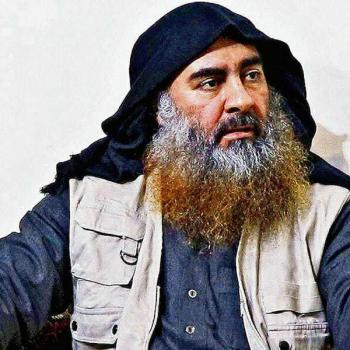
What Is a Caliph? The Islamic State Hijacks...
What Is Eid and How Do Muslims Celebrate...
Today's Diverse American Muslim Population First Arrived 400...
TRENDING AT PATHEOS Religion News

Catholic Integralists believe that religious values – specifically Christian ones – should...

Electing A Virtuous President Would Make Immunity Irrelevant
Presidential immunity can bring with it many risks. So how can we...

Why The Olympic Games Are A ‘Civil Religious’...
Sporting events form a vital space where Americans display their 'civil religious...

After more than a decade of news, research updates, and insights on...

Q: Why do Southern Baptists and like-minded Protestants...
THE RELIGION GUY’S ANSWER: Why? Simple. Because they believe that’s what the...

THE QUESTION: Is gambling evil? THE RELIGION GUY’S ANSWER: Analysts anticipate a...
view all Religion News blogs
Ad-Free & Subscriber Log-In Subscription Support
- About Us
- 2026 Calendar
- Videos
- Podcasts
- Library of World Religions
- Faith In Media Tracker
- Advertise With Us
- Write for Us
- Privacy Policy
- Terms of Service
- Do Not Sell My Data
- Contact Us
- Radiant Digital
- Manage Newsletter Subscriptions
- Unsubscribe From Notifications
- Sitemap
Copyright 2008-2026, Patheos. All rights reserved.
Subscription Support Ad-Free & Subscriber Log-In
Follow Patheos