
BuddhistCatholicContemplativeEvangelicalGeneral ChristianHinduJewishLatter-day SaintMuslimNew VisionsProgressive Christian
Beliefs
- Buddhist
- Catholic
- Contemplative
- Evangelical
- General Christian
- Hindu
- Jewish
- Latter-day Saint
- More Voices
- Muslim
- New Visions
- Pagan
- Progressive Christian
Topics
- Religion News
- Food and Religion
- Sports and Religion
- Religious Art
- Religious Music and Entertainment
- Religious Events
- History and Religion
- Style and Religion
- Politics and Religion
- Women in Religion
- Recreation Outdoors and Religion
- Business Finance and Religion
- Careers Workplace and Religion
- Education and Religion
- Family Parenting and Religion
- Health Fitness and Religion
- Home and Religion
- Relationships and Religion
- Technology and Religion
- Travel and Religion
Columnists
- Buddhist Columnists
- Business Finance and Religion Columnists
- Careers Workplace and Religion Columnists
- Catholic Columnists
- Contemplative Columnists
- Education and Religion Columnists
- Evangelists Columnists
- Family Parenting and Religion Columnists
- General Christian Columnists
- Health Fitness and Religion Columnists
- Hindu Columnists
- History and Religion Columnists
- Home and Religion Columnists
- Jewish Columnists
- More Voices Columnists
- Latter Day Columnists
- Muslim Columnists
- New Visions Columnists
- Nonreligious Columnists
- Pagan Columnists
- Politics and Religion Columnists
- Progressive Columnists
- Recreation Outdoors and Religion Columnists
- Relationships and Religion Columnists
- Religion News Columnists
- Religious Art Columnists
- Religious Events Columnists
- Religious Music and Entertainment Columnists
- Sports and Religion Columnists
- Style and Religion Columnists
- Technology and Religion Columnists
- Travel and Religion Columnists
- Women in Religion Columnists
Resource Library
- 2026 Calendar
- Library of World Religions
- The 100 Most Holy Places on Earth
- Patheos Answers
- Podcasts
- Videos
- Faith Leaders Database
- Anglican Episcopalian
- Bahai
- Baptist
- Buddhism
- Christianity
- Confucianism
- Eastern Orthodoxy
- Hinduism
- Holiness and Pentecostal
- ISKCON
- Islam
- Judaism
- Lutheran
- Methodist
- The Church of Jesus Christ of Latter-day Saints
- New Age
- Paganism
- Presbytarian and Reformed
- Protestantism
- Religion Behind the Scenes
- Roman Catholic
- Scientology
- Shia Islam
- Sikhism
- Sufism
- Sunni Islam
- Taoism
- Zen
- See all religions
Research Tools
 Ad-Free & Subscriber Log-In Subscription Support
Ad-Free & Subscriber Log-In Subscription Support
Follow Patheos 

- Trending:
- Forgiveness
- |
- Marriage
- |
- Consciousness
- |
- Death Penalty
- |
- Election
- |
- Halloween

- Home
- Religion News
- Religion, State, and Soccer in Israel
Religion, State, and Soccer in Israel
Last updated on: August 13, 2013 at 12:07 pm by Guest Contributor
Religion, State, and Soccer in Israel 2013-08-13T12:07:46-04:00 Guest Contributor
Patheos Explore the world's faith through different perspectives on religion and spirituality! Patheos has the views of the prevalent religions and spiritualities of the world.
by Shalom Goldman, Duke University
Throughout the world sports fans can be roused to emotional extremes of enthusiasm, euphoria, and despair that seem almost religious in nature. The only other public manifestation of emotion that comes close to sports in its intensity is at rock and roll concerts—and these concerts are increasingly held in sports stadiums. Also, more and more American sports greats are willing and eager to speak publicly about their Evangelical Christian commitments. These players on U.S. baseball, basketball, and football teams have often expressed their belief in a Higher Power, and their fans have in turn expressed their “belief” in the teams and players
In Europe, Asia, and Africa where soccer (the “real futbol”) is king—or should I say God—religion rarely intrudes into the sports domain.
But in Israel its somewhat more complicated.
Situated geographically in Asia and culturally in Europe, Israel embraced soccer with wild enthusiasm from the time of the state’s establishment in 1948. And it did so with little trace of religious ideas or practices. Actually, the Jewish embrace of soccer came decades before 1948. For the Jews living in British Mandate Palestine, team sports were organized along the political lines of the Yishuv (the loose “state in the making” amalgamation), with sports teams representing Left, Right, and center political affiliations. The assertively secular character of the Yishuv—which drew on the impulse to create a “new Jew”: muscular, athletic, and capable of self-defense—left God’s laws out of the stadium. And because orthodox Jews had little clout in pre-state Palestine, soccer matches were often scheduled on Saturday, the Jewish Sabbath. The same arrangement persisted after 1948, despite the protests of Ultra-Orthodox (Haredi) Jews, whose numbers and political strength grew from the 1970s onward.
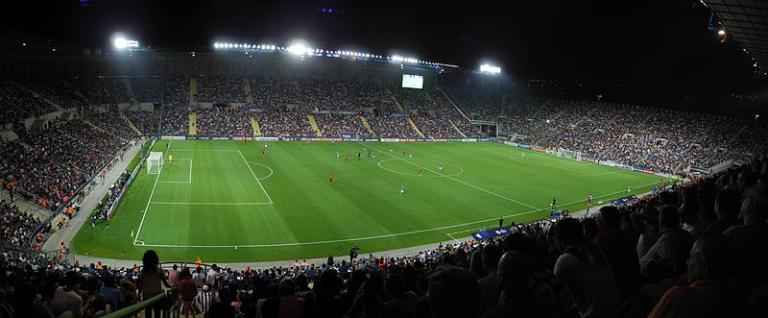
Teddy Stadium, Jerusalem
The number of Israeli soccer teams has also grown—today there are thirty teams—and their economic clout is considerable. And the players and fans are drawn from all sectors of Israel’s citizenry, not only from its Jewish population. There are Arab players on the Jewish teams, and there are Arab teams, some with Jewish team members that are giving the Jewish teams a run for their money.
As I noted in a July 1st article from Israel, “Many Israeli Arabs (who comprise 15 percent of the Israeli population) also attend professional soccer games, often rooting for Arab players. And in response to (anti-Arab) chants from Jewish fans, especially those of Beitar Jerusalem fans, they have responded with their own anti-Jewish taunts. And recently, an Arab team, Bnei Sachnin, a team with some Jewish players and many Jewish fans, has risen to prominence.”
In Israel, an exception to this secularizing tendency in sports is the observance of Yom Kippur, the Day of Atonement, when no public events are held.
For American Jews, whose “Sabbath rest” may include attendance at sports events, the ban on Yom Kippur sports is quite familiar. In fact, one could argue that a landmark day in American Jewish history is Yom Kippur of 1965 (October 6th), when Sandy Koufax, the great LA Dodgers pitcher, refused to play against the Minnesota Twins in the first game of the world series.
(In the Coen brothers’ film The Great Lebowski, The Dude—played by Jeff Bridges—tells the Walter Sobchak character, played by John Goodman, that in keeping kosher and following other Jewish laws he is “living in the f…ing past.” Sobchak’s answer: “Three thousand years of beautiful tradition from Abraham to Sandy Koufax…you’re goddamn right I’m living in the f….ing past.”
So, in Israel, no spectator sports on Yom Kippur—but the other days of the year are fair game.
It’s worth noting that the Jewish tradition isn’t the only one that has a problem with Sabbath sports. The Mormon church too is quite strict about the commandment to keep the Sabbath holy. No games are held on Sundays at the Mormon church’s Brigham Young University.
Back in Israel (where Lebowski has a considerable cult-following, and where Brigham Young University has a campus), “Shabbat Soccer” even overcame the traditional Tel Aviv–Jerusalem dichotomy: that the “first Hebrew city” Tel Aviv, was essentially secular, and that the ancient city of Jerusalem was inherently religious. Soccer trumped strict observance and in Jerusalem and throughout the country soccer was a Saturday phenomenon.
Against this background the announcement this week that one of Israel’s top teams, Beitar Jerusalem, would no longer hold home games on Shabbat came as something of a surprise. As reported in an AP story :
One of Israel’s top football teams has announced that it will not play any of its home games this season during the Jewish Sabbath, bucking the trend in the country…Beitar Jerusalem Football club said Sunday that it had come to an agreement with Israeli broadcasters to ensure that its home games will only be played on Saturday night or on weekdays…A statement on the club’s official website said that “despite the economic risk, Tabib (the team owner) preferred to accommodate the crowd and give more sectors of the community the option to come and support the team.”
In the Jewish State, the heady mix of politics, religion, and soccer is nothing new. A quarter of a century ago the New York Times noted that “In Jerusalem, soccer is also political football.”
The controversy back then, in the late 1980s, was about building a new soccer stadium in the city. The legendary long-term mayor of the city, Teddy Kollek, had promised the fans a stadium, but construction was delayed because of vigorous and at times violent protest by Ultra-Orthodox Jews. At a demonstration, the Times reporter heard a young secular Israeli counter-demonstrator yell at a Haredi man, “If you don’t give us the stadium, we’re going to burn Meah Shearim (Jerusalem’s Ultra-Orthodox stronghold).” (NY Times, “In Jerusalem, Soccer is also political football,” October 16, 1987)
In the 1990s, Teddy Stadium was finally built (and Meah Shearim was spared!)—and soccer games were held on Saturdays. But now that is going to end.
This will no doubt exacerbate tensions between secular and Orthodox Jews—tensions expressed at the ballot box, the public square, and the sports arena.
Shalom Goldman, Religion Department, Duke University
Previous Post

August 2, 2013
"Judaism" or "Jewishness"?
Next Post
September 11, 2013 Johnny Cash Is In the Promised Land
Browse Our Archives
Select a Category Story of God Uncategorized
Select a Month September 2022 August 2022 January 2022 December 2021 August 2021 July 2021 February 2021 January 2021 January 2020 December 2019 November 2019 October 2019 September 2019 August 2019 July 2019 June 2019 May 2019 April 2019 March 2019 February 2019 January 2019 December 2018 November 2018 October 2018 September 2018 July 2018 June 2018 May 2018 April 2018 November 2017 October 2017 August 2017 June 2017 May 2017 April 2017 November 2016 October 2016 September 2016 July 2016 June 2016 May 2016 April 2016 March 2016 February 2016 January 2016 December 2015 November 2015 October 2015 September 2015 August 2015 July 2015 June 2015 May 2015 April 2015 March 2015 February 2015 January 2015 December 2014 October 2014 September 2014 July 2014 May 2014 April 2014 March 2014 February 2014 January 2014 September 2013 August 2013 July 2013 June 2013 May 2013 April 2013 March 2013 February 2013 January 2013 December 2012
Follow Us!
TAKE THE
Religious Wisdom Quiz
Who was raised from the dead by Peter in Joppa?
Select your answer to see how you score.
Tabitha Eutychus Lazarus The widow's son
Related posts from Religion Now
The Little-Known Jewish History in the Heart of...
Why Trump's Tweets on Ilhan Omar and Rashida...
More Than One Religious View on Abortion—What Jewish...
What Israel's New Election Reveals About the Struggle...
TRENDING AT PATHEOS Religion News

Catholic Integralists believe that religious values – specifically Christian ones – should...

Electing A Virtuous President Would Make Immunity Irrelevant
Presidential immunity can bring with it many risks. So how can we...

Why The Olympic Games Are A ‘Civil Religious’...
Sporting events form a vital space where Americans display their 'civil religious...

After more than a decade of news, research updates, and insights on...

Q: Why do Southern Baptists and like-minded Protestants...
THE RELIGION GUY’S ANSWER: Why? Simple. Because they believe that’s what the...

THE QUESTION: Is gambling evil? THE RELIGION GUY’S ANSWER: Analysts anticipate a...
view all Religion News blogs
Ad-Free & Subscriber Log-In Subscription Support
- About Us
- 2026 Calendar
- Videos
- Podcasts
- Library of World Religions
- Faith In Media Tracker
- Advertise With Us
- Write for Us
- Privacy Policy
- Terms of Service
- Do Not Sell My Data
- Contact Us
- Radiant Digital
- Manage Newsletter Subscriptions
- Unsubscribe From Notifications
- Sitemap
Copyright 2008-2026, Patheos. All rights reserved.
Subscription Support Ad-Free & Subscriber Log-In
Follow Patheos