
BuddhistCatholicContemplativeEvangelicalGeneral ChristianHinduJewishLatter-day SaintMuslimNew VisionsProgressive Christian
Beliefs
- Buddhist
- Catholic
- Contemplative
- Evangelical
- General Christian
- Hindu
- Jewish
- Latter-day Saint
- More Voices
- Muslim
- New Visions
- Pagan
- Progressive Christian
Topics
- Religion News
- Food and Religion
- Sports and Religion
- Religious Art
- Religious Music and Entertainment
- Religious Events
- History and Religion
- Style and Religion
- Politics and Religion
- Women in Religion
- Recreation Outdoors and Religion
- Business Finance and Religion
- Careers Workplace and Religion
- Education and Religion
- Family Parenting and Religion
- Health Fitness and Religion
- Home and Religion
- Relationships and Religion
- Technology and Religion
- Travel and Religion
Columnists
- Buddhist Columnists
- Business Finance and Religion Columnists
- Careers Workplace and Religion Columnists
- Catholic Columnists
- Contemplative Columnists
- Education and Religion Columnists
- Evangelists Columnists
- Family Parenting and Religion Columnists
- General Christian Columnists
- Health Fitness and Religion Columnists
- Hindu Columnists
- History and Religion Columnists
- Home and Religion Columnists
- Jewish Columnists
- More Voices Columnists
- Latter Day Columnists
- Muslim Columnists
- New Visions Columnists
- Nonreligious Columnists
- Pagan Columnists
- Politics and Religion Columnists
- Progressive Columnists
- Recreation Outdoors and Religion Columnists
- Relationships and Religion Columnists
- Religion News Columnists
- Religious Art Columnists
- Religious Events Columnists
- Religious Music and Entertainment Columnists
- Sports and Religion Columnists
- Style and Religion Columnists
- Technology and Religion Columnists
- Travel and Religion Columnists
- Women in Religion Columnists
Resource Library
- 2026 Calendar
- Library of World Religions
- The 100 Most Holy Places on Earth
- Patheos Answers
- Podcasts
- Videos
- Faith Leaders Database
- Anglican Episcopalian
- Bahai
- Baptist
- Buddhism
- Christianity
- Confucianism
- Eastern Orthodoxy
- Hinduism
- Holiness and Pentecostal
- ISKCON
- Islam
- Judaism
- Lutheran
- Methodist
- The Church of Jesus Christ of Latter-day Saints
- New Age
- Paganism
- Presbytarian and Reformed
- Protestantism
- Religion Behind the Scenes
- Roman Catholic
- Scientology
- Shia Islam
- Sikhism
- Sufism
- Sunni Islam
- Taoism
- Zen
- See all religions
Research Tools
 Ad-Free & Subscriber Log-In Subscription Support
Ad-Free & Subscriber Log-In Subscription Support
Follow Patheos 

- Trending:
- Forgiveness
- |
- Marriage
- |
- Consciousness
- |
- Death Penalty
- |
- Election
- |
- Halloween

- Home
- Religion News
- God Speed: “Race Cars for Peace” in the Holy City
God Speed: “Race Cars for Peace” in the Holy City
Last updated on: July 1, 2013 at 1:49 pm by Guest Contributor
God Speed: “Race Cars for Peace” in the Holy City 2013-07-01T13:49:16-04:00 Guest Contributor
Patheos Explore the world's faith through different perspectives on religion and spirituality! Patheos has the views of the prevalent religions and spiritualities of the world.
By Shalom Goldman, Duke University
In the US, spectator sports and religious conviction often go hand in hand. Americans are used to players, and teams, who pray and play, invoking Jesus before, during, and after games. This happens on the basketball court, in baseball stadiums, and on football fields. And it is most notable on stock car racetracks, where prayers, along with game results, are often heard over the public address systems. The tone and style of this sports religiosity is that of Evangelical Christianity, and thus the sports and prayer connection is stronger in the South, though by no means absent in other parts of the country.
In Israel, where soccer is king, religiosity and sports are often seen as antithetical. The fiercely loyal fans of Israel’s thirty professional soccer teams are drawn, for the most part, from the secular Jewish population. Orthodox and ultra-Orthodox Jews (who together, comprise some 25% of the country’s Jewish population) are seldom seen at games—especially as many soccer games are held on Saturday, the Jewish Sabbath. But in mid-June, in an event viewed by tens of thousands of Israelis of all ethnic and religious persuasions, race cars were seen and heard screeching along Jerusalem’s roads. And this “Formula One Jerusalem Peace Road Show” was held on weekdays—to offend as few religious sensibilities as possible—and on a track that would draw Arab and Jewish spectators together.
In Jerusalem, where the soccer fans are famously (and as we shall see, in some instances infamously) loyal, the Saturday games at Teddy Stadium are an anathema to the city’s Rabbinic establishment. And the Orthodox parties in Israel’s notoriously contentious parliamentary coalitions have long been engaged in a struggle to outlaw Sabbath soccer games
Tensions linked to religious identity do emerge at Israeli soccer games—in the form of racist chants aimed at Arab players and fans—but these are nationalist tensions, and are not associated with what Americans would consider ‘religious behavior’ such as prayer. Recently, fans of Beitar Jerusalem, the team associated with the Right-leaning Likud party, rioted to protest plans to hire two Muslim soccer players from Chechnya.
As the NY Times reported on January 30, 2013 (“Jerusalem Journal,” by Jodi Rudoren): “The angry, defiant exchanges that punctuated Tuesday night’s unusually tense game here came amid intense protests by Beitar Jerusalem supporters over the team owner’s plans to recruit two Muslim players from Chechnya. Some young men had unfurled a banner at the previous game declaring ‘Beitar pure forever,’ which reminded many here of Nazi Germany’s purging of Jews from athletics in 1933 and prompted statewide discussion about racism on and off the field.”
In that statewide discussion, Israeli officials, including Prime Minister Netanyahu and President Peres, roundly condemned racism on the sports field and in the stadium. But many of the fans felt unfairly condemned as hooligans because of the actions of rowdy and at times violent spectators.
Many Israeli Arabs (who comprise 15% of the Israeli population) also attend professional soccer games, often rooting for Arab players. And in response to chants from Jewish fans , especially those of Beitar Jerusalem fans, they have responded with their own anti-Jewish taunts. And recently, an Arab team, Bnei Sachnin, a team with some Jewish players and many Jewish fans, has risen to prominence.
Israeli sports fans with whom I have discussed these tensions have been surprised to learn that Evangelical Christianity has such strong links to American sports. In response I tell them many great, and not so great American teams, coaches and players have attested to their personal faith in Jesus—and attribute victories (and resolve in defeat) to divine intervention. This type of openly expressed religiosity is unthinkable in Israeli sports.
Perhaps the most ‘Christian’ of all American sports is stock car racing, which is also the spectator sport with the largest fan base—75 million Americans—more than 20% of the population. NASCAR, the National Association of Stock Car Auto Racing, is the governing body of these races, which are held throughout the year. From the time that these races gained a wide national and international audience, the sport has been linked to Evangelical Christianity. Though some Southern preachers objected to the link between car racing and bootlegging (which is how the first stock car racers got their driving skills), by the 1970s “ the antagonism between the pulpit and the speedway has been consigned to the history books.” (“Racing for Jesus,” Christianity Today, June, 2008)
At the many NASCAR racetracks throughout the American South and West, prayer meetings by fans and drivers are held before races. And stock car racing’s bootlegging roots are not forgotten—the great American beer companies sponsor the races, and beer drinking is a big part of the spectator experience. One could even say that beer drinking is a component of NASCAR fan ritual behavior.
For these and many other reasons stock car racing is the last spectator sport one would expect to find promoted in Jerusalem, city of soccer and bastion of religious and nationalist orthodoxies. If such a car event were to be held in Israel it would make sense to have it in Eilat, on Israel’s small and only recently-approved international status race track. And Eilat, an assertively secular Red Sea resort town, is not a place that conjures up visions of religious enthusiasm.
So this past month, in mid-June, Jerusalem, holy to the three monotheistic faiths, was witness to a world-class stock car demonstration that raised some hackles on both sides of the Israeli-Arab divide—but also satisfied many spectators among both communities. The Jerusalem car event wasn’t exactly a race; there was no competition between car drivers.
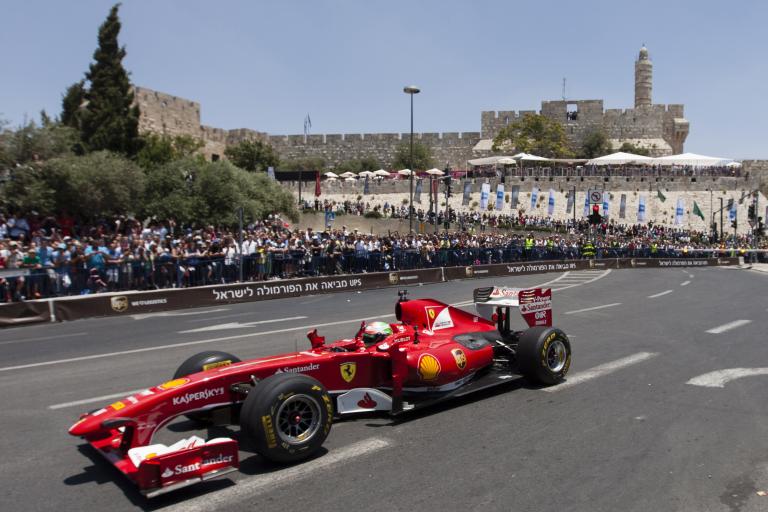
Though the initial idea for the Formula One was promoted by Israeli and international corporations it could not have proceeded without government support and intervention. Especially enthusiastic was Jerusalem mayor Nir Barkat, who just happens to be a racing car enthusiast.
Formula One Jerusalem was a demonstration of race car capabilities, but more importantly, it was an event that would, in Jerusalem mayor Nir Barkat’s words, “position Jerusalem as a global capital of culture.” In response, some local pundits wondered if Jerusalem’s cultural bonafides wouldn’t be better served in other ways.
For weeks before the event the Israel Foreign Affairs Ministry website enthusiastically promoted the car demonstration:
“For Israeli motor-sport fans, the upcoming Formula One Jerusalem Peace Road Show is a dream come true. The June 13-14 event will make history when the sleek F1 cars zip through the streets of Jerusalem against the background of the Old City walls.”
Dubbing the event “The Jerusalem Formula: The Peace Road Show,” the promoters, which included the Ferrari company and American gambling magnate Sheldon Adelson’s newspaper Israel Today, promised that “the world’s fastest automobiles will be magnificently displayed. The track, alongside Jerusalem’s most notable sites, will be one of the most breathtaking in the history of racing, attracting thousands of spectators and motor sports enthusiasts from all backgrounds, nationalities and faiths.”
The improvised race-track, which ran through west Jerusalem neighborhoods and along the 15th-century walls of the Old City, was festooned with banners proclaiming the sponsorship of Israel Today—a free paper dubbed by its critics “bibi-iton” because it is an ‘iton’ (newspaper ) that grants daily enthusiastic endorsement to ‘Bibi’ (Benjamin Netanyahu), Israel’s Prime Minister. During the two-day hoopla surrounding the Formula One events, ‘paper boys’—and girls—waded into the crowds to hand out free copies of Israel Today—a tabloid that makes the NY tabloid, The Daily News, seem like a stately newspaper.
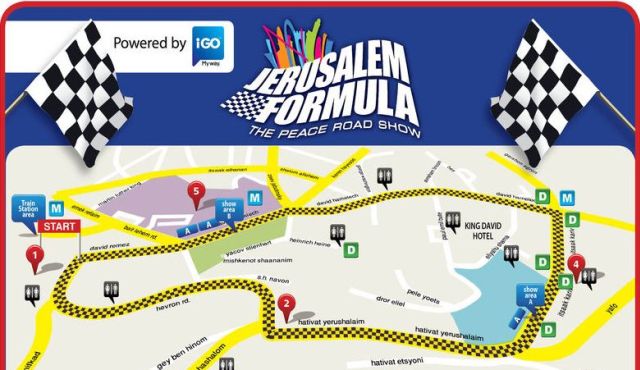
Large sections of Jerusalem were cordoned off to traffic on Thursday and Friday, June 13 and 14th, and spectators were encouraged to line the streets for the event. Which, as I can attest to, they duly did. Somewhere between 70,000-100,000 people watched the race cars from sidewalk, balconies, and rooftops. The sound of the racing cars was deafening, the crowds were very dense, and the heat was intense. But as far as I could tell, the assembled were having a good time. And uniquely, the crowds included Jerusalemites of all kinds, including Ultra-Orthodox Jewish families with many kids in tow, and Palestinian young men who watched the proceedings with groups of friends.
Religiously conservative leaders on both the Palestinian Arab and Israeli Jewish sides of the divide had criticized city government for holding the event and told their followers to stay home. But, judging from the presence of many spectators from both Arab and Jewish communities, many of whom were dressed in their respective traditional garb, these warnings were ineffective. Perhaps most telling were the remarks of a staunch ideologue, Matti Dan of the Settler Movement. He was heard complaining to a senior police officer at the Formula One that this event was corrupting the city’s children and modeling inappropriate behavior. The complaint was registered while both the police officer and the Settler leader were watching the race together.
Shalom Goldman, Religion Department, Duke University
Previous Post

June 10, 2013
Tedx Talk: The Numbers of Religious Freedom
Next Post
August 2, 2013 "Judaism" or "Jewishness"?
Browse Our Archives
Select a Category Story of God Uncategorized
Select a Month September 2022 August 2022 January 2022 December 2021 August 2021 July 2021 February 2021 January 2021 January 2020 December 2019 November 2019 October 2019 September 2019 August 2019 July 2019 June 2019 May 2019 April 2019 March 2019 February 2019 January 2019 December 2018 November 2018 October 2018 September 2018 July 2018 June 2018 May 2018 April 2018 November 2017 October 2017 August 2017 June 2017 May 2017 April 2017 November 2016 October 2016 September 2016 July 2016 June 2016 May 2016 April 2016 March 2016 February 2016 January 2016 December 2015 November 2015 October 2015 September 2015 August 2015 July 2015 June 2015 May 2015 April 2015 March 2015 February 2015 January 2015 December 2014 October 2014 September 2014 July 2014 May 2014 April 2014 March 2014 February 2014 January 2014 September 2013 August 2013 July 2013 June 2013 May 2013 April 2013 March 2013 February 2013 January 2013 December 2012
Follow Us!
TAKE THE
Religious Wisdom Quiz
In Revelation, what color is the horse ridden by Death?
Select your answer to see how you score.
Pale (or green) Black Red White
Related posts from Religion Now
Why Trump's Tweets on Ilhan Omar and Rashida...
What Israel's New Election Reveals About the Struggle...
Kneeling in Silence: Colin Kaepernick and the Religious...
Binding Up This Nation’s Wounds
TRENDING AT PATHEOS Religion News

Catholic Integralists believe that religious values – specifically Christian ones – should...

Electing A Virtuous President Would Make Immunity Irrelevant
Presidential immunity can bring with it many risks. So how can we...

Why The Olympic Games Are A ‘Civil Religious’...
Sporting events form a vital space where Americans display their 'civil religious...

After more than a decade of news, research updates, and insights on...

Q: Why do Southern Baptists and like-minded Protestants...
THE RELIGION GUY’S ANSWER: Why? Simple. Because they believe that’s what the...

THE QUESTION: Is gambling evil? THE RELIGION GUY’S ANSWER: Analysts anticipate a...
view all Religion News blogs
Ad-Free & Subscriber Log-In Subscription Support
- About Us
- 2026 Calendar
- Videos
- Podcasts
- Library of World Religions
- Faith In Media Tracker
- Advertise With Us
- Write for Us
- Privacy Policy
- Terms of Service
- Do Not Sell My Data
- Contact Us
- Radiant Digital
- Manage Newsletter Subscriptions
- Unsubscribe From Notifications
- Sitemap
Copyright 2008-2026, Patheos. All rights reserved.
Subscription Support Ad-Free & Subscriber Log-In
Follow Patheos