
BuddhistCatholicContemplativeEvangelicalGeneral ChristianHinduJewishLatter-day SaintMuslimNew VisionsProgressive Christian
Beliefs
- Buddhist
- Catholic
- Contemplative
- Evangelical
- General Christian
- Hindu
- Jewish
- Latter-day Saint
- More Voices
- Muslim
- New Visions
- Pagan
- Progressive Christian
Topics
- Religion News
- Food and Religion
- Sports and Religion
- Religious Art
- Religious Music and Entertainment
- Religious Events
- History and Religion
- Style and Religion
- Politics and Religion
- Women in Religion
- Recreation Outdoors and Religion
- Business Finance and Religion
- Careers Workplace and Religion
- Education and Religion
- Family Parenting and Religion
- Health Fitness and Religion
- Home and Religion
- Relationships and Religion
- Technology and Religion
- Travel and Religion
Columnists
- Buddhist Columnists
- Business Finance and Religion Columnists
- Careers Workplace and Religion Columnists
- Catholic Columnists
- Contemplative Columnists
- Education and Religion Columnists
- Evangelists Columnists
- Family Parenting and Religion Columnists
- General Christian Columnists
- Health Fitness and Religion Columnists
- Hindu Columnists
- History and Religion Columnists
- Home and Religion Columnists
- Jewish Columnists
- More Voices Columnists
- Latter Day Columnists
- Muslim Columnists
- New Visions Columnists
- Nonreligious Columnists
- Pagan Columnists
- Politics and Religion Columnists
- Progressive Columnists
- Recreation Outdoors and Religion Columnists
- Relationships and Religion Columnists
- Religion News Columnists
- Religious Art Columnists
- Religious Events Columnists
- Religious Music and Entertainment Columnists
- Sports and Religion Columnists
- Style and Religion Columnists
- Technology and Religion Columnists
- Travel and Religion Columnists
- Women in Religion Columnists
Resource Library
- 2026 Calendar
- Library of World Religions
- The 100 Most Holy Places on Earth
- Patheos Answers
- Podcasts
- Videos
- Faith Leaders Database
- Anglican Episcopalian
- Bahai
- Baptist
- Buddhism
- Christianity
- Confucianism
- Eastern Orthodoxy
- Hinduism
- Holiness and Pentecostal
- ISKCON
- Islam
- Judaism
- Lutheran
- Methodist
- The Church of Jesus Christ of Latter-day Saints
- New Age
- Paganism
- Presbytarian and Reformed
- Protestantism
- Religion Behind the Scenes
- Roman Catholic
- Scientology
- Shia Islam
- Sikhism
- Sufism
- Sunni Islam
- Taoism
- Zen
- See all religions
Research Tools
 Ad-Free & Subscriber Log-In Subscription Support
Follow Patheos 

- Trending:
- Advent
- |
- Forgiveness
- |
- Thanksgiving
- |
- Election
- |
- Seasonal Holidays
- |
- Marriage

- Home
- Latter-day Saint
- Religion News
- Latter-day Saint Persecution and the Call to Healing
Latter-day Saint Persecution and the Call to Healing
Last updated on: October 1, 2025 at 8:08 am by Alonzo Gaskill, PhD
Latter-day Saint Persecution and the Call to Healing 2025-10-01T08:08:57-06:00 Alonzo Gaskill, PhD
Patheos Explore the world's faith through different perspectives on religion and spirituality! Patheos has the views of the prevalent religions and spiritualities of the world.

Replica of Christus (1838) by Bertel Thorvaldsen (1770–1844); this replica is located in the Temple Square North Visitors Center of The Church of Jesus Christ of Latter-day Saints, Salt Lake City, Utah. Credit: Bobjgalindo, CC BY-SA 3.0, via Wikimedia Commons

Christians are hardly strangers to persecution. From the visit of the Wise Men to King Herod, down to modern times, people outside of the faith have perceived believers in Jesus as either a threat to “the establishment,” or as somehow “less than” because of their unique and seemingly unorthodox beliefs. Indeed, starting in the mid-first-century, Roman rulers unleashed one government sponsored persecution of Christians after another.
Later, Christianity struggled to find acceptance under the Persian Empire (4th to 7th centuries) and within the Ottoman Empire (15th through 20th centuries). More recently, Christians in China, the former Soviet Union, North Korea, and in parts of the Middle East, have suffered terribly for their beliefs and the supposed threats they pose to society, government, or other religious traditions.
In the first century, while Christians ultimately rubbed wrong the political establishment of their day, it was religious conflict that provoked the initial persecution of believers. Men like Saul of Tarsus saw Christians as essentially “apostate Jews” who were going about corrupting religion and drawing away believers into their apostate form or worship. Saul was so enraged by the growth and teachings of Christianity that he participated in extreme forms of persecution of those who followed Jesus, not only engaging in acts of violence against them, but also consenting to their deaths (Acts 7:58, 8:1). He is said to have “made havoc of the Church,” and where he could not kill them, he committed many believers to “prison” (Acts 8:3, 22:4).
In modern times, members of The Church of Jesus Christ of Latter-day Saints have their own history of being a persecuted people. Like the ancient believers in Jesus (whom the New Testament frequently refers to as “the saints”), Latter-day Saint Christians have found themselves on the wrong side of the government and hated by other religions as well. Even before the Church was officially organized, its first leader (Joseph Smith, Jr.) found that his visions of God and angels, rather than stirring interest, often brought about anger and opposition. From his first vision of the divine (in 1820) until his assassination at the hands of an armed mob (in 1844), Joseph was under constant threat, sometimes by government officials, but usually by those of other religions who saw his teachings as “sacrilegious” and his fellow believers as “evil heretics” who must be “exterminated” from the face of the planet.
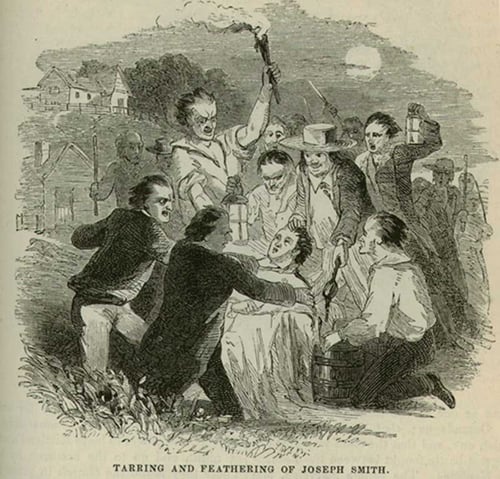
Depiction of Joseph Smith being tarred and feathered. Public domain, via Wikimedia Commons
Indeed, the progressive migrations of the “Mormons” from upper New York State to the Mexican territory that would eventually become the State of Utah was the direct result of unrelenting religious persecutions. For example, in 1833, members of the Church had gathered in significant numbers in Jackson County, Missouri. However, because of the Saints’ rejection of slavery, combined with their growing influence in the county, mobs destroyed their homes and businesses, and the governor of the state issued an “Extermination Order,” forcing members of the Church from the county and, ultimately, from the state. By 1838, members of the Church of Jesus Christ were being attacked in northern Missouri—where the famed “Haun’s Mill Massacre” took place, resulting in the slaughtering of 17 LDS men and children, in addition to wounding more than a dozen others.
By the winter of 1838-39, Latter-day Saint Christians were fleeing the State of Missouri and seeking refuge on the Illinois bank of the Mississippi River. However, once again, suspicion by the “locals” arose over the Saints’ political positions, religious beliefs and practices, and their growing impact in the community as they gathered in ever-increasing numbers. This ultimately led to the murder of their Church’s Prophet and his brother, Hyrum. And, once again, the Saints lost their homes, their businesses, and their sacred Temple.
With the ever-increasing persecutions in Illinois, in the winter of 1846, members of the Church of Jesus Christ crossed the frozen Mississippi and headed toward the West, with a large number making the 3-4 month 1,300 mile trek on foot, often pulling handcarts filled with what few possessions they could carry. More than 6,000 members of the Church would die during their efforts to flee from their persecutors—some from exposure or starvation, while others from exhaustion, disease, or accidents resulting from the arduous trek.
Once the Latter-day Saints arrived in the inhospitable desert that would become the state of Utah, their hopes were that they would finally be left alone by their enemies. However, the peace they had hoped to nurture in the valley of the Rocky Mountains would not last long. While they got along relatively well with the Native Americans in the region, within a decade of arriving in this region “outside” of the United States, U.S. President James Buchanan sent troops to the Utah Territory, fearing members of The Church of Jesus Christ of Latter-day Saints were rebelling against the United States government. The President’s decision to do so nearly led to open conflict between government troops and the members of the Church.
Throughout the last third of the 19th century, the Church also faced persecution in the form of numerous legal challenges from the government, including the Morrill Act of 1862, the Edmunds Act of 1882, and the Edmunds–Tucker Act of 1887—each specifically targeting the Church. Thousands of members were fined and/or imprisoned, and the government sought to disenfranchise the Church, with federal authorities seizing its properties.
In the twentieth century, the persecution began to shift, less often centered around physical violence (as in the early years), but now becoming more of an ideological battle. Certainly, on a lesser scale, physical attacks have continued—with dozens of church buildings and temples vandalized, burglarized, and even bombed since the beginning of the twentieth century.
However, the days of the “Old West” are gone, and so the persecution today tends to be mostly through words—with a growing number of publications directly targeting the Church. As printing became less expensive, exposés on the Church and its supposed “hidden” beliefs became commonplace. Later, with the development of the internet, the salacious stories and online persecutions would become endless. Some criticisms may be fair, though many consist of outright lies or teachings and practices stripped of their context and, therefore, meaning.
Sadly, as an almost shocking return to the Church’s earlier history, on September 28, 2025, a man (in Grand Blanc Township, Michigan) rammed his truck into a packed church building as Latter-day Saints inside were worshiping. After opening fire on the congregation, the man set the building on fire, killing multiple people and injuring even more. According to news reports, the gunman had told others that members of The Church of Jesus Christ of Latter-day Saints are “the Antichrist” and are “going to take over the world.” While the persecutions of earlier years are mostly the “stuff” of history books, this most recent event caught the attention of the world because it unfolded in real-time with drones, cell phone videos, and news of the horrific events being carried instantaneously across the world.
As a sort of parallel to this most recent act of violence against the Latter-day Saints, Saul of Tarsus was also convinced that the Christians of his day were the equivalent of the Antichrist, and he too feared they were taking over the world in which he lived. Saul sought to stop them, and the way he did so was through persecution, violence, imprisonment, and even murder. Ironically, Saul’s teacher (the noted scribe and “doctor of the law,” Gamaliel) counseled, “My advice to you is not to interfere with these people, but to leave them alone. For if this idea or this movement has a human origin, it will collapse” (Acts 5:38). In his anger and hatred, Saul struggled to take that advice until a dramatic spiritual experience on the Damascus Road (Acts 9) changed his views of Christianity, Jesus, and even his personal life-purpose.
Now, one can wholeheartedly disagree with Latter-day Saint Christians on their theology, their lifestyle, their views on morality, or even on their history; but one really should ask, If I persecute, vilify, injure, or murder those I perceive as “Antichrists” or “false Christians,” who really is acting as an Antichrist? Can we ever truly combat perceived evil by acting evil ourselves?
In an era of increasing intolerance for, and violence toward, those who believe or live differently, the world would do well to embrace the counsel of Gamaliel, and trust that a movement that is not of God will ultimately collapse on its own. Ironically, that famous first century scribe, after telling Saul (and others) to “leave the Christians alone,” added this warning: “If they are of God, you will not be able to overthrow them—and in that case, you may even be found fighting against God!” (Acts 5:39). With the increasing degree of persecution that exists in our day—for other religious, races, political views, sexual orientations, or ideologies—Gamaliel would certainly invite us to “wake up,” quit hating, seek understanding, and even where we cannot agree with someone, strive to be loving, kind, and compassionate.
The attack on Latter-day Saint Christians and their history of being persecuted is really a symbol for the cancer that is ravaging our society today. Yes, the events over the last two hundred years of LDS history have at times been horrific and inhuman—as was the recent massacre at a Michigan congregation of the Church of Jesus Christ. However, this history of a persecuted people is merely a microcosm of a greater problem in our world today. People fear what they do not understand, they hate what they perceive as different, and they assume what they do not know.
If we, as a society, are to survive these turbulent and divisive days, we need to set aside our prejudices and spark our curiosity, desiring to know and understand those who think or live differently than we.
If there was ever a hope for healing our inhuman world, it will start with you and me desiring to understand rather than destroy that which we perceive as “different.”
Latter-day Saint
General Christian
History and Religion
Previous Post

September 1, 2025
Patheos September 2025 Featured Writer: Dr. David K. Ewen
Next Post

October 1, 2025 Patheos October 2025 Featured Writer: Anthony Costello
Recent Comments
"Thanks for this compendium of reviews on the movie. I also wrote a review about ..."
Can Inside Out 2 Navigate Beliefs, ..."
"thats unfortunate !"
Premier Progressive Christian Podcast Relaunches in ..."
Browse Our Archives
Select a Category Calendar Featured Writers Religion News Sacred Spaces Uncategorized
Select a Month November 2026 October 2026 September 2026 August 2026 July 2026 June 2026 May 2026 April 2026 March 2026 February 2026 January 2026 December 2025 November 2025 October 2025 September 2025 August 2025 July 2025 June 2025 May 2025 April 2025 March 2025 February 2025 January 2025 December 2024 November 2024 October 2024 September 2024 August 2024 July 2024 June 2024 May 2024 April 2024 March 2024 February 2024 January 2024 December 2023 November 2023 October 2023 September 2023 August 2023 July 2023 June 2023 May 2023 April 2023 March 2023 February 2023 January 2023 December 2022 November 2022 October 2022 September 2022 August 2022 July 2022 June 2022 May 2022
TAKE THE
Religious Wisdom Quiz
Who does the Bible say is Lord of the Sabbath?
Select your answer to see how you score.
Jesus Satan Moses Man
Related posts from Religion News Roundup

The 2025 Most-Read Faith Articles: Politics Dominated
Dig Into History: Join Our Biblical Archaeology Live...

From Focus to Fallout: The Life and Legacy...

Ozzy’s Faith Was Louder Than You Think
TRENDING AT PATHEOS Religion News

Are You a Scrooge or an Ebenezer?
A Call to Remember As the Christmas season rings in, will we...

Noah’s Ark Archaeologists: Gopher Wood or Should We...
Ancient wood, a boat-shaped formation and dates that invite a second look:...

Smart people saying smart things (11.24.26)
Please take time to listen to Perry Bacon, Sarah Posner, Adam Serwer,...

The Contingency of Our Technology
Last week we were hit with a raft of massive technology outages....

In 1939, President Franklin D. Roosevelt moved Thanksgiving from November 30 to...

Reasons for Restraint: Ricardo Gonzalez, Florida and Dec...
The Morning of January 3 I begin with the dead. On the...
view all Religion News blogs
What Are Your Thoughts?leave a comment
Ad-Free & Subscriber Log-In Subscription Support
- About Us
- 2026 Calendar
- Videos
- Podcasts
- Library of World Religions
- Faith In Media Tracker
- Advertise With Us
- Write for Us
- Privacy Policy
- Terms of Service
- Do Not Sell My Data
- Contact Us
- Radiant Digital
- Manage Newsletter Subscriptions
- Unsubscribe From Notifications
- Sitemap
Copyright 2008-2026, Patheos, part of the Radiant Digital network of media brands. All rights reserved.
Subscription Support Ad-Free & Subscriber Log-In
Follow Patheos