
BuddhistCatholicContemplativeEvangelicalGeneral ChristianHinduJewishLatter-day SaintMuslimNew VisionsProgressive Christian
Beliefs
- Buddhist
- Catholic
- Contemplative
- Evangelical
- General Christian
- Hindu
- Jewish
- Latter-day Saint
- More Voices
- Muslim
- New Visions
- Pagan
- Progressive Christian
Topics
- Religion News
- Food and Religion
- Sports and Religion
- Religious Art
- Religious Music and Entertainment
- Religious Events
- History and Religion
- Style and Religion
- Politics and Religion
- Women in Religion
- Recreation Outdoors and Religion
- Business Finance and Religion
- Careers Workplace and Religion
- Education and Religion
- Family Parenting and Religion
- Health Fitness and Religion
- Home and Religion
- Relationships and Religion
- Technology and Religion
- Travel and Religion
Columnists
- Buddhist Columnists
- Business Finance and Religion Columnists
- Careers Workplace and Religion Columnists
- Catholic Columnists
- Contemplative Columnists
- Education and Religion Columnists
- Evangelists Columnists
- Family Parenting and Religion Columnists
- General Christian Columnists
- Health Fitness and Religion Columnists
- Hindu Columnists
- History and Religion Columnists
- Home and Religion Columnists
- Jewish Columnists
- More Voices Columnists
- Latter Day Columnists
- Muslim Columnists
- New Visions Columnists
- Nonreligious Columnists
- Pagan Columnists
- Politics and Religion Columnists
- Progressive Columnists
- Recreation Outdoors and Religion Columnists
- Relationships and Religion Columnists
- Religion News Columnists
- Religious Art Columnists
- Religious Events Columnists
- Religious Music and Entertainment Columnists
- Sports and Religion Columnists
- Style and Religion Columnists
- Technology and Religion Columnists
- Travel and Religion Columnists
- Women in Religion Columnists
Resource Library
- 2026 Calendar
- Library of World Religions
- The 100 Most Holy Places on Earth
- Patheos Answers
- Podcasts
- Videos
- Faith Leaders Database
- Anglican Episcopalian
- Bahai
- Baptist
- Buddhism
- Christianity
- Confucianism
- Eastern Orthodoxy
- Hinduism
- Holiness and Pentecostal
- ISKCON
- Islam
- Judaism
- Lutheran
- Methodist
- The Church of Jesus Christ of Latter-day Saints
- New Age
- Paganism
- Presbytarian and Reformed
- Protestantism
- Religion Behind the Scenes
- Roman Catholic
- Scientology
- Shia Islam
- Sikhism
- Sufism
- Sunni Islam
- Taoism
- Zen
- See all religions
Research Tools
 Ad-Free & Subscriber Log-In Subscription Support
Follow Patheos 

- Trending:
- Advent
- |
- Forgiveness
- |
- Thanksgiving
- |
- Election
- |
- Seasonal Holidays
- |
- Marriage

- Home
- Muslim
- Religion News
- A Brief History Of Israel And Its Conflicts
A Brief History Of Israel And Its Conflicts
Last updated on: June 19, 2025 at 12:05 am by Alonzo Gaskill, PhD
A Brief History Of Israel And Its Conflicts 2025-06-19T00:05:38-06:00 Alonzo Gaskill, PhD
Patheos Explore the world's faith through different perspectives on religion and spirituality! Patheos has the views of the prevalent religions and spiritualities of the world.
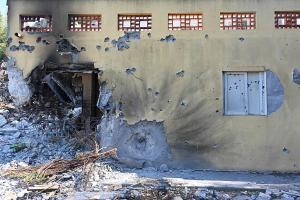
Damaged building in the kibbutz Be’eri in Israel. Photo by Kobi Gideon / GPO via Wikimedia
In the recent Patheos Answers article, Why Does It Seem Israel Is Always at War With Its Neighbors? we tackled the theological, geopolitical, and cultural dynamics fueling conflict in the Middle East today. Here, we take a look at the long history behind those modern tensions. From ancient tribal battles recorded in religious sacred texts to modern-day wars, the region known as the Holy Land has endured thousands of years of struggle.
This brief overview traces key moments in that long arc of conflict—conflicts that continue to shape both regional identity and international debate.
- Cain and Abel (or Qabil and Habil): The very first recorded “conflict” in the region was between two of Adam and Eve’s children, Cain and Abel (or Qabil and Habil, as they are referred to in the Qur’an). It was a “mini-war” between two brothers that led to one being murdered by the other. According to the sacred texts of Judaism, Christianity, and Islam, the conflict was rooted primarily in religious issues, as God accepted the sacrificial offering of one brother and rejected the non-sacrificial “fruit” offering of the other. A secondary cause often seen by commentators in this “family war” is jealousy—Cain felt his younger brother was looked upon with favor by God. Some extra-canonical accounts also suggest that greed may have played a role in this conflict.
- Tribal Conflicts: In the Patriarchal Period (beginning, according to scholars, around 1800 BCE), the descendants of Abraham, Isaac, and Jacob (whose name was changed by God to “Israel”) frequently lived in tension with other local tribes, including the people of Canaan and Philistia.
- Joshua: During the time in which Moses’ successor, Joshua (circa 1200 BCE), led the “children of Israel,” the Bible says the Israelites entered the land of Canaan and conquered it. Through a series of battles (e.g., Jericho, Ai, Southern and Northern Canaan), the natives of that region are described as being wiped out by their conquerors. (Some historians question the historicity of these battles, but the biblical text claims that the ancient Israelites conquered various peoples at God’s command.)
- Kings David and Solomon: After acquiring the lands and wealth of various peoples, Israel became a united people led by King David and then his son, King Solomon. During that time, there were wars between the people of Israel and other regional powers, including the Philistines. (However, after Solomon’s passing [circa 931 BCE], the kingdom split into Israel in the north and Judah in the south.)
- Assyria: In the 8th century BCE, Israel (the Northern Kingdom) lost a battle with Assyria, and the “Ten Tribes” residing in that portion of the kingdom were exiled (722 BCE). This is often referred to as the “scattering of Israel.”
- Babylon: In the 6th century BCE, Judah (the Southern Kingdom) lost a conflict with the Babylonians, resulting in their kingdom being conquered and their temple (known as “Solomon’s Temple” or Israel’s “First Temple”) being destroyed. Many of Israel’s most prominent people were exiled to Babylon (586 BCE).
- Alexander the Great: While the Persian king Cyrus allowed Jews to return to Israel (538 BCE) to rebuild their temple, in the 4th century the region was again conquered, this time by Alexander the Great (332 BCE). This led to significant conflict, both religiously and culturally.
- The Maccabean Revolt: Due to significant religious persecution under Grecian rule, the Jews revolted, which led to intense fighting and the establishment of the Hasmonean Kingdom. The Hasmoneans were initially only semi-autonomous but expanded their territory through conflict, gaining independence over time. However, that independence was short-lived, as Roman rule would soon reduce their Jerusalem-based kingdom’s power.
- The Roman Republic: The Roman general Pompey conquered Jerusalem and the Hasmoneans (in 63 BCE), bringing the region under Roman rule. As Rome’s governmental structure evolved, the Israelites were ruled by local kings (often called “client kings”), such as Herod the Great. Once Herod died (4 BCE), his kingdom was divided among his sons. In 6 CE, Coponius—the first Roman prefect—was appointed to govern Judea (including Jerusalem), which had been annexed as a Roman province.
- The Great Jewish Revolt: A major uprising took place in Judea (66–73 CE), during which the Jewish people fought the Roman authorities under whom they lived. This famously led to the destruction of Herod’s Temple (70 CE) and ultimately to a significant loss of life and a Jewish diaspora from the region.
- The Bar Kokhba Revolt: This war (commonly called the “Third Jewish-Roman War”) was a Jewish uprising against the Romans (132–136 CE), led by a Jewish man, Simon bar Kokhba, whom some at the time perceived to be the Jewish Messiah. In the end, it brought mass killings, suppression of the practice of Judaism in the region, and another diaspora.
- Muslim Conquest: By the 7th century CE, the Byzantine Empire held power in Jerusalem. However, in 638 CE, Muslim armies invaded and captured the city from the Byzantines, though they allowed Jews and Christians to continue living there. (While most of the previous conflicts directly involved the descendants of Jacob, or “Israel,” this conflict was primarily between Orthodox Christians and Arab Muslims.)
- The Christian Crusades: From the 11th through 13th centuries, the city of Jerusalem was in constant upheaval. In 1099 CE, crusader armies captured the city and massacred not only the Muslim rulers but also the Jews who dwelt in the area. Then, in the 12th century, Saladin—the Muslim Sultan of Egypt and Syria—recaptured the city (1187 CE). Control of the city changed hands multiple times between 1099 and 1291, each time through warfare.
- The Ottoman Empire: While Jerusalem and the region saw significant upheaval and warfare between the Christian Crusades (1099–1291 CE) and the era of Ottoman rule (1517–1917 CE), the next major conflict was the Battle of Marj Dabiq (1516 CE), in which the Ottomans defeated the Mamluks and began a 400-year reign in Jerusalem. During the Ottoman period, what became known as the “Zionist Movement” began. While many trace this to Austrian Jew Theodor Herzl (circa 1897), in reality, a noticeable migration of Jews back to “Ottoman Palestine” (or the “Holy Land”) began in the late 1800s. As a result, from 1882 through 1917, tensions in the region grew, particularly over disputes about ancestral homeland and who had the right to Palestine and Jerusalem.
- 20th–21st Centuries: The skirmishes of the twentieth and twenty-first centuries are too numerous to discuss in detail here. Some of the most noteworthy include: the Israeli War of Independence (1948), Suez Crisis (1956), Six-Day War (1967), Yom Kippur War (1973), Lebanon Wars (1982 & 2006), First Intifada (1987–1993), Second Intifada (2000–2005), Israel–Hamas War (Oct. 2023–present), and the Israel–Iran War (June 13, 2025–present).
Muslim
Jewish
History and Religion
Previous Post

June 11, 2025
Faith, Politics, and NJ’s Governor Showdown
Next Post

July 1, 2025 Patheos July 2025 Featured Writer: Alan Lechusza
Recent Comments
"Thanks for this compendium of reviews on the movie. I also wrote a review about ..."
Can Inside Out 2 Navigate Beliefs, ..."
"thats unfortunate !"
Premier Progressive Christian Podcast Relaunches in ..."
Browse Our Archives
Select a Category Calendar Featured Writers Religion News Sacred Spaces Uncategorized
Select a Month November 2026 October 2026 September 2026 August 2026 July 2026 June 2026 May 2026 April 2026 March 2026 February 2026 January 2026 December 2025 November 2025 October 2025 September 2025 August 2025 July 2025 June 2025 May 2025 April 2025 March 2025 February 2025 January 2025 December 2024 November 2024 October 2024 September 2024 August 2024 July 2024 June 2024 May 2024 April 2024 March 2024 February 2024 January 2024 December 2023 November 2023 October 2023 September 2023 August 2023 July 2023 June 2023 May 2023 April 2023 March 2023 February 2023 January 2023 December 2022 November 2022 October 2022 September 2022 August 2022 July 2022 June 2022 May 2022
TAKE THE
Religious Wisdom Quiz
Who said, "If we are thrown into the blazing furnace, the God we serve is able to deliver us"?
Select your answer to see how you score.
The high priest Nebuchadnezzar Shadrach, Meshach, and Abednego Daniel
Related posts from Religion News Roundup

The 2025 Most-Read Faith Articles: Politics Dominated
Dig Into History: Join Our Biblical Archaeology Live...
Latter-day Saint Persecution and the Call to Healing
From Focus to Fallout: The Life and Legacy...
TRENDING AT PATHEOS Religion News

Noah’s Ark Archaeologists: Gopher Wood or Should We...
Ancient wood, a boat-shaped formation and dates that invite a second look:...

Smart people saying smart things (11.24.26)
Please take time to listen to Perry Bacon, Sarah Posner, Adam Serwer,...

The Contingency of Our Technology
Last week we were hit with a raft of massive technology outages....

In 1939, President Franklin D. Roosevelt moved Thanksgiving from November 30 to...

Reasons for Restraint: Ricardo Gonzalez, Florida and Dec...
The Morning of January 3 I begin with the dead. On the...

I published this column for Thanksgiving 2012 in the Deseret News....
view all Religion News blogs
What Are Your Thoughts?leave a comment
Ad-Free & Subscriber Log-In Subscription Support
- About Us
- 2026 Calendar
- Videos
- Podcasts
- Library of World Religions
- Faith In Media Tracker
- Advertise With Us
- Write for Us
- Privacy Policy
- Terms of Service
- Do Not Sell My Data
- Contact Us
- Radiant Digital
- Manage Newsletter Subscriptions
- Unsubscribe From Notifications
- Sitemap
Copyright 2008-2026, Patheos, part of the Radiant Digital network of media brands. All rights reserved.
Subscription Support Ad-Free & Subscriber Log-In
Follow Patheos