
BuddhistCatholicContemplativeEvangelicalGeneral ChristianHinduJewishLatter-day SaintMuslimNew VisionsProgressive Christian
Beliefs
- Buddhist
- Catholic
- Contemplative
- Evangelical
- General Christian
- Hindu
- Jewish
- Latter-day Saint
- More Voices
- Muslim
- New Visions
- Pagan
- Progressive Christian
Topics
- Religion News
- Food and Religion
- Sports and Religion
- Religious Art
- Religious Music and Entertainment
- Religious Events
- History and Religion
- Style and Religion
- Politics and Religion
- Women in Religion
- Recreation Outdoors and Religion
- Business Finance and Religion
- Careers Workplace and Religion
- Education and Religion
- Family Parenting and Religion
- Health Fitness and Religion
- Home and Religion
- Relationships and Religion
- Technology and Religion
- Travel and Religion
Columnists
- Buddhist Columnists
- Business Finance and Religion Columnists
- Careers Workplace and Religion Columnists
- Catholic Columnists
- Contemplative Columnists
- Education and Religion Columnists
- Evangelists Columnists
- Family Parenting and Religion Columnists
- General Christian Columnists
- Health Fitness and Religion Columnists
- Hindu Columnists
- History and Religion Columnists
- Home and Religion Columnists
- Jewish Columnists
- More Voices Columnists
- Latter Day Columnists
- Muslim Columnists
- New Visions Columnists
- Nonreligious Columnists
- Pagan Columnists
- Politics and Religion Columnists
- Progressive Columnists
- Recreation Outdoors and Religion Columnists
- Relationships and Religion Columnists
- Religion News Columnists
- Religious Art Columnists
- Religious Events Columnists
- Religious Music and Entertainment Columnists
- Sports and Religion Columnists
- Style and Religion Columnists
- Technology and Religion Columnists
- Travel and Religion Columnists
- Women in Religion Columnists
Resource Library
- 2026 Calendar
- Library of World Religions
- The 100 Most Holy Places on Earth
- Patheos Answers
- Podcasts
- Videos
- Faith Leaders Database
- Anglican Episcopalian
- Bahai
- Baptist
- Buddhism
- Christianity
- Confucianism
- Eastern Orthodoxy
- Hinduism
- Holiness and Pentecostal
- ISKCON
- Islam
- Judaism
- Lutheran
- Methodist
- The Church of Jesus Christ of Latter-day Saints
- New Age
- Paganism
- Presbytarian and Reformed
- Protestantism
- Religion Behind the Scenes
- Roman Catholic
- Scientology
- Shia Islam
- Sikhism
- Sufism
- Sunni Islam
- Taoism
- Zen
- See all religions
Research Tools
 Ad-Free & Subscriber Log-In Subscription Support
Ad-Free & Subscriber Log-In Subscription Support
Follow Patheos 

- Trending:
- Forgiveness
- |
- Marriage
- |
- Consciousness
- |
- Death Penalty
- |
- Election
- |
- Halloween

- Home
- Muslim
- Religion News
- RNS at 90: Religion Reporting In A Divisive World
RNS at 90: Religion Reporting In A Divisive World
Last updated on: September 14, 2024 at 10:15 am by Travis Henry
RNS at 90: Religion Reporting In A Divisive World 2024-09-14T10:15:16-06:00 Travis Henry
Patheos Explore the world's faith through different perspectives on religion and spirituality! Patheos has the views of the prevalent religions and spiritualities of the world.
Perhaps it’s appropriate that the Religion News Service’s 90th-anniversary celebration in New York took place on the day of the presidential debate, which also happened to be one day before the 23rd anniversary of the September 11 attacks. The anniversary symposium and gala at Fordham University’s Lincoln Center in New York City on Sept. 10, 2024, focused on why accurate multi-faith religion reporting has been important throughout history and emphasized why it’s just as crucial for the future.
The symposium panels held throughout the day were a good reminder that religion is intertwined with all facets of life, especially politics, technology, and our relationships with one another.
The Evolution Of RNS: A Response To Religious Intolerance
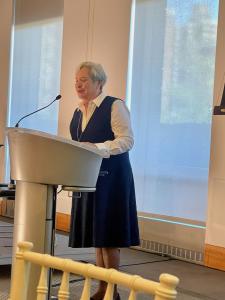
Sister Norma Pimentel speaks at the Religion News Service’s 90th-anniversary celebration in New York on Sept. 10, 2024. | Travis Henry
RNS got its start after Jewish journalist Louis Minsky proposed the idea to the National Conference of Christians and Jews, a conference created in response to rising anti-Jewish and anti-Catholic prejudice in America in the late 1920s. Members of the conference included prominent Americans of the time, such as Theodore Roosevelt, activist Jane Addams and U.S. Supreme Court Justice Charles Evans Hughes.
According to a welcome by RNS Publisher Deborah Caldwell, the idea then was that if “Americans could read about people of differing faiths and ethnicities, they would better understand each other and reject hatred.”
While the early service sent dispatches to newspapers nationwide and focused mostly on helping people understand Judaism and different branches of Christianity, including Catholicism, today’s RNS is a non-profit global news organization with podcasts, a strong digital presence, and coverage of all faiths.
Author and public speaker Wajahat Ali, a practicing Muslim, acted as MC of the event and kicked off the symposium by recounting how his immigrant father was almost deported due to bigotry. Ali told his own story about how, even though he was born and raised in America, he became “a foreigner, a suspect” after 9/11 due to his faith and the color of his skin. He said it’s important these stories be told so bigotry and hate can be addressed.
“RNS has been telling these stories for 90 years,” Ali said.
During a panel on “Chronicling a Changing America,” Trinity College Professor of Religion Mark Silk noted that the idea of religious pluralism post-World War II consisted mostly of recognizing Protestants, Catholics, and Jews.
Silk said it wasn’t until the Immigration and Naturalization Act of 1965, which abolished an earlier quota system based on national origin, that different religious communities began to emerge in the United States.
“Before then, if you even wanted to cover Muslims, you would have to look hard,” Silk said.
Silk noted that although it took a while, RNS eventually began covering Eastern Orthodox religions and the Black religious community, exposing the nation to diversity it hadn’t seen before.
Sister Norma Pimentel, executive director of Catholic Charities of the Rio Grande Valley, also sat on the panel and stole the morning with her story of working with refugees and immigrants to the United States.
She said it was important that people remember we are all human, no matter our nationality and faith.
“If we don’t learn to walk together, we will never get there,” she said.
Other panels tackled political polarization in churches, the rise of Christian nationalism, and the use of religion as a tool of authoritarianism.
The Authoritarian Bargain
One symposium panel discussed The After Party project, which promised to “reframe our political identity away from the ‘what’ of political positions and toward the ‘how,’ being centered on Jesus.”
The After Party co-founder Curtis Chang said pastors trying to move past divisiveness feel they are in an uphill battle.
“We are hearing from pastors, ‘Fox News gets my congregation for 25 hours a week, I get them for one,’” Chang said.
During the symposium, the Public Religion Research Institute (PRRI) unveiled for the first time the findings of their study examining data that reveal how religious belief and denominational affiliation influence Americans’ attitudes toward autocratic governance.
Executive findings from the report included:
- “Right-wing authoritarian views are more prevalent among Republicans, particularly those who hold favorable views of Trump, white evangelical Protestants, and weekly churchgoers.”
- “Right-wing authoritarians and Christian nationalists are most supportive of the need for a strong leader who is willing to break the rules.”
- “Support for authoritarianism and Christian nationalism is associated with the belief that America is in danger of losing its culture and identity.”
New York University authoritarianism expert Ruth Ben-Ghiat said that authoritarian leaders and religious groups throughout history have struck up an “authoritarian bargain,” in which the leaders, who are not necessarily religious but often lack morals, need “the moral legitimacy of the religious institution.”
In turn, religious groups get preferential treatment and influence with the government.
“Once these bargains are struck, they are very durable,” Ben-Ghiat said.
The Tech Threat Of AI
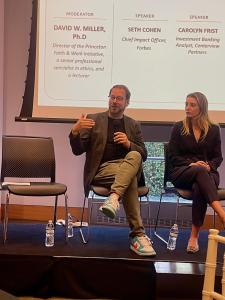
Seth Cohen, Chief Impact Officer of Forbes, speaks next to Investment Banking Analyst Carolyn Frist at the Religion News Service’s 90th-anniversary celebration in New York on Sept. 10, 2024. | Travis Henry
The technological threat of Artificial Intelligence was also discussed in a breakout session entitled “AI and Faith: Navigating Ethics in a Technological Era.”
The panel members seemed to agree that while AI could be a useful tool in allowing people to explore and learn more about religion, it shouldn’t be used to write sermons or as a replacement for human companionship.
“AI is a very thin line between inspiration and atrocity,” Forbes Chief Impact Officer Seth Cohen said.
Cohen added that he believes AI is remarkable in that it democratizes information and wisdom, and that it could spark a theological revolution similar to when the invention of the printing press suddenly allowed all people access to the Bible.
Confronting Divisive Issues with Compassion
Perhaps one of the most moving sessions of the day was a panel on Interfaith Relations in Crisis, which addressed the Israel-Hamas conflict.
Panel moderator Rev. Paul Brandeis Raushenbush, president and CEO of the Interfaith Alliance, started the panel by stating this has been “the hardest year” for interfaith relations.
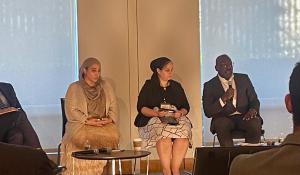
From Left to right: Najeeba Syeed, Executive Director of the Interfaith Institute at Augsburg University; Rabba Rori Picker Neiss, the Senior Vice President for Community Relations at the Jewish Council for Public Affairs; and Frederick Davie, Senior Strategic Advisor to the President, Union Theological Seminary. | Travis Henry
On the panel were Najeeba Syeed, the inaugural El-Hibri Chair and Executive Director of the Interfaith Institute at Augsburg University, who is Muslim, and Rabba Rori Picker Neiss, the Senior Vice President for Community Relations at the Jewish Council for Public Affairs.
Both women told stories of how the conflict has impacted them and their communities, and they called for compassion from all sides to understand the trauma people are enduring.
Syeed said as divisions between faiths continue to be exposed, it’s important to keep exploring “Who benefits from us being in conflict?”
Why Fair Religion Coverage Is Important
While there is plenty of data and news being circulated that tells bad news about religion, there is also lots of evidence that there is a need for more positive and fair-minded faith-related journalism.
In 2022, the groundbreaking Global Faith and Media Study was launched by RNS anniversary sponsor Faith and Media Initiative (FAMI), changing the conversation around how media engages with faith-related topics.
Commissioned by FAMI and carried out by HarrisX, a global market research firm, the study revealed a significant demand for more media coverage of faith matters. At the same time, it highlighted that journalists acknowledge the lack of encouragement and support for reporting on these issues.
FAMI also noted that a vast majority of the 9,000 global participants believe that media coverage often reinforces faith-related stereotypes rather than challenging or dispelling them.
According to the study, “there is a growing gap between the coverage of religion and the needs of the faithful.”
The study reported:
- 53% of respondents say the media actively ignores religion as an aspect of society and culture.
- 59% of respondents believe it’s important that the news media cover a diverse set of faith and religious perspectives.
- 63% of people globally say that high-quality content on faith and religion is needed in their respective countries.
FAMI’s study reported that media members they interviewed had a fear of covering religion and getting it wrong. It said interviewees “described a general fear around covering religion. In an era when religion has become increasingly politicized, news coverage, often at speed, brings with it the tacit acceptance that it’s impossible to cover the topic with a level of nuance and sensitivity given the time and resources available.”
The study reported that while readers desired more coverage about their particular faiths, journalists with a strong faith background were concerned they might be negatively judged for covering stories related to their beliefs, potentially raising questions about their impartiality and risking their reputations.
READ MORE:
Global Faith and Media Study: Religion Writers React
Final Note
While Tuesday’s event was a celebration of the great work RNS has done for 90 years, it was hard not to reflect on our mission and work at Patheos.
At Patheos, “We exist to help provide information, stories, and conversation that lead to understanding, empathy, and acceptance of all faiths.”
The past year has tested that, especially with the Israel-Hamas conflict. We had Jewish thought leaders who write for us angry that we were allowing commentary in support of Palestine they thought was anti-Semitic. At the same time, we had other thought leaders angry that we were allowing Jewish writers to tell their stories, accusing us of supporting the killing of Palestinians.
The truth is, we are a publishing platform for diverse voices doing our best to allow thoughtful people a place to discuss faith. My only wish then was that writers stuck to the examination of religion and questions of theology. Much of the writing didn’t seem to touch on religion at all. I understand the passion though and can’t imagine having family or friends involved in the conflict on either side.
I have felt the same about politics too. I don’t believe Patheos is the place to stump for Donald Trump or Kamala Harris. However, it’s the perfect place to examine the faith questions in the election and what the different candidates’ positions are regarding them.
I still believe it, but my reflections from the RNS event were a good reminder that faith is intertwined in everything, and we can’t ignore the reality.
However, our main mission remains that what we do “leads to understanding, empathy, and acceptance of all faiths.”
And while it’s an ambitious goal that we may fall short of, we will keep trying.
Are you a religious thought leader who would like to contribute to the conversation? Apply here.
Muslim
Jewish
Previous Post
September 1, 2024
Patheos Sept. 2024 Featured Writer Benjamin Raven Pressley
Next Post
October 4, 2024 Patheos October 2024 Featured Writer William T. Orr
Recent Comments
Browse Our Archives
Select a Category Calendar Featured Writers Religion News Sacred Spaces Uncategorized
Select a Month October 2026 September 2026 August 2026 July 2026 June 2026 May 2026 April 2026 March 2026 February 2026 January 2026 December 2025 November 2025 October 2025 September 2025 August 2025 July 2025 June 2025 May 2025 April 2025 March 2025 February 2025 January 2025 December 2024 November 2024 October 2024 September 2024 August 2024 July 2024 June 2024 May 2024 April 2024 March 2024 February 2024 January 2024 December 2023 November 2023 October 2023 September 2023 August 2023 July 2023 June 2023 May 2023 April 2023 March 2023 February 2023 January 2023 December 2022 November 2022 October 2022 September 2022 August 2022 July 2022 June 2022 May 2022
TAKE THE
Religious Wisdom Quiz
What animal is mentioned in Proverbs as having little strength but great wisdom?
Select your answer to see how you score.
Ox Lion Bear Ant
Related posts from Religion News Roundup

The 2025 Most-Read Faith Articles: Politics Dominated
Dig Into History: Join Our Biblical Archaeology Live...
Latter-day Saint Persecution and the Call to Healing
From Focus to Fallout: The Life and Legacy...
TRENDING AT PATHEOS Religion News

Pope Leo Celebrates Mass for Nurses & Docs...
I don't have any idea how he did it, but Pope Leo...

The Sermon on the Mount, Part I: Matthew...
The Sermon on the Mount, Part I (Matthew 4:12-5:12) St. Matthew moves...

What's up from Crossway: Reviewing some of their latest A few weeks...

Janie Learns the Way of the Cross: A...
Teaching children about Jesus' Passion can be challenging. Many parents and educators...

Looking For Good Catholic Writing - October 2026
He alone extends the heavens, and he walks upon the waves of...

In "Irreplaceable," our book on vocation and technology, Trevor Sutton and I...
view all Religion News blogs
What Are Your Thoughts?leave a comment
Ad-Free & Subscriber Log-In Subscription Support
- About Us
- 2026 Calendar
- Videos
- Podcasts
- Library of World Religions
- Faith In Media Tracker
- Advertise With Us
- Write for Us
- Privacy Policy
- Terms of Service
- Do Not Sell My Data
- Contact Us
- Radiant Digital
- Manage Newsletter Subscriptions
- Unsubscribe From Notifications
- Sitemap
Copyright 2008-2026, Patheos. All rights reserved.
Subscription Support Ad-Free & Subscriber Log-In
Follow Patheos