
BuddhistCatholicContemplativeEvangelicalGeneral ChristianHinduJewishLatter-day SaintMuslimNew VisionsProgressive Christian
Beliefs
- Buddhist
- Catholic
- Contemplative
- Evangelical
- General Christian
- Hindu
- Jewish
- Latter-day Saint
- More Voices
- Muslim
- New Visions
- Pagan
- Progressive Christian
Topics
- Religion News
- Food and Religion
- Sports and Religion
- Religious Art
- Religious Music and Entertainment
- Religious Events
- History and Religion
- Style and Religion
- Politics and Religion
- Women in Religion
- Recreation Outdoors and Religion
- Business Finance and Religion
- Careers Workplace and Religion
- Education and Religion
- Family Parenting and Religion
- Health Fitness and Religion
- Home and Religion
- Relationships and Religion
- Technology and Religion
- Travel and Religion
Columnists
- Buddhist Columnists
- Business Finance and Religion Columnists
- Careers Workplace and Religion Columnists
- Catholic Columnists
- Contemplative Columnists
- Education and Religion Columnists
- Evangelists Columnists
- Family Parenting and Religion Columnists
- General Christian Columnists
- Health Fitness and Religion Columnists
- Hindu Columnists
- History and Religion Columnists
- Home and Religion Columnists
- Jewish Columnists
- More Voices Columnists
- Latter Day Columnists
- Muslim Columnists
- New Visions Columnists
- Nonreligious Columnists
- Pagan Columnists
- Politics and Religion Columnists
- Progressive Columnists
- Recreation Outdoors and Religion Columnists
- Relationships and Religion Columnists
- Religion News Columnists
- Religious Art Columnists
- Religious Events Columnists
- Religious Music and Entertainment Columnists
- Sports and Religion Columnists
- Style and Religion Columnists
- Technology and Religion Columnists
- Travel and Religion Columnists
- Women in Religion Columnists
Resource Library
- 2026 Calendar
- Library of World Religions
- The 100 Most Holy Places on Earth
- Patheos Answers
- Podcasts
- Videos
- Faith Leaders Database
- Anglican Episcopalian
- Bahai
- Baptist
- Buddhism
- Christianity
- Confucianism
- Eastern Orthodoxy
- Hinduism
- Holiness and Pentecostal
- ISKCON
- Islam
- Judaism
- Lutheran
- Methodist
- The Church of Jesus Christ of Latter-day Saints
- New Age
- Paganism
- Presbytarian and Reformed
- Protestantism
- Religion Behind the Scenes
- Roman Catholic
- Scientology
- Shia Islam
- Sikhism
- Sufism
- Sunni Islam
- Taoism
- Zen
- See all religions
Research Tools
 Ad-Free & Subscriber Log-In Subscription Support
Follow Patheos 

- Trending:
- Advent
- |
- Forgiveness
- |
- Thanksgiving
- |
- Election
- |
- Seasonal Holidays
- |
- Marriage

- Home
- New Visions
- How Christmas Stories Functioned When They Were Written
How Christmas Stories Functioned When They Were Written
Last updated on: February 24, 2025 at 7:10 am by Tricia Gates Brown
How Christmas Stories Functioned When They Were Written 2025-02-24T07:10:39-08:00 Tricia Gates Brown
Patheos Explore the world's faith through different perspectives on religion and spirituality! Patheos has the views of the prevalent religions and spiritualities of the world.

America is the most influential global empire the world has known. | Photo by Jose Luis Juarez Rodriguez for Scopio.
Perhaps my favorite thing about the Christmas season—just a few days away—is reminding myself and others how extraordinary are the stories of Christmas. Among global literature, they stand out as baldly subversive and anti-imperial while at the same time being neutralized. The gospel writers of Matthew and Luke (the only canonical gospels with birth narratives) each in their own way set up a stark confrontation between Jesus and the Roman Caesars, of all things—something no first-century reader would have failed to recognize or to understand the audacity of. But for the most part, the two dramatically different accounts[1] are harmonized and Hallmark-ized in our day and historically—synthesized into one sweet story of strained hospitality and humble beginnings. At least this is how it is presented in the American context where we uncomfortably find ourselves as empire. America is the most influential global empire the world has known. Has this hampered our ability to understand what the Christmas stories are really saying?
The juxtaposition of Luke’s Christmas story is one between a peace brought through violence (the Pax Romana) and one brought through nonviolence by way of Jesus (Lk 1:79; 2:14; 2:29-32). In his birth narrative, Matthew emphasizes Jesus as the new Davidic king (Luke does as well), and then goes on to show how—unlike the unfathomably violent kingdom of David—the “kingdom of God” elucidated by Jesus is about self-giving, all-embracing love and a transformation of consciousness. These narratives offer a raw critique of imperial methods of controlling people, holding onto power, conquering territory, and advancing/protecting the empire’s survival. In Matthew’s somewhat satirical style, this is epitomized by the feckless, duped, and blood-thirsty King Herod—emissary of Rome—who is so afraid of losing his power to a peasant infant that he has all of the babies in Bethlehem slaughtered. In Luke, it is epitomized in the song of the Galilean teen Mary, Jesus’ mother-to-be, who proclaims:
“He has shown strength with his arm; he has scattered the proud in the thoughts of their hearts. He has brought down the powerful from their thrones, and lifted up the lowly; he has filled the hungry with good things, and sent the rich away empty. He has helped his servant Israel, in remembrance of his mercy, according to the promise he made to our ancestors, to Abraham and to his descendants forever” (Luke 1:51-55).
How can we better understand what is going on in these narratives so we can commemorate and celebrate Christmas in all of its subversive power, reflecting on what the story is saying to people about power and peace?
The Meaning of ‘evangelion’
First, let’s look at what the writers were doing in the first place by calling their writings evangelion(the Greek word translated “gospel” or “good news”). So much in that word. Prior to what we now know as the Christian gospels, the word evangelion had not been used to denote an account of a person in the way the gospels are narrative accounts of Jesus’ ministry. Before Christian usage, evangelionwas essentially a news bulletin of the empire, heralding some imperial accomplishment (“good tidings”).[2] For example, after the Romans conquered a new people or marched into a rebellious colony to wreak havoc and murder, or otherwise achieved a military victory, they would post an evangelion (or more commonly plural: evangelia) stating what they had accomplished to advance the empire. There is also at least one instance when the word evangelion was used to announce or commemorate the birthday of Caesar Augustus, who was called “Lord” and “Savior” and “Son of God.” The birth of the Caesar was considered a divine birth.
Moreover, many of the lauds subjects were required to lavish upon the Roman emperor are lauds written about Jesus in the canonical gospels and other New Testament writings. These include: “Caesar is Lord,” “Savior,” and “Son of God,” as listed above. But subjects were also commanded to say of the Emperor: “There is no other name under heaven given to men by which we may be saved,” the very words used to describe Jesus in the book of Acts (4:12; Acts being Part Two of Luke’s gospel, written by the same author). In other words, the gospel writers were definitely subverting the proclamations of the Roman Empire by claiming that the Galilean teacher Jesus (rather than Caesar) was “Lord” and “Savior” and “Son of God”—the same man who had been executed by way of Rome’s favorite execution method, a cross, and who was understood by his followers to be sent by God to proclaim the upside-down values of God’s “kingdom,” calling people to seek this kingdom where the “first will be last, and the last will be first.” According to the gospel writers, Jesus’ portrait of God and of a new way of being, a new consciousness, was the true evangelion or “good news.”
Modern readers are mostly unaware of these parallels. But first-century readers would have been struck by the scandalousness of the gospels and by their confrontation with the claims of the empire. They knew the gospels were dangerous. It should not be surprising that so many first-century Christians were executed. And though the earliest gospel likely wasn’t completed until late in Nero’s life, it shouldn’t shock us that when Nero needed a scapegoat for the devastating burning of Rome, he chose Christians. Christians were hated by the empire because they mocked it, deconstructed it, and subverted it in favor of a radically new “way of peace.”
How far we have come! Many in our day are trying to dress the American empire up as a Christian nation, doing what they can to create a trumped-up theocracy, when this so entirely misses the point of Jesus and the embracing, inclusive, love-based, peacemaking “realm” he called, quite subversively, “the kingdom of God.”

It can be so easy to forget how we benefit from the domination of people in our own time and historically. | Photo by Andrii Omelnytskyi for Scopio.
Christmas Stories as Microcosms
The Christmas stories in Matthew and Luke served as preludes, or overtures, to those gospels. They encapsulated in miniature the “good news” of the larger piece and are the lens through which to read it. For readers living under the weight of imperial violence, including systematic economic and religious oppression, spying, collective punishments, rule by fear, and outright aggression in the colonies—violence that during the conflict in mid-first-century Palestine burst into all-out war with accompanying rape and torture and tens of thousands crucified, the Christmas stories would have been emboldening, and in certain ways satirical. If we’re going to understand them at all, we must remember that this context inspired the gospels and their Christmastide overtures, and what it meant for a poor man like Jesus to show us and invite us to participate in the incarnation of the Divine in this world—what it meant for him to be lauded with appellations reserved for the Caesar.
In Luke, an angel appears to shepherds (a particularly low status) to herald the birth of this child Jesus who they call “Savior” and “Lord,” absconding Caesar’s titles—titles imperial subjects were imprisoned and killed for refusing to ascribe to the Emperor. Later, Luke portrays Jesus being recognized in the temple by the prophets Simeon and Anna as the one who would be “the redemption of Jerusalem,” the city those reading the gospel in the decades after its creation knew to be recently decimated by Rome. In Matthew, after a long genealogy linking Jesus to the patriarchs, an angel appears to Joseph explaining to him that Mary, his betrothed, will miraculously give birth to a child who will be the salvation of Israel. Magi from the east come to King Herod, Rome’s client king in Palestine who reckoned himself “King of the Jews,” and the Magi ask, where is the child who has been born “King of the Jews”? The story is a direct challenge to all the colonizing rulers Herod’s character represents. Even the very stars align to direct the Magi to baby Jesus, who they shower with gifts fit for a king: gold, frankincense, and myrrh. In parallel with Israel’s story, the holy family must flee to Egypt to escape Herod’s narcissistic baby-killing rampage in Bethlehem.
I find these Christmas stories both challenging and enlivening. If the Christian tradition just sanctioned the status quo, the “domination system,” it would have nothing interesting to offer. It would be another domination narrative by those seeking to advance their tribe and their egos. But the Christmas stories are microcosms of the gospels of Matthew and Luke, or overtures, and as such reveal a rich counter-narrative to the domination system’s way of violence, oppression, and greed. There is so much to love here!
So too, there is so much that challenges us. I am one who—like many in my country—benefits from being a citizen of history’s most far-reaching empire (this, added to the benefits of my being part of the dominant group in America). Almost all Americans benefit from our country’s geopolitical domination, whether in the form of relatively low prices at the market and gas pump, freedom of movement around the world, or in other ways. It can be so easy to forget how we benefit from the domination of people in our own time and historically. And it can make it hard for us to understand the power of the Christmas stories, the confrontation leveled by Jesus.
This Christmas, may we have our ears tuned to hear its challenging message, and may we invite real understanding and all of the reparative efforts it demands of us. If “the first are to be last, and the last first,” it will be so because we actualize this vision in our own spheres of influence, living out the “way of peace” that Jesus taught us.
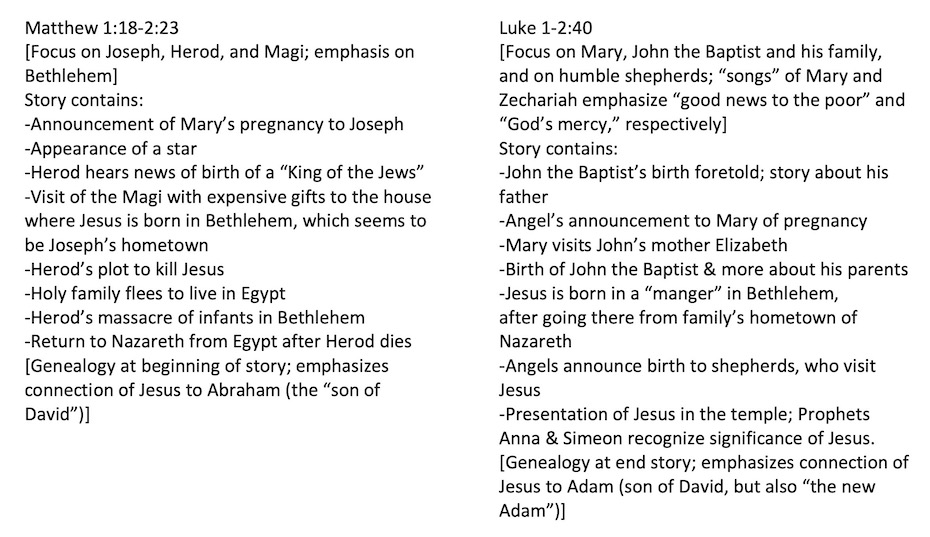
[1] The narratives in Matthew and Luke are quite different, as shown by this chart summarizing their key points:
 [2] To see the Greek passages, visit: http://www.perseus.tufts.edu/hopper/wordfreq?lang=greek&lookup=eu%29agge%2Flion
If you liked this article please leave me a comment below, I am interested in your perspective.
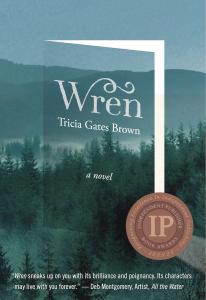
Wren, winner of a 2022 Independent Publishers Award Bronze Medal
Winner of the 2022 Independent Publisher Awards Bronze Medal for Regional Fiction; Finalist for the 2022 National Indie Excellence Awards. (2021) Paperback publication of Wren , a novel. “Insightful novel tackles questions of parenthood, marriage, and friendship with finesse and empathy … with striking descriptions of Oregon topography.” —Kirkus Reviews (2018) Audiobook publication of Wren.
Progressive Christian

About Tricia Gates Brown
Tricia Gates Brown is an everyday theologian working as a writer/editor in Oregon's Willamette Valley, mainly editing and co-writing books for the National Parks Service and Native tribes. After completing an MA in theology then a PhD from the University of St. Andrews in 2000, she continued to pursue her studies—energetically self-educating in theology, spirituality, and the emotional life. She is also an Ordained Deacon in the Episcopal Diocese of Oregon. Tricia is also an art quilter, ceramicist, and poet. She also writes at www.triciagatesbrown.net. You can read more about the author here.
Previous Post

November 24, 2024
Upside-Down: Jesus' Metaphor of 'King'
Next Post

December 16, 2024 Celebrating the Small Beauties of Christmas and Letting Go
Recent Comments
"What is prayer? Different people answer the question differently. "Prayer is all about attunement that ..."
The Many Forms of Prayer: What ..."
""I recently told someone 'I have a man,' instead of 'I am hungry' ..."Oh, what ..."
A Different Kind of Lent: Mindfulness, ..."
"Depending on the genre, music is known to offer multiple benefits to listeners and to ..."
Prayer as Heartful Listening: How Music ..."
"Christmas comes and Christmas goes. Waiting is certainly the right thing for getting further energized ..."
The Already and Not Yet: On ..."
Browse Our Archives
Select a Category Education Essay Excerpt Uncategorized
Select a Month October 2026 September 2026 August 2026 July 2026 June 2026 May 2026 April 2026 March 2026 February 2026 January 2026 December 2025 November 2025 October 2025 September 2025 August 2025 July 2025 June 2025 May 2025 April 2025 March 2025 February 2025 January 2025 December 2024 November 2024 October 2024 September 2024 August 2024 July 2024 June 2024 May 2024 April 2024 March 2024 February 2024 January 2024 December 2023 November 2023 October 2023 September 2023 August 2023 July 2023 June 2023 May 2023 April 2023 March 2023 February 2023 January 2023 December 2022 November 2022 October 2022 September 2022 August 2022 July 2022
Follow Us!
TAKE THE
Religious Wisdom Quiz
Who was the giant defeated by David?
Select your answer to see how you score.
Samson Goliath Herod Pharaoh
Books by This Author Books by About Religion, Doubt and Why They Matter
Related posts from About Religion, Doubt and Why They Matter

The Grief of Healing: Being Found by the...
About Religion, Doubt and Why They Matter

Using Your Gifts Is Ministry: A Retired Deacon's...
About Religion, Doubt and Why They Matter

The Many Forms of Prayer: What Does it...
About Religion, Doubt and Why They Matter

In the Gloaming: What the Anti-Aging Movement Misses
About Religion, Doubt and Why They Matter
TRENDING AT PATHEOS New Visions

The Healing Power of Forgiveness in Marriage
Learning how to give and accept apologies are essential ingredients of a...

The West's Christian Moral Inheritance: A Legacy Denied
Whether we like it or not, our environment matters, shaping us both...

How Does Tôḏâ Connect Florida & Thanksgiving?
The big news this weekend has been about the continued flooding on...
Were Early Christians Drinking Psychedelic Wine?
The Secret Sacrament the Church Took Away The early Christian church was...

As we in the United States approach the national Thanksgiving holiday...

‘Fjord’ Director Mungiu on Religious Family, Bias, Tolerance
Cristian Mungiu’s new film “Fjord” follows a Christian family trying to make...
view all New Visions blogs
What Are Your Thoughts?leave a comment
Ad-Free & Subscriber Log-In Subscription Support
- About Us
- 2026 Calendar
- Videos
- Podcasts
- Library of World Religions
- Faith In Media Tracker
- Advertise With Us
- Write for Us
- Privacy Policy
- Terms of Service
- Do Not Sell My Data
- Contact Us
- Radiant Digital
- Manage Newsletter Subscriptions
- Unsubscribe From Notifications
- Sitemap
Copyright 2008-2026, Patheos. All rights reserved.
Subscription Support Ad-Free & Subscriber Log-In
Follow Patheos