
BuddhistCatholicContemplativeEvangelicalGeneral ChristianHinduJewishLatter-day SaintMuslimNew VisionsProgressive Christian
Beliefs
- Buddhist
- Catholic
- Contemplative
- Evangelical
- General Christian
- Hindu
- Jewish
- Latter-day Saint
- More Voices
- Muslim
- New Visions
- Pagan
- Progressive Christian
Topics
- Religion News
- Food and Religion
- Sports and Religion
- Religious Art
- Religious Music and Entertainment
- Religious Events
- History and Religion
- Style and Religion
- Politics and Religion
- Women in Religion
- Recreation Outdoors and Religion
- Business Finance and Religion
- Careers Workplace and Religion
- Education and Religion
- Family Parenting and Religion
- Health Fitness and Religion
- Home and Religion
- Relationships and Religion
- Technology and Religion
- Travel and Religion
Columnists
- Buddhist Columnists
- Business Finance and Religion Columnists
- Careers Workplace and Religion Columnists
- Catholic Columnists
- Contemplative Columnists
- Education and Religion Columnists
- Evangelists Columnists
- Family Parenting and Religion Columnists
- General Christian Columnists
- Health Fitness and Religion Columnists
- Hindu Columnists
- History and Religion Columnists
- Home and Religion Columnists
- Jewish Columnists
- More Voices Columnists
- Latter Day Columnists
- Muslim Columnists
- New Visions Columnists
- Nonreligious Columnists
- Pagan Columnists
- Politics and Religion Columnists
- Progressive Columnists
- Recreation Outdoors and Religion Columnists
- Relationships and Religion Columnists
- Religion News Columnists
- Religious Art Columnists
- Religious Events Columnists
- Religious Music and Entertainment Columnists
- Sports and Religion Columnists
- Style and Religion Columnists
- Technology and Religion Columnists
- Travel and Religion Columnists
- Women in Religion Columnists
Resource Library
- 2026 Calendar
- Library of World Religions
- The 100 Most Holy Places on Earth
- Patheos Answers
- Podcasts
- Videos
- Faith Leaders Database
- Anglican Episcopalian
- Bahai
- Baptist
- Buddhism
- Christianity
- Confucianism
- Eastern Orthodoxy
- Hinduism
- Holiness and Pentecostal
- ISKCON
- Islam
- Judaism
- Lutheran
- Methodist
- The Church of Jesus Christ of Latter-day Saints
- New Age
- Paganism
- Presbytarian and Reformed
- Protestantism
- Religion Behind the Scenes
- Roman Catholic
- Scientology
- Shia Islam
- Sikhism
- Sufism
- Sunni Islam
- Taoism
- Zen
- See all religions
Research Tools
 Ad-Free & Subscriber Log-In Subscription Support
Ad-Free & Subscriber Log-In Subscription Support
Follow Patheos 

- Trending:
- Forgiveness
- |
- Marriage
- |
- Consciousness
- |
- Death Penalty
- |
- Election
- |
- Halloween

- Home
- New Visions
- Politics and Religion
- 3 Ways Religion Helps Us Embrace Complexity
3 Ways Religion Helps Us Embrace Complexity
Last updated on: December 11, 2023 at 5:42 am by Tricia Gates Brown
3 Ways Religion Helps Us Embrace Complexity 2023-12-11T05:42:42-08:00 Tricia Gates Brown
Patheos Explore the world's faith through different perspectives on religion and spirituality! Patheos has the views of the prevalent religions and spiritualities of the world.
{If you’d like to listen to this piece rather than read, click below on the photo/link to watch a video (~ 8 mins).}

Something increasingly apparent to me in recent months is a lack of nuance in discussions of political positions or world events. Part of this is because the soundbites and snippets of social media can’t provide a full picture of what’s happening around an issue or in a certain part of the world. We feel pressed into amplifying over-simplified messages to show that we care—because we do care and want to help. But adopting a position of learning, of trying our best to learn all that we can about the complexities of an issue, takes time and energy that many of us don’t feel that we have.
With regard to the war in Israel-Gaza, I’ve found no one doing a better job of offering incredibly thoughtful discussions than Ezra Klein, the New York Times opinion columnist and podcaster. But the more I listen to the helpful discussions and interviews he is hosting, the more complex the picture becomes. And this is uncomfortable. One can hold that the mass displacement, and the destruction of lives and homes of thousands of people in Gaza is abhorrent and still hold in one’s heart the complexities that confront the Israeli people who face terrorism and antisemitism and a deeply unpopular governing elite. Behind these statements are volumes of detail and nuance and history.
In order to proceed in the world in love and with hearts that are increasingly open and not increasingly closed, we must hold in our hearts the complexity of opposing ideas, to hold the both/and instead of the either/or. I find myself wondering if religion has something to contribute here. My newsletter and column are called “Religion Matters” because I think religion matters a great deal. We are all religious, in that we all have sacred meaning systems that guide us, even if we are not aware of them. These religions are very consequential. The question I’m pondering at this time of reactionary politics and unnuanced positions is: Can religion help us to embrace complexity? Or does religion only make people more simplistic and unnuanced in their thinking?
First, I suggest that there’s a continuum of healthy to unhealthy religion; or maybe mature to immature religion. There will always be forms of religion that boil issues down to extremes. Good/bad; black/white; light/dark. Just like there are forms of politics or philosophy that do this. This is like the Marvel Comics form of religion: Good guys against bad guys, and violence and might save the day. So let’s start by saying our goal is healthy religion. Healthy religion, of all forms, is religion that broadens our scope and our ability to embrace opposites rather than collapsing our aperture down to false dichotomies.

{Photo by Ravindra Kumar for Scopio; embrace complexity}
So, here are 3 reasons I think healthy religion does allow us to better embrace complexity:
First, at the heart of the ethics of all the religious traditions is the phrase: “Love God and love one’s neighbor as oneself,” or “Do to others as you’d want them to do to you.” In other words, healthy religion fosters empathy. This is the ability to look at the experience of someone seemingly foreign to us and to feel with them. At least to try.
Second, healthy religions teach people to love their enemies. This doesn’t mean we let down important boundaries, and it doesn’t even mean love as an emotion. We don’t have to feel love when we or others are being treated badly. But love of enemies in the spiritual sense does compel us to question our desires for revenge, or our desires to perpetuate harm and conflict in order to satisfy our anger. It does mean we allow the bright light of spirit to expose our desires for revenge and to help us pray to let go of these desires. When we want all things to move toward wholeness, that means all things. Loving enemies basically means we want even their wholeness in the end. This means trusting a form of justice that is bigger than us.
Finally, healthy religions also help us to see an arc to history. They should make us less myopic. We are baited everyday into reacting to daily events. Healthy religion should remind us of patterns and consequences, and can help us to trust in something like redemption.
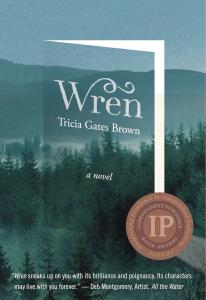
Wren, winner of a 2022 Independent Publishers Award Bronze Medal
Winner of the 2022 Independent Publisher Awards Bronze Medal for Regional Fiction; Finalist for the 2022 National Indie Excellence Awards. (2021) Paperback publication of Wren , a novel. “Insightful novel tackles questions of parenthood, marriage, and friendship with finesse and empathy … with striking descriptions of Oregon topography.” —Kirkus Reviews (2018) Audiobook publication of Wren.
Contemplative
Politics and Religion

About Tricia Gates Brown
Tricia Gates Brown is an everyday theologian working as a writer/editor in Oregon's Willamette Valley, mainly editing and co-writing books for the National Parks Service and Native tribes. After completing an MA in theology then a PhD from the University of St. Andrews in 2000, she continued to pursue her studies—energetically self-educating in theology, spirituality, and the emotional life. She is also an Ordained Deacon in the Episcopal Diocese of Oregon. Tricia is an art quilter, potter, and novelist, besides, living on a farm and loving a menagerie of cats. You can read more about the author here.
Previous Post

December 4, 2023
7 Best Faith-Based Christmas Songs By Pop Artists
Next Post

December 16, 2023 Advent: An Invitation to Remove Obstacles to the Divine
Recent Comments
""I recently told someone 'I have a man,' instead of 'I am hungry' ..."Oh, what ..."
A Different Kind of Lent: Mindfulness, ..."
"Depending on the genre, music is known to offer multiple benefits to listeners and to ..."
Prayer as Heartful Listening: How Music ..."
"Christmas comes and Christmas goes. Waiting is certainly the right thing for getting further energized ..."
The Already and Not Yet: On ..."
"Honesty and humility are weapons of mass construction. They always deepen our relationship with God ..."
Freedom in Humility: God Loves Us ..."
Browse Our Archives
Select a Category Education Essay Excerpt Uncategorized
Select a Month September 2026 August 2026 July 2026 June 2026 May 2026 April 2026 March 2026 February 2026 January 2026 December 2025 November 2025 October 2025 September 2025 August 2025 July 2025 June 2025 May 2025 April 2025 March 2025 February 2025 January 2025 December 2024 November 2024 October 2024 September 2024 August 2024 July 2024 June 2024 May 2024 April 2024 March 2024 February 2024 January 2024 December 2023 November 2023 October 2023 September 2023 August 2023 July 2023 June 2023 May 2023 April 2023 March 2023 February 2023 January 2023 December 2022 November 2022 October 2022 September 2022 August 2022 July 2022
Follow Us!
TAKE THE
Religious Wisdom Quiz
I am a book of sermons and laws, Moses' final words before entering the Promised Land. What book am I?
Select your answer to see how you score.
The second law The law Moses' testimony Deuteronomy
Books by This Author Books by About Religion, Doubt and Why They Matter
Related posts from About Religion, Doubt and Why They Matter

Using Your Gifts Is Ministry: A Retired Deacon's...
About Religion, Doubt and Why They Matter

The Many Forms of Prayer: What Does it...
About Religion, Doubt and Why They Matter

In the Gloaming: What the Anti-Aging Movement Misses
About Religion, Doubt and Why They Matter

God Is in the Obstacle: What Loss Taught...
About Religion, Doubt and Why They Matter
TRENDING AT PATHEOS New Visions

How to Make a Decision When You Can't...
Main point: It’s much more valuable to stay close to God so...

Archdiocese Hosts Military Marriage Retreat in Germany
RASTATT, Germany — The transient military lifestyle, with its frequent deployments and...

Nearly every morning, I make the drive to Detroit with my high-school-age...

The Real AI Story Is Adoption Without Trust
Artificial intelligence has crossed a political threshold. It is no longer a...

A new article, written by Jeff Lindsay and Gale L. Pooley,...

Swimfan: Forgotten Aughts Pleasures
This is a recovery effort. In 2002, My Big Fat Greek Wedding...
view all New Visions blogs
What Are Your Thoughts?leave a comment
Ad-Free & Subscriber Log-In Subscription Support
- About Us
- 2026 Calendar
- Videos
- Podcasts
- Library of World Religions
- Faith In Media Tracker
- Advertise With Us
- Write for Us
- Privacy Policy
- Terms of Service
- Do Not Sell My Data
- Contact Us
- Radiant Digital
- Manage Newsletter Subscriptions
- Unsubscribe From Notifications
- Sitemap
Copyright 2008-2026, Patheos. All rights reserved.
Subscription Support Ad-Free & Subscriber Log-In
Follow Patheos