
BuddhistCatholicContemplativeEvangelicalGeneral ChristianHinduJewishLatter-day SaintMuslimNew VisionsProgressive Christian
Beliefs
- Buddhist
- Catholic
- Contemplative
- Evangelical
- General Christian
- Hindu
- Jewish
- Latter-day Saint
- More Voices
- Muslim
- New Visions
- Pagan
- Progressive Christian
Topics
- Religion News
- Food and Religion
- Sports and Religion
- Religious Art
- Religious Music and Entertainment
- Religious Events
- History and Religion
- Style and Religion
- Politics and Religion
- Women in Religion
- Recreation Outdoors and Religion
- Business Finance and Religion
- Careers Workplace and Religion
- Education and Religion
- Family Parenting and Religion
- Health Fitness and Religion
- Home and Religion
- Relationships and Religion
- Technology and Religion
- Travel and Religion
Columnists
- Buddhist Columnists
- Business Finance and Religion Columnists
- Careers Workplace and Religion Columnists
- Catholic Columnists
- Contemplative Columnists
- Education and Religion Columnists
- Evangelists Columnists
- Family Parenting and Religion Columnists
- General Christian Columnists
- Health Fitness and Religion Columnists
- Hindu Columnists
- History and Religion Columnists
- Home and Religion Columnists
- Jewish Columnists
- More Voices Columnists
- Latter Day Columnists
- Muslim Columnists
- New Visions Columnists
- Nonreligious Columnists
- Pagan Columnists
- Politics and Religion Columnists
- Progressive Columnists
- Recreation Outdoors and Religion Columnists
- Relationships and Religion Columnists
- Religion News Columnists
- Religious Art Columnists
- Religious Events Columnists
- Religious Music and Entertainment Columnists
- Sports and Religion Columnists
- Style and Religion Columnists
- Technology and Religion Columnists
- Travel and Religion Columnists
- Women in Religion Columnists
Resource Library
- 2026 Calendar
- Library of World Religions
- The 100 Most Holy Places on Earth
- Patheos Answers
- Podcasts
- Videos
- Faith Leaders Database
- Anglican Episcopalian
- Bahai
- Baptist
- Buddhism
- Christianity
- Confucianism
- Eastern Orthodoxy
- Hinduism
- Holiness and Pentecostal
- ISKCON
- Islam
- Judaism
- Lutheran
- Methodist
- The Church of Jesus Christ of Latter-day Saints
- New Age
- Paganism
- Presbytarian and Reformed
- Protestantism
- Religion Behind the Scenes
- Roman Catholic
- Scientology
- Shia Islam
- Sikhism
- Sufism
- Sunni Islam
- Taoism
- Zen
- See all religions
Research Tools
 Ad-Free & Subscriber Log-In Subscription Support
Ad-Free & Subscriber Log-In Subscription Support
Follow Patheos 

- Trending:
- Forgiveness
- |
- Marriage
- |
- Consciousness
- |
- Death Penalty
- |
- Election
- |
- Halloween

- Home
- New Visions
- The subversive, confrontational, emboldening stories of Christmas {Part Two}
The subversive, confrontational, emboldening stories of Christmas {Part Two}
Last updated on: March 16, 2023 at 7:34 am by Tricia Gates Brown
The subversive, confrontational, emboldening stories of Christmas {Part Two} 2023-03-16T07:34:39-07:00 Tricia Gates Brown
Patheos Explore the world's faith through different perspectives on religion and spirituality! Patheos has the views of the prevalent religions and spiritualities of the world.

{Photo by Vitaly Chelkis for Scopio}
{Perhaps my favorite thing about this season is reminding readers (and myself) how subversive are the Christmas stories. Before reading this column, I suggest you read Part One HERE.}
The Christmas stories in Matthew and Luke[1] served as preludes, or overtures, to those gospels. They encapsulated in miniature the “good news” of the larger piece and are the lens through which to read it. For readers living under the weight of imperial violence, including systematic economic and religious oppression, spying, collective punishments, rule by fear, and outright aggression in the colonies—violence that during the conflict in mid first-century Palestine burst into all-out war with accompanying rape and torture and tens of thousands crucified, the Christmas stories would have been emboldening, and in certain ways satirical. If we’re going to understand them at all, we must remember that this context inspired the gospels and their Christmastide overtures, and what it meant for a poor man like Jesus to show us and invite us to participate in the incarnation of the Divine in this world—what it meant for him to be lauded with appellations reserved for the Caesar.
In Luke, an angel appears to shepherds (a particularly low status) to herald the birth of this child Jesus who they call “Savior” and “Lord,” absconding Caesar’s titles—titles imperial subjects were imprisoned and killed for refusing to ascribe to the Emperor. Later, Luke portrays Jesus being recognized in the temple by the prophets Simeon and Anna as the one who would be “the redemption of Jerusalem,” the city those reading the gospel in the decades after its creation knew to be recently decimated by Rome. In Matthew, after a long genealogy linking Jesus to the patriarchs, an angel appears to Joseph explaining to him that Mary, his betrothed, will miraculously give birth to a child who will be the salvation of Israel. Magi from the east come to King Herod, Rome’s client king in Palestine who reckoned himself “King of the Jews,” and the Magi ask, where is the child who has been born “King of the Jews”? The story is a direct challenge to all the colonizing rulers Herod’s character represents. Even the very stars align to direct the Magi to baby Jesus, who they shower with gifts fit for a king: gold, frankincense, and myrrh. In parallel with Israel’s story, the holy family must flee to Egypt to escape Herod’s narcissistic baby-killing rampage in Bethlehem.
I find these Christmas stories both challenging and enlivening. If the Christian tradition just sanctioned the status quo, the “domination system,” it would have nothing interesting to offer. It would be another domination narrative by those seeking to advance their tribe and their egos. But the Christmas stories are microcosms of the gospels of Matthew and Luke, or overtures, and as such reveal a rich counter narrative to the domination system’s way of violence, oppression, and greed. There is so much to love here!
So too, there is so much that challenges us. I am an American who—like many Americans—benefits from being a citizen of history’s most far-reaching empire (this, added to the benefits of my being part of the dominant group in America). Almost all Americans benefit from our country’s geopolitical domination, whether in the form of relatively low prices at the market and gas pump, freedom of movement around the world, or in other ways. It can be so easy to forget or to “choose not to remember” how we benefit from the systematic domination of people in our own time and historically. And it can make it hard for us to understand the power of the Christmas stories, the confrontation leveled by Jesus.
This Christmas, may we have our ears tuned to hear its subversive message, and may we invite real understanding and all of the reparative efforts it demands of us. If “the first are to be last, and the last first,” it will be so because we actualize this vision in our own spheres of influence, living out the “way of peace” that Jesus taught us.
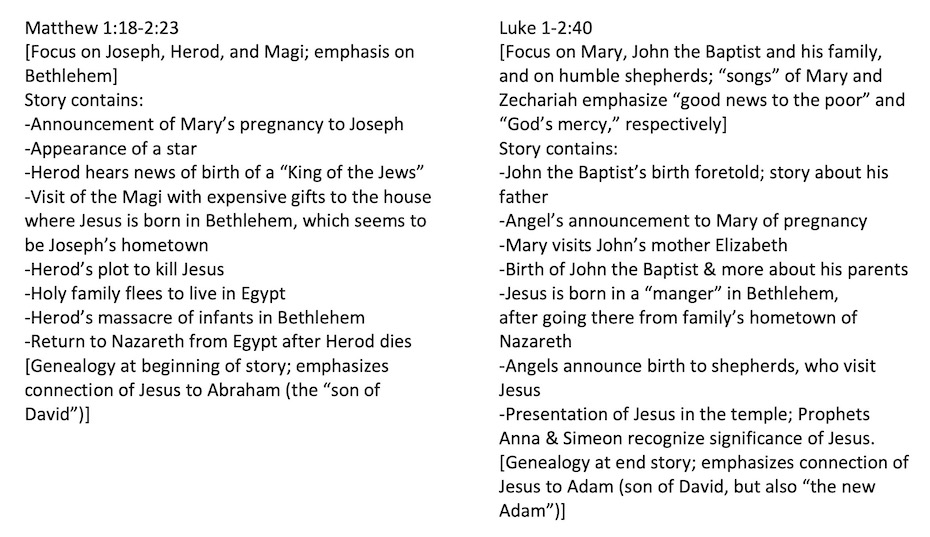
[1] The narratives in Matthew and Luke are quite different, as shown by this chart summarizing their key points:

Wren, winner of an Independent Publishers Award Bronze Medal

Next Post

December 6, 2022 The Arrival: Receiving the gift of Advent today
Browse Our Archives
Select a Category Education Essay Excerpt Uncategorized
Select a Month September 2026 August 2026 July 2026 June 2026 May 2026 April 2026 March 2026 February 2026 January 2026 December 2025 November 2025 October 2025 September 2025 August 2025 July 2025 June 2025 May 2025 April 2025 March 2025 February 2025 January 2025 December 2024 November 2024 October 2024 September 2024 August 2024 July 2024 June 2024 May 2024 April 2024 March 2024 February 2024 January 2024 December 2023 November 2023 October 2023 September 2023 August 2023 July 2023 June 2023 May 2023 April 2023 March 2023 February 2023 January 2023 December 2022 November 2022 October 2022 September 2022 August 2022 July 2022
Follow Us!
TAKE THE
Religious Wisdom Quiz
The light shines in the darkness, and the darkness has not ____ it.
Select your answer to see how you score.
Extinguished Comprehended Understood Accepted
Books by This Author Books by About Religion, Doubt and Why They Matter
Related posts from About Religion, Doubt and Why They Matter

Christmas Blessing in Troubled Times: The Gift of...
About Religion, Doubt and Why They Matter

Our Value Comes From Our Being, Not From...
About Religion, Doubt and Why They Matter

The Already and Not Yet: On Christmas and...
About Religion, Doubt and Why They Matter

How Christmas Stories Functioned When They Were Written
About Religion, Doubt and Why They Matter
TRENDING AT PATHEOS New Visions

How to Make a Decision When You Can't...
Main point: It’s much more valuable to stay close to God so...

Archdiocese Hosts Military Marriage Retreat in Germany
RASTATT, Germany — The transient military lifestyle, with its frequent deployments and...

Nearly every morning, I make the drive to Detroit with my high-school-age...

The Real AI Story Is Adoption Without Trust
Artificial intelligence has crossed a political threshold. It is no longer a...

A new article, written by Jeff Lindsay and Gale L. Pooley,...

Swimfan: Forgotten Aughts Pleasures
This is a recovery effort. In 2002, My Big Fat Greek Wedding...
view all New Visions blogs
Ad-Free & Subscriber Log-In Subscription Support
- About Us
- 2026 Calendar
- Videos
- Podcasts
- Library of World Religions
- Faith In Media Tracker
- Advertise With Us
- Write for Us
- Privacy Policy
- Terms of Service
- Do Not Sell My Data
- Contact Us
- Radiant Digital
- Manage Newsletter Subscriptions
- Unsubscribe From Notifications
- Sitemap
Copyright 2008-2026, Patheos. All rights reserved.
Subscription Support Ad-Free & Subscriber Log-In
Follow Patheos