
BuddhistCatholicContemplativeEvangelicalGeneral ChristianHinduJewishLatter-day SaintMuslimNew VisionsProgressive Christian
Beliefs
- Buddhist
- Catholic
- Contemplative
- Evangelical
- General Christian
- Hindu
- Jewish
- Latter-day Saint
- More Voices
- Muslim
- New Visions
- Pagan
- Progressive Christian
Topics
- Religion News
- Food and Religion
- Sports and Religion
- Religious Art
- Religious Music and Entertainment
- Religious Events
- History and Religion
- Style and Religion
- Politics and Religion
- Women in Religion
- Recreation Outdoors and Religion
- Business Finance and Religion
- Careers Workplace and Religion
- Education and Religion
- Family Parenting and Religion
- Health Fitness and Religion
- Home and Religion
- Relationships and Religion
- Technology and Religion
- Travel and Religion
Columnists
- Buddhist Columnists
- Business Finance and Religion Columnists
- Careers Workplace and Religion Columnists
- Catholic Columnists
- Contemplative Columnists
- Education and Religion Columnists
- Evangelists Columnists
- Family Parenting and Religion Columnists
- General Christian Columnists
- Health Fitness and Religion Columnists
- Hindu Columnists
- History and Religion Columnists
- Home and Religion Columnists
- Jewish Columnists
- More Voices Columnists
- Latter Day Columnists
- Muslim Columnists
- New Visions Columnists
- Nonreligious Columnists
- Pagan Columnists
- Politics and Religion Columnists
- Progressive Columnists
- Recreation Outdoors and Religion Columnists
- Relationships and Religion Columnists
- Religion News Columnists
- Religious Art Columnists
- Religious Events Columnists
- Religious Music and Entertainment Columnists
- Sports and Religion Columnists
- Style and Religion Columnists
- Technology and Religion Columnists
- Travel and Religion Columnists
- Women in Religion Columnists
Resource Library
- 2026 Calendar
- Library of World Religions
- The 100 Most Holy Places on Earth
- Patheos Answers
- Podcasts
- Videos
- Faith Leaders Database
- Anglican Episcopalian
- Bahai
- Baptist
- Buddhism
- Christianity
- Confucianism
- Eastern Orthodoxy
- Hinduism
- Holiness and Pentecostal
- ISKCON
- Islam
- Judaism
- Lutheran
- Methodist
- The Church of Jesus Christ of Latter-day Saints
- New Age
- Paganism
- Presbytarian and Reformed
- Protestantism
- Religion Behind the Scenes
- Roman Catholic
- Scientology
- Shia Islam
- Sikhism
- Sufism
- Sunni Islam
- Taoism
- Zen
- See all religions
Research Tools
 Ad-Free & Subscriber Log-In Subscription Support
Ad-Free & Subscriber Log-In Subscription Support
Follow Patheos 

- Trending:
- Forgiveness
- |
- Marriage
- |
- Consciousness
- |
- Death Penalty
- |
- Election
- |
- Halloween

- Home
- New Visions
- Freedom for Transcendence: The liberation and limitations of our Walden Ponds
Freedom for Transcendence: The liberation and limitations of our Walden Ponds
Last updated on: October 19, 2022 at 5:43 am by Tricia Gates Brown
Freedom for Transcendence: The liberation and limitations of our Walden Ponds 2022-10-19T05:43:52-07:00 Tricia Gates Brown
Patheos Explore the world's faith through different perspectives on religion and spirituality! Patheos has the views of the prevalent religions and spiritualities of the world.
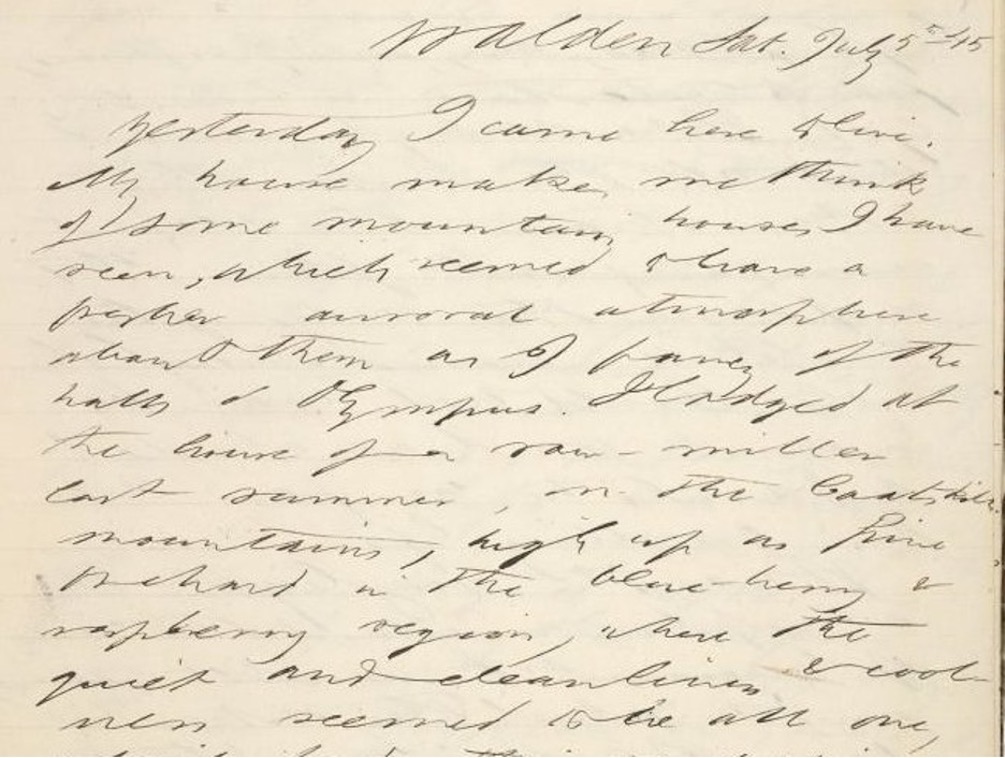
{Photo by Tricia Gates Brown}
{Four years ago at this time, I was at Walden Pond. Before the trip, I wrote this reflection. While in Concord, I saw handwritten, original drafts of Thoreau manuscripts, pictured above.}
When I moved from Oregon’s Willamette Valley to the north Oregon coast in 2004, it was a leap. I parachuted out of a life that no longer accommodated into a 10-month sojourn of dis-illusionment, dismantling, and radiant transformation in a tiny Oceanside, Oregon duplex on a cliff overhanging the Pacific. The move began as a freefall. No one pushed me; I jumped. Fortunately, after a few unsteady years, I landed in 2007—feet on the ground—in a small river valley cottage I helped to build (mostly doing finish work with the help of skilled friends). Turns out many make radical life moves in similar fashion: hold your breath, leap, crash, stand and dust off and survey the new territory. Something about the ocean, in particular, invites this, beckoning those who want a life of substance and synergy with nature—a life difficult to cultivate in bustling towns. People move to such areas seeking reflection and art. We long to pare down our material belongings, our external obligations, and to attend the things that mend the soul. Ultimately, we believe this will change the world.
Then something gradually happens. Slowly our ambrosial Thoreauvian fantasies come face to face with a little reality called the economy. This perplexing imbrication is unavoidable: the shady overlap where our commitments to simplicity meet the realities of high cost of living, high rent and property values, lower paying jobs, taxes, and in the case of those who live on the coasts or similar destinations—economies based largely on tourism, shopping, and second-home ownership. Cognitive dissonance ensues.
But let’s back up to those ten quiet months in Oceanside. During 2004 to 2005, I listened to Thoreau’s Walden on audiobook repeatedly while walking the beach. At earlier times in my life I had attempted the book. Yet I couldn’t still myself enough to absorb the baroque constructions of Thoreau’s language, or to understand his message. Yet walking amidst the wild, solitary expanses of the Pacific coast, I let Walden soak into me and inspire me. The Conclusion became like sacred scripture. In fact, it’s hard not to recognize the similarities between parts of Thoreau’s Conclusion to Walden and some of Jesus’ teachings. Thoreau writes:
“However mean your life is, meet it and live it. Cultivate poverty like a garden herb, like sage. Do not trouble yourself much to get new things, whether clothes or friends. Turn the old; return to them. …Sell your clothes and keep your thoughts.”
“In proportion as he simplifies his life, the laws of the universe will appear less complex, and solitude will not be solitude, nor poverty poverty, nor weakness weakness. If you have built castles in the air, your work need not be lost; that is where they should be. Now put the foundations under them.”
“No face which we can give to a matter will stead us so well at last as the truth. This alone wears well. For the most part, we are not where we are, but in a false position. … However mean your life is, meet it and live it; do not shun it and call it hard names. It is not so bad as you are. It looks poorest when you are richest. The fault-finder will find faults even in paradise. Love your life, poor as it is.”
It was the unclutteredness, the time to “keep my thoughts,” that had drawn me to my life on the Oregon coast. But the contemplative sojourn in Oceanside was only to last ten months, just as life by Walden Pond lasted, for Thoreau, only two years. Many misunderstand Thoreau as a recluse and escapist, but we was neither. He lived his life mostly in town (all but his two years at Walden); he was largely consigned to jobs he didn’t necessary relish (for example, successively teaching, caretaking Emerson’s home and kids, helping run his family’s pencil-making business, surveying) to support vocations that while not money-making, were his life’s work (explorations in nature, writing); he was deeply engaged with his mother and sisters and the family chores, as with members of the Concord community among whom he sang, danced, argued and learned.
In coming weeks [this was written in 2018] I will be visiting Walden Pond for the first time with my grown daughter, and it feels like a pilgrimage. Anticipation rises. I have read no American writer so resonant with my longings for simplicity and transcendence as Henry David. (I say this while simultaneously repudiating Thoreau’s nineteenth-century views tainted with misogyny and racial prejudice, especially in terms used for Native Americans. Both the resonance and repudiation are true.) Thoreau encourages me to keep living the life I have chosen—even if others don’t get it. Whenever my schedule allows time for a quiet walk by wild margins, for artfulness, or a bit of time to sit and reflect, and each time the deep life and energy stir in me, I am reminded of why I choose this path. And whenever I re-read Walden passages like those above, my inner Amen-chorus rouses. Living out the truths of these passages may be easier said than done, but it is worth the effort.
Walden is often dismissed as a nature treatise by those who haven’t really read it. Yet while Thoreau does discourse stunningly on nature in the book, Walden is really a discourse on freedom—freedom of the spirit, freedom from the “lives of quiet desperation” our economic realities lead us into if we are not vigilant. We all have circumstances beyond our control that limit our choices. But Thoreau encourages readers to set ourselves free from the shackles we impose upon ourselves, in our desperation to be seen a certain way by our peers, to live up to societal expectations, to have more and more pretty things, to distract ourselves, to lazily avoid hard questions, to cloyingly grope for company and adulation. The costs of freedom may be high, but the payoff for choosing freedom is resurrection and mirth. To surrender to the mystery, we must first catch a glimpse of what awaits. We must be able to see. That is the challenge. For as Thoreau writes in the final sentences of Walden: “The light which puts out our eyes is darkness to us. Only that day dawns to which we are awake. There is more day to dawn. The sun is but a morning star.”
Thank you for supporting my work by subscribing (free).

Wren, winner of a 2022 Independent Publishers Award Bronze Medal
Contemplative
Previous Post

October 15, 2022
Martin and the Cedar Tree: Serendipities and the Afterlife
Next Post

October 25, 2022 9 Ways Humans Can Know and Understand God
Browse Our Archives
Select a Category Education Essay Excerpt Uncategorized
Select a Month September 2026 August 2026 July 2026 June 2026 May 2026 April 2026 March 2026 February 2026 January 2026 December 2025 November 2025 October 2025 September 2025 August 2025 July 2025 June 2025 May 2025 April 2025 March 2025 February 2025 January 2025 December 2024 November 2024 October 2024 September 2024 August 2024 July 2024 June 2024 May 2024 April 2024 March 2024 February 2024 January 2024 December 2023 November 2023 October 2023 September 2023 August 2023 July 2023 June 2023 May 2023 April 2023 March 2023 February 2023 January 2023 December 2022 November 2022 October 2022 September 2022 August 2022 July 2022
Follow Us!
TAKE THE
Religious Wisdom Quiz
Who saw the Lord high and lifted up, with the train of his robe filling the temple?
Select your answer to see how you score.
Daniel Jeremiah Isaiah Ezekiel
Books by This Author Books by About Religion, Doubt and Why They Matter
Related posts from About Religion, Doubt and Why They Matter

Using Your Gifts Is Ministry: A Retired Deacon's...
About Religion, Doubt and Why They Matter

The Many Forms of Prayer: What Does it...
About Religion, Doubt and Why They Matter

In the Gloaming: What the Anti-Aging Movement Misses
About Religion, Doubt and Why They Matter

God Is in the Obstacle: What Loss Taught...
About Religion, Doubt and Why They Matter
TRENDING AT PATHEOS New Visions

The Sermon on the Mount, Part I: Matthew...
The Sermon on the Mount, Part I (Matthew 4:12-5:12) St. Matthew moves...

What's up from Crossway: Reviewing some of their latest A few weeks...

Janie Learns the Way of the Cross: A...
Teaching children about Jesus' Passion can be challenging. Many parents and educators...

Looking For Good Catholic Writing - October 2026
He alone extends the heavens, and he walks upon the waves of...

In "Irreplaceable," our book on vocation and technology, Trevor Sutton and I...

I was strolling through the top floor of the brand new Parthenon...
view all New Visions blogs
Ad-Free & Subscriber Log-In Subscription Support
- About Us
- 2026 Calendar
- Videos
- Podcasts
- Library of World Religions
- Faith In Media Tracker
- Advertise With Us
- Write for Us
- Privacy Policy
- Terms of Service
- Do Not Sell My Data
- Contact Us
- Radiant Digital
- Manage Newsletter Subscriptions
- Unsubscribe From Notifications
- Sitemap
Copyright 2008-2026, Patheos. All rights reserved.
Subscription Support Ad-Free & Subscriber Log-In
Follow Patheos