
BuddhistCatholicContemplativeEvangelicalGeneral ChristianHinduJewishLatter-day SaintMuslimNew VisionsProgressive Christian
Beliefs
- Buddhist
- Catholic
- Contemplative
- Evangelical
- General Christian
- Hindu
- Jewish
- Latter-day Saint
- More Voices
- Muslim
- New Visions
- Pagan
- Progressive Christian
Topics
- Religion News
- Food and Religion
- Sports and Religion
- Religious Art
- Religious Music and Entertainment
- Religious Events
- History and Religion
- Style and Religion
- Politics and Religion
- Women in Religion
- Recreation Outdoors and Religion
- Business Finance and Religion
- Careers Workplace and Religion
- Education and Religion
- Family Parenting and Religion
- Health Fitness and Religion
- Home and Religion
- Relationships and Religion
- Technology and Religion
- Travel and Religion
Columnists
- Buddhist Columnists
- Business Finance and Religion Columnists
- Careers Workplace and Religion Columnists
- Catholic Columnists
- Contemplative Columnists
- Education and Religion Columnists
- Evangelists Columnists
- Family Parenting and Religion Columnists
- General Christian Columnists
- Health Fitness and Religion Columnists
- Hindu Columnists
- History and Religion Columnists
- Home and Religion Columnists
- Jewish Columnists
- More Voices Columnists
- Latter Day Columnists
- Muslim Columnists
- New Visions Columnists
- Nonreligious Columnists
- Pagan Columnists
- Politics and Religion Columnists
- Progressive Columnists
- Recreation Outdoors and Religion Columnists
- Relationships and Religion Columnists
- Religion News Columnists
- Religious Art Columnists
- Religious Events Columnists
- Religious Music and Entertainment Columnists
- Sports and Religion Columnists
- Style and Religion Columnists
- Technology and Religion Columnists
- Travel and Religion Columnists
- Women in Religion Columnists
Resource Library
- 2026 Calendar
- Library of World Religions
- The 100 Most Holy Places on Earth
- Patheos Answers
- Podcasts
- Videos
- Faith Leaders Database
- Anglican Episcopalian
- Bahai
- Baptist
- Buddhism
- Christianity
- Confucianism
- Eastern Orthodoxy
- Hinduism
- Holiness and Pentecostal
- ISKCON
- Islam
- Judaism
- Lutheran
- Methodist
- The Church of Jesus Christ of Latter-day Saints
- New Age
- Paganism
- Presbytarian and Reformed
- Protestantism
- Religion Behind the Scenes
- Roman Catholic
- Scientology
- Shia Islam
- Sikhism
- Sufism
- Sunni Islam
- Taoism
- Zen
- See all religions
Research Tools
 Ad-Free & Subscriber Log-In Subscription Support
Ad-Free & Subscriber Log-In Subscription Support
Follow Patheos 

- Trending:
- Forgiveness
- |
- Marriage
- |
- Consciousness
- |
- Death Penalty
- |
- Election
- |
- Halloween

- Home
- New Visions
- The Queen and the Monk: On freedom and the death of Queen Elizabeth
The Queen and the Monk: On freedom and the death of Queen Elizabeth
Last updated on: September 10, 2022 at 3:13 pm by Tricia Gates Brown
The Queen and the Monk: On freedom and the death of Queen Elizabeth 2022-09-10T15:13:33-07:00 Tricia Gates Brown
Patheos Explore the world's faith through different perspectives on religion and spirituality! Patheos has the views of the prevalent religions and spiritualities of the world.
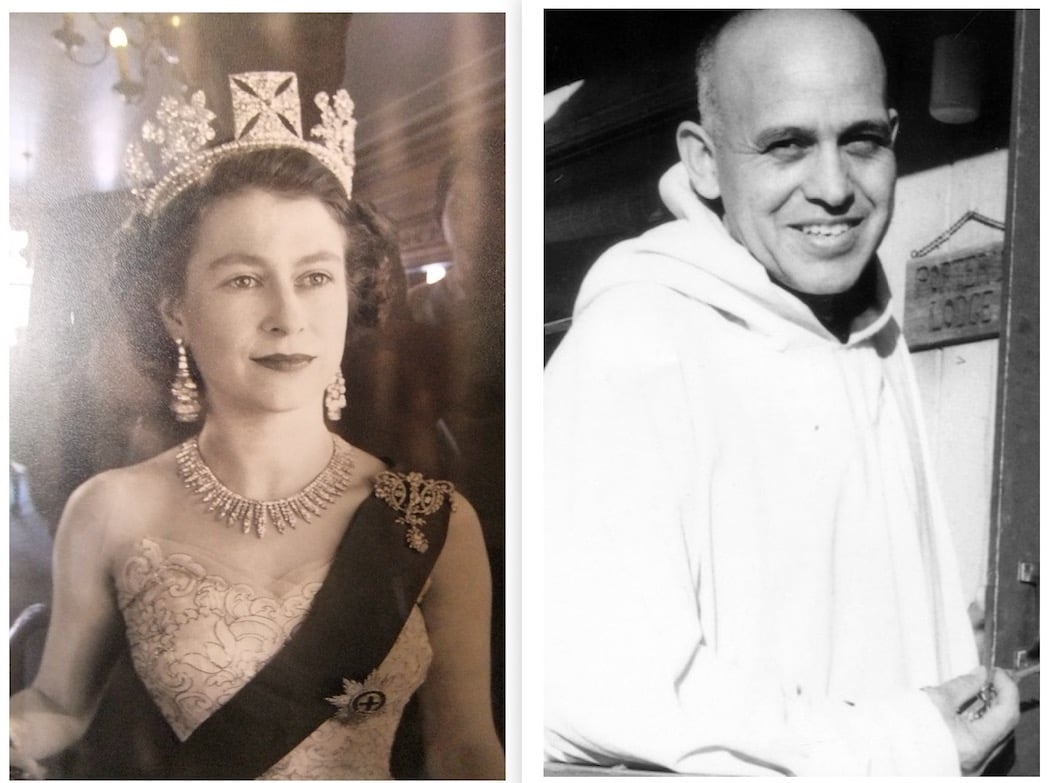
Because I am no expert on the royal family or Queen Elizabeth, I find myself in the days following her death listening while not speaking or writing much about her. As I listen, I am most impressed by the fact that people loved her. Despite ambivalence about what she represented (namely, an empire that has, even in the past hundred years, been unthinkably callous), she is a person much loved. In part, this is due to her “heart,” a word she used with intention and surprisingly limited sentimentality, but also because she could be whimsical and aspirational and fun.
Over the decades, what I have learned of the Queen has impressed upon me the indelible word “duty,” which rarely comes across as fun. While those around her, even her own husband children grandchildren, made costly choices to embrace freedom over duty—something we can all, I believe, sympathize with, the Queen herself seems to have veered seldomly from duty. This quality is one I see in partners caring for those with debilitating illness or parents of special-needs kids. It is a quality I admire. It’s about putting duty above one’s own needs because of, well, a whole panoply of reasons. One could glamorize or sentimentalize duty as purely loving, but at times it is more complicated and fraught. At times people embrace duty because they are not free to do otherwise. At times people embrace duty because of less self-sacrificial reasons—because it is who they want to be.
So in thinking about the Queen’s passing this week, I find myself thoroughly celebrating her freedom. Whatever form our soul’s take upon death (while I completely embrace the idea of afterlife, I have few ideas about what it is; who among us would know?), I can’t help but feel her soul is finally free. Free from position and duty; free from the hierarchical, dominative structures we humans have devised for our lives, and especially for those holding power; free from being confused for a god. In the ‘reign of God’ as Jesus taught, “the first will be last and the last will be first.”
A week ago, the anniversary of another death passed. This was the one-year anniversary of my twenty-year best friend, a Trappist monk named Brother Martin Gonzales. Because I had before Martin not lost someone intimately close to me, I now think about every death in the context of his death. This past year, I’ve looked for his spirit around me. I’ve wondered what it means for his soul to have transitioned to “eternal life.” I’ve pondered “the communion of saints” and “the risen life” in new ways—two phrases he used often. So I keep thinking of the Queen and the Monk as risen souls, and what that means. Whereas the Queen at times wore breathtaking jewels, the monk—who had taken a vow of poverty—often wore clothes tattered and torn. I remember on our last visit—at a care center where he spent a few weeks in the ebbing months of a pandemic that were, unbeknownst to me, the ebbing days of his life—how he wore two layers of sweatpants because the outer layer was so torn. Now there is absolutely no distinction between the Queen and the Monk. They are both souls, vital pieces of Divinity somehow closer to and perhaps merged with the Source of all Love. They both, in a sense, knew duty in ways I cannot conceive. The Monk’s duty being not unlike the Queen’s—his vow, his commitment being to a life that was on occasion arduous and joyless and unfree. Martin joined the Trappists as a twenty-something WWII veteran and had been a monk over 60 years when he died. The Queen ascended the throne in her twenties. Both the Monk and the Queen died at 96. Both are now free—I believe that. I feel it in my marrow. Both are the same.
Living in Scotland for two years around the turn of the millennia, I gained a perspective on the Royalty I would not have had otherwise. The death of Princess Diana occurred just weeks after my arriving in the country. I will never forget a mother crying as I dropped my daughter off for school, or the chill silence that fell over the country on the day of her funeral, with every business shuttered. I came to learn that this national reaction was not just a testament to affection for Diana. It was linked to a consciousness about the monarchy that I only began to understand after living in the Kingdom. Some of the love for Diana seemed tied to her willingness to eschew duty for wellness. And some of the love for Queen Elizabeth seems tied to her willingness to eschew wellness for duty.
In light of this, I feel sorrow for those mourning the Queen. But I also feel celebration for her soul.
Previous Post

September 6, 2022
Don't wait: The Source doesn't need your perfection and purity
Next Post

September 14, 2022 Let's get lost and found
Browse Our Archives
Select a Category Education Essay Excerpt Uncategorized
Select a Month September 2026 August 2026 July 2026 June 2026 May 2026 April 2026 March 2026 February 2026 January 2026 December 2025 November 2025 October 2025 September 2025 August 2025 July 2025 June 2025 May 2025 April 2025 March 2025 February 2025 January 2025 December 2024 November 2024 October 2024 September 2024 August 2024 July 2024 June 2024 May 2024 April 2024 March 2024 February 2024 January 2024 December 2023 November 2023 October 2023 September 2023 August 2023 July 2023 June 2023 May 2023 April 2023 March 2023 February 2023 January 2023 December 2022 November 2022 October 2022 September 2022 August 2022 July 2022
Follow Us!
TAKE THE
Religious Wisdom Quiz
True or False: 1 Peter teaches that judgment must begin with the family of God.
Select your answer to see how you score.
FALSE TRUE
Books by This Author Books by About Religion, Doubt and Why They Matter
Related posts from About Religion, Doubt and Why They Matter

Using Your Gifts Is Ministry: A Retired Deacon's...
About Religion, Doubt and Why They Matter

The Many Forms of Prayer: What Does it...
About Religion, Doubt and Why They Matter

In the Gloaming: What the Anti-Aging Movement Misses
About Religion, Doubt and Why They Matter

God Is in the Obstacle: What Loss Taught...
About Religion, Doubt and Why They Matter
TRENDING AT PATHEOS New Visions

Jad Gillies on New Hillsong Worship Songs and...
For worship leader Jad Gillies, Hillsong Worship’s next chapter is not about...

Looking at the Largest Orthodox Cathedral on Earth
There is often a considerable amount of anger and, shall we...

The Problem with False Prophets
Miller’s Station UMC| 10/18/26| Anchor Verse: Jeremiah 23: 1, 9-23 I...

Emotion in Early Christianity by Andrew Crislip
Andrew Crislip’s Emotion in Early Christianity examines an often overlooked dimension of...

16 Spiritual Touchstones for a More Grounded Life
After decades of spiritual study, here are 16 principles I try...

Catholic Evangelization: Sharing Your Faith Every Day
Welcome back to the Graceful Awakening mini-series called, “From Faith to Mission.” ...
view all New Visions blogs
Ad-Free & Subscriber Log-In Subscription Support
- About Us
- 2026 Calendar
- Videos
- Podcasts
- Library of World Religions
- Faith In Media Tracker
- Advertise With Us
- Write for Us
- Privacy Policy
- Terms of Service
- Do Not Sell My Data
- Contact Us
- Radiant Digital
- Manage Newsletter Subscriptions
- Unsubscribe From Notifications
- Sitemap
Copyright 2008-2026, Patheos. All rights reserved.
Subscription Support Ad-Free & Subscriber Log-In
Follow Patheos