
BuddhistCatholicContemplativeEvangelicalGeneral ChristianHinduJewishLatter-day SaintMuslimNew VisionsProgressive Christian
Beliefs
- Buddhist
- Catholic
- Contemplative
- Evangelical
- General Christian
- Hindu
- Jewish
- Latter-day Saint
- More Voices
- Muslim
- New Visions
- Pagan
- Progressive Christian
Topics
- Religion News
- Food and Religion
- Sports and Religion
- Religious Art
- Religious Music and Entertainment
- Religious Events
- History and Religion
- Style and Religion
- Politics and Religion
- Women in Religion
- Recreation Outdoors and Religion
- Business Finance and Religion
- Careers Workplace and Religion
- Education and Religion
- Family Parenting and Religion
- Health Fitness and Religion
- Home and Religion
- Relationships and Religion
- Technology and Religion
- Travel and Religion
Columnists
- Buddhist Columnists
- Business Finance and Religion Columnists
- Careers Workplace and Religion Columnists
- Catholic Columnists
- Contemplative Columnists
- Education and Religion Columnists
- Evangelists Columnists
- Family Parenting and Religion Columnists
- General Christian Columnists
- Health Fitness and Religion Columnists
- Hindu Columnists
- History and Religion Columnists
- Home and Religion Columnists
- Jewish Columnists
- More Voices Columnists
- Latter Day Columnists
- Muslim Columnists
- New Visions Columnists
- Nonreligious Columnists
- Pagan Columnists
- Politics and Religion Columnists
- Progressive Columnists
- Recreation Outdoors and Religion Columnists
- Relationships and Religion Columnists
- Religion News Columnists
- Religious Art Columnists
- Religious Events Columnists
- Religious Music and Entertainment Columnists
- Sports and Religion Columnists
- Style and Religion Columnists
- Technology and Religion Columnists
- Travel and Religion Columnists
- Women in Religion Columnists
Resource Library
- 2026 Calendar
- Library of World Religions
- The 100 Most Holy Places on Earth
- Patheos Answers
- Podcasts
- Videos
- Faith Leaders Database
- Anglican Episcopalian
- Bahai
- Baptist
- Buddhism
- Christianity
- Confucianism
- Eastern Orthodoxy
- Hinduism
- Holiness and Pentecostal
- ISKCON
- Islam
- Judaism
- Lutheran
- Methodist
- The Church of Jesus Christ of Latter-day Saints
- New Age
- Paganism
- Presbytarian and Reformed
- Protestantism
- Religion Behind the Scenes
- Roman Catholic
- Scientology
- Shia Islam
- Sikhism
- Sufism
- Sunni Islam
- Taoism
- Zen
- See all religions
Research Tools
 Ad-Free & Subscriber Log-In Subscription Support
Follow Patheos 

- Trending:
- Advent
- |
- Forgiveness
- |
- Thanksgiving
- |
- Election
- |
- Seasonal Holidays
- |
- Marriage

- Home
- New Visions
- Animals teach us about God
Animals teach us about God
Last updated on: September 2, 2022 at 6:03 am by Tricia Gates Brown
Animals teach us about God 2022-09-02T06:03:40-07:00 Tricia Gates Brown
Patheos Explore the world's faith through different perspectives on religion and spirituality! Patheos has the views of the prevalent religions and spiritualities of the world.
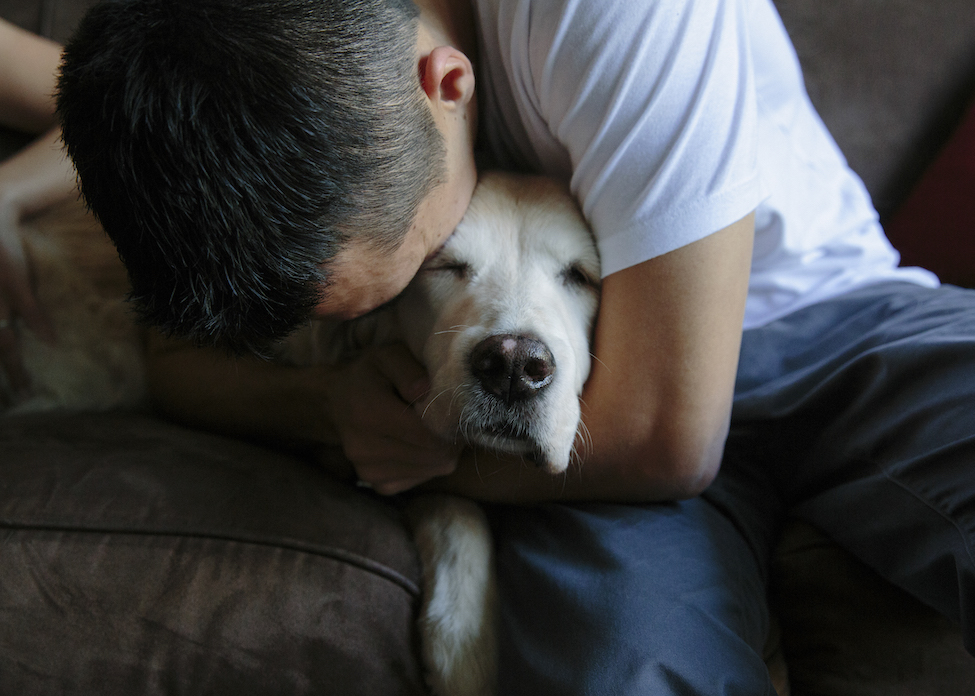
{Photo by Rebecca Chalmers for Scopio}
Of late, some of my closest companions are animals—several cats and one dog. With a few, I am close in ways I am close to few others. Few—or none—of my friends do I kiss and nuzzle and stroke and tell, “I love you so much; you are so precious to me…” (on and on gag infinitum) with regularity. At least in western culture, effusive affection isn’t the language of relationships, apart from those with young children and between couples en amorado.
But then there are animals. Foremost in my own life, a cat named Sybil Luddington with dense gray fur and white markings. I met Sybil when my grown daughter Madison brought her home traumatized, obscenely overweight, and—a vet confirmed after three days of her not eating—quite ill. The diagnosis: stress-induced liver failure. The owner of this timid cat had died four weeks and three days prior; and when Madison looked through a cage into her enormous citrine eyes, she was taken. Though the vet recommended euthanizing Sybil, Madison lugged her home with food syringes, recovery food, and an IV drip to administer twice daily for a week. Valiantly and for two excruciating months, Madison force-fed the fully clawed cat (with me as back-up)—an enterprise most akin to hugging barbed wire. And then one winter day, after I’d resorted to spontaneous kitty reiki and Sybil had finally surrendered to our love, she started eating.
Though my daughter moved away, Sybil remains. When she’s not outside, she sleeps on the guest bed. Each day I lean over the side, kissing her and rubbing her cheeks as she purrs. She returns my love by rubbing against my ankles when she passes, stretching out to let me rub her belly, and with her ever sweet voice.
As I grow older, I’m increasingly convinced of the ways animals know and love God, how the Spirit flows through them like a stream, how Spirit is so much of what they are. I believe animals have an openness to God that is rare for human beings—prone as we are to erecting barriers. God is a part of us as surely as God is a part of the animals, and is inviting us to full incarnation, perhaps the whole point of this life: allowing God to transform us into images of divinity. But animals are less handicapped by the barriers that prevent us from allowing it. My most intransigent blocks are self-doubt, over-analyzing, ego and insecurity, greed, laziness, worry. I can’t imagine these hamper wild animals to the same degree. (Domestic animals living close to humans do sometimes adopt our neurosis. I’ve known dogs to display jealously, aggression, and anxiety rivaling reality TV.)
St. Francis had a rare affinity with animals and reportedly talked with wild creatures. This is, in part, why he’s my favorite male saint. Yet people assume Francis could talk with the animals because he was gifted and saintly. I wonder, on the other hand, if Francis was saintly as a result of his love for and relationship with animals. When we truly see animals, they teach us about the pure flow of Spirit through all beings. They teach us how to love without constantly holding back. Maybe it was animals who taught Francis the simplicity and love needed to kiss lepers, join the poor, and bless the earth.
Last week I came upon a young chipmunk while on a walk. He lay in the middle of a gravel road in the sun, in an area scattered with trees. I couldn’t see or hear other chipmunks, but I knew the area hosted cats. Sitting on the gravel a few minutes, I shaded him. As I sidled close, he didn’t move, but he shook and blinked his eyes—slowly, as if sun-fatigued. I moved closer then reached out and stroked his back. Since he didn’t mind, I moved in again and stroked him repeatedly as he stopped shaking and shifted positions. Intending to carry him out of the sun, I extended my overturned hat so he could clamber onto it, and at a nearby tree, let him run onto the bark. When I held out my hand, he nosed my fingers, and I continued to touch his tiny body while praying what to do. His left eye was sick or injured. It seemed likely he was abandoned.
When I held out my hand to scoop him up, he scampered right onto it. Then I nestled him in the upturned end of my shirt and walked the mile home with him cradled in my sweaty palm; by the time I got there, he was a tight ball of sleep. After googling chipmunk rescue, I learned he was of-age for independence in the wild: thick fur and active, as evidenced by his scurrying frantically around the pet carrier I’d placed him in. And I knew the less time he spent with me, the better.
He was beautiful. In my house of cats, he would be anything but safe and peaceful, and I assumed he would do best in the woods behind my house and neighborhood.
After walking him a half block away (and out of the cats’ hunting range), I offered him a red huckleberry, which he held in his hands, working tiny teeth to break the surface before devouring it, then another and another. I found a stump beside the huckleberry bush that was thickly coated with fresh moss and placed the chipmunk and more huckleberries on top. It was the perfect chipmunk condo, as far as I could tell. While staying close, I watched him explore the stump. Slowly I backed up and took a seat on the ground about three feet away. He ran several inches down the stump and looked at me, then jumped off, clambered over sticks and fallen leaves to reach me, before scrambling onto my sandal and up my leg.
And at this point, I was in serious trouble.
I talked to him a few minutes as he scurried over my hands and arms, and I petted him. Then I put him back on the stump and backed away—again, about three feet. This time, he didn’t explore the stump. He simply jumped off, made his way across the raucous debris, and ran up my leg.
By this point, I was really praying, seeking guidance how to care for the little guy—so tiny and vulnerable, who could barely gnaw through a huckleberry skin. I was plagued with doubts whether I’d done the right thing picking him up in the first place. As I held him in my hands, he seemed to suck on my palm like he still needed a mother. Again, I picked up the creature, who weighed less than a silver dollar, and returned him to the stump. Then I walked far enough away that he couldn’t see me.
I was in tears. He ran down the stump and around the area where I had been sitting. As I watched him skittering about, I walked away, feeling the forceps of sadness seize my heart.
Living with cats, I see dead rodents all the time—mice, shrews, voles. I usually pick the critters up by the tail, saying “poor little guy” and tossing them into the trees without a trace of real remorse. But I cried repeatedly that night as I pictured that tiny chipmunk in the woods. Why was I so broken up over this one chipmunk when I deal with dead rodents all the time? The difference, of course, is connection. That chipmunk and I formed a connection in a short time. We shared a bit of love. It makes me wonder how humans’ relationships with animals would be different if we shared loving connections with more animals—domestic and wild—far more frequently. Very different, I expect.

Wren, Winner of a 2022 Independent Publishers Award Bronze Medal
Contemplative
Rainbow Bridge Remembrance Day
Previous Post

August 24, 2022
Immigration, Illegality, and Mercy
Next Post

August 30, 2022 Things Change: 'The first will be last, and the last will be first'
Browse Our Archives
Select a Category Education Essay Excerpt Uncategorized
Select a Month October 2026 September 2026 August 2026 July 2026 June 2026 May 2026 April 2026 March 2026 February 2026 January 2026 December 2025 November 2025 October 2025 September 2025 August 2025 July 2025 June 2025 May 2025 April 2025 March 2025 February 2025 January 2025 December 2024 November 2024 October 2024 September 2024 August 2024 July 2024 June 2024 May 2024 April 2024 March 2024 February 2024 January 2024 December 2023 November 2023 October 2023 September 2023 August 2023 July 2023 June 2023 May 2023 April 2023 March 2023 February 2023 January 2023 December 2022 November 2022 October 2022 September 2022 August 2022 July 2022
Follow Us!
TAKE THE
Religious Wisdom Quiz
Who was Ruth's first husband?
Select your answer to see how you score.
Mahlon Boaz Elimelech Chilion
Books by This Author Books by About Religion, Doubt and Why They Matter
Related posts from About Religion, Doubt and Why They Matter

The Grief of Healing: Being Found by the...
About Religion, Doubt and Why They Matter

Using Your Gifts Is Ministry: A Retired Deacon's...
About Religion, Doubt and Why They Matter

The Many Forms of Prayer: What Does it...
About Religion, Doubt and Why They Matter

In the Gloaming: What the Anti-Aging Movement Misses
About Religion, Doubt and Why They Matter
TRENDING AT PATHEOS New Visions

How to Have Financial Transparency in Marriage
Despite the fact that financial issues and money problems are the number...
The Healing Power of Forgiveness in Marriage
Learning how to give and accept apologies are essential ingredients of a...

The West's Christian Moral Inheritance: A Legacy Denied
Whether we like it or not, our environment matters, shaping us both...

How Does Tôḏâ Connect Florida & Thanksgiving?
The big news this weekend has been about the continued flooding on...

Were Early Christians Drinking Psychedelic Wine?
The Secret Sacrament the Church Took Away The early Christian church was...

As we in the United States approach the national Thanksgiving holiday...
view all New Visions blogs
Ad-Free & Subscriber Log-In Subscription Support
- About Us
- 2026 Calendar
- Videos
- Podcasts
- Library of World Religions
- Faith In Media Tracker
- Advertise With Us
- Write for Us
- Privacy Policy
- Terms of Service
- Do Not Sell My Data
- Contact Us
- Radiant Digital
- Manage Newsletter Subscriptions
- Unsubscribe From Notifications
- Sitemap
Copyright 2008-2026, Patheos. All rights reserved.
Subscription Support Ad-Free & Subscriber Log-In
Follow Patheos