
BuddhistCatholicContemplativeEvangelicalGeneral ChristianHinduJewishLatter-day SaintMuslimNew VisionsProgressive Christian
Beliefs
- Buddhist
- Catholic
- Contemplative
- Evangelical
- General Christian
- Hindu
- Jewish
- Latter-day Saint
- More Voices
- Muslim
- New Visions
- Pagan
- Progressive Christian
Topics
- Religion News
- Food and Religion
- Sports and Religion
- Religious Art
- Religious Music and Entertainment
- Religious Events
- History and Religion
- Style and Religion
- Politics and Religion
- Women in Religion
- Recreation Outdoors and Religion
- Business Finance and Religion
- Careers Workplace and Religion
- Education and Religion
- Family Parenting and Religion
- Health Fitness and Religion
- Home and Religion
- Relationships and Religion
- Technology and Religion
- Travel and Religion
Columnists
- Buddhist Columnists
- Business Finance and Religion Columnists
- Careers Workplace and Religion Columnists
- Catholic Columnists
- Contemplative Columnists
- Education and Religion Columnists
- Evangelists Columnists
- Family Parenting and Religion Columnists
- General Christian Columnists
- Health Fitness and Religion Columnists
- Hindu Columnists
- History and Religion Columnists
- Home and Religion Columnists
- Jewish Columnists
- More Voices Columnists
- Latter Day Columnists
- Muslim Columnists
- New Visions Columnists
- Nonreligious Columnists
- Pagan Columnists
- Politics and Religion Columnists
- Progressive Columnists
- Recreation Outdoors and Religion Columnists
- Relationships and Religion Columnists
- Religion News Columnists
- Religious Art Columnists
- Religious Events Columnists
- Religious Music and Entertainment Columnists
- Sports and Religion Columnists
- Style and Religion Columnists
- Technology and Religion Columnists
- Travel and Religion Columnists
- Women in Religion Columnists
Resource Library
- 2026 Calendar
- Library of World Religions
- The 100 Most Holy Places on Earth
- Patheos Answers
- Podcasts
- Videos
- Faith Leaders Database
- Anglican Episcopalian
- Bahai
- Baptist
- Buddhism
- Christianity
- Confucianism
- Eastern Orthodoxy
- Hinduism
- Holiness and Pentecostal
- ISKCON
- Islam
- Judaism
- Lutheran
- Methodist
- The Church of Jesus Christ of Latter-day Saints
- New Age
- Paganism
- Presbytarian and Reformed
- Protestantism
- Religion Behind the Scenes
- Roman Catholic
- Scientology
- Shia Islam
- Sikhism
- Sufism
- Sunni Islam
- Taoism
- Zen
- See all religions
Research Tools
 Ad-Free & Subscriber Log-In Subscription Support
Ad-Free & Subscriber Log-In Subscription Support
Follow Patheos 

- Trending:
- Forgiveness
- |
- Marriage
- |
- Consciousness
- |
- Death Penalty
- |
- Election
- |
- Halloween

- Home
- General Christian
- Family, Parenting and Religion
- What Our Reactions To Others Reveal About Ourselves
What Our Reactions To Others Reveal About Ourselves
Last updated on: November 26, 2024 at 5:00 am by Kurt W. Bubna
What Our Reactions To Others Reveal About Ourselves 2024-11-24T14:27:27-08:00 Kurt W. Bubna
Patheos Explore the world's faith through different perspectives on religion and spirituality! Patheos has the views of the prevalent religions and spiritualities of the world.

What Our Reactions Reveal
Image by Gerd Altmann from Pixabay
Have you noticed that the traits or behaviors we see, dislike, and criticize in others often reflect something within ourselves? I first heard the phrase, “You spot it, you got it” from a respected pastor who intended to highlight the importance of self-awareness. Our reactions to others reveal a lot about ourselves. Like it or not, admit it or not, we humans tend to be extremely sensitive in others to what is hidden (or not so hidden) in us.
- I get frustrated when someone tries to control me because I am a controller, too.
- Self-centeredness in others pushes my buttons because I am often selfish.
- A negative spirit in another person results in an overly critical reaction from me.
It is wise to zoom out and ask ourselves, “Why am I behaving with so much emotion over the words or actions of another?” The answer might be that what I hate about myself is what I see in them.
Of course, this negative projection is only sometimes accurate. Sometimes, because of years of experience working and living with people, we see things in the character of others that are not currently true about us. However, Jungian psychology suggests that our sensitivity results from firsthand experiences in the past.
More than I want to own it, what I spot in others is far too often either something I consistently failed at in the past or something I still struggle with now. If that is true, and it is, why am I so quick to judge and criticize others? Why am I so harsh with the shortcomings of others who look and sound like me?
Ouch.
In Mathias Barra’s powerful article about self-awareness, he quotes Vironika Tugaleva, who wrote, “To know yourself, you must sacrifice the illusion that you already do.”

Are You Self-Aware?
Image by Gerd Altmann from Pixabay
To be self-aware is to attempt to understand our thoughts, emotions, and behaviors concerning how and why we act the way we do. By cultivating this practice, we can identify patterns, strengths, and weaknesses in our lives, and that helps us to under-react rather than over-react and operate impulsively toward others. Self-awareness of our shortcomings and sins fosters better relationships as we understand why the actions of others are a trigger. We also learn to be patient with others because we know no stones should be in our hands.
Once upon a time (yes, this is where I tell you a story), I managed ten people on the staff of a huge and growing church. As you would expect, we had weekly team meetings designed to give me the opportunity to inspire and motivate the group. We were the “next-gen” team that included staff members who oversaw everything from the nursery through college ministries. Most of the staff were young, fun-loving, and boisterous. I loved them and had a blast managing that group, but it often stressed me out, too. Leading them was akin to herding wild cats.
My boss, the executive pastor, and I met regularly for him to guide me. His name was Rick, and he was wise and supportive. By design, part of our time together was for me to bubble up any staff concerns and get his insight.
One of the guys on my team was strong-willed, outspoken, and frequently stubborn. Sometimes, his words and actions bordered on rebellion. He always did whatever was needed but was passively aggressive and could have been a better team player.
Rick started smiling as I complained to him and vented my frustrations.
“What the heck, Rick! What’s so funny?”
He leaned forward and, without missing a beat, said, “Funny how we see in others what is often true about us and yet not often understood about ourselves.”
I wasn’t happy.
He wasn’t wrong.
The reality is the guy I was grumping about was much like me. We had a lot in common.
(By the way, here’s another interesting article about Enneagram and self-awareness.)
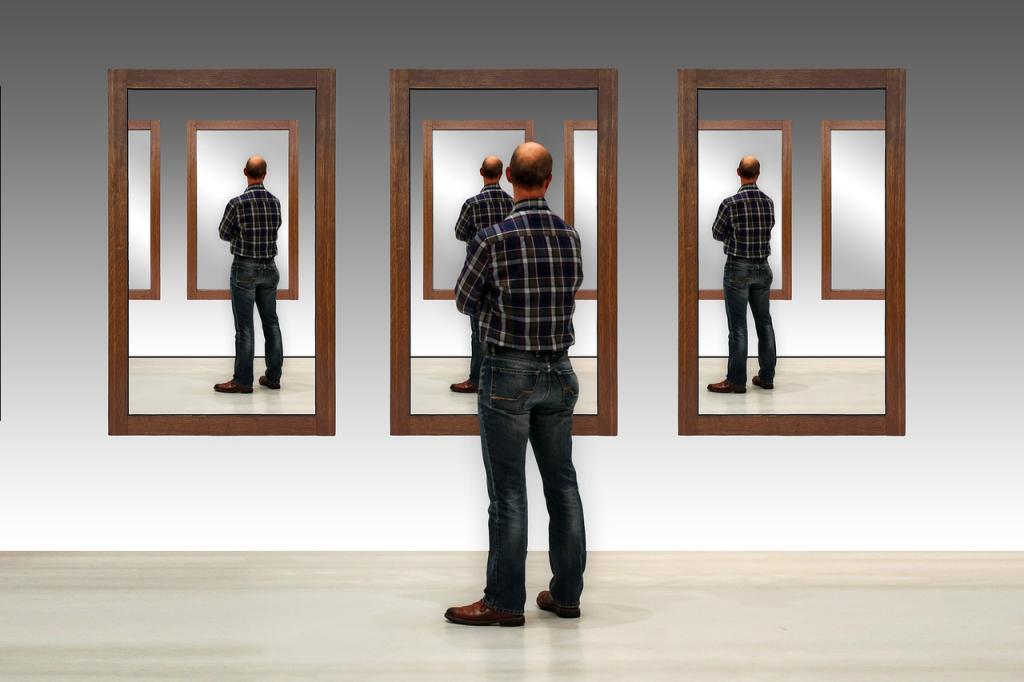
You Spot It, You Got It
Image by Gerd Altmann from Pixabay
So, here are some things I learned (and continue to learn, honestly):
- Before you gripe, curse, or get upset about someone, stop and ask, “Is this true about me?” Being self-aware means you need to look at yourself. (Weird, huh?)
- Complaining about someone to someone isn’t pretty, and it’s probably gossip (i.e., a sin).
- Being a Negative Ned or a Debbie Downer doesn’t truly help you, and it tends to drag others around you into the same ugly pit. No bueno.
- When I have an issue with somebody, the biblical mandate is to go to them and work it out if possible. I can’t change people, but as “far as it depends on me, I am to live at peace with everyone” (Romans 12:18).
- Instead of first focusing on what the person has said or done to me that ticked me off, it is always (and yes, I mean always) better to consider this first, “Why are they that way? Why did they do that?” I mentioned the “why” issue earlier in this article because it matters so much. When I take the time to consider why someone acts the way they do, I have the opportunity to sympathize or empathize, which softens my heart. I need to remember that hurt people hurt people.
In his book Love It Forward, Jeff Brown writes, “Eat your stuff before your stuff eats you.” Jeff does not explain what he means by “stuff,” but I suggest that, whether he meant it or not, my stuff includes my broken, fragile ego that quickly sees in others what I don’t want to see in myself.
So, the next time you’re standing next to me, and I go off in a negative rant about how stupid, irritating, and annoying someone else is, please pop me in the back of the head and say, “Funny how you spot it when you got it.”
‘Cause I probably do.
Please leave a comment below, and let’s engage in a conversation.
You can find out more about Kurt Bubna and his writing on Twitter and Facebook. You can read more about his views and insights, both in his books and on his website.
General Christian
Evangelical
Relationships and Religion
Previous Post

November 19, 2024
Family: The Other “F” Word That Sparks Either Joy or Terror
Next Post

December 3, 2024 Lessons Learned From The Original Sister Wives
Recent Comments
"Thanks for sharing this detailed post. I have one question: do you think this method ..."
Finding Hope Beyond the Three Hardest ..."
"Thank you, James. So appreciate the kind words."
Adult Kids, Divorce, And Christmas
"Kurt, You'll never remember me but you'll always remember us... ministering in Eastern Washinton. You ..."
Adult Kids, Divorce, And Christmas
"ya, Satan is alive and well, and always smack dab in the middle of family ..."
When Adult Children Walk Away: A ..."
Browse Our Archives
Select a Category Church issues Divorce Emotional & Relational Health For Leaders and Pastors Forgiveness & Restoration Guilt & Shame Insights on Being Human Loss & Struggle Parenting Uncategorized
Select a Month October 2026 September 2026 August 2026 June 2026 April 2026 March 2026 January 2026 December 2025 November 2025 October 2025 September 2025 August 2025 July 2025 June 2025 May 2025 April 2025 February 2025 December 2024 November 2024 October 2024 September 2024 August 2024 July 2024 June 2024 May 2024 April 2024
Follow Us!
TAKE THE
Religious Wisdom Quiz
I am confidence in what is hoped for and assurance about what is not seen. Without me, it's impossible to please God. What am I?
Select your answer to see how you score.
Faith Belief Hope Trust
Books by This Author Books by Relationship Matters!
Related posts from Relationship Matters!

How Do You Live Your Best Life?

Stop Living in the Land of What If

What Happens When a Christian Keeps Failing?

When Submission in Marriage Gets Twisted & Misused
TRENDING AT PATHEOS Family, Parenting and Religion

The Problem with False Prophets
Miller’s Station UMC| 10/18/26| Anchor Verse: Jeremiah 23: 1, 9-23 I...

Emotion in Early Christianity by Andrew Crislip
Andrew Crislip’s Emotion in Early Christianity examines an often overlooked dimension of...

16 Spiritual Touchstones for a More Grounded Life
After decades of spiritual study, here are 16 principles I try...

Catholic Evangelization: Sharing Your Faith Every Day
Welcome back to the Graceful Awakening mini-series called, “From Faith to Mission.” ...

The Pillar of the Boatmen: the Ancient Monument...
The Pillar of the Boatmen is a Romano-Gaulish sculpture that dates from...

In one sense walking into Westminster Abbey is like walking down the...
view all Family, Parenting and Religion blogs
What Are Your Thoughts?leave a comment
Ad-Free & Subscriber Log-In Subscription Support
- About Us
- 2026 Calendar
- Videos
- Podcasts
- Library of World Religions
- Faith In Media Tracker
- Advertise With Us
- Write for Us
- Privacy Policy
- Terms of Service
- Do Not Sell My Data
- Contact Us
- Radiant Digital
- Manage Newsletter Subscriptions
- Unsubscribe From Notifications
- Sitemap
Copyright 2008-2026, Patheos. All rights reserved.
Subscription Support Ad-Free & Subscriber Log-In
Follow Patheos