
BuddhistCatholicContemplativeEvangelicalGeneral ChristianHinduJewishLatter-day SaintMuslimNew VisionsProgressive Christian
Beliefs
- Buddhist
- Catholic
- Contemplative
- Evangelical
- General Christian
- Hindu
- Jewish
- Latter-day Saint
- More Voices
- Muslim
- New Visions
- Pagan
- Progressive Christian
Topics
- Religion News
- Food and Religion
- Sports and Religion
- Religious Art
- Religious Music and Entertainment
- Religious Events
- History and Religion
- Style and Religion
- Politics and Religion
- Women in Religion
- Recreation Outdoors and Religion
- Business Finance and Religion
- Careers Workplace and Religion
- Education and Religion
- Family Parenting and Religion
- Health Fitness and Religion
- Home and Religion
- Relationships and Religion
- Technology and Religion
- Travel and Religion
Columnists
- Buddhist Columnists
- Business Finance and Religion Columnists
- Careers Workplace and Religion Columnists
- Catholic Columnists
- Contemplative Columnists
- Education and Religion Columnists
- Evangelists Columnists
- Family Parenting and Religion Columnists
- General Christian Columnists
- Health Fitness and Religion Columnists
- Hindu Columnists
- History and Religion Columnists
- Home and Religion Columnists
- Jewish Columnists
- More Voices Columnists
- Latter Day Columnists
- Muslim Columnists
- New Visions Columnists
- Nonreligious Columnists
- Pagan Columnists
- Politics and Religion Columnists
- Progressive Columnists
- Recreation Outdoors and Religion Columnists
- Relationships and Religion Columnists
- Religion News Columnists
- Religious Art Columnists
- Religious Events Columnists
- Religious Music and Entertainment Columnists
- Sports and Religion Columnists
- Style and Religion Columnists
- Technology and Religion Columnists
- Travel and Religion Columnists
- Women in Religion Columnists
Resource Library
- 2026 Calendar
- Library of World Religions
- The 100 Most Holy Places on Earth
- Patheos Answers
- Podcasts
- Videos
- Faith Leaders Database
- Anglican Episcopalian
- Bahai
- Baptist
- Buddhism
- Christianity
- Confucianism
- Eastern Orthodoxy
- Hinduism
- Holiness and Pentecostal
- ISKCON
- Islam
- Judaism
- Lutheran
- Methodist
- The Church of Jesus Christ of Latter-day Saints
- New Age
- Paganism
- Presbytarian and Reformed
- Protestantism
- Religion Behind the Scenes
- Roman Catholic
- Scientology
- Shia Islam
- Sikhism
- Sufism
- Sunni Islam
- Taoism
- Zen
- See all religions
Research Tools
 Ad-Free & Subscriber Log-In Subscription Support
Ad-Free & Subscriber Log-In Subscription Support
Follow Patheos 

- Trending:
- Forgiveness
- |
- Marriage
- |
- Consciousness
- |
- Death Penalty
- |
- Election
- |
- Halloween

- Home
- Careers, Workplace and Religion
- Moving from “Balance” to “Harmony”
Moving from “Balance” to “Harmony”
Last updated on: August 26, 2016 at 9:31 am by Bob Robinson
Moving from “Balance” to “Harmony” 2016-08-25T18:31:46-04:00 Bob Robinson
Patheos Explore the world's faith through different perspectives on religion and spirituality! Patheos has the views of the prevalent religions and spiritualities of the world.
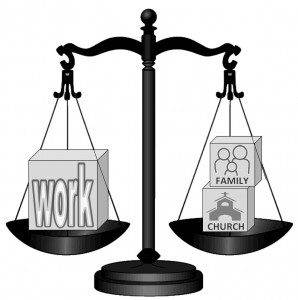 I just heard a Christian talk show host talk about how “men, in particular, are prone to be workaholics, putting their work before their family and/or their church.” (I have news for him, women struggle with this as well…). As a pastor, I have tried to help members of our congregation to live less chaotic lives. In the past, I’ve talked about the need to balance work and life.
In a culture that celebrates the workaholic, pastors see too many people making work into an idol; they become too busy for family or church. When elders and deacons are sought, too many people turn down the opportunity to serve because their lives are too hectic.
Work – Life Balance
The churches I’ve had a privilege to serve have had the most success in ministry when we’ve helped make families healthy. We’ve offered tools and resources for stronger marriages. We’ve had seminars on better parenting skills. We’ve created environments where people can become friends so that they can encourage each other to live with the right priorities: to family, to church, to service.
The thinking of much of church ministry is this: We need to help you strike the right balance in your life. Sure, work is important. It is the means by which you provide for your family; it is the way you create wealth so that you can support church ministry and overseas missions; it is one of the venues in which you are called to share your faith with unbelievers. But remember that work is not
But remember that work is not that important. In an age where people overwork either on purpose (because they find too much significance in their work, or are succumbing to the temptation of greed and want to live a more extravagant lifestyle), or because it is thrust upon them (because of the need to pay mounting bills and debts, or because with downsizing, less people are now needed to do more work and if you want a job you have to work more than ever before), church leaders feel the need to find ways to help congregants balance work with the rest of life.
We’re Just Making it Worse
But here’s the rub: When we set work aside as if it were on one side of the scale with family and church on the other side, we have made a terrible mistake. In an effort to help, we are only exacerbating the problem—because we make work out to be contrary to and even opposing the “important” things in life. When that happens, work gets moved into a category that is separate from the Lordship of Jesus Christ.
What if, instead, we embraced the biblical understanding of the kingdom of God, in which God rules over all of creation? What if all of life is meant to be “spiritual,” even our work life? What if our pastoral ministries not only helped people serve in the local church and help create healthy families, but actually made sense of the work world as well? What if we attempted to rid ourselves of a fragmented view of life?
Harmony is a Much Better Framework
My teenage son Joel has been playing trombone now for several years. As I listen to him practice down in the basement, I enjoy the sound of his playing (It hasn’t always been like this… There are few things more grating to hear than a young boy blowing into a trombone as he first learns the instrument!). As he plays I enjoy the melody traveling up the stairs. Sometimes that melody is instantly recognizable, and I hum along. But at other times, I can’t identify the tune.
As Joel plays, I enjoy the melody traveling up the stairs. Sometimes that melody is instantly recognizable, and I hum along. But at other times, I can’t identify the tune. What is he playing? Often it is not the main melody, but a progression of notes that will add to the harmony of the entire band.
Listening to the full symphonic band is different from listening to just Joel playing his single trombone. The instruments complement each other, creating chord progressions that go toward a destination. There is a definite goal that the composer had in mind, and we are on the journey as we listen.
Think of God as the composer of our lives, with all the various aspects of our living in this world as different instrumental parts. Sometimes the flutes are the center of our attention, playing a sweet melody that is accompanied by the woodwinds and brass playing background harmonies. The music makes you smile as it skips along with joy. But then the brass takes over and with minor notes makes you anxious because you know of the tensions of living in a fallen world. The other instruments continue to play, and in fact, there in the back somewhere is that hint of joy still playing. The woodwinds begin playing the main melody and the others play harmony, and a whole new dimension of the piece is exposed.
It is all going somewhere, though. It is all working together toward a goal based on the succession of the chords’ root relationships. Even though I couldn’t understand it when I listened to just one instrument played by Joel sitting in the basement, the composer did as he wrote how the various instruments will create the symphony.
Work, Family, and Church (and anything else in our lives) are all part of that grand musical score. Let’s not think of “balancing” one of these over-and-against the others.
Let’s create a rhythm that makes it all work together for the glory of God. How are you “harmonizing” all the aspects of your life so that you are participating in the mission of God in the world in every one of them?
Image created by Bob Robinson
Next Post

September 7, 2016 Churches are Not Reaching the Young Adult Generation: A Solution
Browse Our Archives
Select a Category arts and entertainment audio/video bible / theology business church college community culture education faith family government/politics leadership media medicine podcast science & tech social sector tech Uncategorized work and calling
Select a Month November 2025 May 2025 October 2024 September 2024 June 2024 May 2024 April 2024 March 2024 February 2024 January 2024 December 2023 August 2023 July 2023 June 2023 May 2023 April 2023 March 2023 February 2023 January 2023 December 2022 October 2022 August 2022 July 2022 June 2022 April 2022 March 2022 February 2022 January 2022 December 2021 November 2021 October 2021 August 2021 June 2021 May 2021 April 2021 March 2021 February 2021 January 2021 December 2020 October 2020 September 2020 August 2020 July 2020 June 2020 May 2020 March 2020 February 2020 January 2020 November 2019 October 2019 September 2019 July 2019 May 2019 April 2019 March 2019 February 2019 January 2019 December 2018 July 2018 May 2018 April 2018 March 2018 July 2017 April 2017 March 2017 February 2017 November 2016 September 2016 August 2016 May 2016 April 2016 March 2016 February 2016 January 2016 December 2015 November 2015 October 2015 September 2015 August 2015 July 2015 June 2015 May 2015 April 2015 January 2015 December 2014 November 2014 October 2014 September 2014 August 2014 July 2014 June 2014 May 2014 April 2014 March 2014 February 2014 January 2014 December 2013 November 2013 October 2013 September 2013 August 2013 July 2013 June 2013 May 2013 April 2013 March 2013 February 2013 January 2013 December 2012 November 2012 October 2012 September 2012 August 2012
Follow Us!
TAKE THE
Religious Wisdom Quiz
What happened to the first stone tablets of the Ten Commandments?
Select your answer to see how you score.
They were placed in the Ark Pharaoh destroyed them They were lost in battle Moses broke them
Related posts from (re)integrate

Becoming a Wise Leader with ULI CHI

Women's Callings in their Work with Joanna Meyer

Reintegrate Faith and Science - with John Van...
How to Reintegrate Faith and Vocations with Logos...
TRENDING AT PATHEOS Careers, Workplace and Religion

St. Francis by Bill Droel Pope Leo XIV declares 2026 as “Year...

Catholics are schooled in the faith by memorizing dogmatic points and lots...

The Good News of Our Human Limitations -...
After another day of trying to meet deadlines and working on projects,...

Quiet Holy Attentiveness (podcast) with Sarah Clarkson
We know that quiet is an essential aspect of the spiritual life,...

Every Vocation Everywhere All At Once
What is a vocation? How does it endure through the years? Can...

I promise this is not going to become a Taylor Swift Studies...
view all Careers, Workplace and Religion blogs
Ad-Free & Subscriber Log-In Subscription Support
- About Us
- 2026 Calendar
- Videos
- Podcasts
- Library of World Religions
- Faith In Media Tracker
- Advertise With Us
- Write for Us
- Privacy Policy
- Terms of Service
- Do Not Sell My Data
- Contact Us
- Radiant Digital
- Manage Newsletter Subscriptions
- Unsubscribe From Notifications
- Sitemap
Copyright 2008-2026, Patheos. All rights reserved.
Subscription Support Ad-Free & Subscriber Log-In
Follow Patheos