
BuddhistCatholicContemplativeEvangelicalGeneral ChristianHinduJewishLatter-day SaintMuslimNew VisionsProgressive Christian
Beliefs
- Buddhist
- Catholic
- Contemplative
- Evangelical
- General Christian
- Hindu
- Jewish
- Latter-day Saint
- More Voices
- Muslim
- New Visions
- Pagan
- Progressive Christian
Topics
- Religion News
- Food and Religion
- Sports and Religion
- Religious Art
- Religious Music and Entertainment
- Religious Events
- History and Religion
- Style and Religion
- Politics and Religion
- Women in Religion
- Recreation Outdoors and Religion
- Business Finance and Religion
- Careers Workplace and Religion
- Education and Religion
- Family Parenting and Religion
- Health Fitness and Religion
- Home and Religion
- Relationships and Religion
- Technology and Religion
- Travel and Religion
Columnists
- Buddhist Columnists
- Business Finance and Religion Columnists
- Careers Workplace and Religion Columnists
- Catholic Columnists
- Contemplative Columnists
- Education and Religion Columnists
- Evangelists Columnists
- Family Parenting and Religion Columnists
- General Christian Columnists
- Health Fitness and Religion Columnists
- Hindu Columnists
- History and Religion Columnists
- Home and Religion Columnists
- Jewish Columnists
- More Voices Columnists
- Latter Day Columnists
- Muslim Columnists
- New Visions Columnists
- Nonreligious Columnists
- Pagan Columnists
- Politics and Religion Columnists
- Progressive Columnists
- Recreation Outdoors and Religion Columnists
- Relationships and Religion Columnists
- Religion News Columnists
- Religious Art Columnists
- Religious Events Columnists
- Religious Music and Entertainment Columnists
- Sports and Religion Columnists
- Style and Religion Columnists
- Technology and Religion Columnists
- Travel and Religion Columnists
- Women in Religion Columnists
Resource Library
- 2026 Calendar
- Library of World Religions
- The 100 Most Holy Places on Earth
- Patheos Answers
- Podcasts
- Videos
- Faith Leaders Database
- Anglican Episcopalian
- Bahai
- Baptist
- Buddhism
- Christianity
- Confucianism
- Eastern Orthodoxy
- Hinduism
- Holiness and Pentecostal
- ISKCON
- Islam
- Judaism
- Lutheran
- Methodist
- The Church of Jesus Christ of Latter-day Saints
- New Age
- Paganism
- Presbytarian and Reformed
- Protestantism
- Religion Behind the Scenes
- Roman Catholic
- Scientology
- Shia Islam
- Sikhism
- Sufism
- Sunni Islam
- Taoism
- Zen
- See all religions
Research Tools
 Ad-Free & Subscriber Log-In Subscription Support
Ad-Free & Subscriber Log-In Subscription Support
Follow Patheos 

- Trending:
- Forgiveness
- |
- Marriage
- |
- Consciousness
- |
- Death Penalty
- |
- Election
- |
- Halloween

- Home
- Careers, Workplace and Religion
- Your Calling and the Holy Spirit
Your Calling and the Holy Spirit
Last updated on: February 8, 2016 at 6:48 pm by Bob Robinson
Your Calling and the Holy Spirit 2016-02-08T18:48:17-04:00 Bob Robinson
Patheos Explore the world's faith through different perspectives on religion and spirituality! Patheos has the views of the prevalent religions and spiritualities of the world.
 A major problem with our modern conception of vocation is that we preceive our “spiritual” life as disconnected from the actual work that we do as participation in the mission of God. In his excellent book that explores theology of vocation, Miroslav Volf contends,
“The sphere of the new creation cannot be tied to the ‘inner man.’ Because the whole creation is the Spirit’s sphere of operation, the Spirit is not only the Spirit of religious experience but also the Spirit of worldly engagement.” (Volf, Work in the Spirit, p. 110)
The role of God’s Spirit cannot be ignored in the concept of calling.
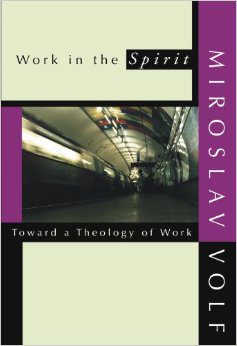 Volf’s theology of vocation centers on the Holy Spirit’s role in the present new creation begun with Christ. For if there is a calling, then there is a caller. Volf believes that our understanding of “Spiritual Gifts” needs to be broadened.
“One should not define charisma so narrowly as to include in the term only ecclesiastical activities.” (p. 111)
Churches often give “Spiritual Gifts Tests” to their congregants with the intention of helping people find their role in the local church. For instance, LifeWay Christian Resources has a downloadable “Spiritual Gifts Survey” authored by Gene Wilkes. In its introduction, he writes,
“Ken Hemphill defines a spiritual gift as ‘an individual manifestation of grace from the Father that enables you to serve Him and thus play a vital role in His plan for the redemption of the world.’ Peter Wagner defines a spiritual gift as “a special attribute given by the Holy Spirit to every member of the Body of Christ according to God’s grace for use within the context of the Body.’ I like to use this definition: A spiritual gift is an expression of the Holy Spirit in the life of believers which empowers them to serve the body of Christ, the church.”
While Hemphil’s definition is broad (he says that spiritual gifts are to “play a vital role in His plan for the redemption of the world”) Wagner’s and Wilkes’s definitions are narrowed to the belief that the gifts can only be used within the context of the church.
The gifts of the Spirit are not just “extraordinary.”
However, Volf points out that biblically, the charisms are not limited to that which is done in the local congregation. After all, he argues, the gift of an evangelist presupposes action outside the Christian fellowship, and contributing to the needs of the destitute does not cease to be a charisma when it is exercised to non-Christians.
We have grown accustomed to calling human skills, abilities, and knowledge (like crafts, poetry, medicine, etc.) “natural,” while we call certain more sensational gifts “supernatural.” No dichotomy like this is found in the Bible, not in the original Created Order, nor in the New Creation in Christ.
Volf says that in spite of the fact that in many churches charismatic gifts are still widely believed to be “extraordinary,” that is not what the New Testrament actually teaches.
“One of the main points of the Pauline theology of charisms is the overcoming of such a restrictive concentration on the miraculous and extraordinary. For this reason it is of great importance to keep the term charisma as a generic term for both the spectacular and the ordinary.” (p. 112)
Image by Isaí Moreno. Used with permission. Sourced via Flickr.
Stay in touch! Like (re)integrate on Facebook:

Next Post

February 8, 2016 “Time, Talents, & Treasure” – Overcoming False Dualism
Browse Our Archives
Select a Category arts and entertainment audio/video bible / theology business church college community culture education faith family government/politics leadership media medicine podcast science & tech social sector tech Uncategorized work and calling
Select a Month November 2025 May 2025 October 2024 September 2024 June 2024 May 2024 April 2024 March 2024 February 2024 January 2024 December 2023 August 2023 July 2023 June 2023 May 2023 April 2023 March 2023 February 2023 January 2023 December 2022 October 2022 August 2022 July 2022 June 2022 April 2022 March 2022 February 2022 January 2022 December 2021 November 2021 October 2021 August 2021 June 2021 May 2021 April 2021 March 2021 February 2021 January 2021 December 2020 October 2020 September 2020 August 2020 July 2020 June 2020 May 2020 March 2020 February 2020 January 2020 November 2019 October 2019 September 2019 July 2019 May 2019 April 2019 March 2019 February 2019 January 2019 December 2018 July 2018 May 2018 April 2018 March 2018 July 2017 April 2017 March 2017 February 2017 November 2016 September 2016 August 2016 May 2016 April 2016 March 2016 February 2016 January 2016 December 2015 November 2015 October 2015 September 2015 August 2015 July 2015 June 2015 May 2015 April 2015 January 2015 December 2014 November 2014 October 2014 September 2014 August 2014 July 2014 June 2014 May 2014 April 2014 March 2014 February 2014 January 2014 December 2013 November 2013 October 2013 September 2013 August 2013 July 2013 June 2013 May 2013 April 2013 March 2013 February 2013 January 2013 December 2012 November 2012 October 2012 September 2012 August 2012
Follow Us!
TAKE THE
Religious Wisdom Quiz
Which book comes directly after Job?
Select your answer to see how you score.
Isaiah Psalms Ecclesiastes Proverbs
Related posts from (re)integrate
The Good News of Our Human Limitations -...
Quiet Holy Attentiveness (podcast) with Sarah Clarkson

Becoming a Wise Leader with ULI CHI

Submitting to Husbands? Ephesians with Dr. Lynn Cohick
TRENDING AT PATHEOS Careers, Workplace and Religion

St. Francis by Bill Droel Pope Leo XIV declares 2026 as “Year...

Catholics are schooled in the faith by memorizing dogmatic points and lots...

The Good News of Our Human Limitations -...
After another day of trying to meet deadlines and working on projects,...

Quiet Holy Attentiveness (podcast) with Sarah Clarkson
We know that quiet is an essential aspect of the spiritual life,...

Every Vocation Everywhere All At Once
What is a vocation? How does it endure through the years? Can...

I promise this is not going to become a Taylor Swift Studies...
view all Careers, Workplace and Religion blogs
Ad-Free & Subscriber Log-In Subscription Support
- About Us
- 2026 Calendar
- Videos
- Podcasts
- Library of World Religions
- Faith In Media Tracker
- Advertise With Us
- Write for Us
- Privacy Policy
- Terms of Service
- Do Not Sell My Data
- Contact Us
- Radiant Digital
- Manage Newsletter Subscriptions
- Unsubscribe From Notifications
- Sitemap
Copyright 2008-2026, Patheos. All rights reserved.
Subscription Support Ad-Free & Subscriber Log-In
Follow Patheos