
BuddhistCatholicContemplativeEvangelicalGeneral ChristianHinduJewishLatter-day SaintMuslimNew VisionsProgressive Christian
Beliefs
- Buddhist
- Catholic
- Contemplative
- Evangelical
- General Christian
- Hindu
- Jewish
- Latter-day Saint
- More Voices
- Muslim
- New Visions
- Pagan
- Progressive Christian
Topics
- Religion News
- Food and Religion
- Sports and Religion
- Religious Art
- Religious Music and Entertainment
- Religious Events
- History and Religion
- Style and Religion
- Politics and Religion
- Women in Religion
- Recreation Outdoors and Religion
- Business Finance and Religion
- Careers Workplace and Religion
- Education and Religion
- Family Parenting and Religion
- Health Fitness and Religion
- Home and Religion
- Relationships and Religion
- Technology and Religion
- Travel and Religion
Columnists
- Buddhist Columnists
- Business Finance and Religion Columnists
- Careers Workplace and Religion Columnists
- Catholic Columnists
- Contemplative Columnists
- Education and Religion Columnists
- Evangelists Columnists
- Family Parenting and Religion Columnists
- General Christian Columnists
- Health Fitness and Religion Columnists
- Hindu Columnists
- History and Religion Columnists
- Home and Religion Columnists
- Jewish Columnists
- More Voices Columnists
- Latter Day Columnists
- Muslim Columnists
- New Visions Columnists
- Nonreligious Columnists
- Pagan Columnists
- Politics and Religion Columnists
- Progressive Columnists
- Recreation Outdoors and Religion Columnists
- Relationships and Religion Columnists
- Religion News Columnists
- Religious Art Columnists
- Religious Events Columnists
- Religious Music and Entertainment Columnists
- Sports and Religion Columnists
- Style and Religion Columnists
- Technology and Religion Columnists
- Travel and Religion Columnists
- Women in Religion Columnists
Resource Library
- 2026 Calendar
- Library of World Religions
- The 100 Most Holy Places on Earth
- Patheos Answers
- Podcasts
- Videos
- Faith Leaders Database
- Anglican Episcopalian
- Bahai
- Baptist
- Buddhism
- Christianity
- Confucianism
- Eastern Orthodoxy
- Hinduism
- Holiness and Pentecostal
- ISKCON
- Islam
- Judaism
- Lutheran
- Methodist
- The Church of Jesus Christ of Latter-day Saints
- New Age
- Paganism
- Presbytarian and Reformed
- Protestantism
- Religion Behind the Scenes
- Roman Catholic
- Scientology
- Shia Islam
- Sikhism
- Sufism
- Sunni Islam
- Taoism
- Zen
- See all religions
Research Tools
 Ad-Free & Subscriber Log-In Subscription Support
Ad-Free & Subscriber Log-In Subscription Support
Follow Patheos 

- Trending:
- Forgiveness
- |
- Marriage
- |
- Consciousness
- |
- Death Penalty
- |
- Election
- |
- Halloween

- Home
- Careers, Workplace and Religion
- What is Vocation?
What is Vocation?
Last updated on: December 8, 2015 at 5:30 pm by Bob Robinson
What is Vocation? 2015-12-08T17:30:05-04:00 Bob Robinson
Patheos Explore the world's faith through different perspectives on religion and spirituality! Patheos has the views of the prevalent religions and spiritualities of the world.
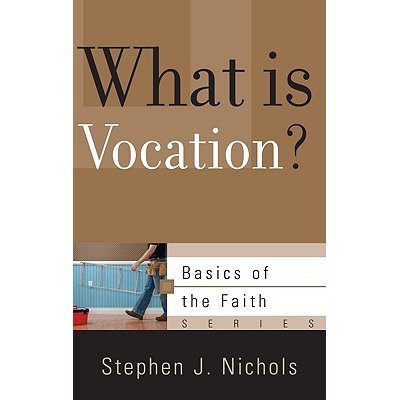 Stephen J. Nichols offers a concise (31 pages) and lucid biblical explanation of vocation in the “Basics of the Faith” booklet, What is Vocation? (2010, P&R Publishing). Nichols briefly explains the history of the notion of vocation (from the Latin word vocare, “calling”).
In the Middle Ages, the idea of “calling” moved away from how God calls each person made in His image to participate in work for His glory and toward a very particular thing: exclusively church work. “Priests, nuns, monks—they each had a calling. Everyone else in medieval culture, from merchants to peasants, from nobles to knights, simply worked.” But the Reformers recaptured the idea of calling for the everyman.
“To Luther, all work and all the roles that we play were potentially holy callings, which could be fulfilled for the glory of God alone.” Johann Sebastian Bach would sign his musical compositions with two sets of initials – JSB and SDG (“Soli Deo Gloria”). Bach knew that “all work—all types of work, not just the work done in the service of the church—was a calling.”
That means that a doctor, a lawyer, a businessperson, a homemaker, a student, a janitor, a landscaper, a millworker, a mechanic, an engineer, a teacher, a (fill in the blank here!) are all participating in God’s calling on their lives if they do their work for the glory of God. (See (re)integrate’s “Vocational Channels” for specific helps in specific fields of vocation.)
Your Work in the Lord is Not in Vain.
But there is a problem that we see in twenty-first century evangelicalism: More often than not, evangelicals still define “calling” or “God-glorifying work” as only that which is church-related and/or evangelistic. Sure, we can talk about Christians in the marketplace glorifying God with their work, but what we really mean is that they are “called” to use their secular work as a means for evangelism or (worse) for financing the work of those in “full-time ministry,” like pastors and missionaries.
I heard this attitude the other day as I shared with a couple of my ministry peers a passage from 1 Corinthians 15. This magnificent chapter talking about the importance of the resurrection ends with a wonderful affirmation of our work in this present life and how it matters, lasting into the next age after Christians are resurrected.
Therefore, my dear brothers, stand firm. Let nothing move you. Always give yourselves fully to the work of the Lord, because you know that your labor in the Lord is not in vain. (1 Cor 15:58)
I said to my two ministry friends that this affirms that what Christians do in this life, whether it be composing a song, writing a novel, designing a building (or whatever!, as long as it is the “work of the Lord”) is not labor done “in vain.” God will take these things into the next age of resurrection life.
They looked at me sideways.
No, they insisted, “the work of the Lord” is evangelism – sharing the good news of the resurrection with people. This work is what we should “give ourselves fully to.”
I appreciate their focus on evangelism. Yes, I affirm that everything that we do is a witness to the Kingdom of God and to the King who is ruling in our lives, and that we are to give ourselves fully to the work of proclaiming that Jesus is the Lord of all things. But without knowing it, these friends (who I deeply respect) had disparaged work in and of itself as a legitimate means for bringing the Kingdom of God to bear in this world.
What is Kingdom Work?
Certainly proclaiming the Kingdom through articulating the gospel to people is something we are all called to do. But doing “Kingdom work” is more than that. It includes everything that we do to bring God’s will on earth as it is in heaven. Everything. Certainly included as a subset of this everything is the actual articulation of the atonement found in Christ. But another subset of this is working to bring justice in the world. Or reconciling people who are in conflict. Or giving a cup of cold water in the name of the Lord. Or creating a cultural artifact, like a painting or a song. Or simply serving others through doing our work with excellence.
Upon reflecting on that conversation, I wondered if my friends were reversing the Reformation’s teaching, heading back to the age that said that only church work is the “work of the Lord,” that the only work that really counts for the Kingdom of God is evangelism. As they disciple Christians, are they teaching in subtle yet harmful ways that the only “real” work for a Christian is evangelism, that a person’s pursuit of a career calling outside of vocational ministry was (in the words of Stephen J. Nichols) “settling for something lesser,” that any other work is not as important as a pastor’s or missionary’s work? Were they not sending signals that if people pursue a career outside vocational ministry that the only real reason to do so is to use that career as a platform for evangelism? Were they not implicitly stating that work, in and of itself, is not important?
Before There was Redemption, There was Creation.
Nichols does a great job of explaining the biblical teaching on vocation within the story of “Creation-Fall-Redemption.” The “creation mandate” or “cultural mandate” was established when God placed Adam and Eve as his vice-regents on earth, to “have dominion over” the creation and to “work” or “cultivate” it. Nichols says, “This theological framework raises work to a whole new horizon of understanding. As we think it through, we begin to see that in our work we are in service of the King, making work both a duty and a wonderful privilege.”
But the Fall warps the purpose of work and the way we work. Because sin runs through everything like a cancer, it damages our calling. We work not in service to and glory of the King, but in service to our own desires and for our own glory (Why is it that we seek the promotion or the recognition award at work? Why is it that we buy the latest technological gadget, drive the slickest car, or dress in the clothes that we do? Why is it that, as Nichols points out, “in our consumer culture we have come to attach greater value to those who produce and consume more than those who produce or consume less”?).
The Redemption found in Christ is the key to re-establishing work as God intended it. In the Incarnation of God in Christ, Nichols writes, “we see Christ as fully and truly human, as well as fully and truly divine.” Jesus was a son, a brother, a person living under the Roman Empire, and a carpenter. “Christ demonstrates the value and integrity of the roles for us, and the value and integrity of work. But more than this, Christ through his redemptive work undoes what Adam did in the fall. And he restores to us the ability and the capacity to be image-bearers as God intended us to be.”
We evangelicals appropriately focus on how we are made in the image of Christ the Redeemer – thus our emphasis on evangelism and mission. But before Redemption there was Creation. While being a Christian is no less than participating in the work of evangelism and mission, it is also so much more. We are created in the image of the Creator and Redeemer God, which means that the Gospel of the Kingdom has as much to say about our work as creators and culture-makers as it does about our work as missionaries and evangelists.
Since Christians are agents of Redemption in the world, Nichols offers us helpful practical guidelines for “how not to work” and “how to work.” He walks the reader through Ephesians 6:5-9, where we are commanded to “serve wholeheartedly, as serving the Lord, not men.” He also helps us reconcile the fact that we get our paychecks from our work. “Culturally, we have by and large attached work to a paycheck…But paychecks are not the sole factor in legitimizing work. And work done for a paycheck is not the only type of work there is.”
Can we establish in our minds the idea that God calls us to work? Can we begin to read our Bibles without medieval notions that the only “work for the Lord” is ministry-related (church, missions, evangelism)? If so, we can hear God’s calling to his people in a whole new, breathtaking way. Verses like Psalm 90:17 take on incredible significance:
“May the favor of the Lord our God rest upon us; establish the work of our hands for us—yes, establish the work of our hands!”
Previous Post

December 5, 2015
Quotable Saturdays: Garber Defines "Vocation"
Next Post

December 17, 2015 The Holy Spirit and Vocation: Spiritual Gifts for Work
Browse Our Archives
Select a Category arts and entertainment audio/video bible / theology business church college community culture education faith family government/politics leadership media medicine podcast science & tech social sector tech Uncategorized work and calling
Select a Month November 2025 May 2025 October 2024 September 2024 June 2024 May 2024 April 2024 March 2024 February 2024 January 2024 December 2023 August 2023 July 2023 June 2023 May 2023 April 2023 March 2023 February 2023 January 2023 December 2022 October 2022 August 2022 July 2022 June 2022 April 2022 March 2022 February 2022 January 2022 December 2021 November 2021 October 2021 August 2021 June 2021 May 2021 April 2021 March 2021 February 2021 January 2021 December 2020 October 2020 September 2020 August 2020 July 2020 June 2020 May 2020 March 2020 February 2020 January 2020 November 2019 October 2019 September 2019 July 2019 May 2019 April 2019 March 2019 February 2019 January 2019 December 2018 July 2018 May 2018 April 2018 March 2018 July 2017 April 2017 March 2017 February 2017 November 2016 September 2016 August 2016 May 2016 April 2016 March 2016 February 2016 January 2016 December 2015 November 2015 October 2015 September 2015 August 2015 July 2015 June 2015 May 2015 April 2015 January 2015 December 2014 November 2014 October 2014 September 2014 August 2014 July 2014 June 2014 May 2014 April 2014 March 2014 February 2014 January 2014 December 2013 November 2013 October 2013 September 2013 August 2013 July 2013 June 2013 May 2013 April 2013 March 2013 February 2013 January 2013 December 2012 November 2012 October 2012 September 2012 August 2012
Follow Us!
TAKE THE
Religious Wisdom Quiz
What famous prophecy is given in Isaiah 53?
Select your answer to see how you score.
Destruction of Edom Plague in Egypt Cyrus the Great's reign The suffering servant Messiah
Related posts from (re)integrate

Becoming a Wise Leader with ULI CHI

Women's Callings in their Work with Joanna Meyer

Reintegrate Faith and Science - with John Van...
How to Reintegrate Faith and Vocations with Logos...
TRENDING AT PATHEOS Careers, Workplace and Religion

St. Francis by Bill Droel Pope Leo XIV declares 2026 as “Year...

Catholics are schooled in the faith by memorizing dogmatic points and lots...

The Good News of Our Human Limitations -...
After another day of trying to meet deadlines and working on projects,...

Quiet Holy Attentiveness (podcast) with Sarah Clarkson
We know that quiet is an essential aspect of the spiritual life,...

Every Vocation Everywhere All At Once
What is a vocation? How does it endure through the years? Can...

I promise this is not going to become a Taylor Swift Studies...
view all Careers, Workplace and Religion blogs
Ad-Free & Subscriber Log-In Subscription Support
- About Us
- 2026 Calendar
- Videos
- Podcasts
- Library of World Religions
- Faith In Media Tracker
- Advertise With Us
- Write for Us
- Privacy Policy
- Terms of Service
- Do Not Sell My Data
- Contact Us
- Radiant Digital
- Manage Newsletter Subscriptions
- Unsubscribe From Notifications
- Sitemap
Copyright 2008-2026, Patheos. All rights reserved.
Subscription Support Ad-Free & Subscriber Log-In
Follow Patheos