
BuddhistCatholicContemplativeEvangelicalGeneral ChristianHinduJewishLatter-day SaintMuslimNew VisionsProgressive Christian
Beliefs
- Buddhist
- Catholic
- Contemplative
- Evangelical
- General Christian
- Hindu
- Jewish
- Latter-day Saint
- More Voices
- Muslim
- New Visions
- Pagan
- Progressive Christian
Topics
- Religion News
- Food and Religion
- Sports and Religion
- Religious Art
- Religious Music and Entertainment
- Religious Events
- History and Religion
- Style and Religion
- Politics and Religion
- Women in Religion
- Recreation Outdoors and Religion
- Business Finance and Religion
- Careers Workplace and Religion
- Education and Religion
- Family Parenting and Religion
- Health Fitness and Religion
- Home and Religion
- Relationships and Religion
- Technology and Religion
- Travel and Religion
Columnists
- Buddhist Columnists
- Business Finance and Religion Columnists
- Careers Workplace and Religion Columnists
- Catholic Columnists
- Contemplative Columnists
- Education and Religion Columnists
- Evangelists Columnists
- Family Parenting and Religion Columnists
- General Christian Columnists
- Health Fitness and Religion Columnists
- Hindu Columnists
- History and Religion Columnists
- Home and Religion Columnists
- Jewish Columnists
- More Voices Columnists
- Latter Day Columnists
- Muslim Columnists
- New Visions Columnists
- Nonreligious Columnists
- Pagan Columnists
- Politics and Religion Columnists
- Progressive Columnists
- Recreation Outdoors and Religion Columnists
- Relationships and Religion Columnists
- Religion News Columnists
- Religious Art Columnists
- Religious Events Columnists
- Religious Music and Entertainment Columnists
- Sports and Religion Columnists
- Style and Religion Columnists
- Technology and Religion Columnists
- Travel and Religion Columnists
- Women in Religion Columnists
Resource Library
- 2026 Calendar
- Library of World Religions
- The 100 Most Holy Places on Earth
- Patheos Answers
- Podcasts
- Videos
- Faith Leaders Database
- Anglican Episcopalian
- Bahai
- Baptist
- Buddhism
- Christianity
- Confucianism
- Eastern Orthodoxy
- Hinduism
- Holiness and Pentecostal
- ISKCON
- Islam
- Judaism
- Lutheran
- Methodist
- The Church of Jesus Christ of Latter-day Saints
- New Age
- Paganism
- Presbytarian and Reformed
- Protestantism
- Religion Behind the Scenes
- Roman Catholic
- Scientology
- Shia Islam
- Sikhism
- Sufism
- Sunni Islam
- Taoism
- Zen
- See all religions
Research Tools
 Ad-Free & Subscriber Log-In Subscription Support
Ad-Free & Subscriber Log-In Subscription Support
Follow Patheos 

- Trending:
- Forgiveness
- |
- Marriage
- |
- Consciousness
- |
- Death Penalty
- |
- Election
- |
- Halloween

- Home
- Careers, Workplace and Religion
- Secular/Sacred Dualism is Destroying Our Mission
Secular/Sacred Dualism is Destroying Our Mission
Last updated on: April 30, 2021 at 12:13 pm by Bob Robinson
Secular/Sacred Dualism is Destroying Our Mission 2021-04-30T12:13:46-04:00 Bob Robinson
Patheos Explore the world's faith through different perspectives on religion and spirituality! Patheos has the views of the prevalent religions and spiritualities of the world.
There is an ongoing assumption in much of North American Christianity that salvation is focused only on the spiritual lives of humans and not on the whole of reality, including the material things that humans do physically in the world.
But God sees all things as spiritual; not as some things being sacred and other things being secular. Os Guinness, in his excellent book The Call, writes that since God is sovereign, “everyone, everywhere, and in everything, should think, speak, live, and act entirely for him.” To think otherwise is to fall prey to what he calls the “Catholic distortion,” “a form of dualism that elevates the spiritual at the expense of the secular.”
Martin Luther was the first to identify this distortion. He wrote,
“It is pure invention that pope, bishop, priests and monks are to be called the ‘spiritual estate’ while princes, lords, artisans, and farmers the ‘temporal estate.’ This is indeed a piece of deceit and hypocrisy. Yet no one need be intimidated by it, and for this reason: all Christians are truly of the ‘spiritual estate,’ and there is no difference among them except that of office.” (Three Treatises)
Protestants, however, have perpetuated this distortion with what Guinness calls “the fallacy of the contemporary Protestant term full-time Christian service—as if those not working for churches or Christian organizations are only part-time in the service of Christ.”
How would our mission be radically transformed if we rid ourselves of this conception that pastors and missionaries are the full-time ministers and all the rest of the congregation are there just to support their work?
False Dualism
According to Brian Walsh and J. Richard Middleton, the reason for this distortion of the biblical worldview can be summed up in one word: “dualism.”
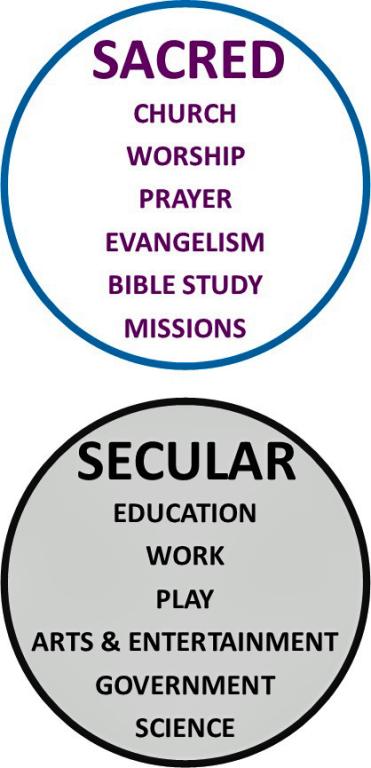
False Dualism
“Dualism is a split-vision world-view. It separates reality into two fundamentally distinct categories: holy and profane, sacred and secular… In the place of a biblical understanding of the kingdom of God as God’s rule over all creation, the kingdom is identified with what has been called our spiritual life.” (The Transforming Vision: Shaping a Christian World View)
This split-vision view limits the “spiritual life” to things like prayer, Bible study, church attendance, evangelism, etc. Walsh and Middleton say that the notion of “full-time Christian service” that Guinness identified will continue to persist as long as this dualistic Christian worldview is propagated.
Not only that, they say that…
“Even when we reject this notion of full-time service and say that all Christians are full-time servants of the Lord, an unconscious dualism may still constrain us. We often mean that we are all called to evangelize, no matter what situation we find ourselves in. In this case submission to Christ may still be limited to a so-called spiritual activity that is unrelated to the actual work of a secular occupation… Most of us are Christians and something else; we do not engage in our daily tasks integrally as Christians.”
In diagnosing the gap between Christian theology and our everyday lives, Robert Banks (in Redeeming the Routines: Bringing Theology to Life) provides a list of several problems that stem from dualism. How have you seen these manifest themselves in your Christian community?
- Few of us apply or know how to apply our belief to our work, or lack of work.
- We only make minimal connections between our faith and our spare time activities.
- We have little sense of a Christian approach to regular activities like domestic chores.
- Our everyday concerns receive little attention in the church.
- Only occasionally do professional theologians address routine activities.
Image by Michael Pardo. Used with permission. Sourced via Flickr.

Next Post

December 4, 2015 I Don't Believe in Being Platonic
Browse Our Archives
Select a Category arts and entertainment audio/video bible / theology business church college community culture education faith family government/politics leadership media medicine podcast science & tech social sector tech Uncategorized work and calling
Select a Month November 2025 May 2025 October 2024 September 2024 June 2024 May 2024 April 2024 March 2024 February 2024 January 2024 December 2023 August 2023 July 2023 June 2023 May 2023 April 2023 March 2023 February 2023 January 2023 December 2022 October 2022 August 2022 July 2022 June 2022 April 2022 March 2022 February 2022 January 2022 December 2021 November 2021 October 2021 August 2021 June 2021 May 2021 April 2021 March 2021 February 2021 January 2021 December 2020 October 2020 September 2020 August 2020 July 2020 June 2020 May 2020 March 2020 February 2020 January 2020 November 2019 October 2019 September 2019 July 2019 May 2019 April 2019 March 2019 February 2019 January 2019 December 2018 July 2018 May 2018 April 2018 March 2018 July 2017 April 2017 March 2017 February 2017 November 2016 September 2016 August 2016 May 2016 April 2016 March 2016 February 2016 January 2016 December 2015 November 2015 October 2015 September 2015 August 2015 July 2015 June 2015 May 2015 April 2015 January 2015 December 2014 November 2014 October 2014 September 2014 August 2014 July 2014 June 2014 May 2014 April 2014 March 2014 February 2014 January 2014 December 2013 November 2013 October 2013 September 2013 August 2013 July 2013 June 2013 May 2013 April 2013 March 2013 February 2013 January 2013 December 2012 November 2012 October 2012 September 2012 August 2012
Follow Us!
TAKE THE
Religious Wisdom Quiz
Who anointed Jesus' feet with expensive perfume and her hair?
Select your answer to see how you score.
Mary Magdalene Anna Mary of Bethany Elizabeth
Related posts from (re)integrate

Becoming a Wise Leader with ULI CHI

Submitting to Husbands? Ephesians with Dr. Lynn Cohick

SCOT MCKNIGHT - Rethinking Revelation (podcast)

Women's Callings in their Work with Joanna Meyer
TRENDING AT PATHEOS Careers, Workplace and Religion

St. Francis by Bill Droel Pope Leo XIV declares 2026 as “Year...

Catholics are schooled in the faith by memorizing dogmatic points and lots...

The Good News of Our Human Limitations -...
After another day of trying to meet deadlines and working on projects,...

Quiet Holy Attentiveness (podcast) with Sarah Clarkson
We know that quiet is an essential aspect of the spiritual life,...

Every Vocation Everywhere All At Once
What is a vocation? How does it endure through the years? Can...

I promise this is not going to become a Taylor Swift Studies...
view all Careers, Workplace and Religion blogs
Ad-Free & Subscriber Log-In Subscription Support
- About Us
- 2026 Calendar
- Videos
- Podcasts
- Library of World Religions
- Faith In Media Tracker
- Advertise With Us
- Write for Us
- Privacy Policy
- Terms of Service
- Do Not Sell My Data
- Contact Us
- Radiant Digital
- Manage Newsletter Subscriptions
- Unsubscribe From Notifications
- Sitemap
Copyright 2008-2026, Patheos. All rights reserved.
Subscription Support Ad-Free & Subscriber Log-In
Follow Patheos