
BuddhistCatholicContemplativeEvangelicalGeneral ChristianHinduJewishLatter-day SaintMuslimNew VisionsProgressive Christian
Beliefs
- Buddhist
- Catholic
- Contemplative
- Evangelical
- General Christian
- Hindu
- Jewish
- Latter-day Saint
- More Voices
- Muslim
- New Visions
- Pagan
- Progressive Christian
Topics
- Religion News
- Food and Religion
- Sports and Religion
- Religious Art
- Religious Music and Entertainment
- Religious Events
- History and Religion
- Style and Religion
- Politics and Religion
- Women in Religion
- Recreation Outdoors and Religion
- Business Finance and Religion
- Careers Workplace and Religion
- Education and Religion
- Family Parenting and Religion
- Health Fitness and Religion
- Home and Religion
- Relationships and Religion
- Technology and Religion
- Travel and Religion
Columnists
- Buddhist Columnists
- Business Finance and Religion Columnists
- Careers Workplace and Religion Columnists
- Catholic Columnists
- Contemplative Columnists
- Education and Religion Columnists
- Evangelists Columnists
- Family Parenting and Religion Columnists
- General Christian Columnists
- Health Fitness and Religion Columnists
- Hindu Columnists
- History and Religion Columnists
- Home and Religion Columnists
- Jewish Columnists
- More Voices Columnists
- Latter Day Columnists
- Muslim Columnists
- New Visions Columnists
- Nonreligious Columnists
- Pagan Columnists
- Politics and Religion Columnists
- Progressive Columnists
- Recreation Outdoors and Religion Columnists
- Relationships and Religion Columnists
- Religion News Columnists
- Religious Art Columnists
- Religious Events Columnists
- Religious Music and Entertainment Columnists
- Sports and Religion Columnists
- Style and Religion Columnists
- Technology and Religion Columnists
- Travel and Religion Columnists
- Women in Religion Columnists
Resource Library
- 2026 Calendar
- Library of World Religions
- The 100 Most Holy Places on Earth
- Patheos Answers
- Podcasts
- Videos
- Faith Leaders Database
- Anglican Episcopalian
- Bahai
- Baptist
- Buddhism
- Christianity
- Confucianism
- Eastern Orthodoxy
- Hinduism
- Holiness and Pentecostal
- ISKCON
- Islam
- Judaism
- Lutheran
- Methodist
- The Church of Jesus Christ of Latter-day Saints
- New Age
- Paganism
- Presbytarian and Reformed
- Protestantism
- Religion Behind the Scenes
- Roman Catholic
- Scientology
- Shia Islam
- Sikhism
- Sufism
- Sunni Islam
- Taoism
- Zen
- See all religions
Research Tools
 Ad-Free & Subscriber Log-In Subscription Support
Follow Patheos 

- Trending:
- Advent
- |
- Forgiveness
- |
- Thanksgiving
- |
- Election
- |
- Seasonal Holidays
- |
- Marriage

- Home
- Careers, Workplace and Religion
- Kingdom of God: Scot McKnight, Yoder, and Constantine
Kingdom of God: Scot McKnight, Yoder, and Constantine
Last updated on: September 18, 2015 at 2:32 pm by Bob Robinson
Kingdom of God: Scot McKnight, Yoder, and Constantine 2015-09-18T14:32:37-04:00 Bob Robinson
Patheos Explore the world's faith through different perspectives on religion and spirituality! Patheos has the views of the prevalent religions and spiritualities of the world.
 Fourth in a series on the Kingdom of God.
Scot McKnight, in Kingdom Conspiracy: Returning to the Radical Mission of the Local Church, lays out the case for the Anabaptist view of the kingdom.
The Kingdom of God as God’s Rule Over His Church
McKnight contends,
“‘A people governed by a king’—this is how the Old Testament uses the term ‘kingdom.’…Israel is a kingdom. Moses legislates how a king in Israel is to behave: ‘When he takes the throne of his kingdom, he is to write for himself on a scroll a copy of this law’ (Deut. 17:18). If he does this, that king ‘will reign a long time over his kingdom in [the land of] Israel.’ (Deut. 17:20).” (Kingdom Conspiracy, pp. 68, 69)
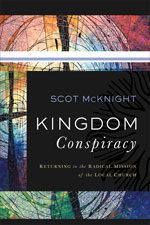 In his book, McKnight deeply criticizes the view of the influential George Eldon Ladd. And he has a point. He says, that for those who follow Ladd’s conception of the kingdom,
“The word ‘kingdom,’ then, is not a place or a space or a realm or a people with boundaries and kings and a temple. No, ‘kingdom’ refers to the abstract dynamic that God is now at work redeeming individuals in Jesus Christ in this world, and this rule in Jesus Christ will be completed and universal at the eschaton when the kingdom arrives fully.” (Kingdom Conspiracy, p. 13)
McKnight counters,
“Over and over, the word ‘kingdom’ in the Old Testament refers to a people governed by a king. Any suggestion, then, that ‘kingdom’ means only ‘ruling’ or ‘reigning’ cannot satisfy what the Bible explicitly affirms… Gerhard Lohfink, a German scholar, pushes against this all-too-common conclusion in these memorable words: ‘A king without a people is no king at all but a figure in a museum.’ He’s right. To say that kingdom is ‘reign’ is to tell half the story.” (p. 70 & 74)
Some in the missional church movement resonate with McKnight’s vision of the kingdom and church, stating,
“The missional church as an alternative community is called to demonstrate an alternative culture in a fallen world, to engage in practicing alternative economics, and to provide the world with an example of living out an alternative approach to the exercise of power. This takes place as the missional church embodies Jesus’s mission and patterns as its own actions in the world.” (Craig Van Gelder and Dwight J. Zscheile, The Missional Church in Perspective: Mapping Trends and Shaping the Conversation (Baker Academic, 2011), 50.)
The Constantinian Temptation

John Howard Yoder
One of the main concerns that Darrel Guder, Alan Hirsch and others in the missional church movement articulate concerning the North American church is what Scot McKnight calls “The Constantinian Temptation,” which flows from John Howard Yoder.
“Perhaps the most recurring theme in Yoder’s theology is his depiction and critique of ‘Constantinianism.’ In short, Yoder argues that the history of Christianity must be read in light of a deep and lasting, though often subtle, shift that took place with respect to the relationship between church and world, and which he claims is best associated with the reign of Constantine.
Whereas pre-Constantinian Christianity was that of a minority church existing in a world that was largely hostile toward it, Yoder claims that the Constantinian shift resulted in an alignment of the church with the ruling political regime of the day. As Yoder himself describes it, the structure of Constantinianism is rooted in the ‘basic axiom’ that ‘the true meaning of history, the true locus of salvation, is in the cosmos and not in the church. What God is really doing is being done primarily through the framework of society as a whole and not in the Christian community.’
It is important to recognize the sense in which Yoder identifies the Constantinian temptation as existing even in a supposedly post-Constantinian context, in which the church is officially separate from the state. Short of the actual institutional alignment of church and state, Yoder claims that Constantinianism continues where there is merely a formal identification of the church with the prevailing political establishment, as in American public discourse.
Yoder maintains that it is only through its concrete presence as an alternative community that the church can truly serve as a witness to the world.”
(Chris Huebner, A Precarious Peace: Yoderian Explorations on Theology, Knowledge, and Identity (Waterloo, Ontario: Herald Press, 2006), 57-8.)
The Anabaptist desire to be an alternative community leads to a reticence toward participating in the political process which, in turn, leads to their suspicion of the desire of Christians to influence culture. This is very evident throughout the pages of Scot’s book, Kingdom Conspiracy. For instance:
“When the majority of the citizens are Christian, as they were more or less in Europe and North America until later in the twentieth century, the culture takes on Christian themes naturally, and Christians are able to influence culture. But when Christianity became less and less the majority, Christians began to raise their voices in protest and—here is the element we must observe—they sought through political means to influence culture and state.” (Kingdom Conspiracy, p. 216)
We have indeed seen this in America in recent decades. The rise of the “Religious Right” in the 1980s is still being felt in today’s political debates, as seen in the Christian reponse to the recent Supreme Court decision about same-sex marriage, the battle over Planned Parenthood’s funding, and the struggle for the rights of Christians to practice their faith in the workplace. Most of the opposition has been through political means.
This branch of Christianity says that the locus of the kingdom is in the local church.
According to Yoder and McKnight, the kingdom of God must be understood exclusively as God’s reign over his people, as opposed to God’s reign over the cosmos.
So, this raises some very serious questions.
Are Christians mandated to bring about cultural change? Or are we mandated to be a counterculture, a model of God’s reign as a witness to those in the culture around us?
Yoder and McKnight (and I can add names like Shane Claiborne to the mix) want us to move away from the whole idea of trying to transform culture, because it inevitably leads to the Constantinian Temptation – to do so through political means. And for them, the political realm is one of the “kingdoms of the world,” in opposition to the kingdom of God.
Is the kingdom of God manifested exclusively in the church, that is, in the people of God gathered for the sake of being a counter-culture? Are we misguided when we seek to bring change to the culture? Is this notion of promoting the common good contrary to the kingdom of God?
Image by Luke Andrew Scowen. Used with permission. Sourced via Flickr.
Previous Post

September 9, 2015
Kingdom of God: Specific to Christians and the Church?
Next Post

September 11, 2015 Kingdom of God: Inaugurated Eschatology and Kuyperianism
Browse Our Archives
Select a Category arts and entertainment audio/video bible / theology business church college community culture education faith family government/politics leadership media medicine podcast science & tech social sector tech Uncategorized work and calling
Select a Month November 2025 May 2025 October 2024 September 2024 June 2024 May 2024 April 2024 March 2024 February 2024 January 2024 December 2023 August 2023 July 2023 June 2023 May 2023 April 2023 March 2023 February 2023 January 2023 December 2022 October 2022 August 2022 July 2022 June 2022 April 2022 March 2022 February 2022 January 2022 December 2021 November 2021 October 2021 August 2021 June 2021 May 2021 April 2021 March 2021 February 2021 January 2021 December 2020 October 2020 September 2020 August 2020 July 2020 June 2020 May 2020 March 2020 February 2020 January 2020 November 2019 October 2019 September 2019 July 2019 May 2019 April 2019 March 2019 February 2019 January 2019 December 2018 July 2018 May 2018 April 2018 March 2018 July 2017 April 2017 March 2017 February 2017 November 2016 September 2016 August 2016 May 2016 April 2016 March 2016 February 2016 January 2016 December 2015 November 2015 October 2015 September 2015 August 2015 July 2015 June 2015 May 2015 April 2015 January 2015 December 2014 November 2014 October 2014 September 2014 August 2014 July 2014 June 2014 May 2014 April 2014 March 2014 February 2014 January 2014 December 2013 November 2013 October 2013 September 2013 August 2013 July 2013 June 2013 May 2013 April 2013 March 2013 February 2013 January 2013 December 2012 November 2012 October 2012 September 2012 August 2012
Follow Us!
TAKE THE
Religious Wisdom Quiz
What was the primary worship language in the Bible?
Select your answer to see how you score.
Latin Aramaic Hebrew Greek
Related posts from (re)integrate

Becoming a Wise Leader with ULI CHI
Submitting to Husbands? Ephesians with Dr. Lynn Cohick
Christians, Israel, and Palestine with GARY BURGE (podcast)
SCOT MCKNIGHT - Rethinking Revelation (podcast)
TRENDING AT PATHEOS Careers, Workplace and Religion

St. Francis by Bill Droel Pope Leo XIV declares 2026 as “Year...

Catholics are schooled in the faith by memorizing dogmatic points and lots...

The Good News of Our Human Limitations -...
After another day of trying to meet deadlines and working on projects,...

Quiet Holy Attentiveness (podcast) with Sarah Clarkson
We know that quiet is an essential aspect of the spiritual life,...

Every Vocation Everywhere All At Once
What is a vocation? How does it endure through the years? Can...

I promise this is not going to become a Taylor Swift Studies...
view all Careers, Workplace and Religion blogs
Ad-Free & Subscriber Log-In Subscription Support
- About Us
- 2026 Calendar
- Videos
- Podcasts
- Library of World Religions
- Faith In Media Tracker
- Advertise With Us
- Write for Us
- Privacy Policy
- Terms of Service
- Do Not Sell My Data
- Contact Us
- Radiant Digital
- Manage Newsletter Subscriptions
- Unsubscribe From Notifications
- Sitemap
Copyright 2008-2026, Patheos, part of the Radiant Digital network of media brands. All rights reserved.
Subscription Support Ad-Free & Subscriber Log-In
Follow Patheos