
BuddhistCatholicContemplativeEvangelicalGeneral ChristianHinduJewishLatter-day SaintMuslimNew VisionsProgressive Christian
Beliefs
- Buddhist
- Catholic
- Contemplative
- Evangelical
- General Christian
- Hindu
- Jewish
- Latter-day Saint
- More Voices
- Muslim
- New Visions
- Pagan
- Progressive Christian
Topics
- Religion News
- Food and Religion
- Sports and Religion
- Religious Art
- Religious Music and Entertainment
- Religious Events
- History and Religion
- Style and Religion
- Politics and Religion
- Women in Religion
- Recreation Outdoors and Religion
- Business Finance and Religion
- Careers Workplace and Religion
- Education and Religion
- Family Parenting and Religion
- Health Fitness and Religion
- Home and Religion
- Relationships and Religion
- Technology and Religion
- Travel and Religion
Columnists
- Buddhist Columnists
- Business Finance and Religion Columnists
- Careers Workplace and Religion Columnists
- Catholic Columnists
- Contemplative Columnists
- Education and Religion Columnists
- Evangelists Columnists
- Family Parenting and Religion Columnists
- General Christian Columnists
- Health Fitness and Religion Columnists
- Hindu Columnists
- History and Religion Columnists
- Home and Religion Columnists
- Jewish Columnists
- More Voices Columnists
- Latter Day Columnists
- Muslim Columnists
- New Visions Columnists
- Nonreligious Columnists
- Pagan Columnists
- Politics and Religion Columnists
- Progressive Columnists
- Recreation Outdoors and Religion Columnists
- Relationships and Religion Columnists
- Religion News Columnists
- Religious Art Columnists
- Religious Events Columnists
- Religious Music and Entertainment Columnists
- Sports and Religion Columnists
- Style and Religion Columnists
- Technology and Religion Columnists
- Travel and Religion Columnists
- Women in Religion Columnists
Resource Library
- 2026 Calendar
- Library of World Religions
- The 100 Most Holy Places on Earth
- Patheos Answers
- Podcasts
- Videos
- Faith Leaders Database
- Anglican Episcopalian
- Bahai
- Baptist
- Buddhism
- Christianity
- Confucianism
- Eastern Orthodoxy
- Hinduism
- Holiness and Pentecostal
- ISKCON
- Islam
- Judaism
- Lutheran
- Methodist
- The Church of Jesus Christ of Latter-day Saints
- New Age
- Paganism
- Presbytarian and Reformed
- Protestantism
- Religion Behind the Scenes
- Roman Catholic
- Scientology
- Shia Islam
- Sikhism
- Sufism
- Sunni Islam
- Taoism
- Zen
- See all religions
Research Tools
 Ad-Free & Subscriber Log-In Subscription Support
Ad-Free & Subscriber Log-In Subscription Support
Follow Patheos 

- Trending:
- Forgiveness
- |
- Marriage
- |
- Consciousness
- |
- Death Penalty
- |
- Election
- |
- Halloween

- Home
- Careers, Workplace and Religion
- Quick History Lesson Part 2: How We Have Understood “Christian Mission”
Quick History Lesson Part 2: How We Have Understood “Christian Mission”
Last updated on: June 10, 2021 at 8:29 pm by Bob Robinson
Quick History Lesson Part 2: How We Have Understood “Christian Mission” 2021-06-10T20:29:21-04:00 Bob Robinson
Patheos Explore the world's faith through different perspectives on religion and spirituality! Patheos has the views of the prevalent religions and spiritualities of the world.
 Part 2 of 2: The Rise of a New Generation of Evangelical Christians.
(Note: While I was working on my Master of Divinity at Trinity Evangelical Divinity School, I had the great privilege of studying under both Kenneth Kantzer and Carl Henry. They’re wisdom, grace, and love for the Lord were so clearly evident. I will never forget it!)
Because of the rise of the “Social Gospel,” conservative Christians embraced what were called the “Fundamentals” (see my last post). “Evangelicals rejected the social gospel and thus shied away from any social agenda whatsoever for church and mission. The fundamentalist-modernist debate polarized the positions further, impacting mission work and theology.”[1]
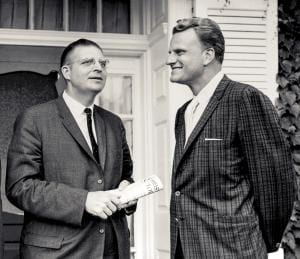
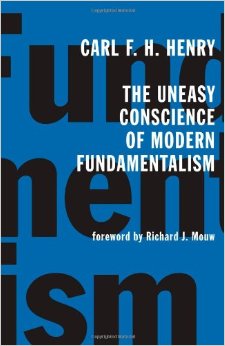 In response to this divide, in 1947 Carl F. H. Henry wrote a book entitled The Uneasy Conscience of Modern Fundamentalism.[2] Henry (pictured above with Billy Graham) made the case that the liberals had mistakenly correlated the gospel to a political agenda while the conservatives had over-reacted to the social gospel. When they preached on the kingdom of God, the conservatives saw it only as a future, other-worldly event and believed that the only mission for the church had to do with the “spiritual” matters of evangelism and personal piety.
He advocated moving beyond the modernist-fundamentalist divide and called for a course between the two. “A Christianity without a passion to turn the world upside down is not reflective of apostolic Christianity.”[3]
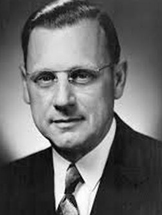
Harold Ockenga
His plea was for evangelicalism to develop a compelling Christian mind but then to apply these thoughts to the culture at large to curtail evil. “The battle against evil in all its forms must be pressed unsparingly; we must pursue the enemy, in politics, in economics, in science, in ethics—everywhere, in every field, we must pursue relentlessly.”[4]
However, Henry made it clear that he believed that the “evangelical task primarily is the preaching of the Gospel, in the interest of individual regeneration by the supernatural grace of God, in such a way that divine redemption can be recognized as the best solution of our problems, individual and social.”[5]
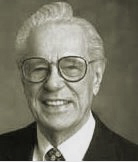
Kenneth Kantzer
Henry was among a new generation of Christians that came to be known as the neo-evangelicals, a term coined by Harold Ockenga, one of the co-founders of Fuller Seminary. Along with Ockenga and Henry, other leading voices in the neo-evangelical movement were Kenneth Kantzer, the founder of Trinity Evangelical Divinity School and evangelist Billy Graham. In the midst of a desire to see the Gospel as a both/and (evangelism and social action), these new evangelicals believed that social action is either the means for evangelism or the consequence of evangelism.
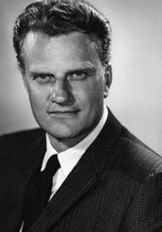
Billy Graham
The Lausanne Committee for World Evangelization (aka, the Lausanne Movement) has been a major influence in the definition of the mission of God’s people. It began in 1974 when “the gathering was called by a committee headed by Rev. Billy Graham and drew more than 2,300 evangelical leaders, from 150 countries… The gathering produced The Lausanne Covenant, a declaration that is ‘intended to define the necessity, responsibilities, and goals of spreading the Gospel.’”[6]
The Lausanne Covenant defined “God’s Purpose” as “He has been calling out from the world a people for himself, and sending his people back into the world to be his servants and his witnesses, for the extension of his kingdom, the building up of Christ’s body, and the glory of his name.”[7]
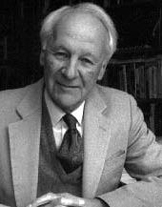
John Sott
John Stott chaired the drafting committee and is known as its chief architect.
And while the covenant is specifically for the purpose of world evangelization (“to spread the good news that Jesus Christ died for our sins and was raised from the dead according to the Scriptures, and that as the reigning Lord he now offers the forgiveness of sins and the liberating gifts of the Spirit to all who repent and believe”[8]), the results of evangelism “include obedience to Christ, incorporation into his Church and responsible service in the world.” The covenant stated that Christians “should share (God’s) concern for justice and reconciliation throughout human society and for the liberation of men and women from every kind of oppression.”[9] Therefore, “World evangelization requires the whole Church to take the whole gospel to the whole world.”[10]
William Carey’s paradigm from the century before of defining Christian mission by interpreting the “Great Commission” (“go and make disciples”)[11] as primarily the geographic expansion of Christianity by means of making converts through evangelism was still widely accepted in the fundamentalist evangelical camp.
“Protestants who used the Great Commission as their foundation for mission assumed the following: that salvation was individualistic; that salvation had to do primarily with a spiritual and personal relationship with Jesus Christ; that the primary calling of the church’s mission was geographic: Christians were called to ‘go’; that the ‘going’ was primarily from the west and north of the globe to the east and south…”[12]
But does the “Great Commission” tell us to “go and make converts?” No, it does not. What does it mean to “Go and make disciples?” What does it mean to be “sent” as missionaries into our world?
See Part 1 of “A Quick History Lesson on How We Have Understood “Christian Mission”
Next, see: What Does it Mean to “Make Disciples?”
_______________
[1] Ott and Strauss, Encountering Theology of Mission.
[2] Carl F. H. Henry, The Uneasy Conscience of Modern Fundamentalism (Grand Rapids, Mich: Wm. B. Eerdmans Publishing, 1947).
[3] Ibid, 16.
[4] Ibid, 86.
[5] Ibid, 88.
[6] “Lausanne I: The International Congress on World Evangelization,” Lausanne Movement, accessed November 4, 2014, http://www.lausanne.org/gatherings/congress/lausanne-i-the-international-congress-on-world-evangelization-2.
[7] “The Lausanne Covenant,” 1974, paragraph 1, Lausanne Movement, accessed November 4, 2014, http://www.lausanne.org/content/covenant/lausanne-covenant.
[8] Ibid, paragraph 4.
[9] Ibid, paragraph 5.
[10] Ibid, paragraph 6.
[11] Matthew 28:18-20
[12] Charles Van Engen, “‘Mission’ Defined and Described,” in MissionShift: Global Mission Issues in the Third Millennium, ed. David Hesselgrave and Ed Stetzer (B&H Academic, 2010), 15.
Uneasy Conscience of Modern Fundamentalism
Previous Post

April 21, 2015
A Quick History Lesson on How We Have Understood "Christian Mission"
Next Post
April 29, 2015 Serving the City, Shaping the Political Community - David Kim
Browse Our Archives
Select a Category arts and entertainment audio/video bible / theology business church college community culture education faith family government/politics leadership media medicine podcast science & tech social sector tech Uncategorized work and calling
Select a Month November 2025 May 2025 October 2024 September 2024 June 2024 May 2024 April 2024 March 2024 February 2024 January 2024 December 2023 August 2023 July 2023 June 2023 May 2023 April 2023 March 2023 February 2023 January 2023 December 2022 October 2022 August 2022 July 2022 June 2022 April 2022 March 2022 February 2022 January 2022 December 2021 November 2021 October 2021 August 2021 June 2021 May 2021 April 2021 March 2021 February 2021 January 2021 December 2020 October 2020 September 2020 August 2020 July 2020 June 2020 May 2020 March 2020 February 2020 January 2020 November 2019 October 2019 September 2019 July 2019 May 2019 April 2019 March 2019 February 2019 January 2019 December 2018 July 2018 May 2018 April 2018 March 2018 July 2017 April 2017 March 2017 February 2017 November 2016 September 2016 August 2016 May 2016 April 2016 March 2016 February 2016 January 2016 December 2015 November 2015 October 2015 September 2015 August 2015 July 2015 June 2015 May 2015 April 2015 January 2015 December 2014 November 2014 October 2014 September 2014 August 2014 July 2014 June 2014 May 2014 April 2014 March 2014 February 2014 January 2014 December 2013 November 2013 October 2013 September 2013 August 2013 July 2013 June 2013 May 2013 April 2013 March 2013 February 2013 January 2013 December 2012 November 2012 October 2012 September 2012 August 2012
Follow Us!
TAKE THE
Religious Wisdom Quiz
Who said, "I am not ashamed of the gospel"?
Select your answer to see how you score.
Paul Peter James John
Related posts from (re)integrate

Submitting to Husbands? Ephesians with Dr. Lynn Cohick

SCOT MCKNIGHT - Rethinking Revelation (podcast)

Women's Callings in their Work with Joanna Meyer
CHRISTOPHER JH WRIGHT Great Commission and Mission of...
TRENDING AT PATHEOS Careers, Workplace and Religion

St. Francis by Bill Droel Pope Leo XIV declares 2026 as “Year...

Catholics are schooled in the faith by memorizing dogmatic points and lots...

The Good News of Our Human Limitations -...
After another day of trying to meet deadlines and working on projects,...

Quiet Holy Attentiveness (podcast) with Sarah Clarkson
We know that quiet is an essential aspect of the spiritual life,...

Every Vocation Everywhere All At Once
What is a vocation? How does it endure through the years? Can...

I promise this is not going to become a Taylor Swift Studies...
view all Careers, Workplace and Religion blogs
Ad-Free & Subscriber Log-In Subscription Support
- About Us
- 2026 Calendar
- Videos
- Podcasts
- Library of World Religions
- Faith In Media Tracker
- Advertise With Us
- Write for Us
- Privacy Policy
- Terms of Service
- Do Not Sell My Data
- Contact Us
- Radiant Digital
- Manage Newsletter Subscriptions
- Unsubscribe From Notifications
- Sitemap
Copyright 2008-2026, Patheos. All rights reserved.
Subscription Support Ad-Free & Subscriber Log-In
Follow Patheos