
BuddhistCatholicContemplativeEvangelicalGeneral ChristianHinduJewishLatter-day SaintMuslimNew VisionsProgressive Christian
Beliefs
- Buddhist
- Catholic
- Contemplative
- Evangelical
- General Christian
- Hindu
- Jewish
- Latter-day Saint
- More Voices
- Muslim
- New Visions
- Pagan
- Progressive Christian
Topics
- Religion News
- Food and Religion
- Sports and Religion
- Religious Art
- Religious Music and Entertainment
- Religious Events
- History and Religion
- Style and Religion
- Politics and Religion
- Women in Religion
- Recreation Outdoors and Religion
- Business Finance and Religion
- Careers Workplace and Religion
- Education and Religion
- Family Parenting and Religion
- Health Fitness and Religion
- Home and Religion
- Relationships and Religion
- Technology and Religion
- Travel and Religion
Columnists
- Buddhist Columnists
- Business Finance and Religion Columnists
- Careers Workplace and Religion Columnists
- Catholic Columnists
- Contemplative Columnists
- Education and Religion Columnists
- Evangelists Columnists
- Family Parenting and Religion Columnists
- General Christian Columnists
- Health Fitness and Religion Columnists
- Hindu Columnists
- History and Religion Columnists
- Home and Religion Columnists
- Jewish Columnists
- More Voices Columnists
- Latter Day Columnists
- Muslim Columnists
- New Visions Columnists
- Nonreligious Columnists
- Pagan Columnists
- Politics and Religion Columnists
- Progressive Columnists
- Recreation Outdoors and Religion Columnists
- Relationships and Religion Columnists
- Religion News Columnists
- Religious Art Columnists
- Religious Events Columnists
- Religious Music and Entertainment Columnists
- Sports and Religion Columnists
- Style and Religion Columnists
- Technology and Religion Columnists
- Travel and Religion Columnists
- Women in Religion Columnists
Resource Library
- 2026 Calendar
- Library of World Religions
- The 100 Most Holy Places on Earth
- Patheos Answers
- Podcasts
- Videos
- Faith Leaders Database
- Anglican Episcopalian
- Bahai
- Baptist
- Buddhism
- Christianity
- Confucianism
- Eastern Orthodoxy
- Hinduism
- Holiness and Pentecostal
- ISKCON
- Islam
- Judaism
- Lutheran
- Methodist
- The Church of Jesus Christ of Latter-day Saints
- New Age
- Paganism
- Presbytarian and Reformed
- Protestantism
- Religion Behind the Scenes
- Roman Catholic
- Scientology
- Shia Islam
- Sikhism
- Sufism
- Sunni Islam
- Taoism
- Zen
- See all religions
Research Tools
 Ad-Free & Subscriber Log-In Subscription Support
Ad-Free & Subscriber Log-In Subscription Support
Follow Patheos 

- Trending:
- Forgiveness
- |
- Marriage
- |
- Consciousness
- |
- Death Penalty
- |
- Election
- |
- Halloween

- Home
- Careers, Workplace and Religion
- A Quick History Lesson on How We Have Understood “Christian Mission”
A Quick History Lesson on How We Have Understood “Christian Mission”
Last updated on: June 10, 2021 at 8:24 pm by Bob Robinson
A Quick History Lesson on How We Have Understood “Christian Mission” 2021-06-10T20:24:50-04:00 Bob Robinson
Patheos Explore the world's faith through different perspectives on religion and spirituality! Patheos has the views of the prevalent religions and spiritualities of the world.
Part 1: Evangelicals and the Shift to Seeing Mission as Purely Evangelism.
A survey of the recent history of evangelical understanding of Christian mission reveals an ebb and flow between seeing the mission of God’s people as being about the redemption of all aspects of life on earth to being solely about evangelism and the destiny of souls in the afterlife.
The Legacy of William Carey
The “father of Protestant missions,”[1] William Carey (1761-1834), focused on the “Great Commission” at the end of the Gospel of Matthew as the purpose of Christian mission. David J. Bosch states, “Carey—like thousands of other missionary enthusiasts since—has built his case almost exclusively on the commission of the risen Lord. Christ has commanded us to go into all the world, therefore it is incumbent upon us to go.”[2]
The text of the Great Commission is
“Go therefore and make disciples of all nations, baptizing them in the name of the Father and of the Son and of the Holy Spirit, teaching them to observe all that I have commanded you. And behold, I am with you always, to the end of the age.”[3]
Bosch criticizes Carey and those who follow him with starting with a presumption “that we already know what ‘mission’ is and now have only to discover it in Scripture. For most Western Christians, Roman Catholics and Protestants alike, from the Middle Ages down to our own times, mission meant the actual geographic movement from a Christian locality to a pagan locality for the purpose of winning converts and expanding the Western Church into that area.”[4]
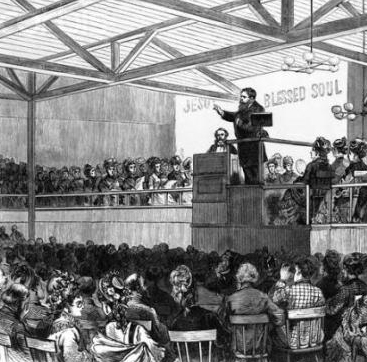
D. L. Moody
That presumption about mission was “defined almost exclusively as the verbal proclamation of an other-worldly message and a preparation for the hereafter. Consequences of mission, such as social and political changes, were, in essence, regarded as by-products. Other activities of the missionary societies, such as education and medical care, were only ancillaries to the verbal proclamation of the gospel.”[5]
Some evangelists in the United States, such as D. L. Moody (1837-1899), used “the priority of evangelism, together with premillennialism, as an excuse to avoid saying much on social issues.”[6]
Evangelism vs. Social Action
Historian George Marsden makes the case that for most evangelicals in the middle and end of the nineteenth century, “the principal emphasis was not on social concerns, but they were certainly an integral part of the evangelical program.”[7]
But at the beginning of the twentieth century, influential Christians like Walter Rauschenbusch and Henry Emerson Fosdick began writing about what would eventually be called “the social gospel,” which defined sin as injustice in society and promoted the belief that the kingdom of God could be ushered in by the Church transforming society. “Optimism was in the air. The generator was the old postmillennialism…wedded to the Darwinian theory of evolution.”[8]
According to Marsden,
“Until this time in American history considerable numbers of revivalist evangelicals had always been in the forefront of social and political reform efforts (antislavery, for instance), even though many other evangelicals had been socially conservative. In the twentieth century, however, evangelical participation in progressive reforms, except in some of the older crusades such as for prohibition, dwindled sharply. As theological liberals spoke more and more about the social implications of the gospel, revivalist evangelicals spoke of them correspondingly less.”[9]
In the early 1900s, “Modernists” (i.e., liberal Protestants) defined the Christian mission as philanthropy and development and began no longer seeing non-Christian religions as false or intrinsically evil. “Modernists tended to increasingly emphasize mission as democratization and improvement of living standards. Hospitals and schools were no longer seen as means or partners of evangelism, but as ends in themselves.”[10]
 The early twentieth century saw a clash between Christians who emphasized the social gospel and those who were influenced by North American revivalism. In response to the optimistic progressive modernists, conservatives advocated what they called “The Fundamentals,” stimulated by pamphlets of that title funded by Lyman Stewart, a wealthy businessman and proponent of Dispensationalism.
“The practical essays and personal testimonies in The Fundamentals display an overwhelming emphasis on soul-saving, personal experience, and individual prayer, with very little attention to specific ethical issues, either personal or social.”[11]
“Evangelicals rejected the social gospel and thus shied away from any social agenda whatsoever for church and mission. The fundamentalist-modernist debate polarized the positions further, impacting mission work and theology.”[12]
But there came a new generation of evangelical Christians who saw the divorce between evangelism and social action as being unbiblical and unchristian.
NEXT: Carl F. H. Henry and the rise of the Neo-evangelicals in the mid-1900s.
_____________
[1] Christianity Today, “William Carey,” Christianitytoday.com, August 8, 2008, accessed September 12, 2014, http://www.christianitytoday.com/ch/131christians/missionaries/carey.html.
[2] D. J. Bosch, “Hermeneutical Principles in the Biblical Foundation for Mission,” Evangelical Review of Theology 17, no. 4 (1993): 439.
[3] Matthew 28:19–20
[4] Bosch, “Hermeneutical Principles in the Biblical Foundation for Mission.”
[5] Ibid, 440.
[6] George M. Marsden, Fundamentalism and American Culture, 2 edition (Oxford University Press, USA, 2006), 90.
[7] Ibid, 80.
[8] David Jacobus Bosch, Transforming Mission: Paradigm Shifts in Theology of Mission (Maryknoll, N.Y: Orbis Books, 1991), 321.
[9] George M. Marsden, Understanding Fundamentalism and Evangelicalism (Wm. B. Eerdmans Publishing, 1991), 30.
[10] Craig Ott and Stephen J. Strauss, Encountering Theology of Mission: Biblical Foundations, Historical Developments, and Contemporary Issues, Encountering Mission edition (Grand Rapids, Mich: Baker Academic, 2010), 129.
[11] Marsden, Fundamentalism and American Culture, 120.
[12] Ott and Strauss, Encountering Theology of Mission.

Next Post

April 24, 2015 Quick History Lesson Part 2: How We Have Understood “Christian Mission”
Browse Our Archives
Select a Category arts and entertainment audio/video bible / theology business church college community culture education faith family government/politics leadership media medicine podcast science & tech social sector tech Uncategorized work and calling
Select a Month November 2025 May 2025 October 2024 September 2024 June 2024 May 2024 April 2024 March 2024 February 2024 January 2024 December 2023 August 2023 July 2023 June 2023 May 2023 April 2023 March 2023 February 2023 January 2023 December 2022 October 2022 August 2022 July 2022 June 2022 April 2022 March 2022 February 2022 January 2022 December 2021 November 2021 October 2021 August 2021 June 2021 May 2021 April 2021 March 2021 February 2021 January 2021 December 2020 October 2020 September 2020 August 2020 July 2020 June 2020 May 2020 March 2020 February 2020 January 2020 November 2019 October 2019 September 2019 July 2019 May 2019 April 2019 March 2019 February 2019 January 2019 December 2018 July 2018 May 2018 April 2018 March 2018 July 2017 April 2017 March 2017 February 2017 November 2016 September 2016 August 2016 May 2016 April 2016 March 2016 February 2016 January 2016 December 2015 November 2015 October 2015 September 2015 August 2015 July 2015 June 2015 May 2015 April 2015 January 2015 December 2014 November 2014 October 2014 September 2014 August 2014 July 2014 June 2014 May 2014 April 2014 March 2014 February 2014 January 2014 December 2013 November 2013 October 2013 September 2013 August 2013 July 2013 June 2013 May 2013 April 2013 March 2013 February 2013 January 2013 December 2012 November 2012 October 2012 September 2012 August 2012
Follow Us!
TAKE THE
Religious Wisdom Quiz
I denied my Lord three times before dawn broke and a bird announced the morning. What creature's cry fulfilled the prophecy?
Select your answer to see how you score.
A rooster A raven An eagle A dove
Related posts from (re)integrate

The Good News of Our Human Limitations -...

Quiet Holy Attentiveness (podcast) with Sarah Clarkson

Submitting to Husbands? Ephesians with Dr. Lynn Cohick

SCOT MCKNIGHT - Rethinking Revelation (podcast)
TRENDING AT PATHEOS Careers, Workplace and Religion

St. Francis by Bill Droel Pope Leo XIV declares 2026 as “Year...

Catholics are schooled in the faith by memorizing dogmatic points and lots...

The Good News of Our Human Limitations -...
After another day of trying to meet deadlines and working on projects,...

Quiet Holy Attentiveness (podcast) with Sarah Clarkson
We know that quiet is an essential aspect of the spiritual life,...

Every Vocation Everywhere All At Once
What is a vocation? How does it endure through the years? Can...

I promise this is not going to become a Taylor Swift Studies...
view all Careers, Workplace and Religion blogs
Ad-Free & Subscriber Log-In Subscription Support
- About Us
- 2026 Calendar
- Videos
- Podcasts
- Library of World Religions
- Faith In Media Tracker
- Advertise With Us
- Write for Us
- Privacy Policy
- Terms of Service
- Do Not Sell My Data
- Contact Us
- Radiant Digital
- Manage Newsletter Subscriptions
- Unsubscribe From Notifications
- Sitemap
Copyright 2008-2026, Patheos. All rights reserved.
Subscription Support Ad-Free & Subscriber Log-In
Follow Patheos