
BuddhistCatholicContemplativeEvangelicalGeneral ChristianHinduJewishLatter-day SaintMuslimNew VisionsProgressive Christian
Beliefs
- Buddhist
- Catholic
- Contemplative
- Evangelical
- General Christian
- Hindu
- Jewish
- Latter-day Saint
- More Voices
- Muslim
- New Visions
- Pagan
- Progressive Christian
Topics
- Religion News
- Food and Religion
- Sports and Religion
- Religious Art
- Religious Music and Entertainment
- Religious Events
- History and Religion
- Style and Religion
- Politics and Religion
- Women in Religion
- Recreation Outdoors and Religion
- Business Finance and Religion
- Careers Workplace and Religion
- Education and Religion
- Family Parenting and Religion
- Health Fitness and Religion
- Home and Religion
- Relationships and Religion
- Technology and Religion
- Travel and Religion
Columnists
- Buddhist Columnists
- Business Finance and Religion Columnists
- Careers Workplace and Religion Columnists
- Catholic Columnists
- Contemplative Columnists
- Education and Religion Columnists
- Evangelists Columnists
- Family Parenting and Religion Columnists
- General Christian Columnists
- Health Fitness and Religion Columnists
- Hindu Columnists
- History and Religion Columnists
- Home and Religion Columnists
- Jewish Columnists
- More Voices Columnists
- Latter Day Columnists
- Muslim Columnists
- New Visions Columnists
- Nonreligious Columnists
- Pagan Columnists
- Politics and Religion Columnists
- Progressive Columnists
- Recreation Outdoors and Religion Columnists
- Relationships and Religion Columnists
- Religion News Columnists
- Religious Art Columnists
- Religious Events Columnists
- Religious Music and Entertainment Columnists
- Sports and Religion Columnists
- Style and Religion Columnists
- Technology and Religion Columnists
- Travel and Religion Columnists
- Women in Religion Columnists
Resource Library
- 2026 Calendar
- Library of World Religions
- The 100 Most Holy Places on Earth
- Patheos Answers
- Podcasts
- Videos
- Faith Leaders Database
- Anglican Episcopalian
- Bahai
- Baptist
- Buddhism
- Christianity
- Confucianism
- Eastern Orthodoxy
- Hinduism
- Holiness and Pentecostal
- ISKCON
- Islam
- Judaism
- Lutheran
- Methodist
- The Church of Jesus Christ of Latter-day Saints
- New Age
- Paganism
- Presbytarian and Reformed
- Protestantism
- Religion Behind the Scenes
- Roman Catholic
- Scientology
- Shia Islam
- Sikhism
- Sufism
- Sunni Islam
- Taoism
- Zen
- See all religions
Research Tools
 Ad-Free & Subscriber Log-In Subscription Support
Ad-Free & Subscriber Log-In Subscription Support
Follow Patheos 

- Trending:
- Forgiveness
- |
- Marriage
- |
- Consciousness
- |
- Death Penalty
- |
- Election
- |
- Halloween

- Home
- Careers, Workplace and Religion
- Everyday Ordinary Christian Living is Radical
Everyday Ordinary Christian Living is Radical
Last updated on: April 17, 2014 at 8:04 am by Bob Robinson
Everyday Ordinary Christian Living is Radical 2014-04-17T08:04:03-04:00 Bob Robinson
Patheos Explore the world's faith through different perspectives on religion and spirituality! Patheos has the views of the prevalent religions and spiritualities of the world.
Being a “radical,” “missional” Christian is slowly becoming the “new legalism.” We need more ordinary God and people lovers (Matt 22:36-40). – @drantbradley
That was a tweet sent out from Anthony Bradley, Associate Professor of Theology and Ethics at The King’s College in New York City and a Research Fellow at the Acton Institute.
Can a Christian simply dedicate his or her life to loving God and loving neighbors, or does God demand from us a life that is extraordinary? What does it take to glorify God in today’s world?
Can Christians have significance even as they live their everyday lives?
Anthony Bradley expands on what he meant in his tweet at a post at The Acton Institute’s Power Blog (and re-printed at WORLD). In his post, “The New Legalism: Missional, Radical, Narcissistic, and Shamed,” Bradley writes,
“I continue to be amazed by the number of youth and young adults who are stressed and burnt out from the regular shaming and feelings of inadequacy if they happen to not be doing something unique and special. Today’s Millennial generation is being fed the message that if they don’t do something extraordinary in this life they are wasting their gifts and potential. The sad result is that many young adults feel ashamed if they “settle” into ordinary jobs, get married early and start families, live in small towns, or as 1 Thess 4:11 says, “aspire to live quietly, and to mind [their] affairs, and to work with [their] hands.” For too many Millennials their greatest fear in this life is being an ordinary person with a non-glamorous job, living in the suburbs, and having nothing spectacular to boast about.”
 Bradley names what he believes are the causes of this. The first is an attitude of “anti-suburbanism” that is being promoted to and by young adult Christians which places such an emphasis on doing ministry in neglected cities that living in the suburbs is seen as settling for something less spiritual. The second cause is “missional narcissism,” when a zeal for local missions gets coupled with the Millennial generation’s tendency to have an inflated view of the self. The result, according to Bradley, is that the only way that Millenials have been taught that their faith life is meaningful is when it is “done in a unique and special way, a ‘missional’ way.”
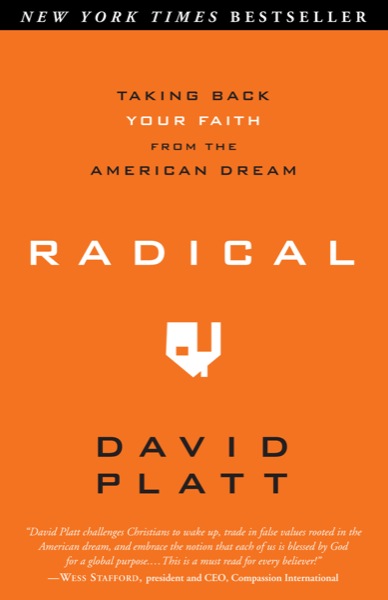
This leads him to his criticism of the “radical Christianity” movement that has been promoted by such books as David Platt’s Radical. In an earlier review of that book for WORLD, Bradley stated,
“Using Christianity as a means of achieving comfort, safety, ease, and professional success has certainly poisoned the missional spirit of many Christians. But while Platt rightly calls this syncretism sin, in the end readers are left with nothing more than a ‘compassionate revivalist’ Christianity that fails to radically call Christians to live in harmony with God’s desire to redeem the entire creation… Reducing the mission of the Kingdom to evangelism tends to discourage Christians from pressing the claims of Christ into renewing and creating culture.”
The High Calling’s Marcus Goodyear had similar thoughts on Platt’s book, saying,
“Work is not merely a means to evangelism. If we elevate evangelism above work, we recreate the sacred-secular divide. Some Christian activities become a higher calling than others. Apart from a healthy view of work and the cultural mandate, the great commission becomes a message we deliver. We elevate the message of the gospel above and beyond the actions of the gospel.
The message of the gospel is important! Yes! We want to help people understand and meet Jesus. But the message we deliver is not more important than what work we do. And what we do does not merely add credibility to what we say…
If we recognize God in our words but not in our work, we are only seeing part of God’s nature. If we evangelize others without a sense of the intrinsic value of work, we may be sharing an incomplete gospel.”
Are we in danger of creating a new legalism?
So what Anthony Bradley is cautioning Christians about is that all this talk about “love for the city” and “missional incarnation” and “radical Christianity” loads up a lot of shame on Christians. This is what he calls a “new legalism,” because it creates a man-made standard when all we are actually called to do is to love God and love our neighbor. Bradley states,
“Maybe Christians are simply to pursue living well and invite others to do so according to how God has ordered the universe. An emphasis on human flourishing, ours and others, becomes important because it is characterized by a holistic concern for the spiritual, moral, physical, economic, material, political, psychological, and social context necessary for human beings to live according to their design.”
I still think that there is a great need to call Christians away from the “Suburban” malaise that American Civil “Christianity” (in quotes, since it is a pale imitation of the real thing) has created, where the desire for comfort and security takes precedence over the willingness to take risks and make sacrifices for the sake of the Kingdom. But that being said, Bradley seems to me to be correct about how we often have a tendency to swing the pendulum too far the other way. Certainly we want to be on the front lines of transformation in needy places, but that is not the calling of every Christian. We can glorify God in the ordinary as well.
What does God actually expect from Christians?
In college ministry (where I spend the majority of my time), this is always the tension: I want to encourage college students to live life as whole-hearted disciples of Christ, where every sphere is yielded to his Lordship. Why? So that they can “transform the world!” But can any of these students actually do this? Both Andy Crouch and James Davison Hunter say, “No.” They say that changing the world is too grand a cause for any one of us. As Crouch writes,
“When we thoughtlessly grasp for the heedless rhetoric of ‘changing the world,’ we expose ourselves to temptation. We find ourselves in a situation similar to Adam and Eve’s in the Garden. ‘You will be like God, knowing good and evil’… Is there a way to change the world without falling into one of the many traps laid for would-be world changers? If so, it will require us to learn the one thing the language of ‘changing the world’ usually lacks: humility” (Andy Crouch, Culture Making, p. 201).
Hunter states that all Christians are actually called to do is to be a “faithful presence” in the places that God has placed them,
“…fully present and committed in their spheres of social influence, whatever they may be: their families, neighborhoods, voluntary activities, and places of work…to create conditions in the structures of social life we inhabit that are conducive to the flourishing of all.” (Hunter, To Change the World, p. 247)
So in my college ministry, I try to help young Christians realize that they will actually make their greatest contributions not as “radical” missionaries with some high-profile ministry or NGO, but within the vocations to which God has called them.
- This serves the common good (both for the city and for the suburbs) as they faithfully and intentionally work for the flourishing of all — their co-workers, the communities and cultural spheres that are affected by their industry, our culture’s various institutions, our families, etc.
- This is missional because it participates with God in his redemption of the world as they love their neighbors in and through their vocations,
- And this is indeed radical, because as they live faithfully in their everyday vocations they are intentionally looking for ways to participate in God’s kingdom. As they are purposeful in all they do to help people experience the way God intends things to be, their ethics and proclamation will be genuine and effective.
What Anthony Bradley is telling us is that, as Christians live normal lives characterized by love and a desire to promote shalom (universal flourishing), they are indeed living radical Christian lives.
Image by Mathias Klintberg [Public domain], via Wikimedia Commons. This article is also featured at The High Calling.

Previous Post

April 14, 2014
The Five Biggest Career Mistakes Christians Make
Next Post
April 18, 2014 Four Things to Do When You Make a Mistake at Work
Browse Our Archives
Select a Category arts and entertainment audio/video bible / theology business church college community culture education faith family government/politics leadership media medicine podcast science & tech social sector tech Uncategorized work and calling
Select a Month November 2025 May 2025 October 2024 September 2024 June 2024 May 2024 April 2024 March 2024 February 2024 January 2024 December 2023 August 2023 July 2023 June 2023 May 2023 April 2023 March 2023 February 2023 January 2023 December 2022 October 2022 August 2022 July 2022 June 2022 April 2022 March 2022 February 2022 January 2022 December 2021 November 2021 October 2021 August 2021 June 2021 May 2021 April 2021 March 2021 February 2021 January 2021 December 2020 October 2020 September 2020 August 2020 July 2020 June 2020 May 2020 March 2020 February 2020 January 2020 November 2019 October 2019 September 2019 July 2019 May 2019 April 2019 March 2019 February 2019 January 2019 December 2018 July 2018 May 2018 April 2018 March 2018 July 2017 April 2017 March 2017 February 2017 November 2016 September 2016 August 2016 May 2016 April 2016 March 2016 February 2016 January 2016 December 2015 November 2015 October 2015 September 2015 August 2015 July 2015 June 2015 May 2015 April 2015 January 2015 December 2014 November 2014 October 2014 September 2014 August 2014 July 2014 June 2014 May 2014 April 2014 March 2014 February 2014 January 2014 December 2013 November 2013 October 2013 September 2013 August 2013 July 2013 June 2013 May 2013 April 2013 March 2013 February 2013 January 2013 December 2012 November 2012 October 2012 September 2012 August 2012
Follow Us!
TAKE THE
Religious Wisdom Quiz
Who is known as the "weeping prophet"?
Select your answer to see how you score.
Isaiah Ezekiel Joel Jeremiah
Related posts from (re)integrate
The Good News of Our Human Limitations -...
Quiet Holy Attentiveness (podcast) with Sarah Clarkson

Becoming a Wise Leader with ULI CHI

Submitting to Husbands? Ephesians with Dr. Lynn Cohick
TRENDING AT PATHEOS Careers, Workplace and Religion

St. Francis by Bill Droel Pope Leo XIV declares 2026 as “Year...

Catholics are schooled in the faith by memorizing dogmatic points and lots...

The Good News of Our Human Limitations -...
After another day of trying to meet deadlines and working on projects,...

Quiet Holy Attentiveness (podcast) with Sarah Clarkson
We know that quiet is an essential aspect of the spiritual life,...

Every Vocation Everywhere All At Once
What is a vocation? How does it endure through the years? Can...

I promise this is not going to become a Taylor Swift Studies...
view all Careers, Workplace and Religion blogs
Ad-Free & Subscriber Log-In Subscription Support
- About Us
- 2026 Calendar
- Videos
- Podcasts
- Library of World Religions
- Faith In Media Tracker
- Advertise With Us
- Write for Us
- Privacy Policy
- Terms of Service
- Do Not Sell My Data
- Contact Us
- Radiant Digital
- Manage Newsletter Subscriptions
- Unsubscribe From Notifications
- Sitemap
Copyright 2008-2026, Patheos. All rights reserved.
Subscription Support Ad-Free & Subscriber Log-In
Follow Patheos