
BuddhistCatholicContemplativeEvangelicalGeneral ChristianHinduJewishLatter-day SaintMuslimNew VisionsProgressive Christian
Beliefs
- Buddhist
- Catholic
- Contemplative
- Evangelical
- General Christian
- Hindu
- Jewish
- Latter-day Saint
- More Voices
- Muslim
- New Visions
- Pagan
- Progressive Christian
Topics
- Religion News
- Food and Religion
- Sports and Religion
- Religious Art
- Religious Music and Entertainment
- Religious Events
- History and Religion
- Style and Religion
- Politics and Religion
- Women in Religion
- Recreation Outdoors and Religion
- Business Finance and Religion
- Careers Workplace and Religion
- Education and Religion
- Family Parenting and Religion
- Health Fitness and Religion
- Home and Religion
- Relationships and Religion
- Technology and Religion
- Travel and Religion
Columnists
- Buddhist Columnists
- Business Finance and Religion Columnists
- Careers Workplace and Religion Columnists
- Catholic Columnists
- Contemplative Columnists
- Education and Religion Columnists
- Evangelists Columnists
- Family Parenting and Religion Columnists
- General Christian Columnists
- Health Fitness and Religion Columnists
- Hindu Columnists
- History and Religion Columnists
- Home and Religion Columnists
- Jewish Columnists
- More Voices Columnists
- Latter Day Columnists
- Muslim Columnists
- New Visions Columnists
- Nonreligious Columnists
- Pagan Columnists
- Politics and Religion Columnists
- Progressive Columnists
- Recreation Outdoors and Religion Columnists
- Relationships and Religion Columnists
- Religion News Columnists
- Religious Art Columnists
- Religious Events Columnists
- Religious Music and Entertainment Columnists
- Sports and Religion Columnists
- Style and Religion Columnists
- Technology and Religion Columnists
- Travel and Religion Columnists
- Women in Religion Columnists
Resource Library
- 2026 Calendar
- Library of World Religions
- The 100 Most Holy Places on Earth
- Patheos Answers
- Podcasts
- Videos
- Faith Leaders Database
- Anglican Episcopalian
- Bahai
- Baptist
- Buddhism
- Christianity
- Confucianism
- Eastern Orthodoxy
- Hinduism
- Holiness and Pentecostal
- ISKCON
- Islam
- Judaism
- Lutheran
- Methodist
- The Church of Jesus Christ of Latter-day Saints
- New Age
- Paganism
- Presbytarian and Reformed
- Protestantism
- Religion Behind the Scenes
- Roman Catholic
- Scientology
- Shia Islam
- Sikhism
- Sufism
- Sunni Islam
- Taoism
- Zen
- See all religions
Research Tools
 Ad-Free & Subscriber Log-In Subscription Support
Ad-Free & Subscriber Log-In Subscription Support
Follow Patheos 

- Trending:
- Forgiveness
- |
- Marriage
- |
- Consciousness
- |
- Death Penalty
- |
- Election
- |
- Halloween

- Home
- Careers, Workplace and Religion
- The Great Big Cosmic Gospel
The Great Big Cosmic Gospel
Last updated on: April 12, 2016 at 10:19 am by Bob Robinson
The Great Big Cosmic Gospel 2016-04-12T10:19:54-04:00 Bob Robinson
Patheos Explore the world's faith through different perspectives on religion and spirituality! Patheos has the views of the prevalent religions and spiritualities of the world.
 Below is my graphical representation of the Gospel. It is the four-chapter story of God’s working in history for the restoration of the cosmos that He created.
A few weeks ago, I presented this to a couple of guys in Colorado. They had just discovered that their father has terminal cancer, and I wanted to offer them the Good News so that they could make sense of this tragedy and perhaps move toward faith in Christ. It was exciting to see these two men, one a grizzled outdoorsman, the other an aspiring artist, nod in affirmation and respond with insightful questions. It was a pleasure for my family to circle around that artist and pray for him and his family as they go through this difficult time and that the two men would find comfort in the Lord and Savior Jesus Christ.
The Good News is grand and cosmic. It certainly includes the amazing fact that Christ died for individual sinners so that they can live for all eternity with God. But that is the central aspect of a huge cosmic story of God’s mission in the world. Our individual salvation is actually an invitation from God for each of us to participate with him in this mission.
When I first present this to non-Christians, most resonate with the bigness of the story, and they begin to understand why Jesus came into the world and died on the cross. More often than not, it makes sense to them that God created a good world, that human rebellion has caused the creation to be broken, and that God, in Jesus Christ, rescues his creation.
It also makes sense that God is inviting us to quit being a part of the problem and start becoming part of the solution.
When I first show this diagram to many Christians, they automatically place themselves, as individuals, into this timeline. “I was created, I sinned, I accepted Jesus and was redeemed/saved, and one day I will be in heaven.” But that is not the story. It is only part of the story. It takes a lot of de-programming to help them see this timeline not individualistically, but cosmically: that each of us are certainly in the storyline, but that the storyline is bigger than each one of us. We are participating in a grand and glorious mission.
What God has been doing, through Christ, is the cosmic renewal of all things. When we begin to understand the full biblical story, we understand the gospel beyond how it is portrayed in evangelistic tracts that seek to simplify it to individual need and individual sin and individual salvation. We get the story of how God has been working throughout history to bring about God’s ultimate purpose.
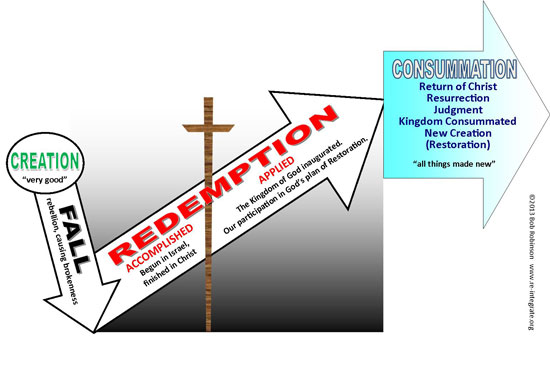
CREATION
When God made all the aspects of the earth he saw that it was all “very good” (Genesis 1:31). And he puts humanity in charge of it.
“Then God said, ‘Let us make mankind in our image, in our likeness, so that they may rule over the fish in the sea and the birds in the sky, over the livestock and all the wild animals, and over all the creatures that move along the ground.’…God blessed them and said to them, ‘Be fruitful and increase in number; fill the earth and subdue it. Rule over the fish in the sea and the birds in the sky and over every living creature that moves on the ground.’” (Genesis 1:26, 28)
Humanity is created in the imago Dei, the image of God. This is who we are intrinsically. And the definition of being an image of God, while multi-faceted, has at its foundation the fact that humans are created to “rule” over the creation. We are placed in charge by the One who is in charge, to represent him.
Not only are the things of nature made by God, but there is order and meaning in life because God made it all. There is a proper way to work because God has made us to worship through our work. In fact, God actually made humanity to work. In Genesis 2:5, we read that the reason “no bush of the field was yet in the land and no small plant of the field had yet sprung up” was not only because God had not yet caused it to rain, but that “there was no man to work the ground.” The reason God placed Adam in the garden of Eden was so that he would “work it and keep it” (Genesis 2:15).
We have purpose in this world – intrinsically in each us as the image of God – to work.
FALL
Adam and Eve, however, failed in their role as the ones in charge of the created order. They did not trust that they could be all that they could be as image-bearers. They wanted more. They wanted to be God themselves (see Genesis 3:5).
The Fall is the result of the human race not trusting God that he has our best interests in mind – and the best for us is to be fully human, robustly reflecting God into his creation. Instead of creating things for the common good, our pride and greed get in the way. Instead of caring for others and the created world, we manipulate them for our selfish interests. Instead of loving God and loving others, we love primarily ourselves.
The world is cursed, in need of redemption, in need of restoration. And God begins using human beings for this very purpose. Why? Because humans are His image-bearers. We are the ones who have been called to rule God’s world in righteousness and Shalom.
REDEMPTION
Accomplished
The gospel is not only about my personal salvation from my sins, but ultimately, it is the story of how Jesus is the King, the One that we must follow as he brings all things back into reconciliation with God (Colossians 1:19-20).
Scot McKnight, in his new book, The King Jesus Gospel: The Original Good News Revisited, writes,
“What Adam was to do in the Garden—that is, to govern this world redemptively on God’s behalf—is the mission God gives to Israel. Like Adam, Israel failed, and so did its kings. God sent his Son to do what Adam and Israel and the kings did not (and evidently could not) do and to rescue everyone from their sins and systemic evil and Satan (the adversary). Hence, the Son is the one who rules as Messiah and Lord” (p. 35).
Contrary to the popular notion of the gospel in much of American evangelicalism, the story of the gospel does not start with me and my sins. It starts with God’s creation and intention for his image-bearers to rule over his creation.
The story of the gospel does not skip over what God was doing in the Old Testament with Israel as if it has no bearing on the story, but is rooted in that story of Israel: their calling, their failure. The story of the gospel is about Jesus fulfilling that calling as King. Even with good intentions (trying to make the gospel more readily understood and accessible), when we disconnect the story of Jesus with the story of Israel, the story of humanity, and the story of cosmic restoration, we get a Jesus that is truncated, altered, and easily misunderstood.
Applied
When Christ died and was raised from the dead, the story of the Church shifted from ethnic Israel to the new Israel – the People of God who trust in Jesus. Christians are “God’s chosen people, a royal priesthood, a holy nation, God’s special possession” charged with the duty of declaring the praises of God, who called us “out of darkness into his wonderful light” (1 Peter 2:9).
God does an amazing work in us: He indwells us with his Holy Spirit through whom he progresses our transformation from sinners into the image of Jesus, empowering us to become fully human again. In other words, because of redemption, the image of God in us can become increasingly restored as we are made into the image of the perfect human, Jesus Christ.
We have purpose rooted in Creation: to care for and subdue the creation, to rule and to work for the common good.
We also have purpose rooted in Redemption: to bring restoration to a broken world, to reconcile all things back to God, and to proclaim through our actions and our words that Jesus Christ, the King, is making the world right again.
CONSUMMATION
(or “Restoration”)
The story finishes when redemption is brought to completion (or “consummated”). Jesus returns and God finishes his work of making “all things new” (Revelation 21:5) and the redemption is fully realized resulting in full restoration. Resurrected humans are then given authority to rule over the new earth, under the rule of Jesus the King. The imago Dei will be fully restored! The Creation will be as it should be!
Certainly it is good news that Jesus saves each one of us from our sins in the act of Justification. But let us not miss the grand, cosmic gospel. The really BIG good news is this: Jesus is the King, and He is redeeming and restoring God’s broken, fallen Creation – every square inch of it. This is why we find that when Jesus proclaimed “the gospel” (or “good news”) it was “the gospel of the kingdom” (Matthew 4:23).
What do you think are the implications of this cosmic gospel for the high calling of our daily work? How does vocation relate to creation, fall, redemption, and consummation? What are you doing in your vocation that reflects who you are as a person created in the image of God?
Previous Post

August 26, 2013
We have a new partner ministry: Celebrate Your Work!
Browse Our Archives
Select a Category arts and entertainment audio/video bible / theology business church college community culture education faith family government/politics leadership media medicine podcast science & tech social sector tech Uncategorized work and calling
Select a Month November 2025 May 2025 October 2024 September 2024 June 2024 May 2024 April 2024 March 2024 February 2024 January 2024 December 2023 August 2023 July 2023 June 2023 May 2023 April 2023 March 2023 February 2023 January 2023 December 2022 October 2022 August 2022 July 2022 June 2022 April 2022 March 2022 February 2022 January 2022 December 2021 November 2021 October 2021 August 2021 June 2021 May 2021 April 2021 March 2021 February 2021 January 2021 December 2020 October 2020 September 2020 August 2020 July 2020 June 2020 May 2020 March 2020 February 2020 January 2020 November 2019 October 2019 September 2019 July 2019 May 2019 April 2019 March 2019 February 2019 January 2019 December 2018 July 2018 May 2018 April 2018 March 2018 July 2017 April 2017 March 2017 February 2017 November 2016 September 2016 August 2016 May 2016 April 2016 March 2016 February 2016 January 2016 December 2015 November 2015 October 2015 September 2015 August 2015 July 2015 June 2015 May 2015 April 2015 January 2015 December 2014 November 2014 October 2014 September 2014 August 2014 July 2014 June 2014 May 2014 April 2014 March 2014 February 2014 January 2014 December 2013 November 2013 October 2013 September 2013 August 2013 July 2013 June 2013 May 2013 April 2013 March 2013 February 2013 January 2013 December 2012 November 2012 October 2012 September 2012 August 2012
Follow Us!
TAKE THE
Religious Wisdom Quiz
Which Christian movement began with John Wesley in the 18th century?
Select your answer to see how you score.
Calvinism Methodism Lutheranism Presbyterianism
Related posts from (re)integrate
The Good News of Our Human Limitations -...
Quiet Holy Attentiveness (podcast) with Sarah Clarkson

Becoming a Wise Leader with ULI CHI

Submitting to Husbands? Ephesians with Dr. Lynn Cohick
TRENDING AT PATHEOS Careers, Workplace and Religion

St. Francis by Bill Droel Pope Leo XIV declares 2026 as “Year...

Catholics are schooled in the faith by memorizing dogmatic points and lots...

The Good News of Our Human Limitations -...
After another day of trying to meet deadlines and working on projects,...

Quiet Holy Attentiveness (podcast) with Sarah Clarkson
We know that quiet is an essential aspect of the spiritual life,...

Every Vocation Everywhere All At Once
What is a vocation? How does it endure through the years? Can...

I promise this is not going to become a Taylor Swift Studies...
view all Careers, Workplace and Religion blogs
Ad-Free & Subscriber Log-In Subscription Support
- About Us
- 2026 Calendar
- Videos
- Podcasts
- Library of World Religions
- Faith In Media Tracker
- Advertise With Us
- Write for Us
- Privacy Policy
- Terms of Service
- Do Not Sell My Data
- Contact Us
- Radiant Digital
- Manage Newsletter Subscriptions
- Unsubscribe From Notifications
- Sitemap
Copyright 2008-2026, Patheos. All rights reserved.
Subscription Support Ad-Free & Subscriber Log-In
Follow Patheos