
BuddhistCatholicContemplativeEvangelicalGeneral ChristianHinduJewishLatter-day SaintMuslimNew VisionsProgressive Christian
Beliefs
- Buddhist
- Catholic
- Contemplative
- Evangelical
- General Christian
- Hindu
- Jewish
- Latter-day Saint
- More Voices
- Muslim
- New Visions
- Pagan
- Progressive Christian
Topics
- Religion News
- Food and Religion
- Sports and Religion
- Religious Art
- Religious Music and Entertainment
- Religious Events
- History and Religion
- Style and Religion
- Politics and Religion
- Women in Religion
- Recreation Outdoors and Religion
- Business Finance and Religion
- Careers Workplace and Religion
- Education and Religion
- Family Parenting and Religion
- Health Fitness and Religion
- Home and Religion
- Relationships and Religion
- Technology and Religion
- Travel and Religion
Columnists
- Buddhist Columnists
- Business Finance and Religion Columnists
- Careers Workplace and Religion Columnists
- Catholic Columnists
- Contemplative Columnists
- Education and Religion Columnists
- Evangelists Columnists
- Family Parenting and Religion Columnists
- General Christian Columnists
- Health Fitness and Religion Columnists
- Hindu Columnists
- History and Religion Columnists
- Home and Religion Columnists
- Jewish Columnists
- More Voices Columnists
- Latter Day Columnists
- Muslim Columnists
- New Visions Columnists
- Nonreligious Columnists
- Pagan Columnists
- Politics and Religion Columnists
- Progressive Columnists
- Recreation Outdoors and Religion Columnists
- Relationships and Religion Columnists
- Religion News Columnists
- Religious Art Columnists
- Religious Events Columnists
- Religious Music and Entertainment Columnists
- Sports and Religion Columnists
- Style and Religion Columnists
- Technology and Religion Columnists
- Travel and Religion Columnists
- Women in Religion Columnists
Resource Library
- 2026 Calendar
- Library of World Religions
- The 100 Most Holy Places on Earth
- Patheos Answers
- Podcasts
- Videos
- Faith Leaders Database
- Anglican Episcopalian
- Bahai
- Baptist
- Buddhism
- Christianity
- Confucianism
- Eastern Orthodoxy
- Hinduism
- Holiness and Pentecostal
- ISKCON
- Islam
- Judaism
- Lutheran
- Methodist
- The Church of Jesus Christ of Latter-day Saints
- New Age
- Paganism
- Presbytarian and Reformed
- Protestantism
- Religion Behind the Scenes
- Roman Catholic
- Scientology
- Shia Islam
- Sikhism
- Sufism
- Sunni Islam
- Taoism
- Zen
- See all religions
Research Tools
 Ad-Free & Subscriber Log-In Subscription Support
Ad-Free & Subscriber Log-In Subscription Support
Follow Patheos 

- Trending:
- Forgiveness
- |
- Marriage
- |
- Consciousness
- |
- Death Penalty
- |
- Election
- |
- Halloween

- Home
- Careers, Workplace and Religion
- The Secret to Better Work and Life Is Not Rocket Science
The Secret to Better Work and Life Is Not Rocket Science
Last updated on: May 16, 2013 at 1:07 pm by Marcus Goodyear
The Secret to Better Work and Life Is Not Rocket Science 2013-05-16T13:07:07-04:00 Marcus Goodyear
Patheos Explore the world's faith through different perspectives on religion and spirituality! Patheos has the views of the prevalent religions and spiritualities of the world.
What if someone told you they knew the secret to a better life? What if they shared this secret with you? They promised you would be able to concentrate better, enjoy life more, increase productivity at work, decrease stress at work and at home, and have a better sense of self-esteem.
It sounds too good to be true.
But researchers at Lancaster University reported these exact results from its Research Centre for Organizational Health and Well-being. In 2010, the university partnered with the Global Corporate Challenge to “study the impact that increasing daily physical activity has on the physical and mental health and wellbeing of employees across the world.”
Christian K. Roberts and R. James Barnard from UCLA had reached similar conclusions in a 2005 study. They write, “There is a solution to this epidemic of metabolic disease that is inundating today’s societies worldwide: exercise and diet.”
That’s the secret to a better life. More exercise and healthier eating.
It’s not a secret really, but it’s an idea that still eludes too many Christians in America. Consider theNorthwestern University study from 2011 that found “young adults who attend church or a bible study once a week are 50% more likely to be obese.”
This statistic is alarming, but don’t make assumptions about what causes what. Church and bible study correlate with increased obesity rates, but that doesn’t mean church causes obesity. Still, I wish church attendance correlated with healthy living rather than obesity.
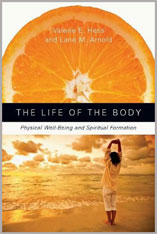 Valerie Hess and Lane Arnold hope for something better, too. In their book The Life of the Body: Physical Well-Being and Spiritual Formation, they argue that Christians have a moral obligation to take care of their bodies. The apostle Paul makes a similar argument to the Corinthians when he says,
Do you not know that your bodies are temples of the Holy Spirit, who is in you, whom you have received from God? You are not your own; you were bought at a price. Therefore honor God with your bodies.
Paul is addressing the problem of lust and sexual immorality in the church at Corinth, but his words speak to our culture’s problem with gluttony and sedentary lifestyles.
The third chapter in The Life of the Body considers traditional Christian settings. Honoring God with our bodies includes the way we hold ourselves during worship or different postures we adopt for prayer. Personally, I have come to love praying as I run, but I was pleased to see the authors quickly expand this concept to daily life.
They explain that keeping a healthy body in and of itself is honoring to God. The spiritual discipline of being healthy is at least as important as how we use our bodies to engage in other spiritual disciplines like prayer and corporate worship. This idea fits well with our thinking at The High Calling where we try to find the holiness of all activities.
I confess that Hess and Arnold almost lose me in their chapter on the theology of food (which could be titled the politics of food) when they reprint three full paragraphs from the Institute for Science in Society about the dangers of genetically modified foods. The work of this controversial group has widely been dismissed as left-wing pseudoscience. Of course, any group doing research on GM foods is diving into controversy, but I wish the authors had cited more credible experts on all sides of the GM debate. (In full disclosure, I consulted with several people while preparing this article, including a communications expert for a GM seed company.)
Mostly, though, the authors stick to good health in the traditional sense—regular exercise and healthier eating. By the end of chapter five, they are back on track with their description of food as a focal practice. Our sister program Laity Lodge has been exploring this approach to spiritual formation for the past few years in their food retreats. Hess and Arnold’s ideas about food and community match closely with ours:
How often do we multitask while eating: grabbing lunch at our desk at work or while running back and forth between the kitchen and the laundry room? …In our rush to “be productive,” we too often forget how to simply be. We view our food with the same detachment we have toward putting gas in the car…. Food is a gift from God to strengthen our bodies and spirits, to be shared in community.
Eating in community is a key element of honoring God with our food, but community is also the key to better habits. When I am looking to change my eating habits and adopt a more active lifestyle, I remember the secret to the secret. The Global Corporate Challenge increased the health and well-being of so many employees in part because those employees worked together. It was a corporatechallenge, a community challenge.
God does not expect us to heal ourselves. As Hess and Arnold say, “God has designed our bodies to seek health.” And God has blessed us with communities—at work, at church, and in our homes—to help us stay focused and honor him with our bodies.
__
On Mondays in May there has been a discussion of this book at The High Calling. To read more of these posts on The Life of the Body: Physical Well-being and Spiritual Formation by Valerie E. Hess and Lane M. Arnold, follow this link.
Image by Jon Rieley-Goddard aka baldyblogger. Used with permission. Sourced via Flickr.
Previous Post

May 10, 2013
Christian Faithful Presence in the Culture
Next Post
May 23, 2013 Asking the Right Questions about Vocation
Browse Our Archives
Select a Category arts and entertainment audio/video bible / theology business church college community culture education faith family government/politics leadership media medicine podcast science & tech social sector tech Uncategorized work and calling
Select a Month November 2025 May 2025 October 2024 September 2024 June 2024 May 2024 April 2024 March 2024 February 2024 January 2024 December 2023 August 2023 July 2023 June 2023 May 2023 April 2023 March 2023 February 2023 January 2023 December 2022 October 2022 August 2022 July 2022 June 2022 April 2022 March 2022 February 2022 January 2022 December 2021 November 2021 October 2021 August 2021 June 2021 May 2021 April 2021 March 2021 February 2021 January 2021 December 2020 October 2020 September 2020 August 2020 July 2020 June 2020 May 2020 March 2020 February 2020 January 2020 November 2019 October 2019 September 2019 July 2019 May 2019 April 2019 March 2019 February 2019 January 2019 December 2018 July 2018 May 2018 April 2018 March 2018 July 2017 April 2017 March 2017 February 2017 November 2016 September 2016 August 2016 May 2016 April 2016 March 2016 February 2016 January 2016 December 2015 November 2015 October 2015 September 2015 August 2015 July 2015 June 2015 May 2015 April 2015 January 2015 December 2014 November 2014 October 2014 September 2014 August 2014 July 2014 June 2014 May 2014 April 2014 March 2014 February 2014 January 2014 December 2013 November 2013 October 2013 September 2013 August 2013 July 2013 June 2013 May 2013 April 2013 March 2013 February 2013 January 2013 December 2012 November 2012 October 2012 September 2012 August 2012
Follow Us!
TAKE THE
Religious Wisdom Quiz
According to Romans, what can separate us from the love of Christ?
Select your answer to see how you score.
Disobedience Unbelief Sin Nothing
Related posts from (re)integrate

SCOT MCKNIGHT - Rethinking Revelation (podcast)

Climbing Every Staircase at the Cleveland Clinic
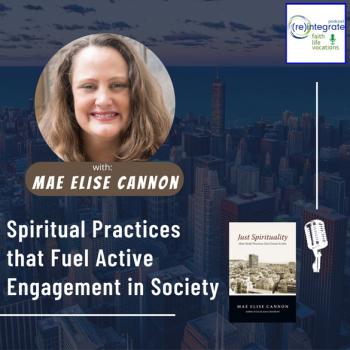
MAE ELISE CANNON: Spiritual Practices that Fuel Active...

Are "Intellectual Properties" Ruining Movies?
TRENDING AT PATHEOS Careers, Workplace and Religion

St. Francis by Bill Droel Pope Leo XIV declares 2026 as “Year...

Catholics are schooled in the faith by memorizing dogmatic points and lots...

The Good News of Our Human Limitations -...
After another day of trying to meet deadlines and working on projects,...

Quiet Holy Attentiveness (podcast) with Sarah Clarkson
We know that quiet is an essential aspect of the spiritual life,...

Every Vocation Everywhere All At Once
What is a vocation? How does it endure through the years? Can...

I promise this is not going to become a Taylor Swift Studies...
view all Careers, Workplace and Religion blogs
Ad-Free & Subscriber Log-In Subscription Support
- About Us
- 2026 Calendar
- Videos
- Podcasts
- Library of World Religions
- Faith In Media Tracker
- Advertise With Us
- Write for Us
- Privacy Policy
- Terms of Service
- Do Not Sell My Data
- Contact Us
- Radiant Digital
- Manage Newsletter Subscriptions
- Unsubscribe From Notifications
- Sitemap
Copyright 2008-2026, Patheos. All rights reserved.
Subscription Support Ad-Free & Subscriber Log-In
Follow Patheos