
BuddhistCatholicContemplativeEvangelicalGeneral ChristianHinduJewishLatter-day SaintMuslimNew VisionsProgressive Christian
Beliefs
- Buddhist
- Catholic
- Contemplative
- Evangelical
- General Christian
- Hindu
- Jewish
- Latter-day Saint
- More Voices
- Muslim
- New Visions
- Pagan
- Progressive Christian
Topics
- Religion News
- Food and Religion
- Sports and Religion
- Religious Art
- Religious Music and Entertainment
- Religious Events
- History and Religion
- Style and Religion
- Politics and Religion
- Women in Religion
- Recreation Outdoors and Religion
- Business Finance and Religion
- Careers Workplace and Religion
- Education and Religion
- Family Parenting and Religion
- Health Fitness and Religion
- Home and Religion
- Relationships and Religion
- Technology and Religion
- Travel and Religion
Columnists
- Buddhist Columnists
- Business Finance and Religion Columnists
- Careers Workplace and Religion Columnists
- Catholic Columnists
- Contemplative Columnists
- Education and Religion Columnists
- Evangelists Columnists
- Family Parenting and Religion Columnists
- General Christian Columnists
- Health Fitness and Religion Columnists
- Hindu Columnists
- History and Religion Columnists
- Home and Religion Columnists
- Jewish Columnists
- More Voices Columnists
- Latter Day Columnists
- Muslim Columnists
- New Visions Columnists
- Nonreligious Columnists
- Pagan Columnists
- Politics and Religion Columnists
- Progressive Columnists
- Recreation Outdoors and Religion Columnists
- Relationships and Religion Columnists
- Religion News Columnists
- Religious Art Columnists
- Religious Events Columnists
- Religious Music and Entertainment Columnists
- Sports and Religion Columnists
- Style and Religion Columnists
- Technology and Religion Columnists
- Travel and Religion Columnists
- Women in Religion Columnists
Resource Library
- 2026 Calendar
- Library of World Religions
- The 100 Most Holy Places on Earth
- Patheos Answers
- Podcasts
- Videos
- Faith Leaders Database
- Anglican Episcopalian
- Bahai
- Baptist
- Buddhism
- Christianity
- Confucianism
- Eastern Orthodoxy
- Hinduism
- Holiness and Pentecostal
- ISKCON
- Islam
- Judaism
- Lutheran
- Methodist
- The Church of Jesus Christ of Latter-day Saints
- New Age
- Paganism
- Presbytarian and Reformed
- Protestantism
- Religion Behind the Scenes
- Roman Catholic
- Scientology
- Shia Islam
- Sikhism
- Sufism
- Sunni Islam
- Taoism
- Zen
- See all religions
Research Tools
 Ad-Free & Subscriber Log-In Subscription Support
Ad-Free & Subscriber Log-In Subscription Support
Follow Patheos 

- Trending:
- Forgiveness
- |
- Marriage
- |
- Consciousness
- |
- Death Penalty
- |
- Election
- |
- Halloween

- Home
- Careers, Workplace and Religion
- Art is Simply and Thoroughly Human
Art is Simply and Thoroughly Human
Last updated on: March 26, 2013 at 8:40 am by Bob Robinson
Art is Simply and Thoroughly Human 2013-03-26T08:40:18-04:00 Bob Robinson
Patheos Explore the world's faith through different perspectives on religion and spirituality! Patheos has the views of the prevalent religions and spiritualities of the world.
Cavin Seerveld, in his magnificent book, Rainbows for the Fallen World, makes the case that a Christian understanding of aesthetics must not succumb to the heresy of Plato’s theory of “Forms.” where the non-material abstract idea of “beauty” is the higher, idealistic spiritual reality while the material world is somehow inferior.
When we talk about art, we are talking about real, physical cultural artifacts – created by and for human beings in the real world, and they are aesthetically important not because they point to some non-material idea but because they are, in fact, material. Seerveld states,
“Poets are not sorcerers; musicians are not progeny of the legendary Orpheus and his ‘divine’ song. Artistic composition and performance is simply and thoroughly human, no matter how unusual it may seem to the workaday beholder.” (p. 26)
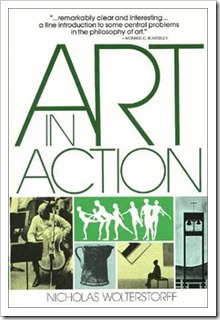 As Nicholas Wolterstorff states,
“Characteristic of many religions and philosophies, characteristic of Christianity at many points throughout history, is a devaluation of the physical side of God’s creation, a devaluation just because of its physicality.” (Art in Action: Toward a Christian Aesthetic (Grand Rapids, MI: Eerdmans, 1980), p. 69).
Wolterstorff itemizes several ways that the church has devalued the material creation, from those who hold that “spiritual values” are somehow superior to “material values,” to those who long for a future ideal nonphysical heavenly existence because they believe that a disembodied existence would somehow be superior to our earthly one.
“Every such form of devaluation flies in the face of God’s affirmation of His creation. The sheer physicality or materiality of something is never a legitimate ground for assigning to it a lower value in our lives.” (p. 69)
Human beings, in Wolterstorff’s words, are “earthlings among earthlings” –
“Earthly existence is one of God’s favors to us. When the Christian affirms the goodness of physical creation, he is not just praising its magnificence. He is saying that the physical creation is good for human beings. It serves human fulfillment. Earth is man’s home, the world his dwelling place.” (p. 72)
Human beings, however, are unique among the earthlings. What makes humans “uniquely unique” from the rest of God’s unique creatures is that God has given humanity a vocation and a purpose that is ours and ours alone. In Genesis, we read that God created humanity in the divine image and likeness:
Then God said, “Let us make mankind in our image, in our likeness, so that they may rule over the fish in the sea and the birds in the sky, over the livestock and all the wild animals, and over all the creatures that move along the ground.”
So God created mankind in his own image,
in the image of God he created them;
male and female he created them.
God blessed them and said to them, “Be fruitful and increase in number; fill the earth and subdue it. Rule over the fish in the sea and the birds in the sky and over every living creature that moves on the ground.” (Genesis 1:26-28, NIV)
God, the creator of all things, created humanity as one of the earthlings, but this earthling is created in theimage of God – which is tied directly with the calling on them to “be fruitful and increase in number, to fill the earth, and subdue it, to rule over the rest of creation as God’s “vice-regents.”
Genesis 2:15 gives us further insight into the vocation of humanity: “The Lord God took the man and put him into the garden of Eden to cultivate it and keep it.” (NASB)
The task of creating art, then, is yet one of many different manifestations of the human vocation of dominion and cultivation of God’s good creation. Art is one of the ways we can fulfill the creation mandate for humanity to take the raw resources of his good creation and to make something of it. Wolterstorff explains:
“It is not difficult to see how man’s vocation of master, of subduer, of humanizer of the world, of one who imposes order for the sake of benefitting mankind or honoring God, applies to the artist.” (p. 77)
![Seerveld-Rainbows[5]](https://www.re-integrate.org/wp-content/uploads/2013/03/Seerveld-Rainbows5.jpg) Calvin Seerveld helps us understand this even further:
Calvin Seerveld helps us understand this even further:
“Art is work, hard, bodily work that can legitimately be a man or woman’s vocation. We have to get past the idea inherited from pagan Greek society (and often compounded by pietism) that poetry takes less of a man’s energy and presence than work with the hands, or that dance is by definition more sensuous and useless than architecturally planning a barn or singing in the church choir. Art is always the act of a whole man or woman, and no matter what form it takes—colored shapes, pulsing tones, rhymed words, stylized gesture—if it be honestly done, the art embodies heart, soul, mind and strength of the artist as he or she responds knowingly to the world of God around him.” (Rainbows for the Fallen World, p. 27)
Seerveld cautions us to not place too much emphasis on art as “beauty,” but rather to think of art as simply another type of vocational work. It is special only in that it has the ability to create metaphor, to work as parable so that we can understand things from a different vantage point. “Art calls to our attention in capital, cursive letters, as it were, what usually flits by in reality as fine print.” (p. 27)
Art is a part of experiencing God’s good life aesthetically. Seerveld identifies the aesthetic life as “the ordinary human activity to be humored and to be merry, to indulge imagining things and to be playful.” (p. 49) Art is the result of humans using their imaginations for human flourishing.
In the New Dictionary of Theology, Seerveld states in his article on “Imagination in Theology,” that “human imagination is the source of metaphorical knowledge and the playfulness so important to anyone’s style of life. Imagination is meant to be an elementary, important, residual moment in everything God’s adopted children do.” (p. 331)
Earthlings enjoying being creative in the material world – this is a major part of what it means to be human.
Image by vigo74. Used with permission. Sourced via Flickr.
Previous Post

March 21, 2013
“We Had Fun”: Living into God's Shalom
Next Post
March 26, 2013 Dallas Willard - Finding God in Business
Browse Our Archives
Select a Category arts and entertainment audio/video bible / theology business church college community culture education faith family government/politics leadership media medicine podcast science & tech social sector tech Uncategorized work and calling
Select a Month November 2025 May 2025 October 2024 September 2024 June 2024 May 2024 April 2024 March 2024 February 2024 January 2024 December 2023 August 2023 July 2023 June 2023 May 2023 April 2023 March 2023 February 2023 January 2023 December 2022 October 2022 August 2022 July 2022 June 2022 April 2022 March 2022 February 2022 January 2022 December 2021 November 2021 October 2021 August 2021 June 2021 May 2021 April 2021 March 2021 February 2021 January 2021 December 2020 October 2020 September 2020 August 2020 July 2020 June 2020 May 2020 March 2020 February 2020 January 2020 November 2019 October 2019 September 2019 July 2019 May 2019 April 2019 March 2019 February 2019 January 2019 December 2018 July 2018 May 2018 April 2018 March 2018 July 2017 April 2017 March 2017 February 2017 November 2016 September 2016 August 2016 May 2016 April 2016 March 2016 February 2016 January 2016 December 2015 November 2015 October 2015 September 2015 August 2015 July 2015 June 2015 May 2015 April 2015 January 2015 December 2014 November 2014 October 2014 September 2014 August 2014 July 2014 June 2014 May 2014 April 2014 March 2014 February 2014 January 2014 December 2013 November 2013 October 2013 September 2013 August 2013 July 2013 June 2013 May 2013 April 2013 March 2013 February 2013 January 2013 December 2012 November 2012 October 2012 September 2012 August 2012
Follow Us!
TAKE THE
Religious Wisdom Quiz
Who led the Israelites into the promised land after Moses?
Select your answer to see how you score.
Solomon David Samuel Joshua
Related posts from (re)integrate

JOSH LARSEN - Enjoying Movies at a Deeper...

RICHARD VANCE GOODWIN - Experiencing God at the...

Are "Intellectual Properties" Ruining Movies?
Our Creativity is a Key to our Spirituality...
TRENDING AT PATHEOS Careers, Workplace and Religion

St. Francis by Bill Droel Pope Leo XIV declares 2026 as “Year...

Catholics are schooled in the faith by memorizing dogmatic points and lots...

The Good News of Our Human Limitations -...
After another day of trying to meet deadlines and working on projects,...

Quiet Holy Attentiveness (podcast) with Sarah Clarkson
We know that quiet is an essential aspect of the spiritual life,...

Every Vocation Everywhere All At Once
What is a vocation? How does it endure through the years? Can...

I promise this is not going to become a Taylor Swift Studies...
view all Careers, Workplace and Religion blogs
Ad-Free & Subscriber Log-In Subscription Support
- About Us
- 2026 Calendar
- Videos
- Podcasts
- Library of World Religions
- Faith In Media Tracker
- Advertise With Us
- Write for Us
- Privacy Policy
- Terms of Service
- Do Not Sell My Data
- Contact Us
- Radiant Digital
- Manage Newsletter Subscriptions
- Unsubscribe From Notifications
- Sitemap
Copyright 2008-2026, Patheos. All rights reserved.
Subscription Support Ad-Free & Subscriber Log-In
Follow Patheos