
BuddhistCatholicContemplativeEvangelicalGeneral ChristianHinduJewishLatter-day SaintMuslimNew VisionsProgressive Christian
Beliefs
- Buddhist
- Catholic
- Contemplative
- Evangelical
- General Christian
- Hindu
- Jewish
- Latter-day Saint
- More Voices
- Muslim
- New Visions
- Pagan
- Progressive Christian
Topics
- Religion News
- Food and Religion
- Sports and Religion
- Religious Art
- Religious Music and Entertainment
- Religious Events
- History and Religion
- Style and Religion
- Politics and Religion
- Women in Religion
- Recreation Outdoors and Religion
- Business Finance and Religion
- Careers Workplace and Religion
- Education and Religion
- Family Parenting and Religion
- Health Fitness and Religion
- Home and Religion
- Relationships and Religion
- Technology and Religion
- Travel and Religion
Columnists
- Buddhist Columnists
- Business Finance and Religion Columnists
- Careers Workplace and Religion Columnists
- Catholic Columnists
- Contemplative Columnists
- Education and Religion Columnists
- Evangelists Columnists
- Family Parenting and Religion Columnists
- General Christian Columnists
- Health Fitness and Religion Columnists
- Hindu Columnists
- History and Religion Columnists
- Home and Religion Columnists
- Jewish Columnists
- More Voices Columnists
- Latter Day Columnists
- Muslim Columnists
- New Visions Columnists
- Nonreligious Columnists
- Pagan Columnists
- Politics and Religion Columnists
- Progressive Columnists
- Recreation Outdoors and Religion Columnists
- Relationships and Religion Columnists
- Religion News Columnists
- Religious Art Columnists
- Religious Events Columnists
- Religious Music and Entertainment Columnists
- Sports and Religion Columnists
- Style and Religion Columnists
- Technology and Religion Columnists
- Travel and Religion Columnists
- Women in Religion Columnists
Resource Library
- 2026 Calendar
- Library of World Religions
- The 100 Most Holy Places on Earth
- Patheos Answers
- Podcasts
- Videos
- Faith Leaders Database
- Anglican Episcopalian
- Bahai
- Baptist
- Buddhism
- Christianity
- Confucianism
- Eastern Orthodoxy
- Hinduism
- Holiness and Pentecostal
- ISKCON
- Islam
- Judaism
- Lutheran
- Methodist
- The Church of Jesus Christ of Latter-day Saints
- New Age
- Paganism
- Presbytarian and Reformed
- Protestantism
- Religion Behind the Scenes
- Roman Catholic
- Scientology
- Shia Islam
- Sikhism
- Sufism
- Sunni Islam
- Taoism
- Zen
- See all religions
Research Tools
 Ad-Free & Subscriber Log-In Subscription Support
Ad-Free & Subscriber Log-In Subscription Support
Follow Patheos 

- Trending:
- Forgiveness
- |
- Marriage
- |
- Consciousness
- |
- Death Penalty
- |
- Election
- |
- Halloween

- Home
- Careers, Workplace and Religion
- Anna Karenina and the Reality of Marriage
Anna Karenina and the Reality of Marriage
Last updated on: November 30, 2012 at 9:27 am by Dr. Steven Garber
Anna Karenina and the Reality of Marriage 2012-11-30T09:27:13-04:00 Dr. Steven Garber
Patheos Explore the world's faith through different perspectives on religion and spirituality! Patheos has the views of the prevalent religions and spiritualities of the world.
“Don’t leave your brains at the box-office.”
They are words that I try live by, hard as it is. Having a lifelong love for movies, all the way back to the Varsity Theater in Davis, CA for Saturday morning matinees when I was a little boy, I have spent hours of my life setting in one more time to a good story, cinematically-told.
Along the way I met Donald Drew (author of Images of Man: A Critique of the Contemporary Cinema), who one day brought me with him to see a film, and he took out of his pocket a piece of paper and a pen. I asked him, and he said, “We don’t leave our brains at the box-office, do we?” Not arrogantly, not superciliously, but simply, straightforwardly explaining that he was going to think carefully and critically about what we were going to see. He caught my heart, and I have been trying to do that ever since. Donald has taught me much.
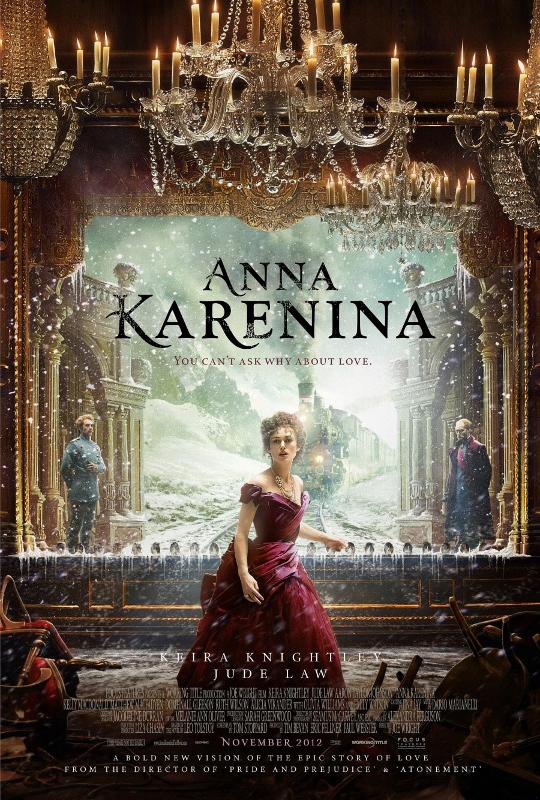 Which brings me to the film, “Anna Karenina,” which some in our family saw the other day. Even the afternoon matinee was completely packed out, which was intriguing. I had read a few reviews and knew something of the theatrical treatment of the story, but given that I think Tolstoy’s tale of two marriages is one of the best books ever written, I was up for seeing it afresh. William Faulkner said of the story that it was “the best ever written.” Not a small thing.
For its two-plus hours, it is wonderfully-done: beautifully-imagined, well-acted, tenderly-told, and when it was all over I was pleased. There is no way that the complexity and nuance of the novel could be captured in a film. So the director and the screenwriter are making choices, for good or not, about how to the tell the story in a way that is fair, but is at the same time their own work of art too. I get that, and honor that.
But there was a false note.
Both Meg and I noticed, but didn’t talk about it until we were walking down the street. At the heart Tolstoy’s “Anna” is a Russian novel-length study of the moral meaning of marriage. We are offered two stories, two marriages twined together, Anna and Alexei Karenina, and Konstantin and Kitty Levin. Because of the grandeur of Tolstoy’s vision and skill, we are offered many windows into the lives of these four people. Over time, and the novel does take time, we begin to know them, as we see ourselves, and our family and friends in them.
As Walker Percy never tires of reminding me, “Bad books always lie. They lie most of all about the human condition.” Tolstoy’s tale is a good book, a very good book, and is so because at its heart it tells the truth about us, human beings that we are.
There is a conversation between Anna and Dolly, her sister-in-law, long into Anna’s adultery with Vronsky. Anna wants to know what she thinks. The conversation that takes place represents a fantasy and fiction, not the world that is really there, or the one that Tolstoy offers in the novel. The film’s Dolly responds that she “wishes that she was as brave” as Anna, and sighs over her lack of courage to be unfaithful to her vows too, viz. she had not committed adultery because “no one has asked me.” I remember wincing, knowing Tolstoy well, and knowing the novel well, thinking, “I don’t think so.”
And so I came home, and this afternoon began searching through the novel, wondering if I could find the conversation. I did. In Part Six, there are several chapters given to Anna speaking to her sister-in-law Dolly “of several matters near her heart.” Knowing what we know of Anna at this point, and of Dolly, we know that Anna has a well-developed practice of hearing what she wants to hear, of knowing what she wants to know. “As if she half-shut her eyes to own life, so as to not see everything.” Most and especially about the moral meaning of marriage.
Moral meaning is about reality. About the world we actually live in– not pre-modern/modern/post-modern imaginative leaps into worlds that do not exist because they cannot exist. That is, unless we choose to so skew ourselves and the world around us, pretending that we are really different than we can possibly be. Some kinds of loves only destroy, both souls and societies, in the world that is really there.
And in the world that really is, Dollys do not say to Annas, “I wish that I was as brave as you… languishing as you are, in torment as you are, full of sorrow as you are.” The only people who say things like that are people lying to themselves about themselves, the Annas of Tolstoy, people who “half-shut” the eyes of their hearts “so as not to see everything.” Like the truth of the human condition, sons of Adam and daughters of Eve that we are. As my all-time favorite Esquire magazine essay once put it, “If you want frustration, guilt, and anxiety, try adultery.” Always, for everyone everywhere.
It is why we should not leave our brains at the box-office.

Previous Post

November 29, 2012
The Christian Life is a Peach, Not an Orange
Next Post
December 4, 2012 "How Are Our Lives Different at Church and at Work?" - Doug Barr
Browse Our Archives
Select a Category arts and entertainment audio/video bible / theology business church college community culture education faith family government/politics leadership media medicine podcast science & tech social sector tech Uncategorized work and calling
Select a Month November 2025 May 2025 October 2024 September 2024 June 2024 May 2024 April 2024 March 2024 February 2024 January 2024 December 2023 August 2023 July 2023 June 2023 May 2023 April 2023 March 2023 February 2023 January 2023 December 2022 October 2022 August 2022 July 2022 June 2022 April 2022 March 2022 February 2022 January 2022 December 2021 November 2021 October 2021 August 2021 June 2021 May 2021 April 2021 March 2021 February 2021 January 2021 December 2020 October 2020 September 2020 August 2020 July 2020 June 2020 May 2020 March 2020 February 2020 January 2020 November 2019 October 2019 September 2019 July 2019 May 2019 April 2019 March 2019 February 2019 January 2019 December 2018 July 2018 May 2018 April 2018 March 2018 July 2017 April 2017 March 2017 February 2017 November 2016 September 2016 August 2016 May 2016 April 2016 March 2016 February 2016 January 2016 December 2015 November 2015 October 2015 September 2015 August 2015 July 2015 June 2015 May 2015 April 2015 January 2015 December 2014 November 2014 October 2014 September 2014 August 2014 July 2014 June 2014 May 2014 April 2014 March 2014 February 2014 January 2014 December 2013 November 2013 October 2013 September 2013 August 2013 July 2013 June 2013 May 2013 April 2013 March 2013 February 2013 January 2013 December 2012 November 2012 October 2012 September 2012 August 2012
Follow Us!
TAKE THE
Religious Wisdom Quiz
What did God put in Isaiah's mouth in his vision to cleanse his lips?
Select your answer to see how you score.
Honey A burning coal A scroll Oil
Related posts from (re)integrate

Submitting to Husbands? Ephesians with Dr. Lynn Cohick

SCOT MCKNIGHT - Rethinking Revelation (podcast)

JOSH LARSEN - Enjoying Movies at a Deeper...
MAE ELISE CANNON: Spiritual Practices that Fuel Active...
TRENDING AT PATHEOS Careers, Workplace and Religion

St. Francis by Bill Droel Pope Leo XIV declares 2026 as “Year...

Catholics are schooled in the faith by memorizing dogmatic points and lots...

The Good News of Our Human Limitations -...
After another day of trying to meet deadlines and working on projects,...

Quiet Holy Attentiveness (podcast) with Sarah Clarkson
We know that quiet is an essential aspect of the spiritual life,...

Every Vocation Everywhere All At Once
What is a vocation? How does it endure through the years? Can...

I promise this is not going to become a Taylor Swift Studies...
view all Careers, Workplace and Religion blogs
Ad-Free & Subscriber Log-In Subscription Support
- About Us
- 2026 Calendar
- Videos
- Podcasts
- Library of World Religions
- Faith In Media Tracker
- Advertise With Us
- Write for Us
- Privacy Policy
- Terms of Service
- Do Not Sell My Data
- Contact Us
- Radiant Digital
- Manage Newsletter Subscriptions
- Unsubscribe From Notifications
- Sitemap
Copyright 2008-2026, Patheos. All rights reserved.
Subscription Support Ad-Free & Subscriber Log-In
Follow Patheos