
BuddhistCatholicContemplativeEvangelicalGeneral ChristianHinduJewishLatter-day SaintMuslimNew VisionsProgressive Christian
Beliefs
- Buddhist
- Catholic
- Contemplative
- Evangelical
- General Christian
- Hindu
- Jewish
- Latter-day Saint
- More Voices
- Muslim
- New Visions
- Pagan
- Progressive Christian
Topics
- Religion News
- Food and Religion
- Sports and Religion
- Religious Art
- Religious Music and Entertainment
- Religious Events
- History and Religion
- Style and Religion
- Politics and Religion
- Women in Religion
- Recreation Outdoors and Religion
- Business Finance and Religion
- Careers Workplace and Religion
- Education and Religion
- Family Parenting and Religion
- Health Fitness and Religion
- Home and Religion
- Relationships and Religion
- Technology and Religion
- Travel and Religion
Columnists
- Buddhist Columnists
- Business Finance and Religion Columnists
- Careers Workplace and Religion Columnists
- Catholic Columnists
- Contemplative Columnists
- Education and Religion Columnists
- Evangelists Columnists
- Family Parenting and Religion Columnists
- General Christian Columnists
- Health Fitness and Religion Columnists
- Hindu Columnists
- History and Religion Columnists
- Home and Religion Columnists
- Jewish Columnists
- More Voices Columnists
- Latter Day Columnists
- Muslim Columnists
- New Visions Columnists
- Nonreligious Columnists
- Pagan Columnists
- Politics and Religion Columnists
- Progressive Columnists
- Recreation Outdoors and Religion Columnists
- Relationships and Religion Columnists
- Religion News Columnists
- Religious Art Columnists
- Religious Events Columnists
- Religious Music and Entertainment Columnists
- Sports and Religion Columnists
- Style and Religion Columnists
- Technology and Religion Columnists
- Travel and Religion Columnists
- Women in Religion Columnists
Resource Library
- 2026 Calendar
- Library of World Religions
- The 100 Most Holy Places on Earth
- Patheos Answers
- Podcasts
- Videos
- Faith Leaders Database
- Anglican Episcopalian
- Bahai
- Baptist
- Buddhism
- Christianity
- Confucianism
- Eastern Orthodoxy
- Hinduism
- Holiness and Pentecostal
- ISKCON
- Islam
- Judaism
- Lutheran
- Methodist
- The Church of Jesus Christ of Latter-day Saints
- New Age
- Paganism
- Presbytarian and Reformed
- Protestantism
- Religion Behind the Scenes
- Roman Catholic
- Scientology
- Shia Islam
- Sikhism
- Sufism
- Sunni Islam
- Taoism
- Zen
- See all religions
Research Tools
 Ad-Free & Subscriber Log-In Subscription Support
Ad-Free & Subscriber Log-In Subscription Support
Follow Patheos 

- Trending:
- Forgiveness
- |
- Marriage
- |
- Consciousness
- |
- Death Penalty
- |
- Election
- |
- Halloween

- Home
- Jewish
- History and Religion
- The Search for Monotheism
The Search for Monotheism
Last updated on: June 22, 2026 at 10:53 pm by Rebecca Wallace Keene
The Search for Monotheism 2026-06-22T22:53:09-04:00 Rebecca Wallace Keene
Patheos Explore the world's faith through different perspectives on religion and spirituality! Patheos has the views of the prevalent religions and spiritualities of the world.
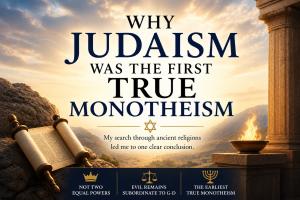
Search for Monotheism
My search for monotheism has spanned many years. That search led me through the religions of the ancient world in pursuit of monotheism’s earliest roots. Such a search often leads scholars back to ancient Persia and Zoroastrianism. This is because of the religion’s purported influence on Judaism and Christianity. However, as I study those influences and Zoroastrianism, it has become clear that Judaism was the first truly monotheistic religion.
Zoroastrian Influence
It is true that there appears to have been some influence from Zoroastrianism on Judaism. Scholars point to similarities on topics such as an afterlife, good versus evil, and angels and demons. The Jewish Encyclopedia explains:
“The points of resemblance between Zoroastrianism and Judaism, and hence also between the former and Christianity, are many and striking. Ahuramazda, the supreme lord of Iran, omniscient, omnipresent, and eternal, endowed with creative power, which he exercises especially through the medium of his Spenta Mainyu (“Holy Spirit”), and governing the universe through the instrumentality of angels and archangels, presents the nearest parallel to Yhwh that is found in antiquity. But Ormuzd’s power is hampered by his adversary, Ahriman, whose dominion, however, like Satan’s, shall be destroyed at the end of the world.”
Search for Monotheism in Exile
This is because the Jewish people were exposed to Zoroastrianism during their exile in Babylon. Hannah M. G. Shapero argued, “It was during the end of the Exile, among the Jews now living in the Persian Empire, that the first significant contact was made between the Jewish and Iranian cultures. And it is evident in the Bible that Jewish thinking changed after the Exile.” However, Judaism ultimately came to a much different conclusion than Zoroastrianism.
True Monotheism vs Dualism
The biggest difference lies in the nature of good and evil. In Judaism, evil is never a force equal to G-d. Even by Jews who believe in satan as a literal entity, he never has equal footing in the world with G-d. satan remains subordinate to G-d’s will. Nothing in creation possesses power equal to the Creator. It is this refusal to grant ultimate authority to any force other than G-d that, in my view, marks the beginning of true monotheism. Thus, the search for monotheism does not lead back to ancient Persia, but to ancient Israel.
Good vs Evil
Zoroastrianism is more of a dualistic religion with a focus on two equal deities, one of good and of evil. The Jewish Encyclopedia notes, “Ahuramazda, or Ormuzd (“the Wise Lord”), leads the forces of good; Angra-Mainyu, or Ahriman (“the Spiritual Enemy”), heads the hosts of evil. Bands of angels and archangels follow the divine leader, while troops of demons and archfiends hasten after the evil lord.” Judaism, however, is much more monotheistic in that satan never becomes a true adversary of G-d. He remains under G-d’s will. Thinking Torah explains, “The satan operates in the world in various aspects. He is able to seduce a person and then accuse that person of sinning. However, his actions are all constrained by the permission granted to him by God.”
satan As a Metaphor
Further, much of modern Judaism often views the idea of satan as a metaphor. Judaism does not see satan as an actual deity competing with G-d. Learning Religions states, “In Judaism “satan” is not a sentient being but a metaphor for the evil inclination – the yetzer hara – that exists in every person and tempts us to do wrong.” While some Jews may carry the belief that an adversary named satan and demons exist, that is not the most common interpretation. In fact, ha-satan, or the satan, which is the term most often used to describe a sentient being satan, appears only three times in The Torah as stated by Thinking Torah.
Search for Monotheism Ends with Judaism
My search ultimately ended with Judaism because it alone maintained that evil, however powerful it may appear, remains subordinate to the will of G-d. Zoroastrianism’s dualistic nature, in my view, disqualifies it as a true monotheism. Though Judaism may have been influenced by the ancient Persian religion, it is the first religion that refused to give anything authority equal to G-d’s. Learning Religions explains, “In conclusion, Judaism is so strictly monotheistic that the rabbis resisted the temptation to characterize anyone other than God with authority.” Thus, it is Judaism where we find the earliest monotheistic religion.
Editor’s note: The word satan is not capitalized intentionally. This is a theological argument that he is not equal to G-d.
General Christian
Politics and Religion

About Rebecca Keene
The author, Rebecca Keene, has a Bachelor of Science in Psychology and Religion. She graduated from the University of Pikeville as Religion Honor Student in 2014. Currently, she is studying for a MA in Women, Gender, Spirituality, and Social Justice at the California Institute of Integral Studies. Also, Rebecca is the author of FAITH UNDER THE RAINBOW: RECLAIMING THE TRUTH ABOUT HOMOSEXUALITY AND THE BIBLE. In addition, she founded and independently runs the social media community, Reclaiming the Truth. Therefore, you should visit Rebecca's author page and purchase her books at: Amazon Author Page or: Publication Page Rebecca is currently in her 3rd year of Kabbalah study. She is ordained to perform LGBT weddings and is certified in Hypnotherapy. Rebecca lives in Kentucky with her two adult children. She practices Non-Denominational Judaism. She is passionate about social justice and fiercely advocates for the marginalized in society and religion. When not with her children or writing, Rebecca enjoys spending time in nature, with G-d, or in a good book. She also enjoys making and selling art which you can find at Art by Rebecca. Rebecca will try to answer all correspondence, but please be patient, as life is busy for us all. You can read more about the author here.
Previous Post

June 17, 2026
Words Are Power: Taking Back the Language of Israel
Next Post

June 30, 2026 Sodom and Gomorrah: Why This Story Isn't About Homosexuality
Browse Our Archives
Select a Category Abortion Appalachia Arks of the Covenant Bible Christianity Christmas conversion Cosmology Creation Curses demons Dietry Laws Easter Ecology Eden Egypt family Gender Gender equality Genesis Hannukah Hell Holidays Holocaust homosexuality Hospitality Code Hygiene Idolatry Immigration Islam Israel Jacob Jesus Jewish law Jewish/Christian Relations Job Lilith Lost Books Love marriage martyr New Testament parenting Passover Peace pedophilia Politics Prayer proof Purim quran rape reviews Rosh Hashanah Sabbath Science sex laws sexuality slavery Synagogue technology Torah transgender Uncategorized War witch women worship Yom Kippur
Select a Month October 2026 September 2026 August 2026 July 2026 June 2026 March 2026 February 2026 September 2024 August 2024 July 2024 June 2024 April 2024 March 2024 February 2024 January 2024 November 2023 October 2023 September 2023 August 2023 July 2023 June 2023 May 2023 April 2023 March 2023 February 2023
Follow Us!
TAKE THE
Religious Wisdom Quiz
Who was Melchizedek?
Select your answer to see how you score.
An angel A prophet A Roman official A priest and king
Related posts from Reclaiming the Truth

Spooky Judaism: Did Adam Father Demons?


The Ark of The Covenant: All Roads Lead...

Two Arks of the Covenant? The Ancient Case...
TRENDING AT PATHEOS Jewish

I was strolling through the top floor of the brand new Parthenon...

What Does Gêvâh Mean For Kimberley Guifoyle &...
This week, a lot of the news is focused on Kimberly Guilfoyle....

INNER CIRCLE: Profound Mystery (Of Christ In All...
Ephesians 5:31-32 “For this reason, a man will leave his father and...

Do Not Rejoice When Your Enemy Falls: The...
Turning an execution into a public spectacle is a disturbing expression of...

'The Chosen' S6 Trailer: The Passion Gets Very...
Not many watching 'The Chosen' worry about spoilers, but just because they...

The purpose-driven labor priest
A labor activist reads Rick Warren and it gets me wondering about...
view all Jewish blogs
Ad-Free & Subscriber Log-In Subscription Support
- About Us
- 2026 Calendar
- Videos
- Podcasts
- Library of World Religions
- Faith In Media Tracker
- Advertise With Us
- Write for Us
- Privacy Policy
- Terms of Service
- Do Not Sell My Data
- Contact Us
- Radiant Digital
- Manage Newsletter Subscriptions
- Unsubscribe From Notifications
- Sitemap
Copyright 2008-2026, Patheos. All rights reserved.
Subscription Support Ad-Free & Subscriber Log-In
Follow Patheos