
BuddhistCatholicContemplativeEvangelicalGeneral ChristianHinduJewishLatter-day SaintMuslimNew VisionsProgressive Christian
Beliefs
- Buddhist
- Catholic
- Contemplative
- Evangelical
- General Christian
- Hindu
- Jewish
- Latter-day Saint
- More Voices
- Muslim
- New Visions
- Pagan
- Progressive Christian
Topics
- Religion News
- Food and Religion
- Sports and Religion
- Religious Art
- Religious Music and Entertainment
- Religious Events
- History and Religion
- Style and Religion
- Politics and Religion
- Women in Religion
- Recreation Outdoors and Religion
- Business Finance and Religion
- Careers Workplace and Religion
- Education and Religion
- Family Parenting and Religion
- Health Fitness and Religion
- Home and Religion
- Relationships and Religion
- Technology and Religion
- Travel and Religion
Columnists
- Buddhist Columnists
- Business Finance and Religion Columnists
- Careers Workplace and Religion Columnists
- Catholic Columnists
- Contemplative Columnists
- Education and Religion Columnists
- Evangelists Columnists
- Family Parenting and Religion Columnists
- General Christian Columnists
- Health Fitness and Religion Columnists
- Hindu Columnists
- History and Religion Columnists
- Home and Religion Columnists
- Jewish Columnists
- More Voices Columnists
- Latter Day Columnists
- Muslim Columnists
- New Visions Columnists
- Nonreligious Columnists
- Pagan Columnists
- Politics and Religion Columnists
- Progressive Columnists
- Recreation Outdoors and Religion Columnists
- Relationships and Religion Columnists
- Religion News Columnists
- Religious Art Columnists
- Religious Events Columnists
- Religious Music and Entertainment Columnists
- Sports and Religion Columnists
- Style and Religion Columnists
- Technology and Religion Columnists
- Travel and Religion Columnists
- Women in Religion Columnists
Resource Library
- 2026 Calendar
- Library of World Religions
- The 100 Most Holy Places on Earth
- Patheos Answers
- Podcasts
- Videos
- Faith Leaders Database
- Anglican Episcopalian
- Bahai
- Baptist
- Buddhism
- Christianity
- Confucianism
- Eastern Orthodoxy
- Hinduism
- Holiness and Pentecostal
- ISKCON
- Islam
- Judaism
- Lutheran
- Methodist
- The Church of Jesus Christ of Latter-day Saints
- New Age
- Paganism
- Presbytarian and Reformed
- Protestantism
- Religion Behind the Scenes
- Roman Catholic
- Scientology
- Shia Islam
- Sikhism
- Sufism
- Sunni Islam
- Taoism
- Zen
- See all religions
Research Tools
 Ad-Free & Subscriber Log-In Subscription Support
Follow Patheos 

- Trending:
- Advent
- |
- Forgiveness
- |
- Thanksgiving
- |
- Election
- |
- Seasonal Holidays
- |
- Marriage

- Home
- Jewish
- History and Religion
- Ancient Egypt as a Setting and Theme in Jewish Literature
Ancient Egypt as a Setting and Theme in Jewish Literature
Last updated on: August 9, 2023 at 1:38 pm by Rebecca Wallace Keene
Ancient Egypt as a Setting and Theme in Jewish Literature 2023-08-09T13:38:32-04:00 Rebecca Wallace Keene
Patheos Explore the world's faith through different perspectives on religion and spirituality! Patheos has the views of the prevalent religions and spiritualities of the world.
Ancient Egypt as a Setting and Theme in Jewish Literature
We take a break from The Women In The Bible Series to hear from our guest blogger Joseph Parks. Joseph will be teaching us about Ancient Egypt as a setting and theme in Jewish literature. Please stay tuned for the continuation of The Women in The Bible Series next week.
Ancient Egypt and the Bible Series
Article 2 – Ancient Egypt as a Setting and Theme in Ancient Jewish Literature
Joseph DeWayne Parks RN, BSN
July 30, 2023
How Israel Viewed Ancient Egypt
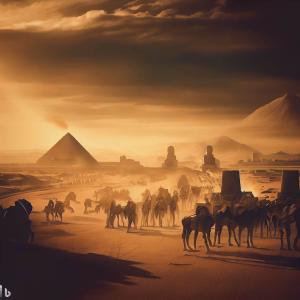
Before we go on to discuss the historicity of the Bible’s accounts of ancient Egypt, let’s review the way Egypt would have been viewed by the ancient Israelites. Egypt would have been viewed as both a literary setting and a source of the ongoing theme of oppression and liberation in ancient Jewish literature. The ancient Israelites would have been able to see ancient Egypt in a similar way to the way we do in the modern world. They would have seen Egypt as a rich, powerful, and culturally influential empire that existed in North Africa alongside the world’s longest river and inside the world’s largest desert.
The Great Pyramid of Khufu at Giza and many other structures would have been as ancient and mysterious to the authors of the Bible as it would have been in the eyes of other visitors: from the Romans under Caesar to the French under Napoleon. However, what did the writers of the Bible think about Egypt, when using it as a setting for the biblical narrative?
Egypt’s Symbolic Meaning
When reading the Bible, it is important to remember that places mentioned in the text are not just real locations but also contain symbolic meaning. Frequently through world literature, a story’s geographical location and/or physical descriptions convey a stereotypical atmosphere, that therefore influences the meaning of the action done by the characters.
For example, in modern American literature, an author could use the city of Las Vegas as a setting for a story about the dangers of ‘immoral’ recreational activities, since Las Vegas is famous for its casinos, nightclubs, and strip clubs. Washington D.C. could be used as the setting for a story that revolves around corrupt politicians and government agencies, who use ‘good old American values’ as an excuse for treading upon the rights of those in need of help. In modern world literature and film, ancient Egypt has become the land of ancient mysteries ruled by kings who held vast amounts of wealth and power along with a pantheon of pagan gods. The god’s magical powers include the ability to raise the dead from their graves and have them seek revenge on the living who defiled sacred sites.
Ancient Egypt as a Setting and Theme in Jewish Literature
Let’s look at Egypt as it is depicted in ancient Jewish literature. Egypt is first introduced in the Bible as the place where Abraham and Sarah go to survive a famine, that is devastating Canaan. While in Egypt, Sarah is taken into the haram of the unnamed pharaoh ruling at that time, due to Abraham’s lies. God saves Sarah from this situation by sending a plague to Egypt which makes the pharaoh discover that Abraham had lied to him. Thus, Abraham and Sarah are kicked out of Egypt by the pharaoh, but they are given a large amount of wealth, in the forms of material goods, livestock, and slaves.
The next time Egypt is introduced is during the story of Joseph, at the end of the Book of Genesis. Joseph is sold into slavery in Egypt by his brothers. While in Egypt, Joseph goes through various ups and downs as an Egyptian slave. Eventually, he makes his way up the social ladder to the second most powerful position in the kingdom as the pharaoh’s grand vizier, thanks to God’s blessings. With news of Joseph still being alive, Jacob moves the Israelite tribes down into Egypt. There they live in prosperity, amongst the native Egyptians.
Sadly, the Book of Exodus starts with a new pharaoh coming to power who didn’t know Joseph. He decided to enslave the Israelites and treated them cruelly, through forced labor and infanticide. The oppression of the Israelites comes to an end with God sending Moses to confront the pharaoh, with a series of plagues. Then, G-d led the Israelites out of Egypt and into freedom in Canaan.
The Lessons Egypt Teaches Us In Jewish Literature
So, from the very earliest stories about Egypt in the Torah, ancient Jewish literature depicts Egypt as a dangerous place where people end up due to making bad choices. Eventually, they become victims of oppression and violence. However, Egypt is also seen as a place where God can perform miracles and deliver His people when they suffer under the yoke of foreign rule.
Following the events of Exodus, the Israelites are warned not to go back to Egypt or to imitate the customs and cultural practices of the ancient Egyptians. There are many examples found within the Book of Leviticus where the Israelites are commanded by God to not follow the practices of Egypt and Canaan and many of these practices include idolatry, magic, uttering curses, and performing sexually immoral acts such as incest.
Therefore, in all biblical stories that are set after the events of the Torah, going to Egypt or making an alliance with Egypt is supposed to be a big red warning sign of upcoming oppression and violence. King Solomon’s marriage to an unnamed Egyptian princess, along with other foreign noblewomen, led to King Solomon breaking the covenant with the Lord. This was done through the construction of pagan temples in Israel. King Solomon also began to act like an Egyptian pharaoh by enslaving Israel’s non-Israelite population and raising taxes on the Israelites. This was to allow him to have the physical labor and funding for his major construction projects.
Five years after the death of King Solomon, Pharaoh Shoshenq I of Egypt led a military campaign throughout the Divided Kingdoms of Israel and Judah. This was because of King Jeroboam I’s alliance with the pharaoh. The alliance was made to challenge King Rehoboam’s heavy taxes over the ten northern tribes.
The Warning
Many prophets like Isaiah would either warn Israelite kings to not form alliances with Egypt, make predictions of divine punishment against Egypt, or make references to the Exodus to remind the Israelites of their past. Even the anonymous poets, of the Book of Psalms, composed their creative retelling of the Book of Exodus to make the theme of oppression and liberation a common melody sung within the Temple. The imagery used by the biblical authors is clear. Egypt is a house of slavery, and the Israelites are to avoid it and its ways to maintain their freedom.
Please click this link and subscribe to the newsletter to be informed when new articles are published. Be sure to tune in next week when we continue our study of Women in The Bible.
General Christian
Education and Religion

About Joseph DeWayne Parks
Joseph DeWayne Parks is a registered nurse with a Bachelor’s Degree in Nursing Science from the University of Pikeville who is also working on becoming a psychiatric mental-health nurse practitioner through his studies at Northern Kentucky University. Despite coming from a medical background, Joseph has always had an interest in the study of ancient history, world cultures, and biblical studies. His personal studies have allowed him to learn 4 languages and how to provide holistic care to patients from different cultural and religious backgrounds. You can read more about the author here.
Previous Post

August 7, 2023
Rebekah: In Charge of Her Own Destiny
Next Post
August 14, 2023 Keturah: The Mother of Nations
Recent Comments
Browse Our Archives
Select a Category Abortion Appalachia Arks of the Covenant Bible Christianity Christmas conversion Cosmology Creation Curses demons Dietry Laws Easter Ecology Eden Egypt family Gender Gender equality Genesis Hannukah Hell Holidays Holocaust homosexuality Hospitality Code Hygiene Idolatry Immigration Islam Israel Jacob Jesus Jewish law Jewish/Christian Relations Job Lilith Lost Books Love marriage martyr New Testament parenting Passover Peace pedophilia Politics Prayer proof Purim quran rape reviews Rosh Hashanah Sabbath Science sex laws sexuality slavery Synagogue technology Torah transgender Uncategorized War witch women worship Yom Kippur
Select a Month November 2026 October 2026 September 2026 August 2026 July 2026 June 2026 March 2026 February 2026 September 2024 August 2024 July 2024 June 2024 April 2024 March 2024 February 2024 January 2024 November 2023 October 2023 September 2023 August 2023 July 2023 June 2023 May 2023 April 2023 March 2023 February 2023
Follow Us!
TAKE THE
Religious Wisdom Quiz
What structure did people build to try to reach heaven?
Select your answer to see how you score.
Ark Altar of Baal Temple of Solomon Tower of Babel
Related posts from Reclaiming the Truth
Has The Ark of The Covenant Been Seen...
Mary Not a Virgin? Why is Belief in...

How to See a Demon According to The...
TRENDING AT PATHEOS Jewish

Smart people saying smart things (11.24.26)
Please take time to listen to Perry Bacon, Sarah Posner, Adam Serwer,...

The Contingency of Our Technology
Last week we were hit with a raft of massive technology outages....

In 1939, President Franklin D. Roosevelt moved Thanksgiving from November 30 to...

Reasons for Restraint: Ricardo Gonzalez, Florida and Dec...
The Morning of January 3 I begin with the dead. On the...

I published this column for Thanksgiving 2012 in the Deseret News....

For many years, Catholicism has been caught up in division over the...
view all Jewish blogs
Ad-Free & Subscriber Log-In Subscription Support
- About Us
- 2026 Calendar
- Videos
- Podcasts
- Library of World Religions
- Faith In Media Tracker
- Advertise With Us
- Write for Us
- Privacy Policy
- Terms of Service
- Do Not Sell My Data
- Contact Us
- Radiant Digital
- Manage Newsletter Subscriptions
- Unsubscribe From Notifications
- Sitemap
Copyright 2008-2026, Patheos, part of the Radiant Digital network of media brands. All rights reserved.
Subscription Support Ad-Free & Subscriber Log-In
Follow Patheos