
BuddhistCatholicContemplativeEvangelicalGeneral ChristianHinduJewishLatter-day SaintMuslimNew VisionsProgressive Christian
Beliefs
- Buddhist
- Catholic
- Contemplative
- Evangelical
- General Christian
- Hindu
- Jewish
- Latter-day Saint
- More Voices
- Muslim
- New Visions
- Pagan
- Progressive Christian
Topics
- Religion News
- Food and Religion
- Sports and Religion
- Religious Art
- Religious Music and Entertainment
- Religious Events
- History and Religion
- Style and Religion
- Politics and Religion
- Women in Religion
- Recreation Outdoors and Religion
- Business Finance and Religion
- Careers Workplace and Religion
- Education and Religion
- Family Parenting and Religion
- Health Fitness and Religion
- Home and Religion
- Relationships and Religion
- Technology and Religion
- Travel and Religion
Columnists
- Buddhist Columnists
- Business Finance and Religion Columnists
- Careers Workplace and Religion Columnists
- Catholic Columnists
- Contemplative Columnists
- Education and Religion Columnists
- Evangelists Columnists
- Family Parenting and Religion Columnists
- General Christian Columnists
- Health Fitness and Religion Columnists
- Hindu Columnists
- History and Religion Columnists
- Home and Religion Columnists
- Jewish Columnists
- More Voices Columnists
- Latter Day Columnists
- Muslim Columnists
- New Visions Columnists
- Nonreligious Columnists
- Pagan Columnists
- Politics and Religion Columnists
- Progressive Columnists
- Recreation Outdoors and Religion Columnists
- Relationships and Religion Columnists
- Religion News Columnists
- Religious Art Columnists
- Religious Events Columnists
- Religious Music and Entertainment Columnists
- Sports and Religion Columnists
- Style and Religion Columnists
- Technology and Religion Columnists
- Travel and Religion Columnists
- Women in Religion Columnists
Resource Library
- 2026 Calendar
- Library of World Religions
- The 100 Most Holy Places on Earth
- Patheos Answers
- Podcasts
- Videos
- Faith Leaders Database
- Anglican Episcopalian
- Bahai
- Baptist
- Buddhism
- Christianity
- Confucianism
- Eastern Orthodoxy
- Hinduism
- Holiness and Pentecostal
- ISKCON
- Islam
- Judaism
- Lutheran
- Methodist
- The Church of Jesus Christ of Latter-day Saints
- New Age
- Paganism
- Presbytarian and Reformed
- Protestantism
- Religion Behind the Scenes
- Roman Catholic
- Scientology
- Shia Islam
- Sikhism
- Sufism
- Sunni Islam
- Taoism
- Zen
- See all religions
Research Tools
 Ad-Free & Subscriber Log-In Subscription Support
Ad-Free & Subscriber Log-In Subscription Support
Follow Patheos 

- Trending:
- Forgiveness
- |
- Marriage
- |
- Consciousness
- |
- Death Penalty
- |
- Election
- |
- Halloween
 Rebecca Florence Miller
- Home
- Evangelical
- Does the Bible Approve of the Sexual Violence in The Handmaid’s Tale?
Does the Bible Approve of the Sexual Violence in The Handmaid’s Tale?
Last updated on: April 28, 2017 at 9:52 am by Rebecca Florence Miller
Does the Bible Approve of the Sexual Violence in The Handmaid’s Tale? 2017-04-28T09:52:23-06:00 Rebecca Florence Miller
Patheos Explore the world's faith through different perspectives on religion and spirituality! Patheos has the views of the prevalent religions and spiritualities of the world.
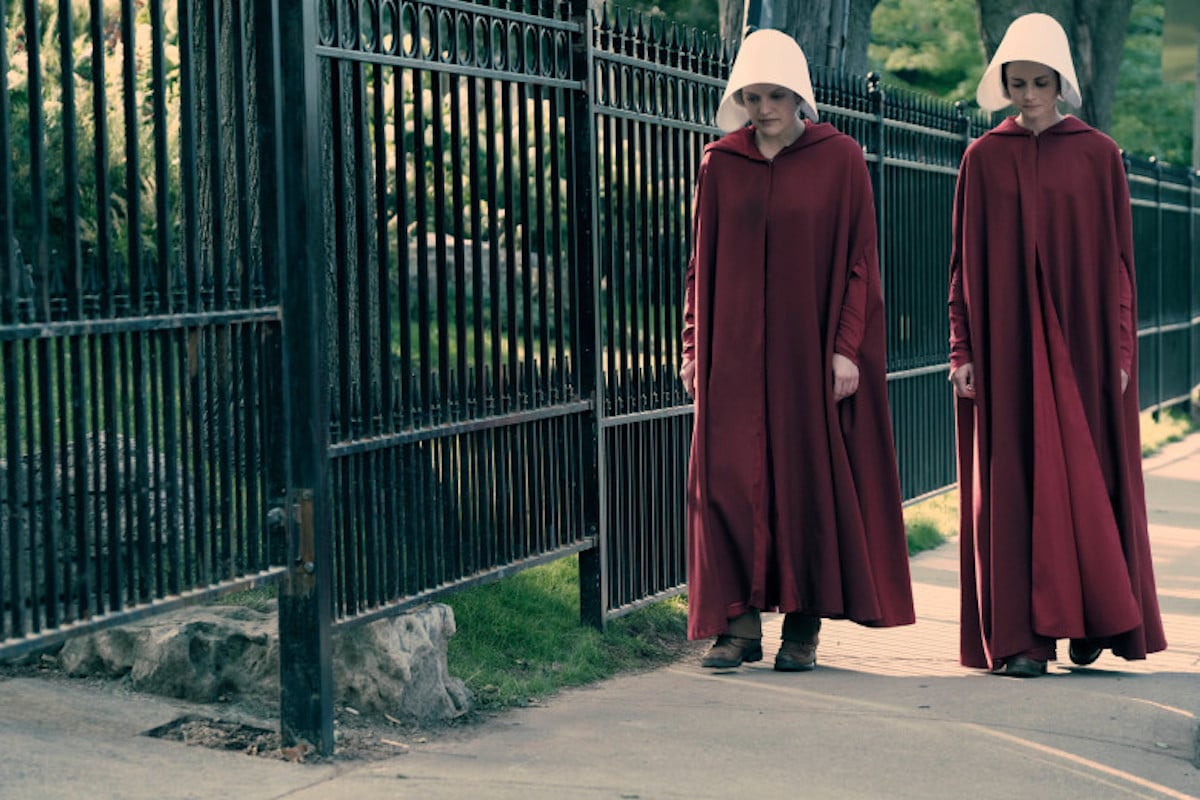 As I write, streaming service Hulu has just released the first three episodes of the much-anticipated, critically acclaimed adaptation of Margaret Atwood’s classic dystopian novel, The Handmaid’s Tale.
In this story, America has become a fundamentalist authoritarian state, Gilead.
The authoritarian state is established in response to the widespread national infertility of women, which is viewed as God’s judgment. In the desperation for offspring, Americans have yielded or had taken from them, all control over their lives. Women are forced into three classes—the wives, the handmaids (forced to bear children for the infertile wives), and the Marthas (charged with housekeeping and cooking). The justification that Gilead offers for the horrifying practice of using handmaids to produce babies for married men is drawn from Genesis 30, the story of Rachel and Leah.
As viewers watch the adaptation, they may believe the Bible condones this sexual violence. However, an honest reading of the biblical account reveals the exact opposite.
The Seeds of Dysfunction
To set the stage, Jacob has fled his family dysfunction due to parental favoritism, conflicts over the birthright inheritance, his own deception, and his brother’s murderous rage. The seeds of this family dysfunction stretch back at least as far as Abraham, a man who on two occasions engaged in deception and put his own wife at risk because of his fear and faithlessness.
Jacob flees his immediate family and runs to the extended family on his mother’s side—the family of his mother’s brother, Laban. Upon arriving, he falls in love with his cousin Rachel (yes, strange to our ears today, but keep in mind there were fewer people in that era, and culturally this was considered normal at the time) and agrees to work for his uncle for seven years in order to claim her hand in marriage. It appears to be a genuine love story. Genesis 29:20 reports, “So Jacob served seven years to get Rachel, but they seemed like only a few days to him because of his love for her” (NIV).
However, the deceiver Jacob (whose name, meaning “he grasps the heel,” was an idiom referring to one who deceives) now is deceived. What goes around comes around, as the saying goes. Under the cover of darkness, Laban gives a probably veiled Leah (Rachel’s older sister) to Jacob, corrupting what would have been a beautiful bond of monogamy. This is not portrayed as something God guided Laban to do, but as an unjust action against Jacob (and Rachel and Leah). Jacob only realizes what has happened after he consummates the marriage … and he is distraught. Laban, justifying his actions as looking out for the firstborn before the secondborn, agrees to give Rachel to Jacob as his wife after a week honeymoon with Leah, provided he agrees to work another seven years for Laban.
After Jacob is finally able to marry the woman he truly loves, he is plagued with a new problem: Rachel is infertile but Leah is able to bear children. Drawing on cultural traditions, not on God’s command (and that is key here), Rachel forces her maid Bilhah to sleep with Jacob and produce babies that she will regard as her own. Bilhah becomes a surrogate mother but has no agency to say yes or no to this demand. This heightens the dysfunctional competition between Leah and Rachel, and Leah now gives Jacob her maid, Zilpah, in order to produce even more children and beat her sister at her own game. Leah knows she is not loved, so having children and being better than Rachel at this one thing is all she has.
It is a terribly sad story; Jacob letting himself be pulled back and forth, giving in to these demands that run so far afield from God’s original intent for sex and marriage. The women, without agency, grasping the small bits of control they do have. The maids having absolutely no say in what is done to their bodies. A dysfunctional family system set up by the deception of Laban yields horrifying results.
Dysfunction in a family almost always traces back generations. All of us, whether we like admitting it or not, are affected by the decisions of our ancestors, those both far and near to us in time. And Jacob was no exception. Not only was his grandfather, Abraham, someone who had been guilty of cowardice and deception (as was Jacob’s mother, Rebekah), but his grandparents also engaged in the kind of forced surrogacy that Rachel and Leah imposed on their maids.
Previous Post

April 24, 2017
The Immorality of Profiting Off Opioid Addiction
Next Post

May 3, 2017 How White Conservatives Can Empathize with Black Americans' Distrust of Police
Browse Our Archives
Select a Category Books Charis Christian Witness Church Year Conversation Creativity Cultural Engagement Curiosity Current Events Film Jesus Lectionary Message Literature Lutheran Theology Politics Story Television Theology Uncategorized
Select a Month December 2017 November 2017 October 2017 September 2017 August 2017 July 2017 June 2017 May 2017 April 2017 March 2017 February 2017 December 2016 October 2016 August 2016 July 2016 June 2016 May 2016 April 2016 March 2016 February 2016 January 2016 December 2015 November 2015 October 2015 September 2015 August 2015 July 2015 June 2015 May 2015 April 2015 March 2015 February 2015 January 2015 December 2014 November 2014 October 2014
Follow Us!
TAKE THE
Religious Wisdom Quiz
Which letter encourages believers to "be quick to listen, slow to speak, and slow to anger"?
Select your answer to see how you score.
1 John 2 Peter James Romans
Related posts from Rebecca Florence Miller


An Interview with the Christian and Atheist Friends...

Our Response to Sexual Abuse Should Not Be...

Conflict and Challenge, instead of Cheap Grace
TRENDING AT PATHEOS Evangelical

The REST of Your Life: A Creative Wrestles...
This week I had a conversation with a good friend from church....

How the author of the world's best hymn...
I've been working with John Newton for a while now. This makes...

Long before this Lectio Divina, Psalm 130 - the song - started...

What About the Trees? Another Living Parable
After I finished writing the last article about falling leaves as a...

Why Classical Education Is a Conversation, Not a...
Come and Read: Joy in Classical Education When I was a little...

Cornell University has received a great deal of negative publicity and intense...
view all Evangelical blogs
Ad-Free & Subscriber Log-In Subscription Support
- About Us
- 2026 Calendar
- Videos
- Podcasts
- Library of World Religions
- Faith In Media Tracker
- Advertise With Us
- Write for Us
- Privacy Policy
- Terms of Service
- Do Not Sell My Data
- Contact Us
- Radiant Digital
- Manage Newsletter Subscriptions
- Unsubscribe From Notifications
- Sitemap
Copyright 2008-2026, Patheos. All rights reserved.
Subscription Support Ad-Free & Subscriber Log-In
Follow Patheos