
BuddhistCatholicContemplativeEvangelicalGeneral ChristianHinduJewishLatter-day SaintMuslimNew VisionsProgressive Christian
Beliefs
- Buddhist
- Catholic
- Contemplative
- Evangelical
- General Christian
- Hindu
- Jewish
- Latter-day Saint
- More Voices
- Muslim
- New Visions
- Pagan
- Progressive Christian
Topics
- Religion News
- Food and Religion
- Sports and Religion
- Religious Art
- Religious Music and Entertainment
- Religious Events
- History and Religion
- Style and Religion
- Politics and Religion
- Women in Religion
- Recreation Outdoors and Religion
- Business Finance and Religion
- Careers Workplace and Religion
- Education and Religion
- Family Parenting and Religion
- Health Fitness and Religion
- Home and Religion
- Relationships and Religion
- Technology and Religion
- Travel and Religion
Columnists
- Buddhist Columnists
- Business Finance and Religion Columnists
- Careers Workplace and Religion Columnists
- Catholic Columnists
- Contemplative Columnists
- Education and Religion Columnists
- Evangelists Columnists
- Family Parenting and Religion Columnists
- General Christian Columnists
- Health Fitness and Religion Columnists
- Hindu Columnists
- History and Religion Columnists
- Home and Religion Columnists
- Jewish Columnists
- More Voices Columnists
- Latter Day Columnists
- Muslim Columnists
- New Visions Columnists
- Nonreligious Columnists
- Pagan Columnists
- Politics and Religion Columnists
- Progressive Columnists
- Recreation Outdoors and Religion Columnists
- Relationships and Religion Columnists
- Religion News Columnists
- Religious Art Columnists
- Religious Events Columnists
- Religious Music and Entertainment Columnists
- Sports and Religion Columnists
- Style and Religion Columnists
- Technology and Religion Columnists
- Travel and Religion Columnists
- Women in Religion Columnists
Resource Library
- 2026 Calendar
- Library of World Religions
- The 100 Most Holy Places on Earth
- Patheos Answers
- Podcasts
- Videos
- Faith Leaders Database
- Anglican Episcopalian
- Bahai
- Baptist
- Buddhism
- Christianity
- Confucianism
- Eastern Orthodoxy
- Hinduism
- Holiness and Pentecostal
- ISKCON
- Islam
- Judaism
- Lutheran
- Methodist
- The Church of Jesus Christ of Latter-day Saints
- New Age
- Paganism
- Presbytarian and Reformed
- Protestantism
- Religion Behind the Scenes
- Roman Catholic
- Scientology
- Shia Islam
- Sikhism
- Sufism
- Sunni Islam
- Taoism
- Zen
- See all religions
Research Tools
 Ad-Free & Subscriber Log-In Subscription Support
Ad-Free & Subscriber Log-In Subscription Support
Follow Patheos 

- Trending:
- Forgiveness
- |
- Marriage
- |
- Consciousness
- |
- Death Penalty
- |
- Election
- |
- Halloween
 Rebecca Florence Miller
- Home
- Evangelical
- Dispatch from the Big Sky Documentary Film Festival: Empathy at the Movies
Dispatch from the Big Sky Documentary Film Festival: Empathy at the Movies
Last updated on: February 20, 2017 at 1:40 pm by Rebecca Florence Miller
Dispatch from the Big Sky Documentary Film Festival: Empathy at the Movies 2017-02-20T13:40:44-06:00 Rebecca Florence Miller
Patheos Explore the world's faith through different perspectives on religion and spirituality! Patheos has the views of the prevalent religions and spiritualities of the world.
Telling the Story of Slavery (dir., Kalim Armstrong)
This short film packs a lot of history into its twelve minutes. It concerns a museum about slavery in America which is housed on the now-purchased Whitney Plantation in Louisiana. The idea is that there should be way of remembering the past wrongs that were committed so that some of the evils of the past might be corrected. One thinks of the adage, “Those who forget history are doomed to repeat it.”
It is, of course, impossible to understand the current movement for racial justice without a clear-eyed understanding of our history. The film points out that Germany, rather than shying away from its horrendous evils of the past, has atoned in part by setting up memorials at concentration camps, places where people can come and learn the story and thereby guard the future. John Cummings, the wealthy white man who used his money to buy the plantation for this purpose says of the Germans that they are not proud of their history, but they “have studied … embraced … owned it. We have not done that in America.” I commend this short film to you, and I am so happy to tell you that you can watch the whole thing on YouTube.
Walk with Me: The Trials of Damon J. Keith (dir., Jesse Nesser)
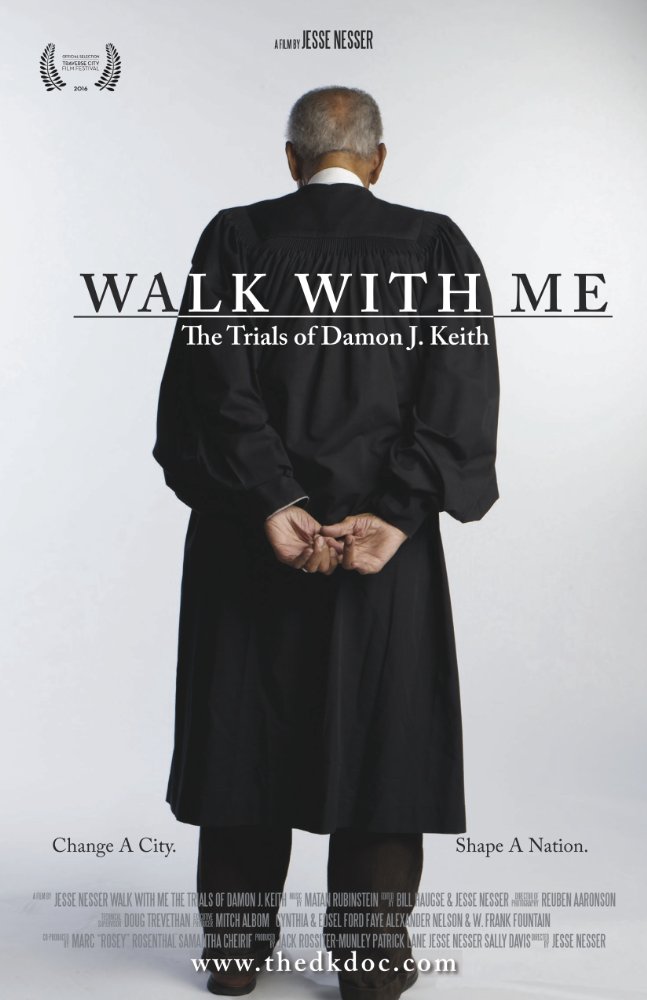 The now elderly Judge Damon Keith is legendary in Detroit for his landmark civil rights rulings as a Johnson-appointed federal judge during the 1970s. He now sits on the Sixth District Court of Appeals.
Judge Keith attended the historically black Howard University where he was taught that the law should be used as “a means of social change.” As the film points out, the 1960s were the era of activism and legislation in regards to civil rights, but the 1970s were the time when civil rights hit the courts. If a law is not enforced and applied, and if there are no penalties for seeking to avoid and shirk the law, then the law is virtually useless. A good judge can make sure justice is actually enacted.
It is unusual for a federal judge to have even one important case hit his desk, but Judge Keith worked several, right in a row. The first was the busing case in Pontiac, Michigan, in which the judge ruled that schools must be desegregated in actuality, not just in theory, and that the vehicle for this desegregation (since neighborhoods were segregated) would be busing students in order to integrate them. It was expensive and hugely controversial. The hysteria surrounding this decision is one of the hardest parts of the film to watch. White people protested loudly that their children must not be forced to mix with black children. Things came to a head when the Michigan KKK actually blew up empty Pontiac schoolbuses to try to prevent busing. The judge was sent death threats. White people moved away. It was absolute madness. But what mattered to the judge was justice and the provision of a good education for all students, without discrimination, as the law stated.
The judge also provided a ruling on a case involving workplace discrimination (the two companies who discriminated actually funded the whole film even though it is unflinchingly critical of their actions in that era). Next, the judge ruled on a case involving housing discrimination in which blacks were forced out of the city of Hamtramck. Judge Keith also ruled on wiretapping of the White Panthers which the Nixon administration conducted without a warrant, ruling that it violated the fourth amendment of the Constitution.
Finally, Judge Keith took on a case ruling on the disproportionate number of black policemen in the city and upholding the importance of Affirmative Action to better fill out the police force with representative members of the community. Keith spoke to the importance of Affirmative Action to right a historical problem without pointing fingers at any one individual, adding, that America was “not yet a colorblind society.” Judge Keith’s ruling helped make possible the current situation of a Detroit Police force now made up of 61% African-Americans.
Judge Keith is portrayed as a widely respected leader in the Detroit community and while he has suffered virulent criticism in the past, the director found it difficult to find anyone–even of his critics–who would speak an unkind word about him as a person. Most touching in the film is his deep devotion to his wife, Rachel. This film would be accessible even to those who are unfamiliar with the history of civil rights and would provide a wonderful introduction to key issues that are impacting racial justice still today.
The Barber of Augusta (dir., Michèle Hozer)
This short film was the great surprise of my day at the film festival. Unlike many of the others I saw, it is not a film about racial justice, but an endearing and moving character study. It centers around a young man named Matt Genser who suffers from mental illness, who has battled addiction, and who now dons a cape and superhero costume as he runs his barber shop in Toronto. When I read the synopsis, I thought, “well, I’ll watch that and wait for a more interesting short next.”
But instead what I received was a moving story, an honest story, and an empathetic character portrayal. Matt Genser grew up with a lot of pain, the “weird” kid in school. Doctors told his mother he would never be able to show affection. He grew into a young man who drank heavily and made dark decisions that he now deeply regrets.
Now sober, he not only has found stability and focus through his skill as a hair stylist but he also takes his superhero duds and his salon chair into the streets of the city, offering a free cut to passersby–including the homeless. He offers these folks, who often exist on the fringe of society, a few moments of kindness and empathy. Beyond my expectations, I was deeply moved by Genser and the way he has undertaken his vocation.
I was pleased too by his refreshing honesty, telling of reading of portrayals of himself in magazines that describe him as “not doing it for attention but just out of the goodness of his heart.” “Obviously I’m doing it for attention,” he says. “I’m wearing a purple cape!” Attention-seeking or not, the guy treats outsiders to society like human beings and uses his own pain to empathize with them. He deserves our salute! And if you get near a film festival, you really need to see this film.
Big Sky Documentary Film Festival
Walk with Me: The Trials of Damon J. Keith
Previous Post

February 8, 2017
The Plight of Refugees--the Risk and the Call of Christ
Next Post

March 1, 2017 On Streaming: A Film about McCarthyism, Edward R. Murrow, and Courage
Browse Our Archives
Select a Category Books Charis Christian Witness Church Year Conversation Creativity Cultural Engagement Curiosity Current Events Film Jesus Lectionary Message Literature Lutheran Theology Politics Story Television Theology Uncategorized
Select a Month December 2017 November 2017 October 2017 September 2017 August 2017 July 2017 June 2017 May 2017 April 2017 March 2017 February 2017 December 2016 October 2016 August 2016 July 2016 June 2016 May 2016 April 2016 March 2016 February 2016 January 2016 December 2015 November 2015 October 2015 September 2015 August 2015 July 2015 June 2015 May 2015 April 2015 March 2015 February 2015 January 2015 December 2014 November 2014 October 2014
Follow Us!
TAKE THE
Religious Wisdom Quiz
How many animals did Moses take on the Ark?
Select your answer to see how you score.
Seven of each One of each None Two of each
Related posts from Rebecca Florence Miller

A New Normal: Grief and Facing the Brokenness...

An Interview with the Christian and Atheist Friends...

Our Response to Sexual Abuse Should Not Be...

#Loser: How the Call of Christ Is Antithetical...
TRENDING AT PATHEOS Evangelical

The REST of Your Life: A Creative Wrestles...
This week I had a conversation with a good friend from church....

How the author of the world's best hymn...
I've been working with John Newton for a while now. This makes...

Long before this Lectio Divina, Psalm 130 - the song - started...

What About the Trees? Another Living Parable
After I finished writing the last article about falling leaves as a...

Why Classical Education Is a Conversation, Not a...
Come and Read: Joy in Classical Education When I was a little...

Cornell University has received a great deal of negative publicity and intense...
view all Evangelical blogs
Ad-Free & Subscriber Log-In Subscription Support
- About Us
- 2026 Calendar
- Videos
- Podcasts
- Library of World Religions
- Faith In Media Tracker
- Advertise With Us
- Write for Us
- Privacy Policy
- Terms of Service
- Do Not Sell My Data
- Contact Us
- Radiant Digital
- Manage Newsletter Subscriptions
- Unsubscribe From Notifications
- Sitemap
Copyright 2008-2026, Patheos. All rights reserved.
Subscription Support Ad-Free & Subscriber Log-In
Follow Patheos