
BuddhistCatholicContemplativeEvangelicalGeneral ChristianHinduJewishLatter-day SaintMuslimNew VisionsProgressive Christian
Beliefs
- Buddhist
- Catholic
- Contemplative
- Evangelical
- General Christian
- Hindu
- Jewish
- Latter-day Saint
- More Voices
- Muslim
- New Visions
- Pagan
- Progressive Christian
Topics
- Religion News
- Food and Religion
- Sports and Religion
- Religious Art
- Religious Music and Entertainment
- Religious Events
- History and Religion
- Style and Religion
- Politics and Religion
- Women in Religion
- Recreation Outdoors and Religion
- Business Finance and Religion
- Careers Workplace and Religion
- Education and Religion
- Family Parenting and Religion
- Health Fitness and Religion
- Home and Religion
- Relationships and Religion
- Technology and Religion
- Travel and Religion
Columnists
- Buddhist Columnists
- Business Finance and Religion Columnists
- Careers Workplace and Religion Columnists
- Catholic Columnists
- Contemplative Columnists
- Education and Religion Columnists
- Evangelists Columnists
- Family Parenting and Religion Columnists
- General Christian Columnists
- Health Fitness and Religion Columnists
- Hindu Columnists
- History and Religion Columnists
- Home and Religion Columnists
- Jewish Columnists
- More Voices Columnists
- Latter Day Columnists
- Muslim Columnists
- New Visions Columnists
- Nonreligious Columnists
- Pagan Columnists
- Politics and Religion Columnists
- Progressive Columnists
- Recreation Outdoors and Religion Columnists
- Relationships and Religion Columnists
- Religion News Columnists
- Religious Art Columnists
- Religious Events Columnists
- Religious Music and Entertainment Columnists
- Sports and Religion Columnists
- Style and Religion Columnists
- Technology and Religion Columnists
- Travel and Religion Columnists
- Women in Religion Columnists
Resource Library
- 2026 Calendar
- Library of World Religions
- The 100 Most Holy Places on Earth
- Patheos Answers
- Podcasts
- Videos
- Faith Leaders Database
- Anglican Episcopalian
- Bahai
- Baptist
- Buddhism
- Christianity
- Confucianism
- Eastern Orthodoxy
- Hinduism
- Holiness and Pentecostal
- ISKCON
- Islam
- Judaism
- Lutheran
- Methodist
- The Church of Jesus Christ of Latter-day Saints
- New Age
- Paganism
- Presbytarian and Reformed
- Protestantism
- Religion Behind the Scenes
- Roman Catholic
- Scientology
- Shia Islam
- Sikhism
- Sufism
- Sunni Islam
- Taoism
- Zen
- See all religions
Research Tools
 Ad-Free & Subscriber Log-In Subscription Support
Ad-Free & Subscriber Log-In Subscription Support
Follow Patheos 

- Trending:
- Forgiveness
- |
- Marriage
- |
- Consciousness
- |
- Death Penalty
- |
- Election
- |
- Halloween
 Rebecca Florence Miller
- Home
- Evangelical
- THE SEVENTH SEAL, the Hiddenness of God, and the Inescapability of Death
THE SEVENTH SEAL, the Hiddenness of God, and the Inescapability of Death
Last updated on: March 2, 2016 at 9:45 pm by Rebecca Florence Miller
THE SEVENTH SEAL, the Hiddenness of God, and the Inescapability of Death 2016-03-02T21:45:02-06:00 Rebecca Florence Miller
Patheos Explore the world's faith through different perspectives on religion and spirituality! Patheos has the views of the prevalent religions and spiritualities of the world.
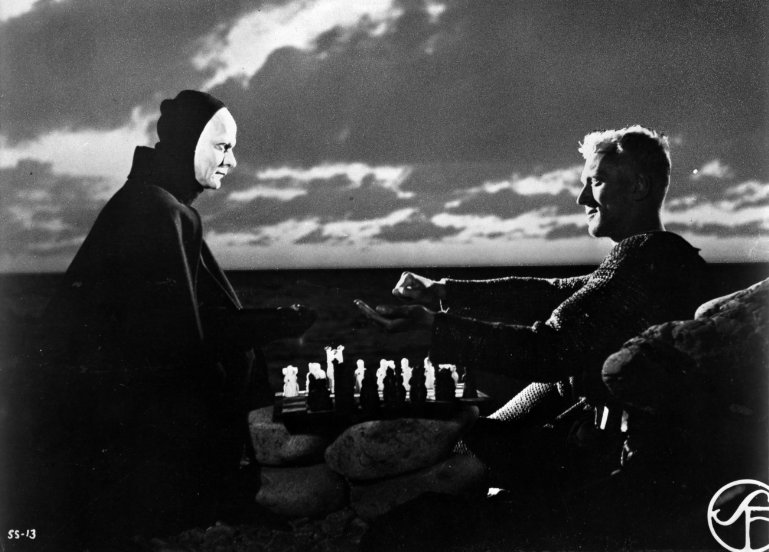 This post is part of a ten-part series drawing from the Arts and Faith Top 100 Films. You can read the introduction the series here, along with the schedule of films to be featured.
Of all the films in this series thus far, none has hit me right in the gut like Ingmar Bergman’s The Seventh Seal did. In its honest grappling with the hiddenness of God, the silence of God, and the inescapability of death, it grabbed me up for it’s bare hour and a half and didn’t let go.
The Seventh Seal takes its title from Revelation 8:1-5:
When he opened the seventh seal, there was silence in heaven for about half an hour.
And I saw the seven angels who stand before God, and seven trumpets were given to them.
Another angel, who had a golden censer, came and stood at the altar. He was given much incense to offer, with the prayers of all God’s people, on the golden altar in front of the throne. The smoke of the incense, together with the prayers of God’s people, went up before God from the angel’s hand. Then the angel took the censer, filled it with fire from the altar, and hurled it on the earth; and there came peals of thunder, rumblings, flashes of lightning and an earthquake. (NIV, emphasis added)
Bergman frames his story around a medieval knight (Max von Sydow), war-weary as he returns from ten years fighting in the Crusades, coming home to a Sweden that is beset with the horrifying specter of the bubonic plague, which is killing huge swaths of people in the most horrifying way imaginable. Death, personified in black, with the harsh, severe face of Bengt Ekerot, appears throughout the film, playing a game of chess with the knight; if the knight loses, he loses his life. Death communicates the inevitability of the knight’s loss, but grants him a reprieve while the game of chess goes on. The knight uses this time to ask the hard, philosophical questions, questions that Bergman himself clearly grappled with throughout his life.
This might be a fictional, fantasy-laden plot but it still manages to strike at the heart of our doubts and questions today. Peter Cowie writes:
For all its richly embroidered dialogue, The Seventh Seal remains a personal film in the profoundest sense of the term. Bergman is exorcising his own demons, his own dread of the eternal darkness, and to his surprise and delight this process has appealed to audiences in practically every corner of the world. It is as though for the first time in the movies someone had dared to ask in public those most intimate and basic questions that each of us asks in private; to illustrate and analyze on screen the doubts and fears, yearnings and aspirations, for which most filmmakers cannot find a visual language.
That Bergman frames the film around the horrifying plague makes it all the more visceral. At this time, no one understood scientifically or medically why so many were becoming infected and dying horrifying deaths–shriveled up, dehydrated, covered in horribly painful boils. It’s hard to imagine a more torturous way to die. But all the plague did was make visible to the humans of that time (and to us the viewers) the inescapability of death. The plague–along with the black-robed Ekerot–make the human dilemma more pressing, more urgent, more fearful, and more difficult to ignore. But ultimately, it is the same dilemma we all face: How will I deal with the reality that I must die one day? The film shows us how different kinds of people handle the inescapable reality of our ultimate end: death.
Previous Post
February 19, 2016
INTO GREAT SILENCE: Joy and Vocation in the Cloister
Next Post
March 14, 2016 How Do We Make America Great Again? Repent
Browse Our Archives
Select a Category Books Charis Christian Witness Church Year Conversation Creativity Cultural Engagement Curiosity Current Events Film Jesus Lectionary Message Literature Lutheran Theology Politics Story Television Theology Uncategorized
Select a Month December 2017 November 2017 October 2017 September 2017 August 2017 July 2017 June 2017 May 2017 April 2017 March 2017 February 2017 December 2016 October 2016 August 2016 July 2016 June 2016 May 2016 April 2016 March 2016 February 2016 January 2016 December 2015 November 2015 October 2015 September 2015 August 2015 July 2015 June 2015 May 2015 April 2015 March 2015 February 2015 January 2015 December 2014 November 2014 October 2014
Follow Us!
TAKE THE
Religious Wisdom Quiz
Who was Rebekah's father?
Select your answer to see how you score.
Terah Bethuel Laban Abraham
Related posts from Rebecca Florence Miller


A New Normal: Grief and Facing the Brokenness...

An Interview with the Christian and Atheist Friends...

#Loser: How the Call of Christ Is Antithetical...
TRENDING AT PATHEOS Evangelical

How the author of the world's best hymn...
I've been working with John Newton for a while now. This makes...

Long before this Lectio Divina, Psalm 130 - the song - started...

What About the Trees? Another Living Parable
After I finished writing the last article about falling leaves as a...

Why Classical Education Is a Conversation, Not a...
Come and Read: Joy in Classical Education When I was a little...

Falling Leaves: A Living Parable on Letting Go
I’ve spent the vast majority of my life in the southeast corner...

Cornell University has received a great deal of negative publicity and intense...
view all Evangelical blogs
Ad-Free & Subscriber Log-In Subscription Support
- About Us
- 2026 Calendar
- Videos
- Podcasts
- Library of World Religions
- Faith In Media Tracker
- Advertise With Us
- Write for Us
- Privacy Policy
- Terms of Service
- Do Not Sell My Data
- Contact Us
- Radiant Digital
- Manage Newsletter Subscriptions
- Unsubscribe From Notifications
- Sitemap
Copyright 2008-2026, Patheos. All rights reserved.
Subscription Support Ad-Free & Subscriber Log-In
Follow Patheos