
BuddhistCatholicContemplativeEvangelicalGeneral ChristianHinduJewishLatter-day SaintMuslimNew VisionsProgressive Christian
Beliefs
- Buddhist
- Catholic
- Contemplative
- Evangelical
- General Christian
- Hindu
- Jewish
- Latter-day Saint
- More Voices
- Muslim
- New Visions
- Pagan
- Progressive Christian
Topics
- Religion News
- Food and Religion
- Sports and Religion
- Religious Art
- Religious Music and Entertainment
- Religious Events
- History and Religion
- Style and Religion
- Politics and Religion
- Women in Religion
- Recreation Outdoors and Religion
- Business Finance and Religion
- Careers Workplace and Religion
- Education and Religion
- Family Parenting and Religion
- Health Fitness and Religion
- Home and Religion
- Relationships and Religion
- Technology and Religion
- Travel and Religion
Columnists
- Buddhist Columnists
- Business Finance and Religion Columnists
- Careers Workplace and Religion Columnists
- Catholic Columnists
- Contemplative Columnists
- Education and Religion Columnists
- Evangelists Columnists
- Family Parenting and Religion Columnists
- General Christian Columnists
- Health Fitness and Religion Columnists
- Hindu Columnists
- History and Religion Columnists
- Home and Religion Columnists
- Jewish Columnists
- More Voices Columnists
- Latter Day Columnists
- Muslim Columnists
- New Visions Columnists
- Nonreligious Columnists
- Pagan Columnists
- Politics and Religion Columnists
- Progressive Columnists
- Recreation Outdoors and Religion Columnists
- Relationships and Religion Columnists
- Religion News Columnists
- Religious Art Columnists
- Religious Events Columnists
- Religious Music and Entertainment Columnists
- Sports and Religion Columnists
- Style and Religion Columnists
- Technology and Religion Columnists
- Travel and Religion Columnists
- Women in Religion Columnists
Resource Library
- 2026 Calendar
- Library of World Religions
- The 100 Most Holy Places on Earth
- Patheos Answers
- Podcasts
- Videos
- Faith Leaders Database
- Anglican Episcopalian
- Bahai
- Baptist
- Buddhism
- Christianity
- Confucianism
- Eastern Orthodoxy
- Hinduism
- Holiness and Pentecostal
- ISKCON
- Islam
- Judaism
- Lutheran
- Methodist
- The Church of Jesus Christ of Latter-day Saints
- New Age
- Paganism
- Presbytarian and Reformed
- Protestantism
- Religion Behind the Scenes
- Roman Catholic
- Scientology
- Shia Islam
- Sikhism
- Sufism
- Sunni Islam
- Taoism
- Zen
- See all religions
Research Tools
 Ad-Free & Subscriber Log-In Subscription Support
Ad-Free & Subscriber Log-In Subscription Support
Follow Patheos 

- Trending:
- Forgiveness
- |
- Marriage
- |
- Consciousness
- |
- Death Penalty
- |
- Election
- |
- Halloween
 Rebecca Florence Miller
- Home
- Evangelical
- Ozu’s Tokyo Story and the Struggle to Honor Our Parents
Ozu’s Tokyo Story and the Struggle to Honor Our Parents
Last updated on: March 18, 2016 at 4:59 pm by Rebecca Florence Miller
Ozu’s Tokyo Story and the Struggle to Honor Our Parents 2016-03-18T16:59:19-06:00 Rebecca Florence Miller
Patheos Explore the world's faith through different perspectives on religion and spirituality! Patheos has the views of the prevalent religions and spiritualities of the world.
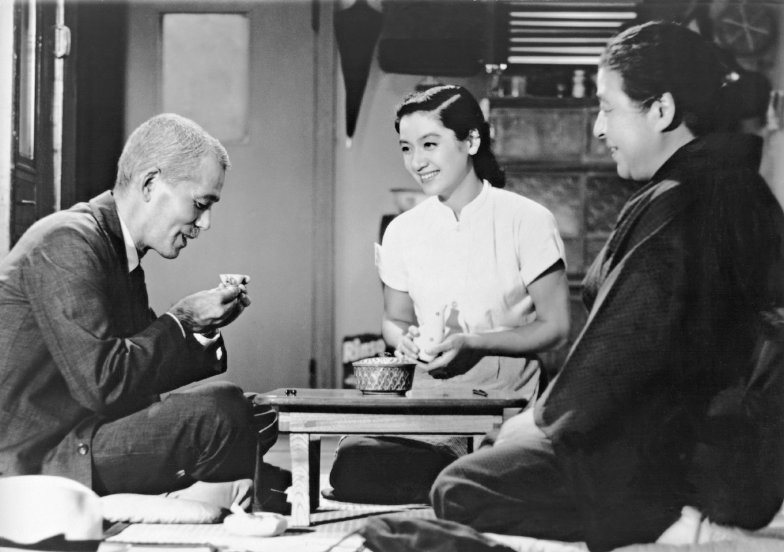 This post is part of a ten-part series drawing from the Arts and Faith Top 100 Films. You can read the introduction the series here, along with the schedule of films to be featured.
Note: My apologies for the tardiness of this post.
Of all of the world, art-house films in my current series, Yasujiro Ozu’s Tokyo Story (1953), with its simplicity and easily recognizable characters seems one of the most accessible to a general audience. Yes, you have to contend with subtitles and with a less dramatic plot than you would in a Hollywood film. But this is not what I would call a “difficult” film, but rather one with deceptive simplicity.
The story is this: Two elderly parents, Shukichi and Tomi, leave their small, pastoral Japanese community to travel via train to the busy city of Tokyo. They face a city hustling and bustling, with confusing geography to navigate; likewise, their children and grandchildren are busy and engaged in their own routines with little time for their out-of-town relatives. They pass their parents around, even calling on their deceased brother’s wife to entertain her inlaws and finally paying for a short stay at a modern hotel for their parents rather than engage. Still, when the adult children are with their parents, they seem pretty respectful and what passes for neglect of elders in Japanese society would be pretty good treatment in American society. Even so, the themes of the disconnect between generations and social contexts remain relevant today.
Shukichi and Tomi raised their children with certain expectations in mind: most likely, they anticipated a traditional family situation where adult children would care for their elders. Simultaneously, they want success for their children and are pleased when their children achieve even moderately. They are of two minds–wanting their children to do well, to flourish in the new urban world, and yet missing the family connections that characterized past generations. Rapid change can be hard to adjust to, even for those willing to try.
The film focuses mainly on the parents’ perspective, although sometimes we get to see the perspective of the adult children as well. The parents are gamely trying to respect their children’s new lives, but despite these attempts, they seem lonely and sad at their increasing irrelevance to those lives. The children do honor their parents, but privately they reveal some indifference and annoyance that their busy rhythm of city life is being disturbed. Nobody is a monster, but everyone is struggling in completely ordinary, relatable ways, especially after a great deal of time apart.
Ozu focuses on geometric angles which frame each shot, as characters move in and out of the static camera frame. His distinctive low angle of camera placement is called a “tatami shot,” referring to the height a person sitting on a tatami mat would be at if they were part of the scene. This angle frequently gave me the impression that I was peering into a dollhouse to see the action within.
The orderliness of each frame offsets the disorder of a world increasingly fragmented by the abandonment of traditional Japanese values, by the sorrow and loss of war, by the changes wrought by technology and urban life. It is as if Ozu is seeking to calm the viewer’s anxieties, using his sharp angles and lines and orderly, neat homes.
The themes of this film and other Ozu films are probably everlastingly relevant. How will a younger generation honor its parents’ sacrifices and yet remain engaged in the fast flow of everyday life? How does a younger generation honor a previous generation which made grievous mistakes? After all, it is one thing to honor parents who did a pretty good job, but quite another to find the right way to relate to and honor parents who abused, neglected, or wounded their children. (In the film, it is revealed that Shukichi was once a heavy drinker and not altogether kind to his wife; could this have impacted the separation the children sought and their sometimes indifference?) Yet, despite our parents’ successes and failures, Tokyo Story does a lot to unsentimentally increase empathy for the older generation and to consider that we can only demonstrate love to our parents while they are alive, not after their death.
Showing honor to parents is part of the Ten Commandments–and as my seven-year-old told me once, it is probably one of the hardest commandments to obey:
Honor your father and your mother, so that you may live long in the land the Lord your God is giving you.–Exodus 20:15 (NIV)
So, since this is a tough commandment to keep, let’s talk about it:
Do you struggle with honoring parents or do you find it easy? In what ways do you do honor your parents?
Are there times when parents should not be honored–or should only be honored in certain ways, but not in others?
Are there ways in which younger generations need to do better at honoring their parents?
How can parent and child bridge an often large generational divide (especially in terms of beliefs, experiences, and changing technology and context)?
For more on Ozu and Tokyo Story, read this and this. And definitely watch this video essay by Lewis Bond.
——————-
Community discussion guidelines:
Because this is a Christian blog, the things I’m talking about will obviously be topics that people feel strongly about in one direction or another. Please keep in mind that this is a place for substantive, respectful, constructive conversation. All perspectives are welcome to discuss here as long as all can treat each other with kindness and respect. Please ignore trolls, refuse to engage in personal attacks, try not to derail the conversation into divisive rabbit trails, and observe the comment policy listed on the right side of the page. Comments that violate these guidelines may be deleted. Vulgar remarks may result in immediate blacklisting. For those who clearly violate these policies repeatedly, my policy is to issue a warning which, if not regarded, may lead to blacklisting. This is not about censorship, but about creating a healthy, respectful environment for discussion.
P.S. Please also note that I am not a scientist, but a person with expertise in theology and the arts. While I am very interested in the relationship between science and faith, I do not believe I personally will be able to adequately address the many questions that inevitably come up related to science and religion. I encourage you to seek out the writings of theistic or Christian scientists to help with those discussions.
———————-
Image source: IMDB.com.
Previous Post

March 14, 2016
How Do We Make America Great Again? Repent
Next Post

March 26, 2016 Babette's Feast: New Creation and Easter's Resurrection
Browse Our Archives
Select a Category Books Charis Christian Witness Church Year Conversation Creativity Cultural Engagement Curiosity Current Events Film Jesus Lectionary Message Literature Lutheran Theology Politics Story Television Theology Uncategorized
Select a Month December 2017 November 2017 October 2017 September 2017 August 2017 July 2017 June 2017 May 2017 April 2017 March 2017 February 2017 December 2016 October 2016 August 2016 July 2016 June 2016 May 2016 April 2016 March 2016 February 2016 January 2016 December 2015 November 2015 October 2015 September 2015 August 2015 July 2015 June 2015 May 2015 April 2015 March 2015 February 2015 January 2015 December 2014 November 2014 October 2014
Follow Us!
TAKE THE
Religious Wisdom Quiz
True or False: John's Gospel identifies Jesus as 'the Lamb of God' in the first chapter.
Select your answer to see how you score.
TRUE FALSE
Related posts from Rebecca Florence Miller


An Interview with the Christian and Atheist Friends...

Our Response to Sexual Abuse Should Not Be...

Conflict and Challenge, instead of Cheap Grace
TRENDING AT PATHEOS Evangelical

How the author of the world's best hymn...
I've been working with John Newton for a while now. This makes...

Long before this Lectio Divina, Psalm 130 - the song - started...

What About the Trees? Another Living Parable
After I finished writing the last article about falling leaves as a...

Why Classical Education Is a Conversation, Not a...
Come and Read: Joy in Classical Education When I was a little...

Falling Leaves: A Living Parable on Letting Go
I’ve spent the vast majority of my life in the southeast corner...

Cornell University has received a great deal of negative publicity and intense...
view all Evangelical blogs
Ad-Free & Subscriber Log-In Subscription Support
- About Us
- 2026 Calendar
- Videos
- Podcasts
- Library of World Religions
- Faith In Media Tracker
- Advertise With Us
- Write for Us
- Privacy Policy
- Terms of Service
- Do Not Sell My Data
- Contact Us
- Radiant Digital
- Manage Newsletter Subscriptions
- Unsubscribe From Notifications
- Sitemap
Copyright 2008-2026, Patheos. All rights reserved.
Subscription Support Ad-Free & Subscriber Log-In
Follow Patheos